Do you really need a solar pergola in 2027?
YES. If your backyard gets real sun and you actually use it, a solar pergola is one of the few upgrades that does two jobs with one structure: shade you live under every day, and power your home runs on, without putting a single panel on your roof.
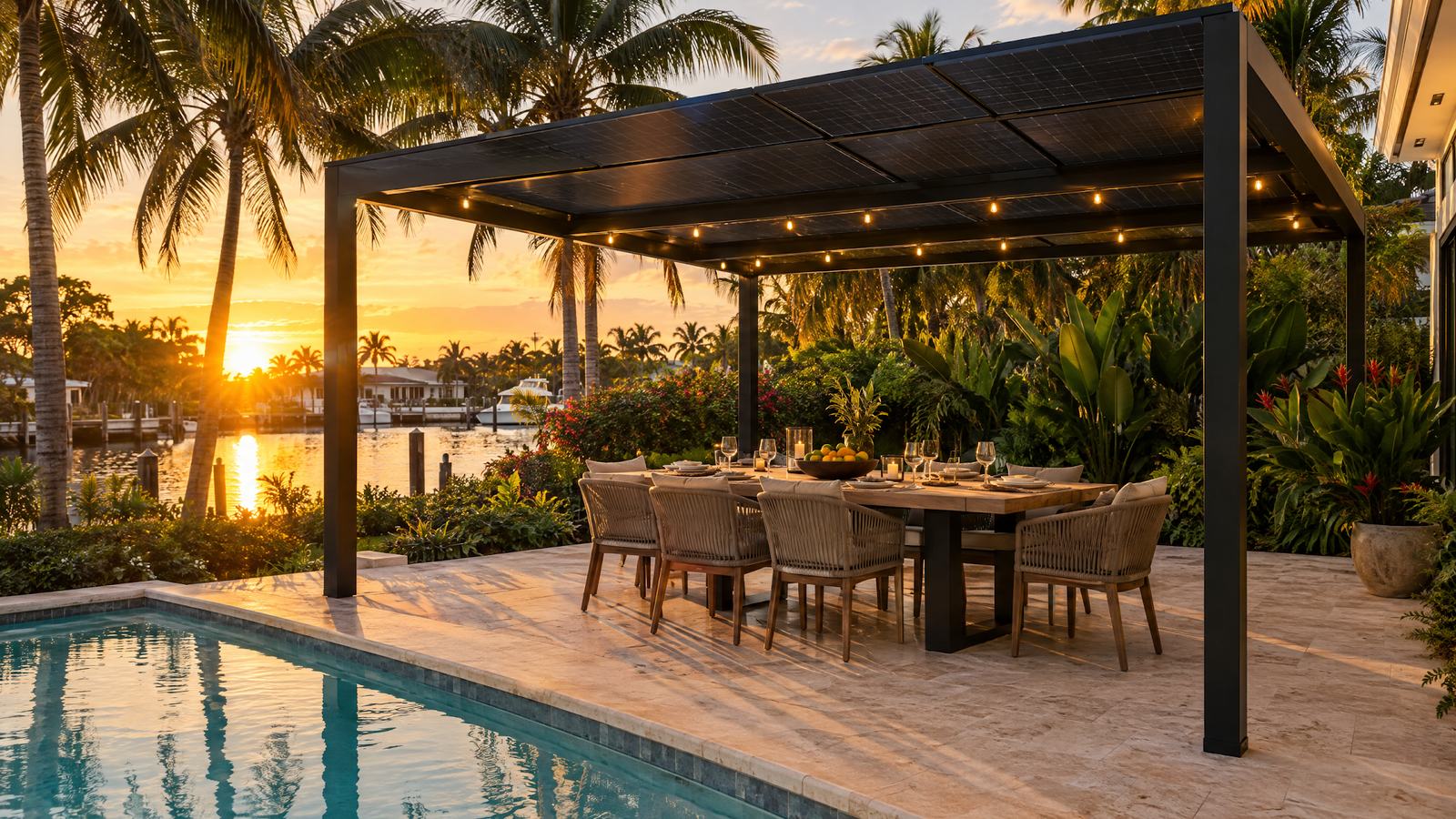
That "yes" comes with conditions, and this page is honest about them. A solar pergola is not the cheapest way to buy solar panels. It is the best way we know to get solar and a backyard you use more, from the same money and the same square footage. If you would build a pergola anyway, or your roof is the wrong shape, the wrong direction or near the end of its life, it is very hard to beat.
Two jobs, one structure: tap to compare
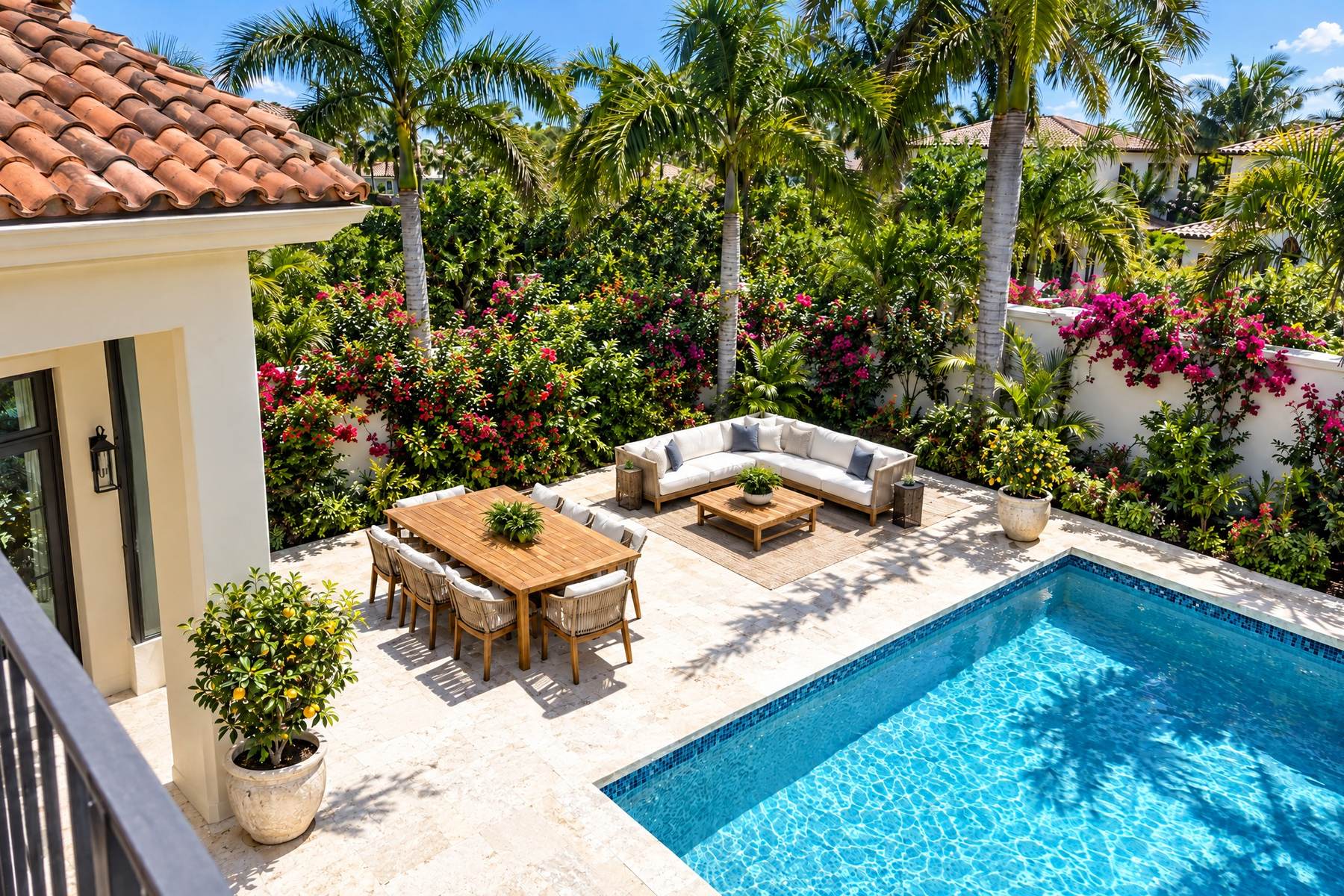
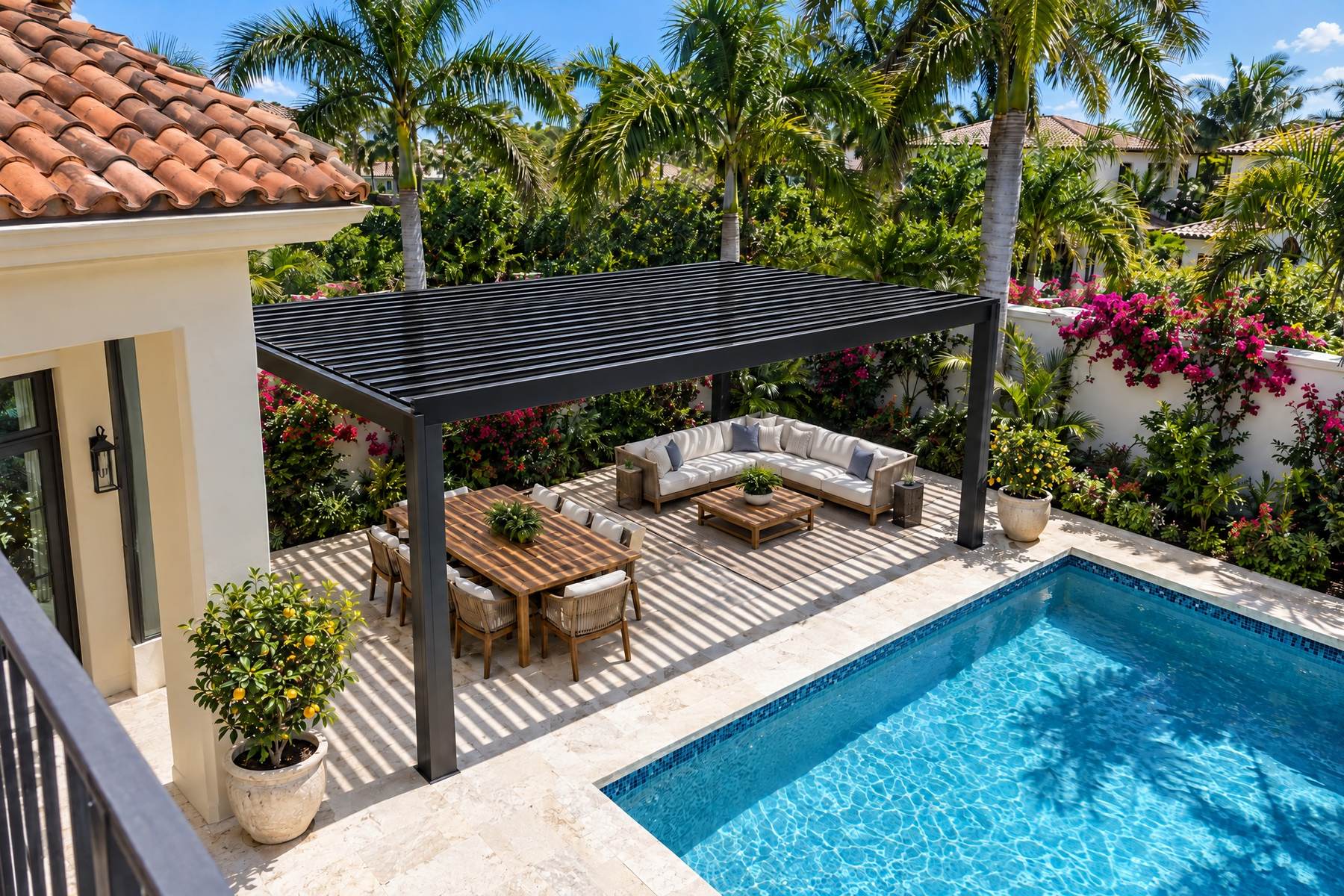
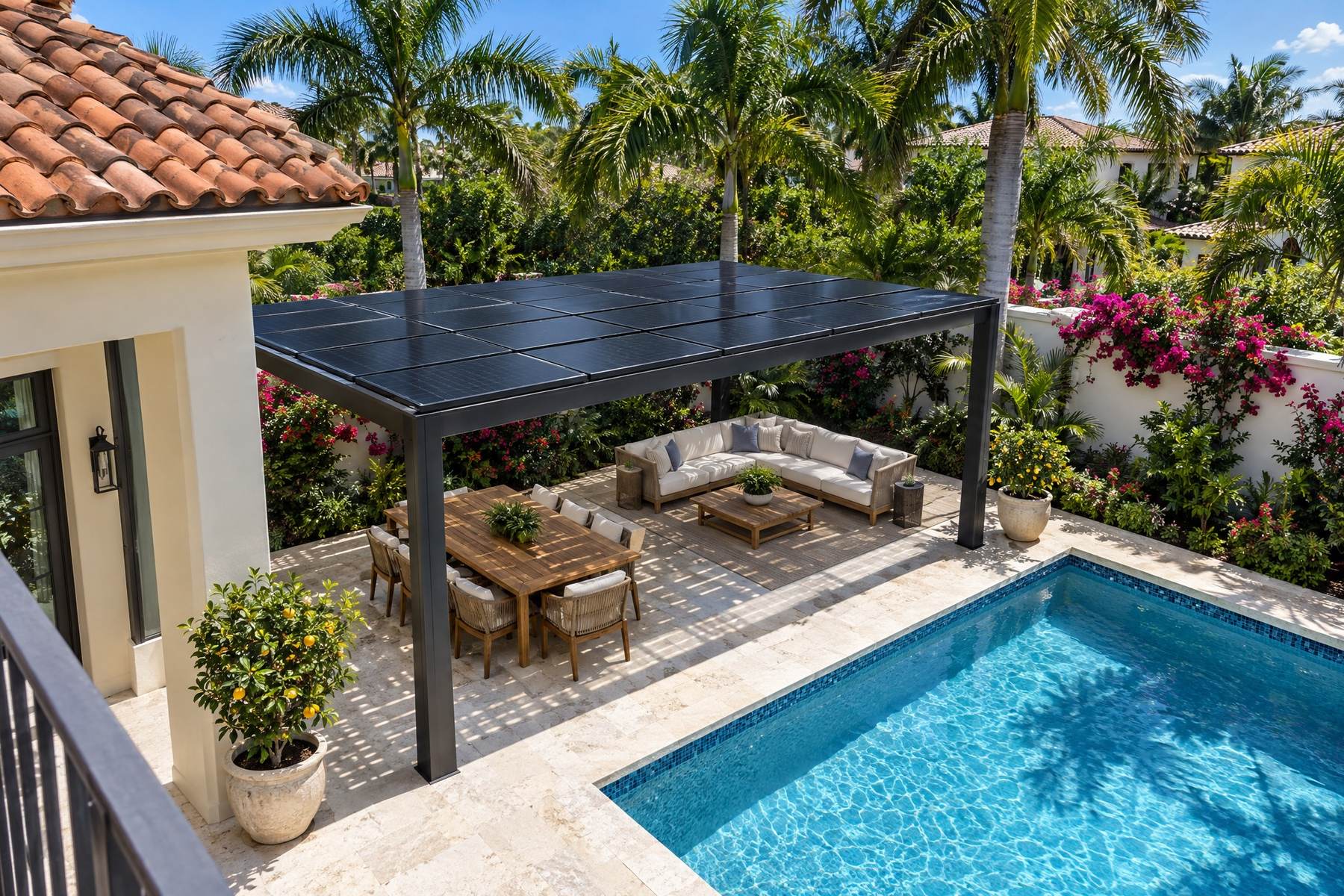
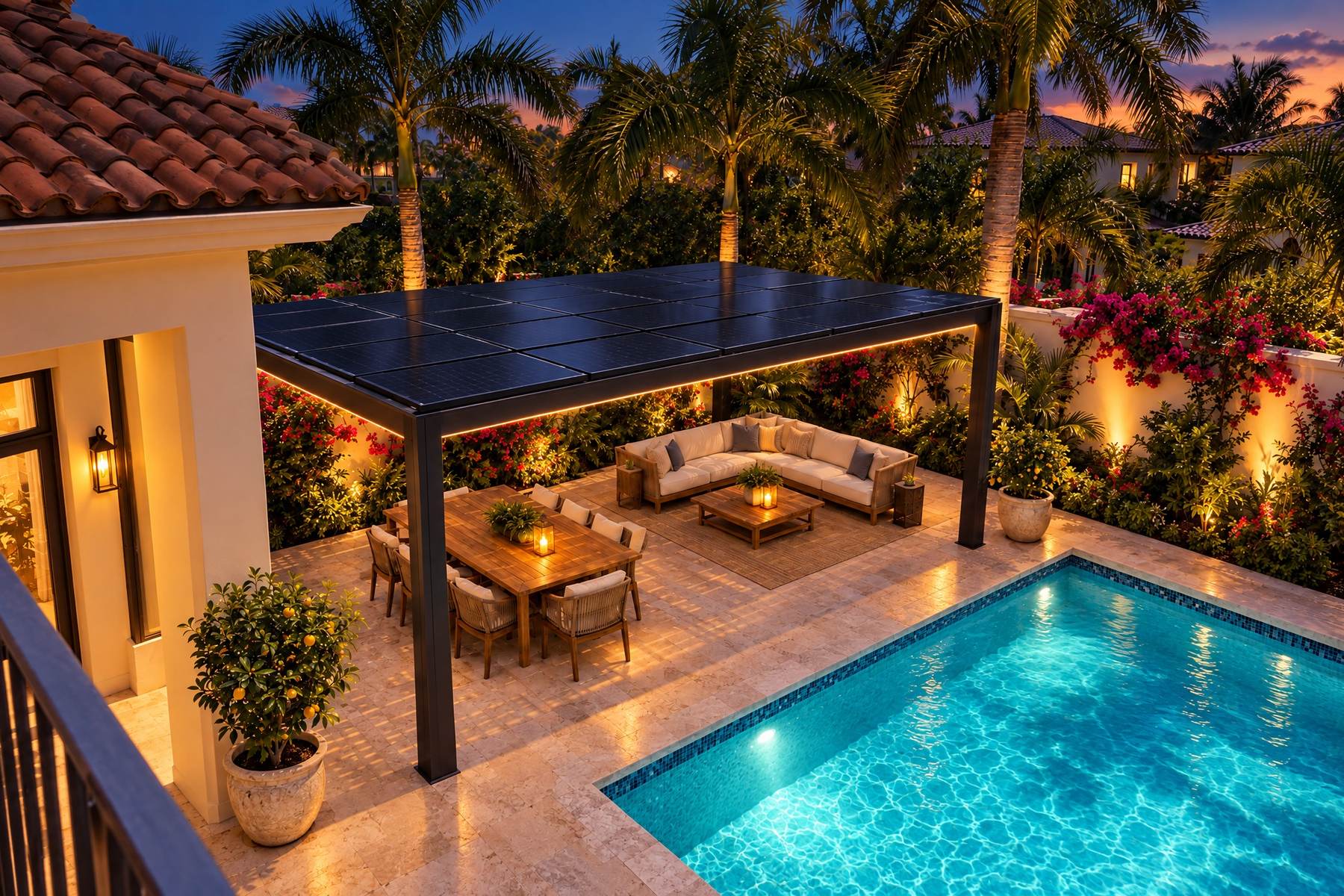 Today: open deckA plain pergolaA solar pergolaAfter sunset
The starting point. A deck that is too hot to use from late morning to late afternoon for much of the year. The furniture is there; the people are inside with the air conditioning.
A plain pergola. Slats break up the sun, so you get striped shade and a place to hang lights and a fan. It is a nice upgrade, and it is a one-job structure: it costs money and gives back shade.
A solar pergola. The panels are the roof, so the shade is close to solid and the structure makes electricity every sunny day. What it makes goes to your home first, and extra daytime power becomes credit under Florida net metering [2].
After sunset. Lights, a fan and an outdoor kitchen run under the same roof that made power all day. Add a battery and some of that daytime sunlight can carry into the evening, and through an outage [11].
Same backyard, same light, four versions. Photos are illustrations, not a specific product. Panel figures are from the Qcells data sheet; watts per square foot is our arithmetic [3].
Why it makes sense heading into 2027
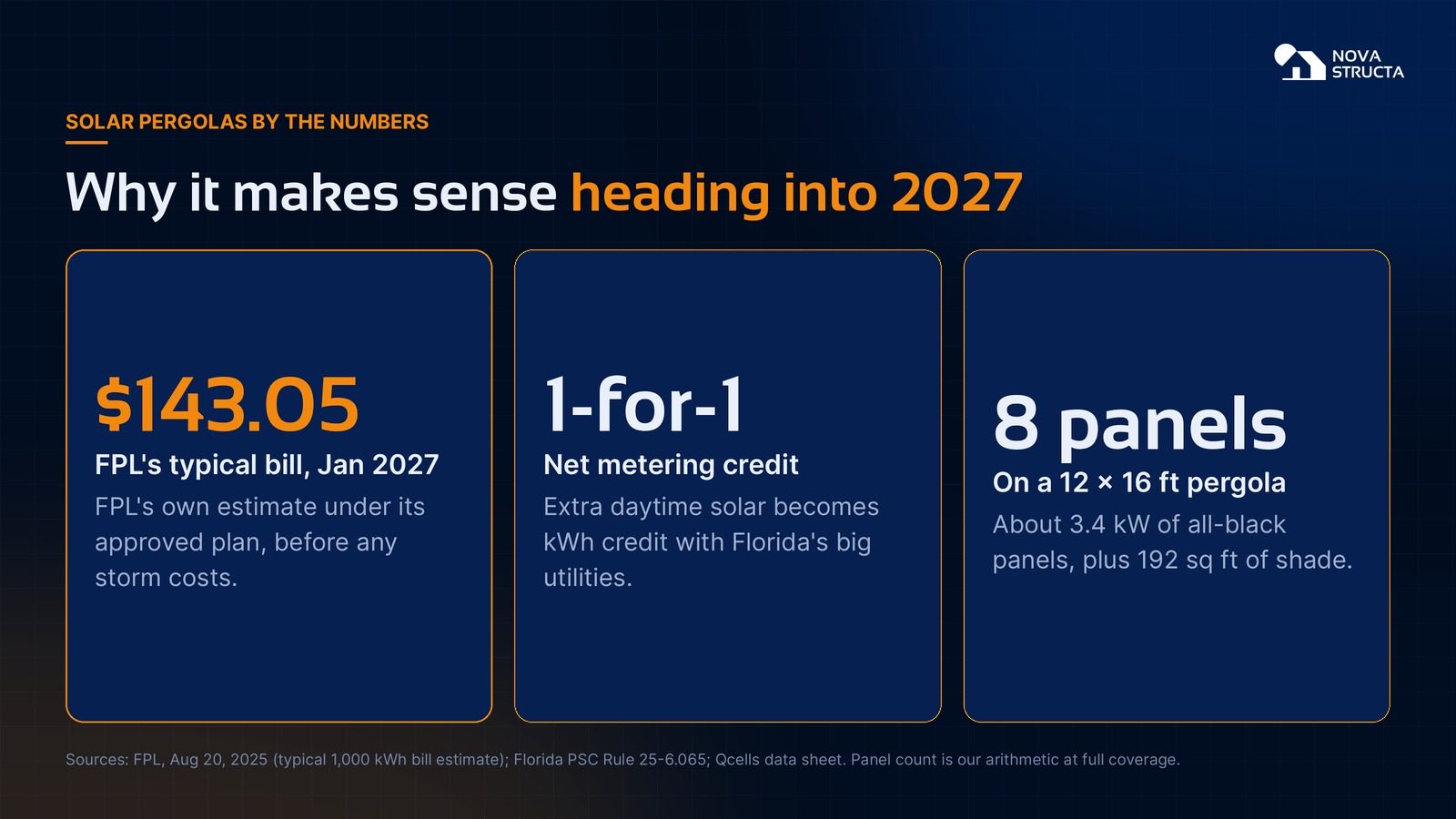
- Grid power keeps climbing. Under its approved rate plan, FPL estimates the typical bill reaches about $143.05 in January 2027, $146.24 in January 2028 and $148.15 by December 2029, and those figures leave out any future storm costs [1].
- Florida still credits extra solar one for one. With the big investor-owned utilities, extra daytime solar becomes kWh credit on your bill under the state net metering rule [2].
- Florida does not tax the equipment the usual way. Solar on a home does not raise its assessed value for property tax [7], and solar energy systems are exempt from Florida sales tax [8]. Ask how either applies to the pergola structure itself, which is not solar equipment.
- The federal homeowner credit is gone. It does not apply to systems paid for after December 31, 2025 [9], so 2027 pricing is the real price. That makes it worth getting more than one job out of every dollar.
- Outages are not hypothetical. Hurricanes in 2024 gave U.S. customers the most hours without power in ten years [12]. A pergola with a battery is one way to keep chosen circuits on.
Nova Structa does not provide tax advice. Tax rules change and depend on your situation, so check with a qualified tax professional.
Solar pergola vs. solar on the roof
| Solar pergola | Solar on your roof | |
|---|---|---|
| What you get | Shade you use every day, plus power | Power |
| Which way it faces | Wherever the backyard allows, set out for the sun | Whatever directions your roof planes face |
| Your roof | Not involved. No holes, nothing to lift off at the next reroof | Needs years of life left, or a reroof first |
| Cost | The structure plus the solar | The solar, usually less per watt; Florida averaged $2.12 per watt in September 2026 [4] |
| Size | Set by the footprint you want to shade | Set by usable roof area |
| Wind | Engineered as a structure to your address's wind loads [10] | Mounts engineered to the roof's wind loads [10] |
| HOA | Expect architectural review; see below | Florida law bars HOAs from banning it [6] |
The short version: if all you want is the most power for the money and your roof is young, sunny and faces south or west, rooftop solar usually wins on price per watt. The pergola wins when the shade has value to you, when the roof is the problem, or when you want both and only want to build once.
How big, how much power?
Panel count is simple geometry. The panels in the systems we offer measure 1722 × 1134 mm, about 5.65 × 3.72 ft, and are rated 415 to 440 W each [3]. Here is how many whole panels fit common pergola sizes, using 425 W per panel:
| Pergola | Panels that fit | Panel rating | Shade |
|---|---|---|---|
| 10 × 12 ft | 4 | 1.7 kW | 120 sq ft |
| 12 × 16 ft | 8 | 3.4 kW | 192 sq ft |
| 16 × 20 ft | 12 | 5.1 kW | 320 sq ft |
| 20 × 24 ft | 20 | 8.5 kW | 480 sq ft |
That is our arithmetic at full coverage. Real designs leave room for the frame, the gaps between panels and code requirements, and what a system produces depends on its direction, tilt, shade and weather, so a design review gives the real estimate. For scale, the average Florida home used about 1,104 kWh a month in 2024 [5]. A pergola can carry part of that, and it can sit alongside panels on the roof. Try different sizes on our solar pergola page.
Built for a Florida hurricane season
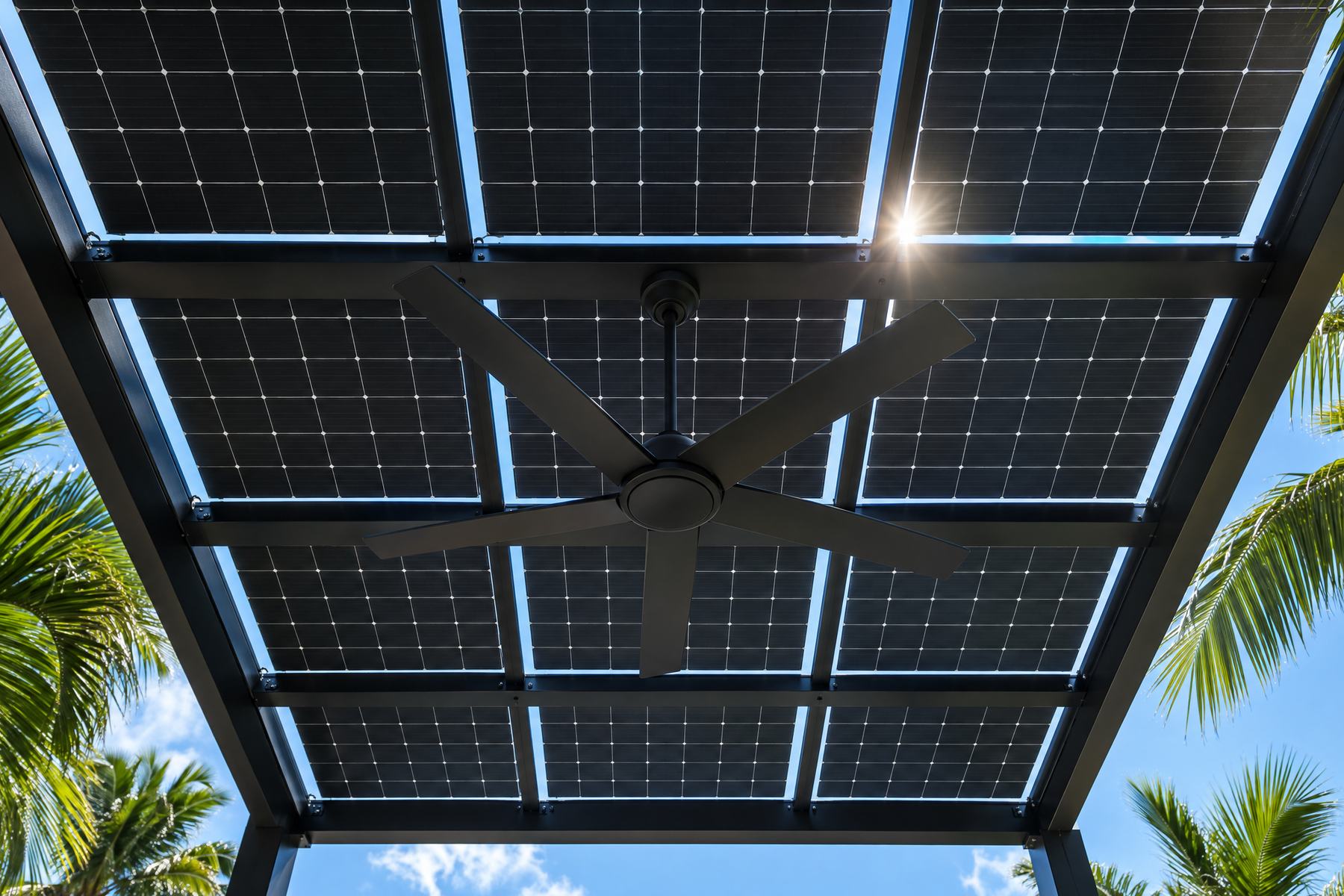
A solar pergola is a structure that holds a roof of glass in hurricane country, so it is designed and permitted like one. The Florida Building Code sets wind loads by location using the ASCE 7 standard [10], and the posts, beams, connections and footings are engineered to them.
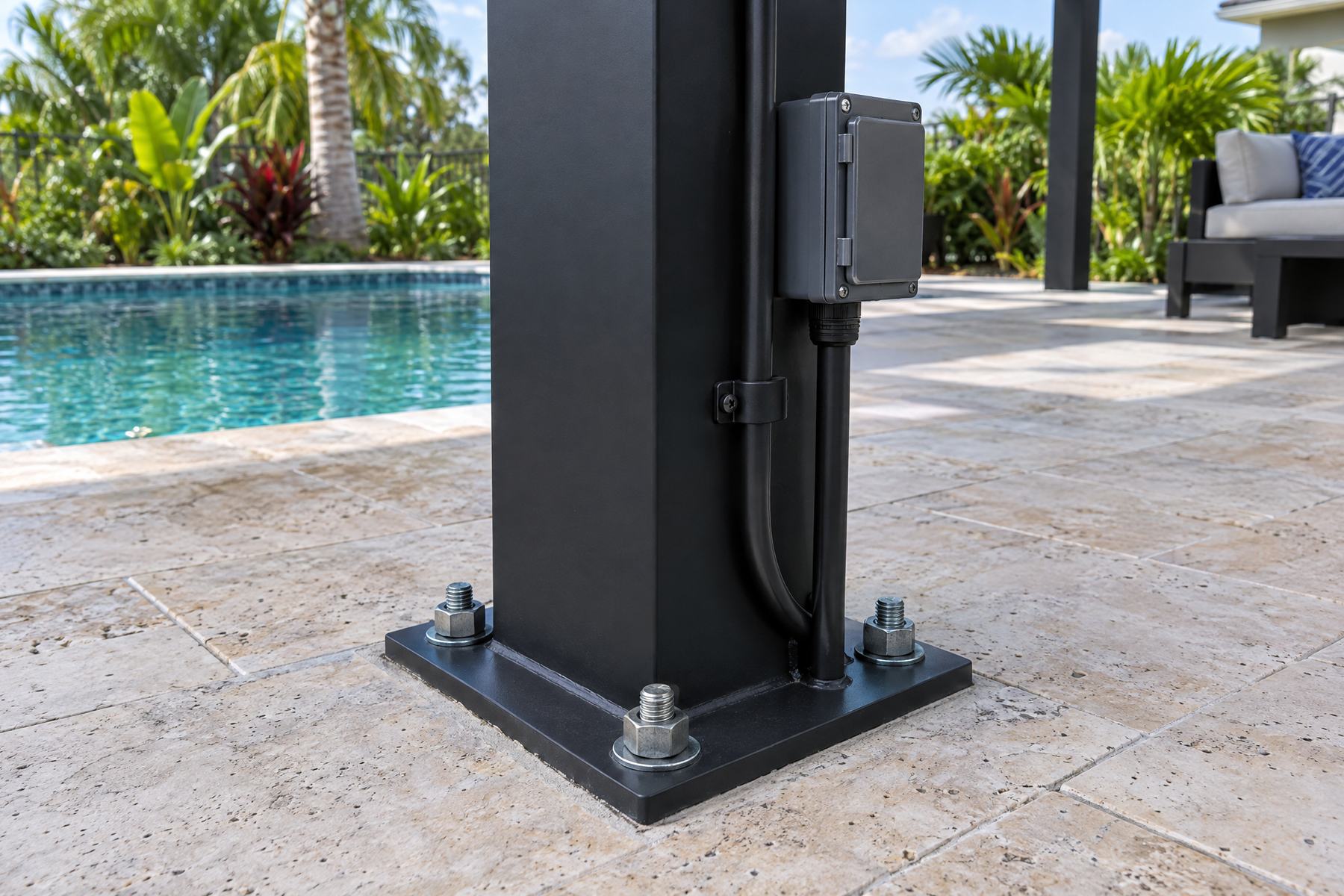
Ask any company for four things in writing: the engineered drawings for your address, the permits (building and electrical), the warranty for the structure as well as the panels, and who services it after a storm.
The HOA question
Florida's solar rights law says deed restrictions and HOA rules may not prohibit solar collectors installed on buildings, and lets an association choose where on the roof they go [6]. A freestanding pergola is a different case. Expect your association's architectural review to weigh in on its size, location, color and setbacks, the same as for any backyard structure. Bring drawings and photos early, and get approval in writing before anything is ordered. This is general information, not legal advice.
Is a solar pergola right for your backyard?
01How much sun does your backyard get?
02How is your roof for solar?
03How often are you out back?
04Want power during outages?
Answer the four questions to see where you land.
Strong candidate. A sunny backyard is exactly where a solar pergola earns its keep: daily shade plus a roof that makes power.
Have the shade measured first. Partial sun can still work. A shading review shows how many hours the pergola roof actually sees.
A pergola may not be the solar answer here. If trees or buildings shade the yard, the roof or a different spot may be the better place for panels. A plain pergola can still give you the outdoor room.
Probably not your project. A shaded yard you rarely use is not a good home for either the shade or the panels. Look at the roof first.
Honest note: if you rarely go outside, rooftop panels usually give the same power for less. The pergola pays its way when you live under it.
Keep the panels off that roof. A pergola avoids drilling an older or tile roof, and avoids lifting panels off at the next reroof.
Add a battery. Solar alone shuts off when the grid goes down [11]. A battery keeps chosen circuits on. See how solar and a battery share the load.
Tap one answer per question. The result is a starting point for a conversation, not a design.
What to ask before you sign
- The drawings. Engineered for your address, showing footings, anchors and connections [10].
- The permits. Building and electrical, pulled by the licensed contractor doing the work.
- The panels. Make, model and data sheet. Ours are Qcells with 25-year product and power warranties [3].
- The structure warranty. Separate from the panel warranty, and in writing.
- The wiring. Where it runs, where the disconnect sits, and how it ties into your panel.
- The extras. Lights, fans, an outdoor kitchen circuit, an EV charger or a battery, priced up front rather than added later.
- The HOA. Approval in writing before anything is ordered.
The bottom line
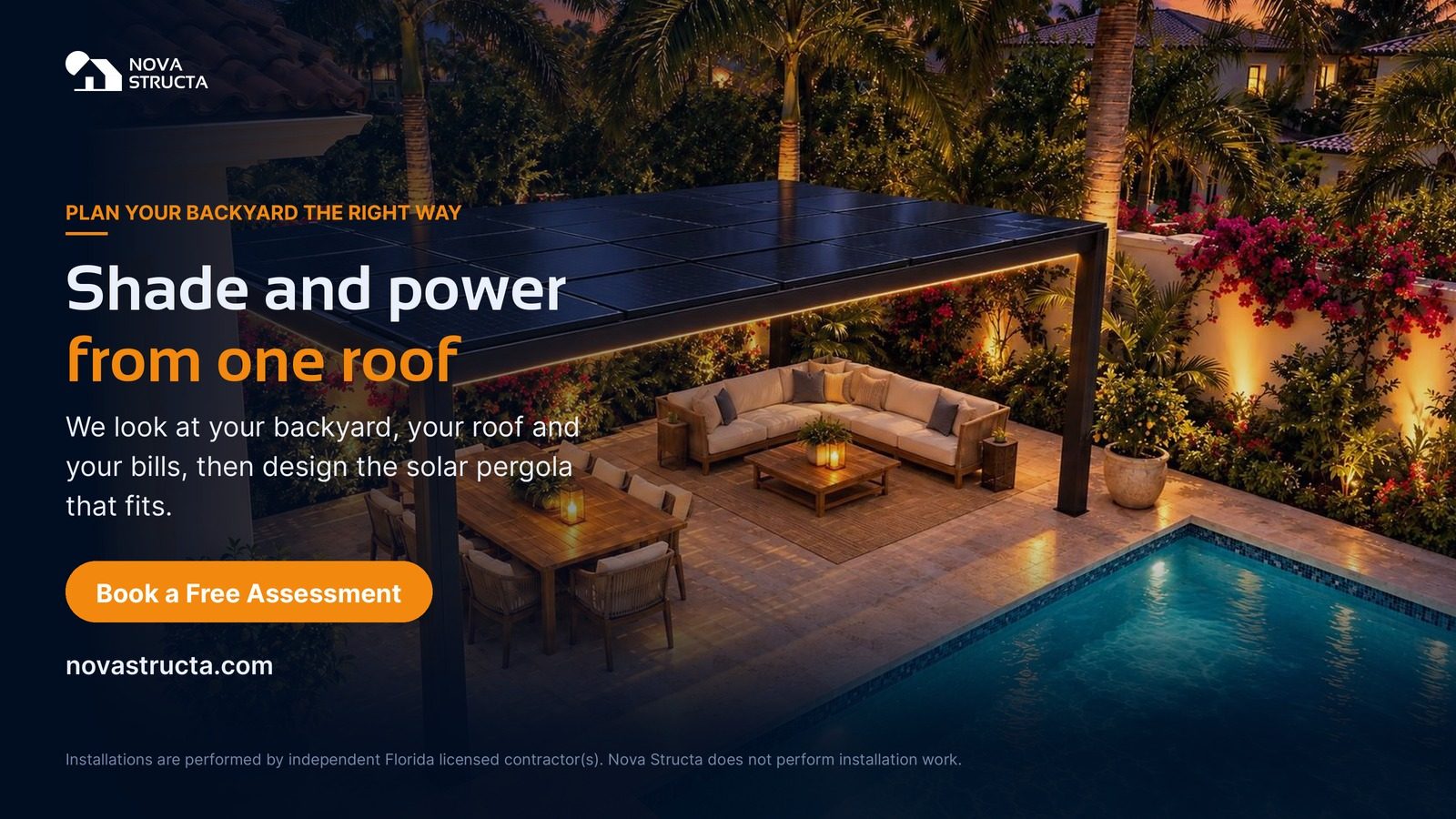
Do you really need a solar pergola in 2027? If you have a sunny backyard you would use more with real shade, yes. It turns one structure into an outdoor room and a power source, keeps panels off your roof, and lets the array face the sun even when your house does not. If you rarely go outside or your yard sits in shade, start with the roof instead.
If you would like someone to look at your backyard, your roof and your bills, see solar pergolas and solar systems, or book a free assessment.
Results vary by home, site, usage, rate plan and installation. Examples and visuals are illustrative only. Nova Structa coordinates consultations, project review, and customer support, but does not perform installation work. Installations are performed by independent Florida licensed contractor(s). Qcells is a trademark of its owner. Reference to it is for product identification only and does not imply sponsorship, endorsement, certification, partnership, or affiliation.
Sources
- Florida Power & Light, "FPL rate settlement reduces request by nearly a third, limits average annual bill increases to 2%, maintains consumer protections," August 20, 2025. newsroom.fpl.com
- Florida Public Service Commission, Rule 25-6.065, F.A.C., Interconnection and Net Metering of Customer-Owned Renewable Generation. Rule text (PDF)
- Qcells, Q.TRON BLK M-G2+ series data sheet, 415 to 440 Wp, 1722 × 1134 × 30 mm (Rev04, North America). Qcells data sheet (PDF)
- EnergySage, "Cost of solar panels in Florida," updated September 25, 2026. energysage.com
- U.S. Energy Information Administration, 2024 average monthly residential electricity consumption by state (Table 5A). eia.gov (PDF)
- Florida Statutes, Section 163.04, Energy devices based on renewable resources (2026). flsenate.gov
- Florida Statutes, Section 193.624, Assessment of renewable energy source devices (2026). flsenate.gov
- Florida Statutes, Section 212.08(7)(hh), solar energy systems exemption, as applied in Florida Department of Revenue TAA 15A-008. TAA 15A-008
- Internal Revenue Service, Instructions for Form 5695 (2025), Residential Energy Credits. irs.gov
- Florida Building Code, 8th Edition (2023), Building, Chapter 16 Structural Design (wind loads per ASCE 7). codes.iccsafe.org
- EnergySage, "Do solar panels work during a power outage?" updated August 11, 2026. energysage.com
- U.S. Energy Information Administration, "Hurricanes in 2024 led to the most hours without power in the United States in 10 years," December 1, 2025. eia.gov
Savings and utility-bill examples shown are illustrative only, are not guaranteed, and may not reflect typical results. Actual savings depend on your energy usage, system size, roof and site conditions, financing terms, utility rates, net-metering rules, and other factors specific to your home.