Tesla Roof & Powerwalls
Powering Your Home Day and Night: How Solar, Powerwall 3 and the Tesla App Work Together in Florida (2026)
How does a solar and Powerwall system power a home day and night?
Solar panels run the house in daylight and send what the home does not use into a Powerwall 3. After sunset the battery takes over, and if the grid goes down it switches the home to backup on its own. The Tesla app decides how the battery behaves: everyday savings, a backup reserve, or a full charge before a storm.
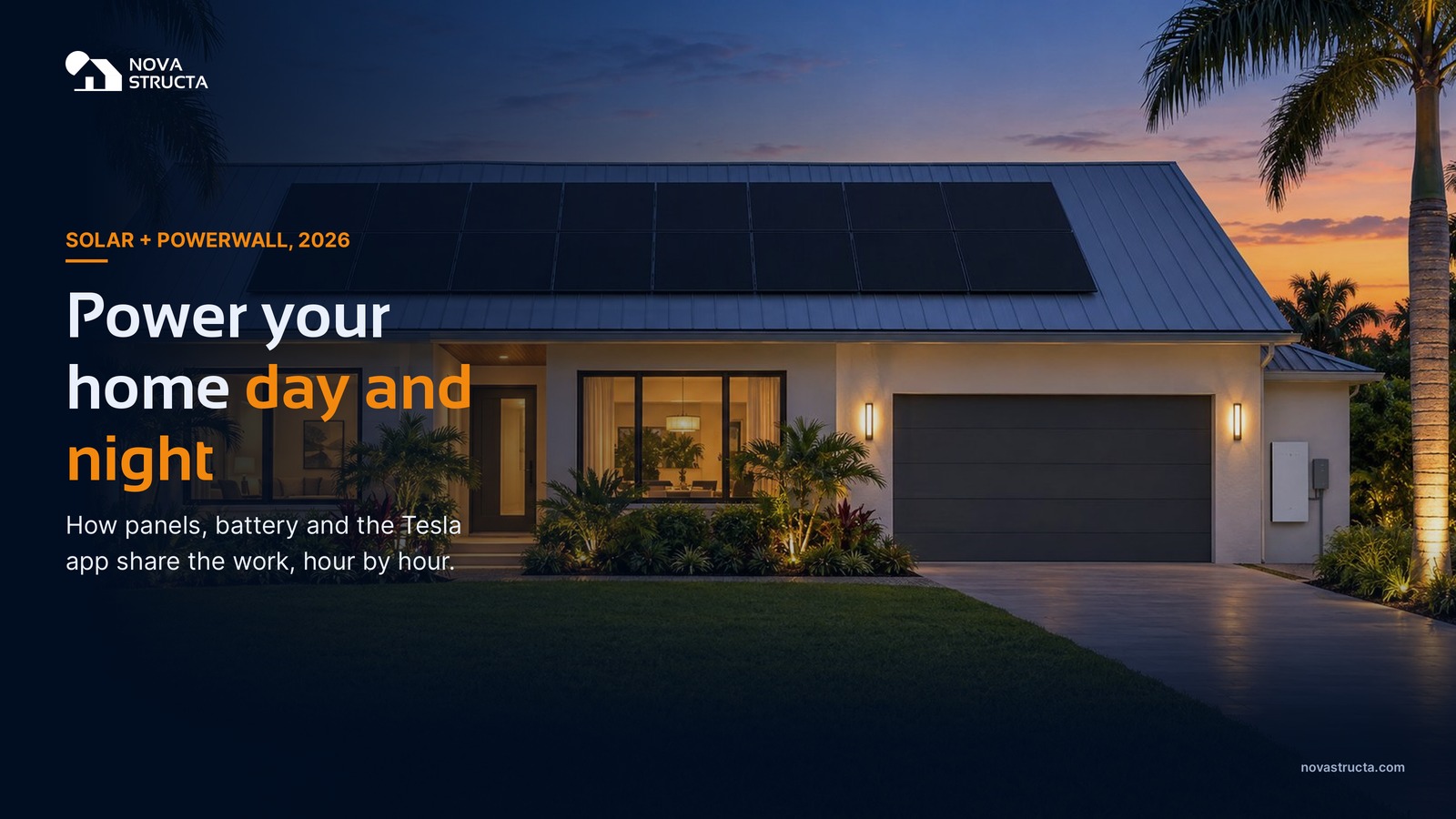
Most solar homes in Florida have a quiet gap in the day. The panels make the most power around midday, when nobody is home, and nothing at all from sunset to sunrise, when the AC, the kitchen and the pool pump are working hardest. Without a battery, a solar home buys its evening power from the utility like everyone else, and when the grid goes down, the panels shut off too [9].
A battery closes that gap. This guide walks through how the pieces fit, what a day looks like hour by hour, how far one battery goes in a Florida home, and which settings in the Tesla app matter most here. Every claim links to a source. It is general information, not financial or engineering advice for your home.
The four parts of a day and night system
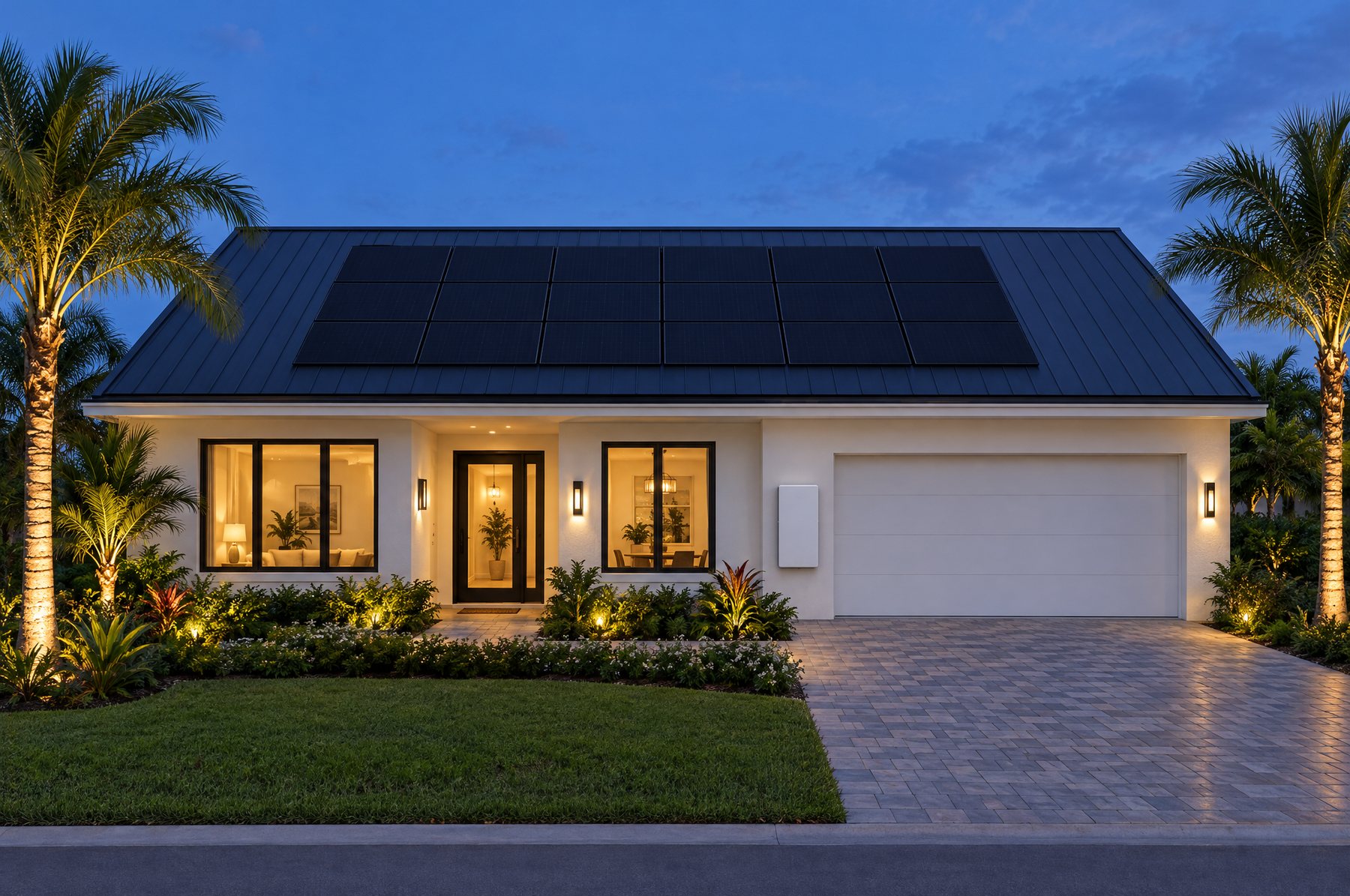
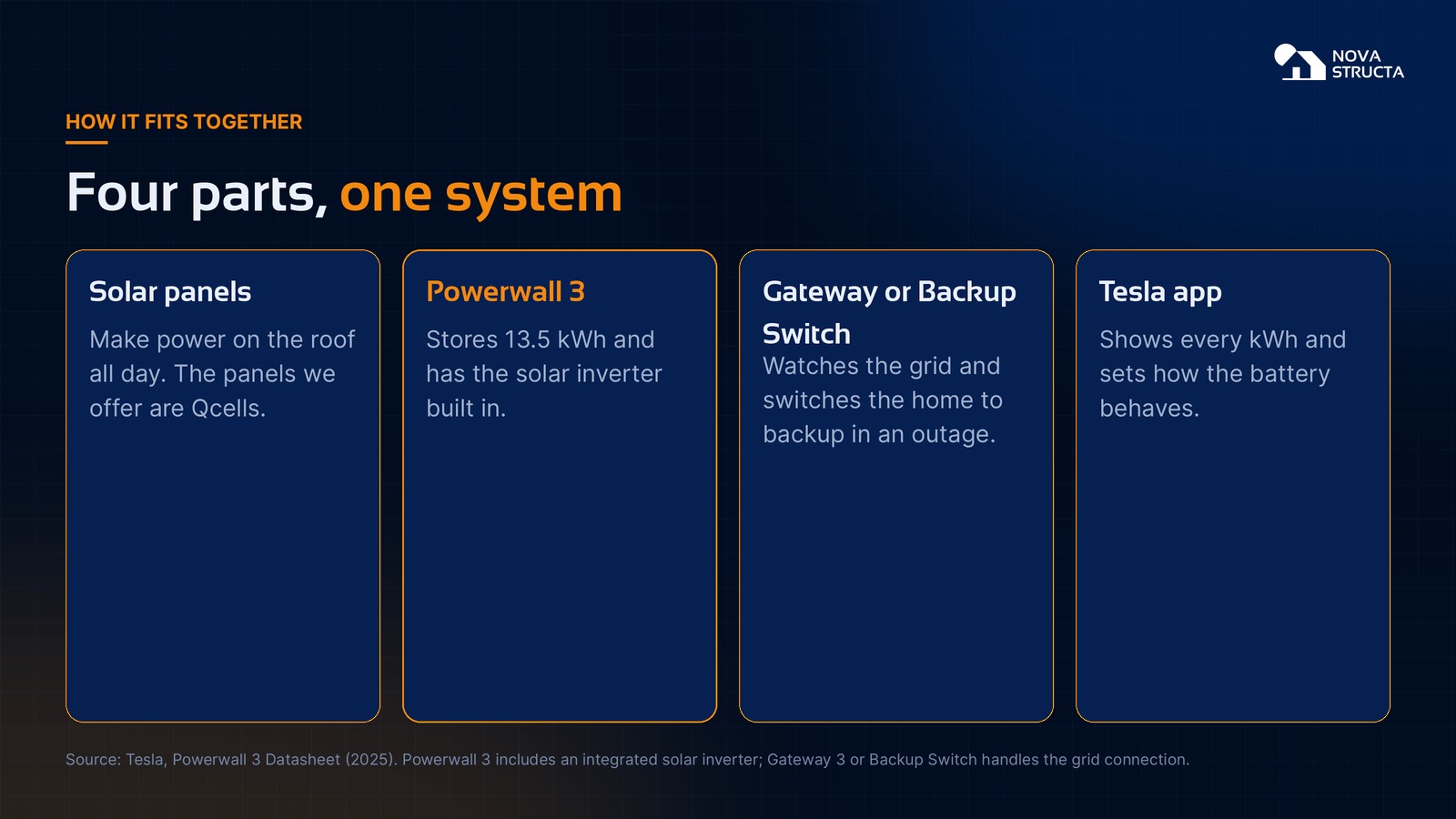
- Solar panels make the power. The panels in the systems we offer are Qcells. Qcells builds panels in Dalton, Georgia, which it called the largest plant of its kind in the Western Hemisphere when it expanded to more than 5.1 GW in 2023 [15]. In June 2026 it began making solar cells in Cartersville, Georgia, and puts its total Georgia panel capacity at 8.6 GW a year [16].
- Powerwall 3 stores it and converts it. Each unit holds 13.5 kWh and has a solar inverter built in, so the panels can feed it directly, up to 20 kW of solar on 6 separate inputs [1].
- A Gateway 3 or Backup Switch watches the grid. It is the part that senses an outage and moves the home to battery power automatically [1].
- The Tesla app runs the show. It shows your home, solar and battery data by day, month, year or lifetime [7], and it is where you choose how the battery behaves.
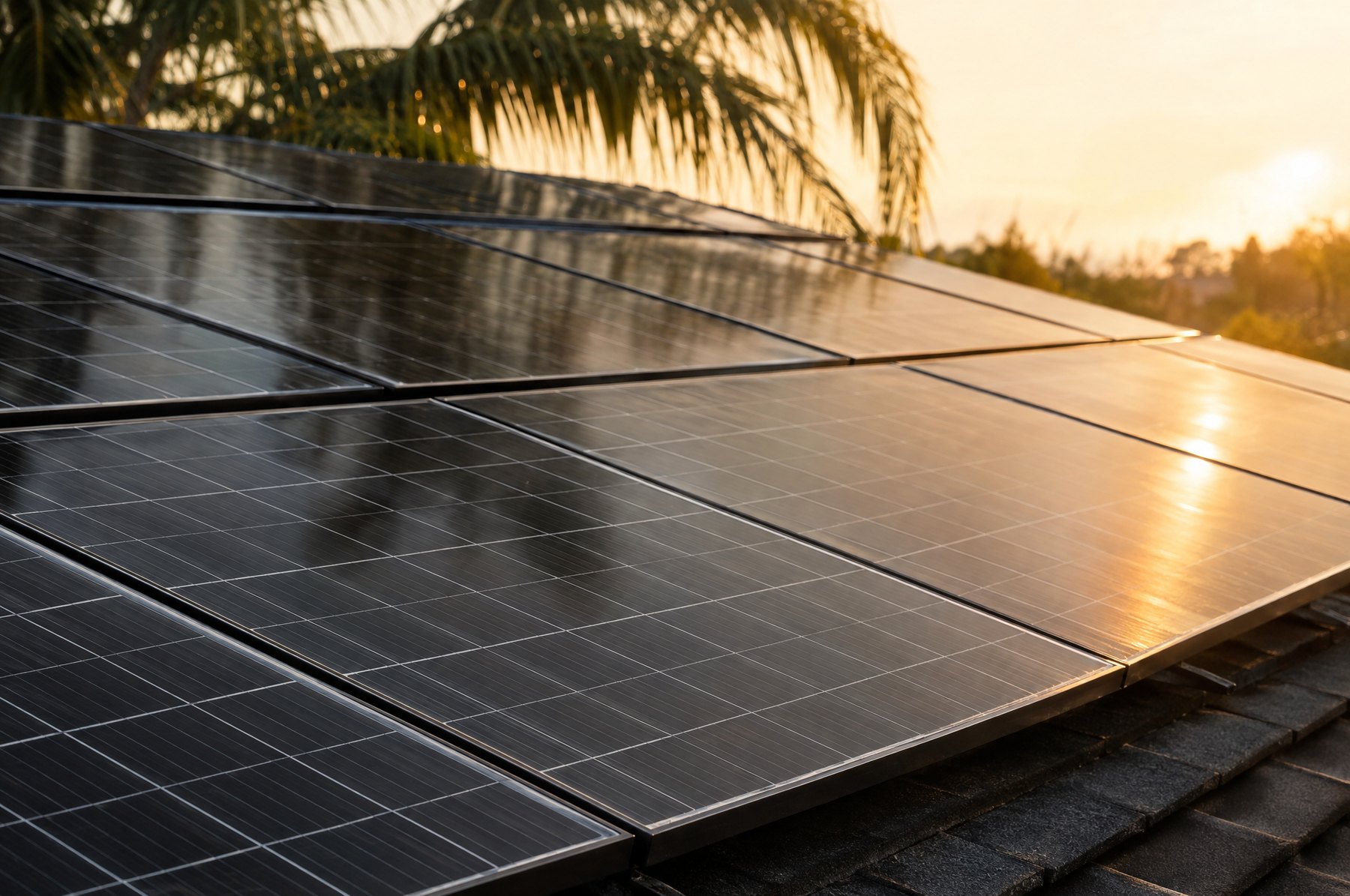
Because the inverter lives inside the battery, a Powerwall 3 system has fewer boxes on the wall than older designs. Tesla rates it at 97.5% efficient from solar to home, and 89% for a round trip from solar into the battery and back out to the home [1]. In plain terms, a small share of stored energy is lost to the round trip, so the system works best when the home uses solar directly whenever it can.
A day in the life of a solar and battery home
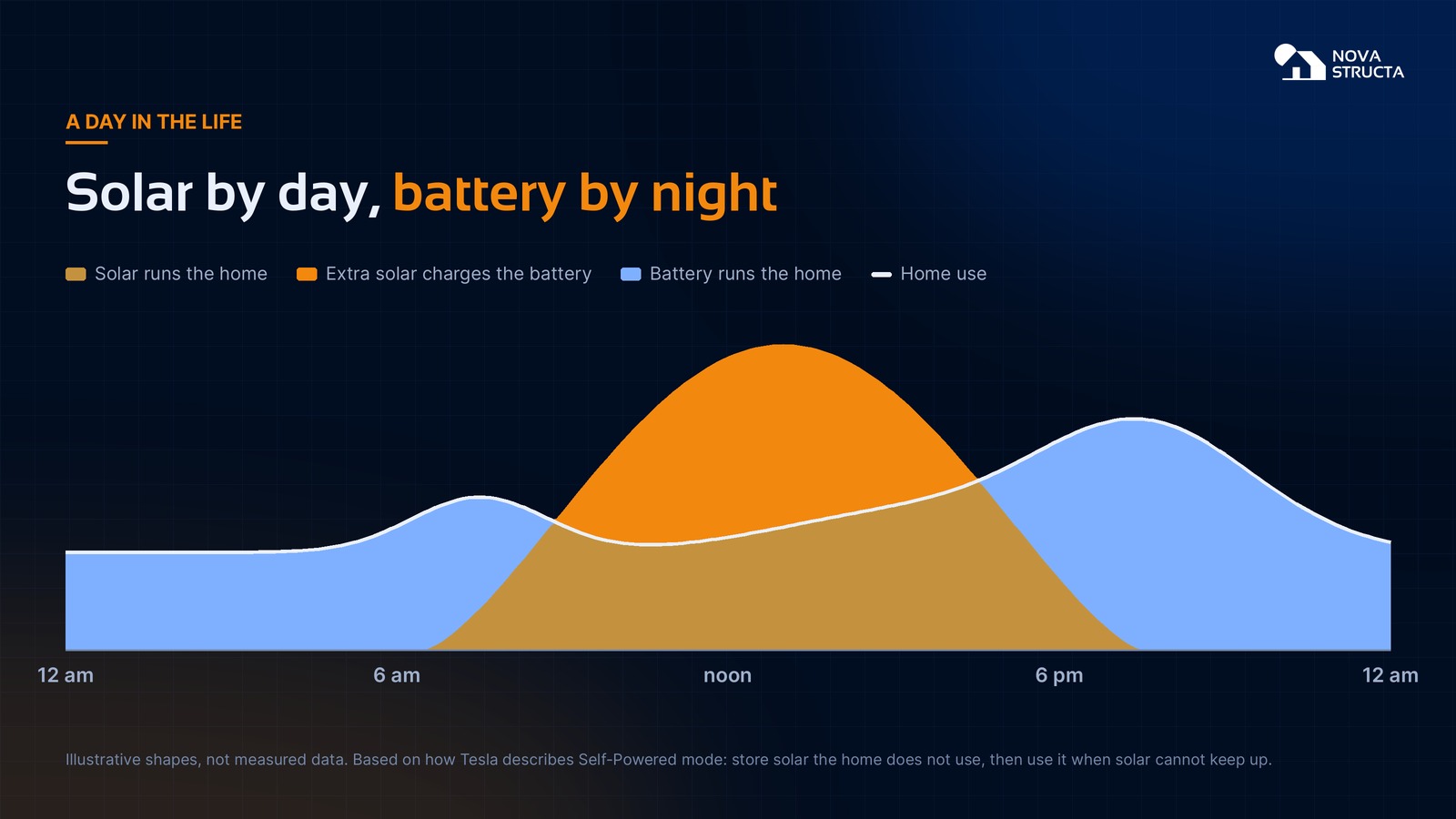
In Self-Powered mode, Powerwall stores the solar your home does not use and powers the home with it when solar cannot keep up [2]. Here is how that plays out on a normal Florida day:
- Early morning. The sun is low and the house is waking up. The battery covers coffee, showers and the AC with what it saved yesterday.
- Mid morning to mid afternoon. Solar outruns the home. The panels run the house directly, and every extra kilowatt-hour goes into the battery [2].
- When the battery is full. Extra solar flows out to the grid, where Florida net metering turns it into kWh credit on your next bill [2] [12].
- Late afternoon. Solar fades just as the family gets home and the AC works hardest. The battery starts filling the gap.
- Evening and overnight. The battery carries the home until it reaches the reserve you set in the app. After that, the home draws from the grid as usual [3].
How much can one Powerwall 3 run?
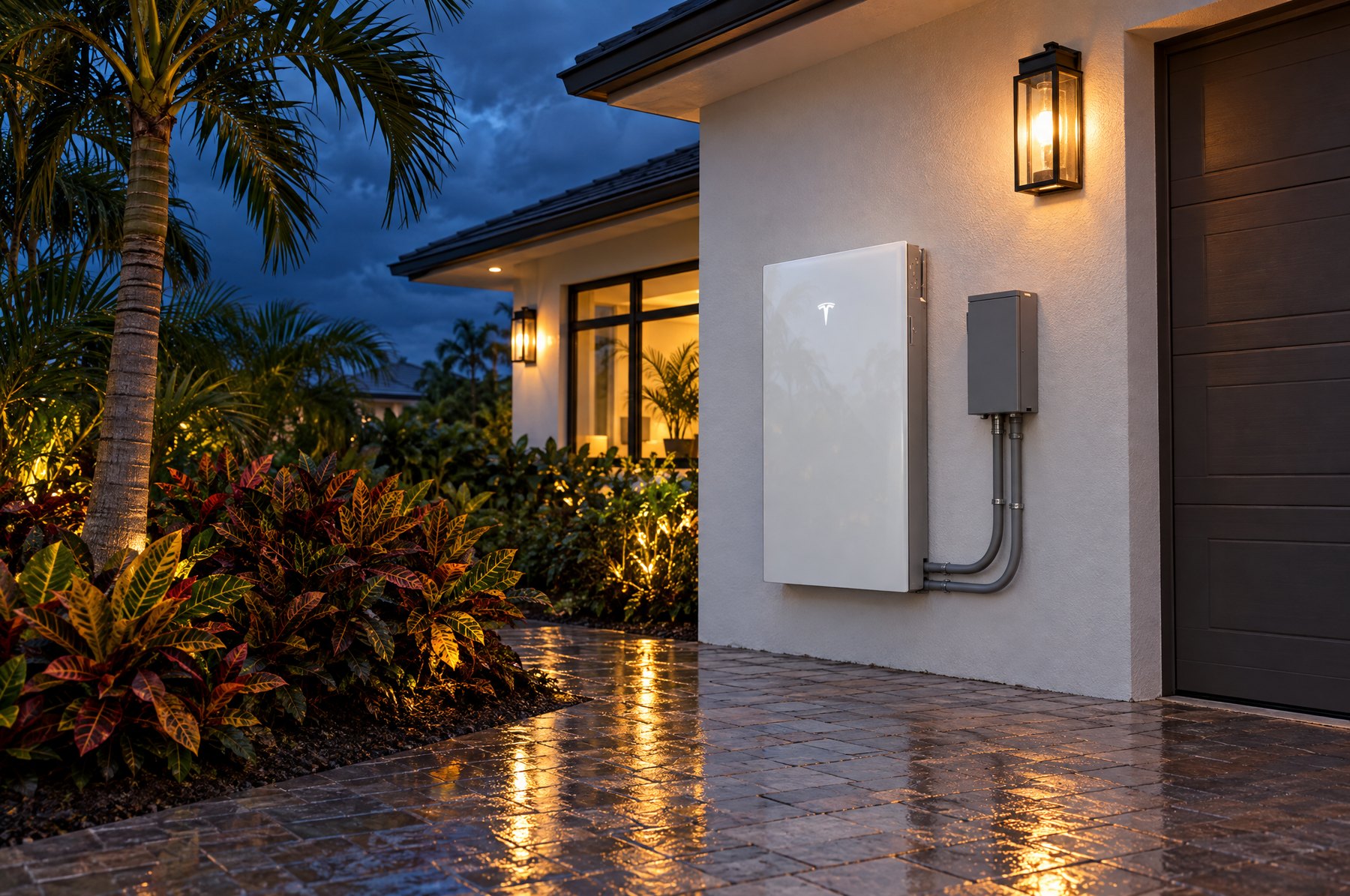
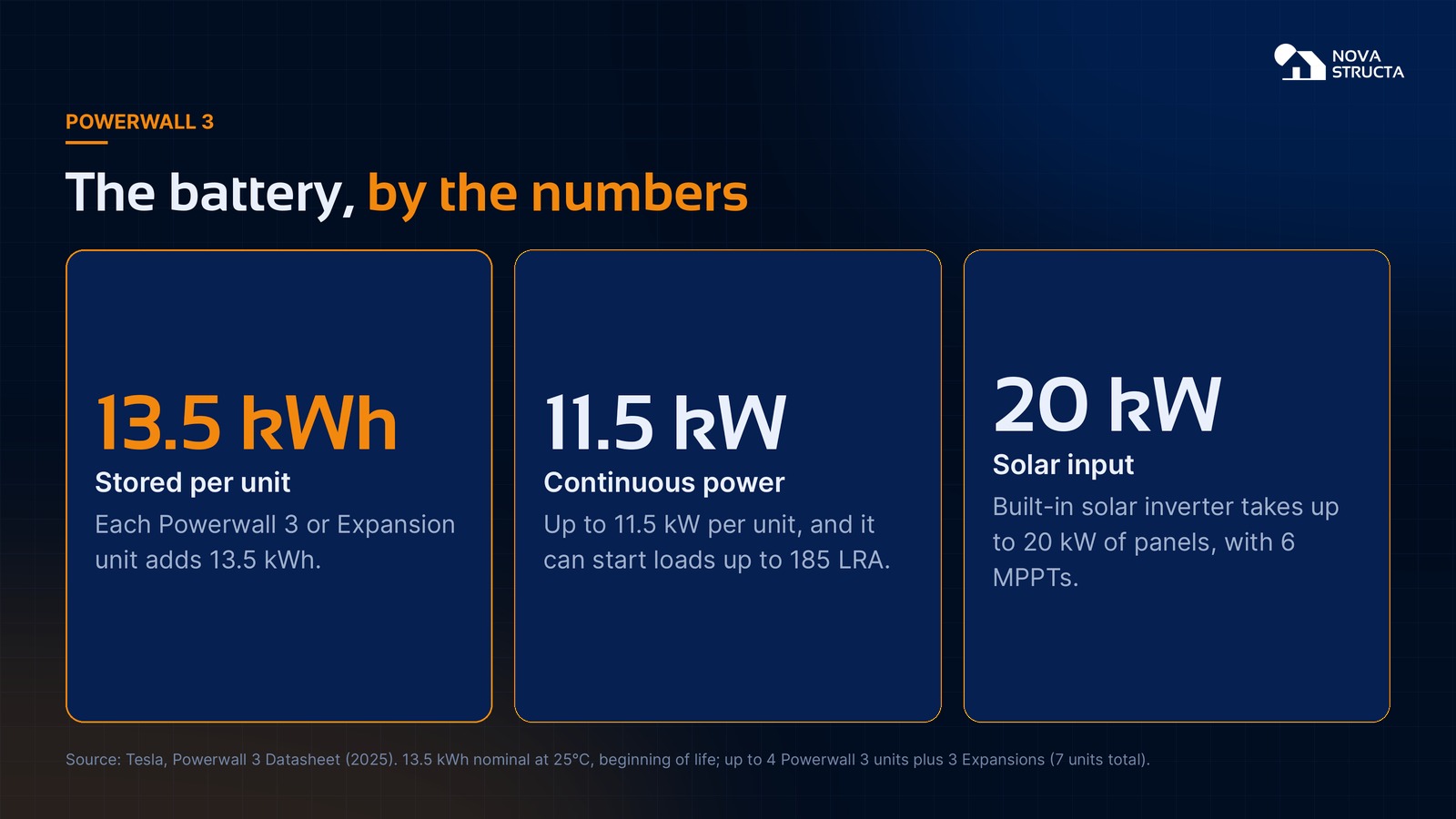
Two numbers decide what a battery can do. Energy (kWh) is how long it can run things. Power (kW) is how much it can run at once. Here is what the Powerwall 3 datasheet says [1]:
| Spec | Powerwall 3 | What it means at home |
|---|---|---|
| Energy | 13.5 kWh | How much the battery holds |
| Continuous power | 11.5 kW | How much it can run at the same time |
| Motor start | 185 LRA | Enough surge to start large motors like an AC compressor |
| Solar input | Up to 20 kW, 6 inputs | Panels on different roof faces can feed one unit |
| Expansion | Up to 4 Powerwall 3 plus 3 Expansion units | Up to 7 units of 13.5 kWh each |
| Rating | IP67, indoor or outdoor | Sealed against water and dust |
| Temperature | Operates from -4°F to 122°F | Output is reduced above 104°F |
| Warranty | 10 years | Check the terms for your install |
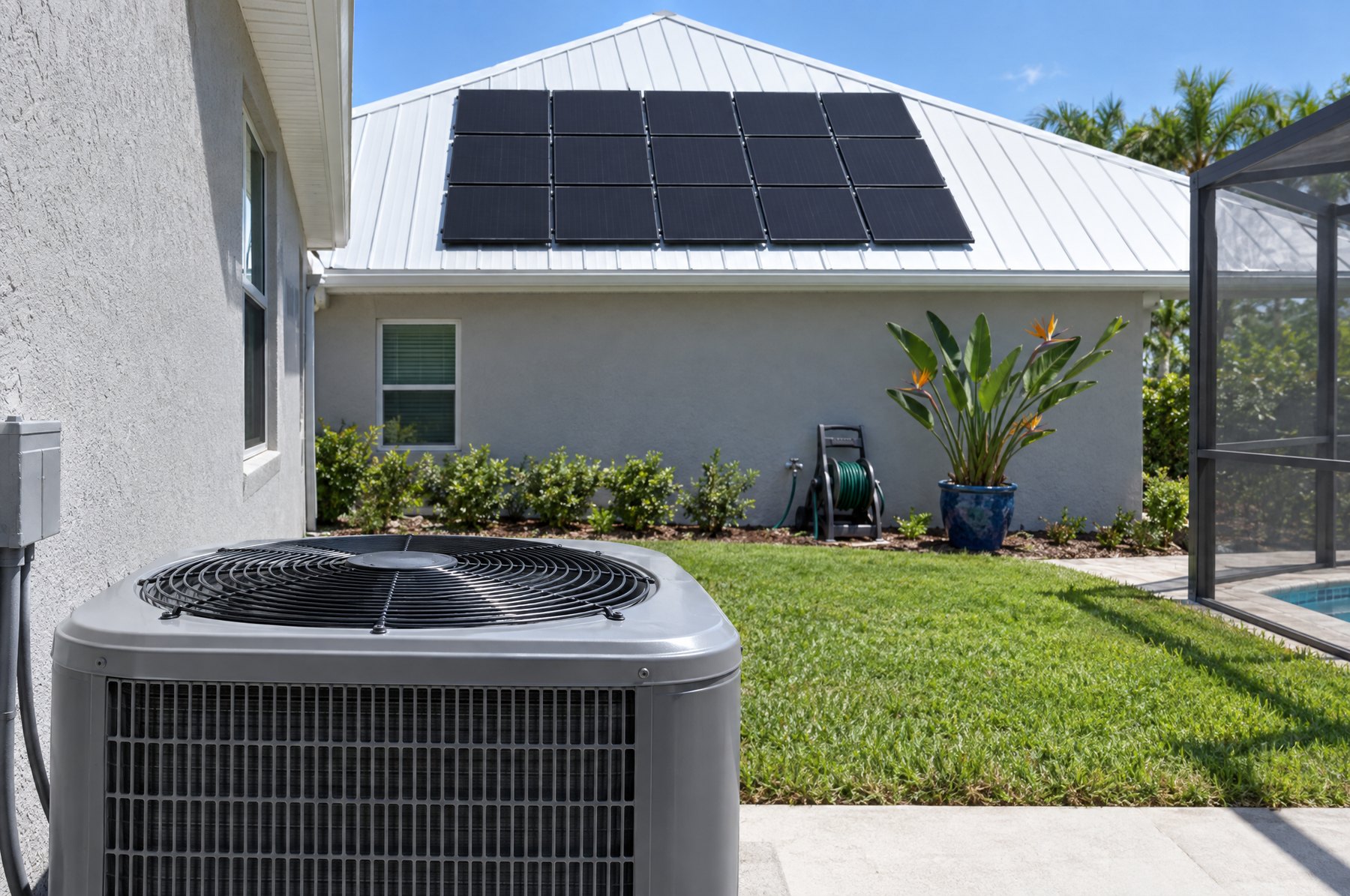
The motor start number matters more in Florida than almost anywhere. Central AC compressors and pool pumps need a big burst of current to start, measured in locked rotor amps (LRA). A battery that can store plenty of energy but cannot start the compressor still leaves you hot.
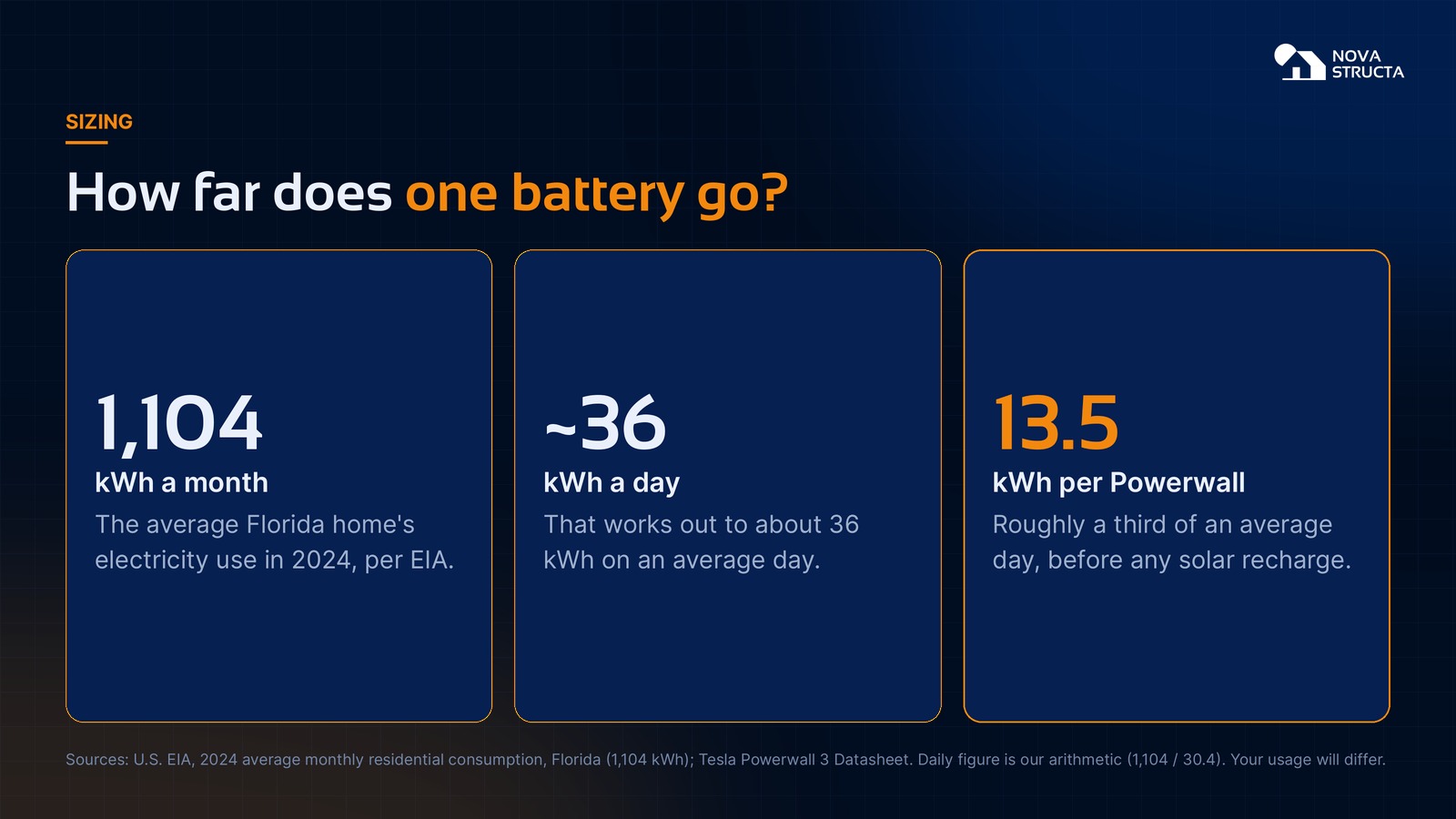
Now the math. The average Florida home used 1,104 kWh a month in 2024 [13]. Spread over a month, that is about 36 kWh a day. One Powerwall 3 holds 13.5 kWh [1], so on an average day it can cover a bit more than a third of the home's total use before any solar recharge. That is our arithmetic on averages. A summer day with the AC running hard can use far more, and a mild winter day far less.
This is why sizing is a conversation, not a formula. The right answer depends on your bills, what you want running in an outage, and how much roof you have for panels to recharge the battery.
The Tesla app: five settings that run the show
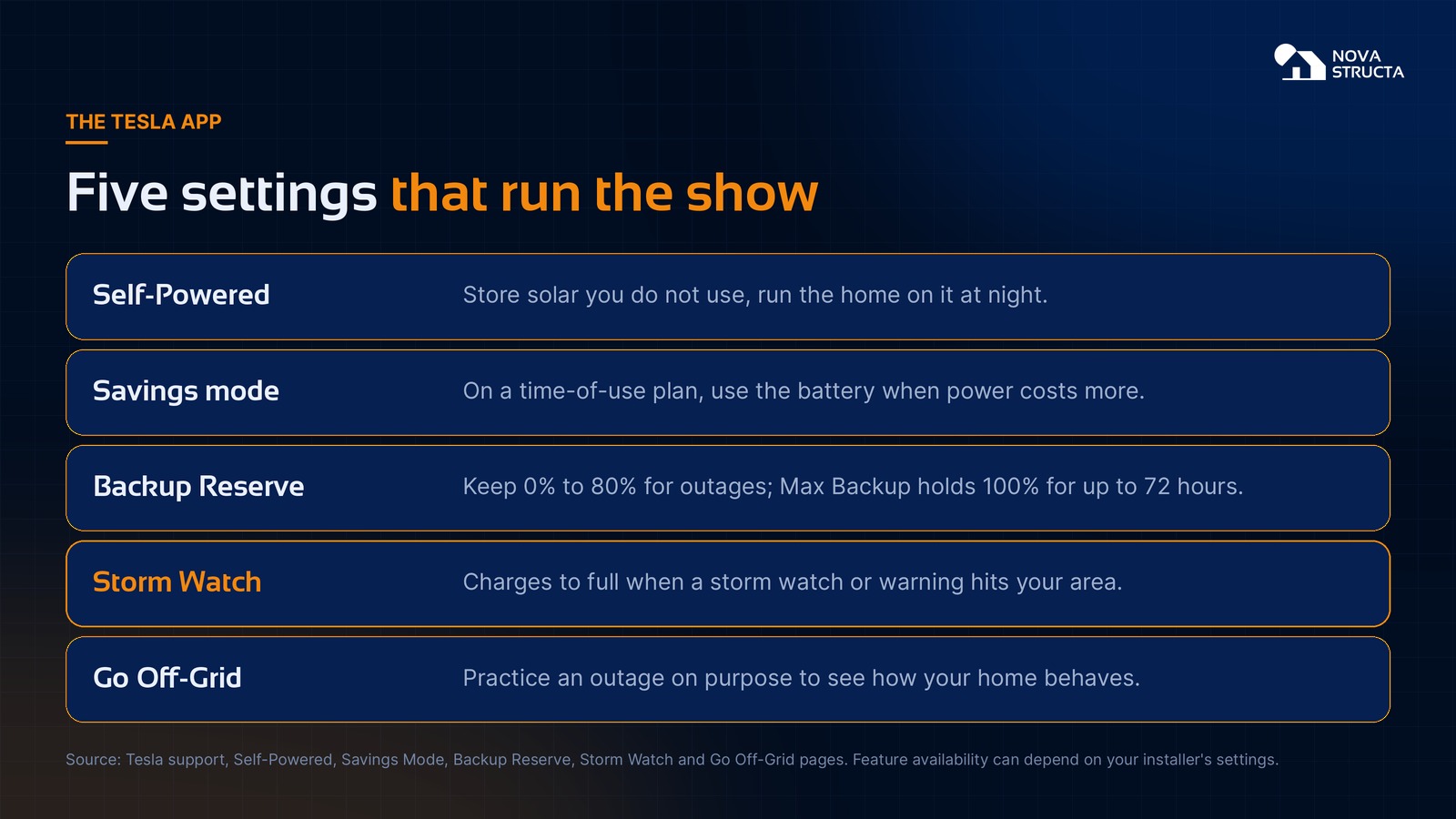
| Setting | What it does | When it fits in Florida |
|---|---|---|
| Self-Powered | Stores solar the home does not use and uses it when solar cannot keep up [2] | The everyday default on a standard FPL plan |
| Savings mode | Charges when power is cheap and powers the home when it is costly, based on your utility's time-of-use plan [5] | Only worth it if you are on a time-of-use rate |
| Backup Reserve | Holds back a share of the battery for outages [3] | Raise it during hurricane season |
| Storm Watch | Charges the battery to full when severe weather is on the way [4] | Leave it on from June through November |
| Go Off-Grid | Disconnects from the grid on purpose to simulate an outage [6] | Run it once before storm season |
Backup Reserve is the setting most people should think about. It is the share of the battery the app will not spend on everyday use, so it is still there if the grid fails. Tesla lets you set it from 0% to 80%, and a Max Backup option holds the battery at 100% for up to 72 hours. Set it below 20% and the app warns you that backup will be limited [3]. Tesla also suggests a higher reserve if your area sees more outages [9], which describes most of coastal Florida from June to November.
Energy Data is where you learn your home. The app shows home use, solar production and battery charging by day, month, year or lifetime [7]. A month of watching it tells you more about your sizing than any average. For a walkthrough of the screens, see how to read your solar monitoring app.
What triggers Storm Watch?
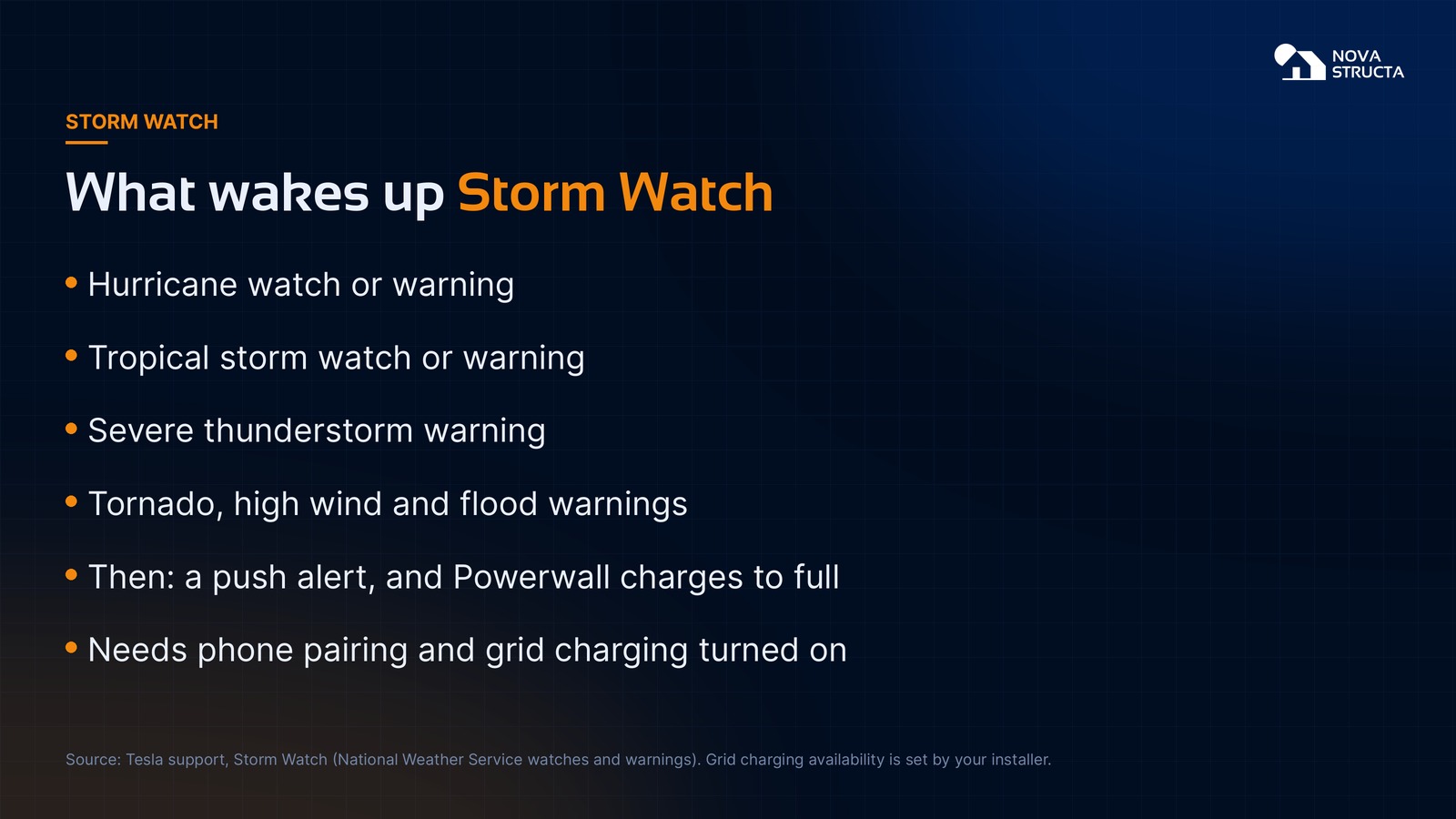
Storm Watch listens for National Weather Service alerts for your address, including hurricane and tropical storm watches and warnings, severe thunderstorm warnings, and tornado, high wind and flood warnings. When one is issued, the app sends a push alert and charges Powerwall to full so it is ready if the grid goes down [4].
Two details catch people out. Storm Watch needs your phone paired with the system, and it needs grid charging turned on, which your installer sets [4]. Check both in May, not the night before a storm.
What happens when the grid goes down?
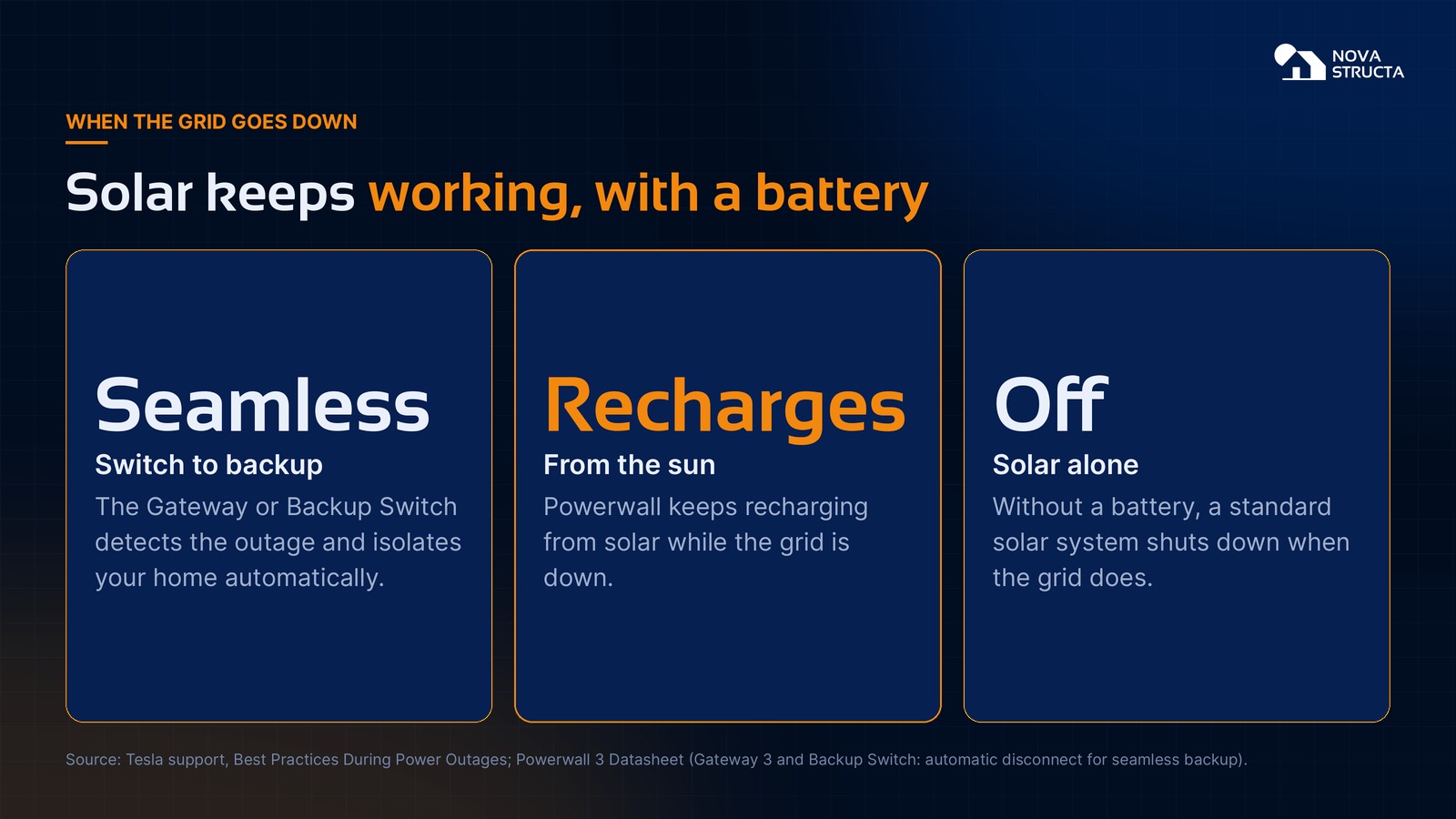
- The switch is automatic. The Gateway or Backup Switch senses the outage and moves the home to battery power on its own. Tesla calls it seamless backup [1].
- Solar keeps working. With a battery, the panels keep recharging Powerwall during the outage, so the home runs on solar and battery together. Tesla is direct about the alternative: a traditional solar system without a Powerwall does not function during a grid outage [9].
- The battery protects itself. If the battery drops below 10%, it goes into standby and tries to recharge from solar every hour between 8 a.m. and 4 p.m. [9].
To stretch the battery during a long outage, Tesla recommends cutting back on the heaviest loads, like air conditioning, EV charging, electric heaters and dishwashers [9]. In practice that might mean cooling one or two rooms and holding off on laundry until the sun is up. For what the panels themselves go through in a storm, see do solar panels work in a hurricane?
Whole home or partial home backup?
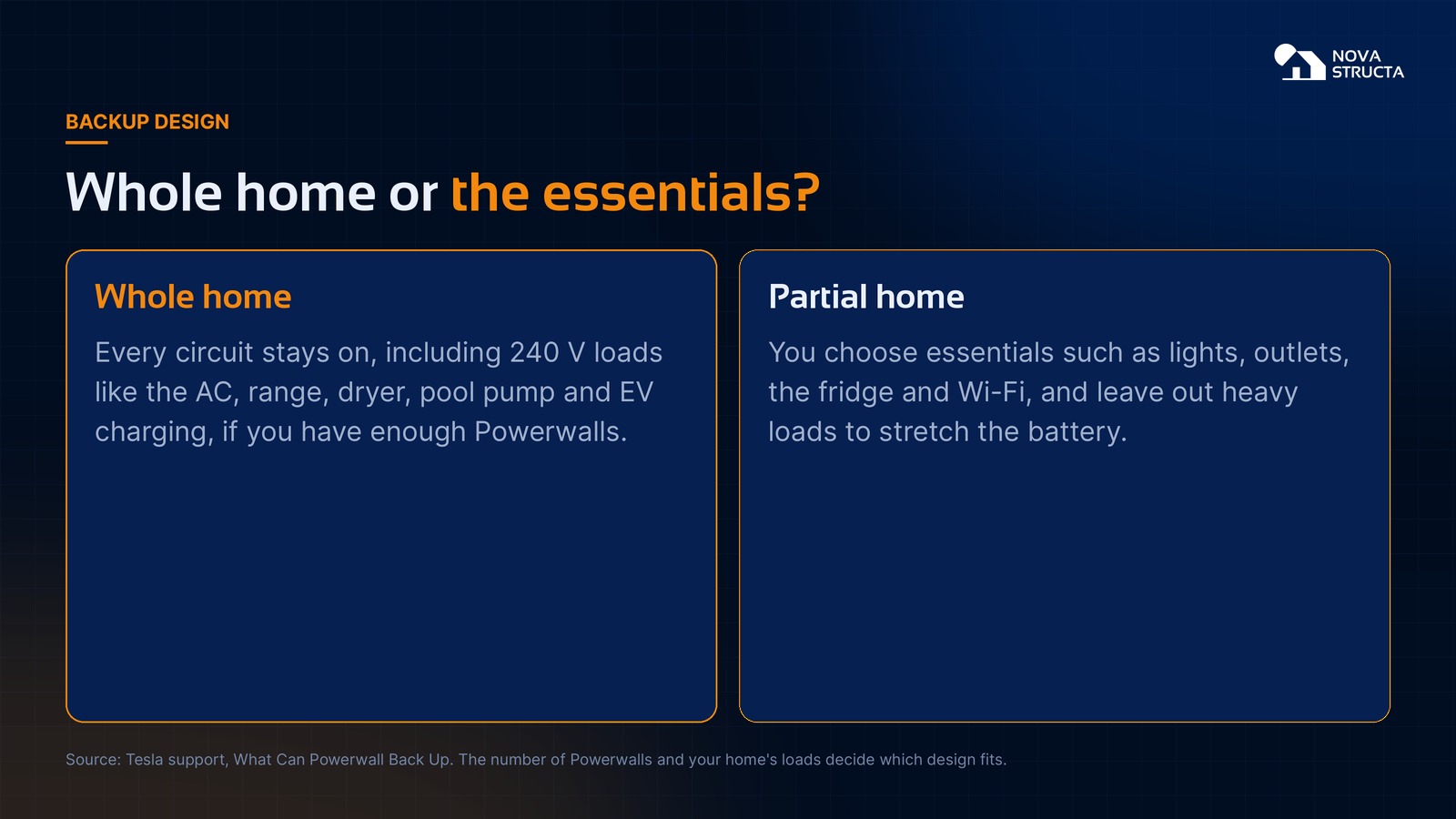
Tesla says your home's energy needs and the number of Powerwalls decide which kind of backup you get [8].
| Whole home backup | Partial home backup | |
|---|---|---|
| What stays on | The entire home, including all appliances [8] | Essentials you choose, like lights and outlets [8] |
| Heavy 240 V loads | Can include AC, range, dryer, water heater, pool pump and EV charging, depending on battery count [8] | Usually left out to save the battery [8] |
| Best for | Homes with more batteries, or owners who want no change in an outage | Smaller systems, or owners who want the battery to last as long as possible |
For a Florida home, the deciding question is usually the AC. Keeping central air on through an outage takes more battery and more solar to refill it. Keeping only the fridge, Wi-Fi, lights, fans and a medical device on can make one battery go much further.
How Florida net metering and time-of-use fit in
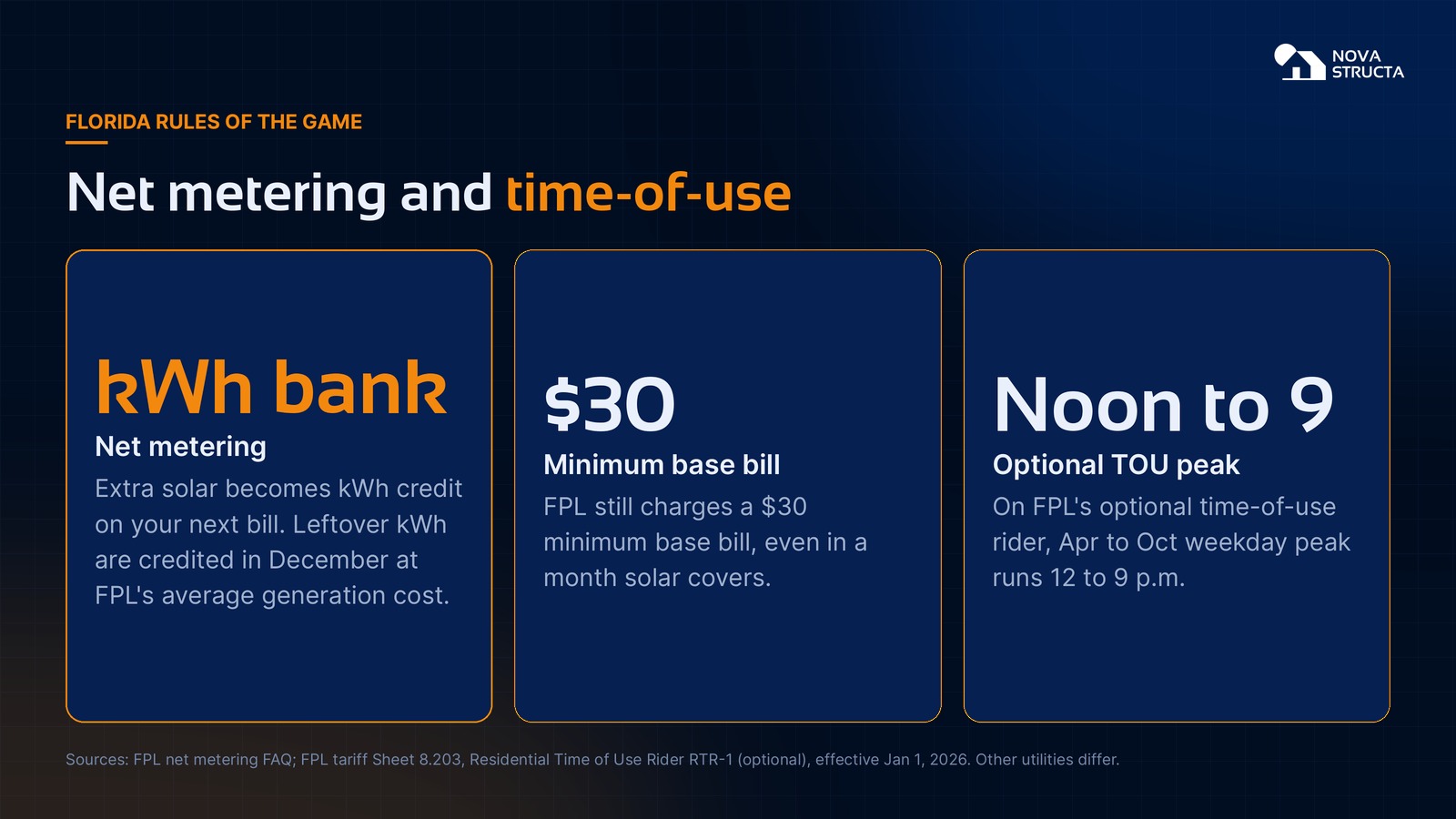
Three FPL rules that shape how a battery earns its keep.
Net metering banks kWh, not dollars. When your solar makes more than you use, the extra becomes kWh credit on your next bill. Credit left over when your meter is read in December is credited on that bill at FPL's average annual cost of generating power [12].
The bill never reaches zero. FPL keeps a $30 minimum base bill so every customer helps pay for the grid [12].
Time-of-use is optional. FPL's RTR-1 rider prices on-peak power higher. From April through October, the on-peak window is noon to 9 p.m. on weekdays. From November through March, it is 6 to 10 a.m. and 6 to 10 p.m. on weekdays [10].
Here is the honest part. On a standard FPL plan, net metering already gives you kWh credit for the solar you send out [12], so a battery does little extra for the bill by itself. Its main value is backup and the confidence of keeping your home running in an outage.
Time-of-use changes the picture. FPL describes peak power at about 26 cents per kWh and off-peak at about 9 cents, as an approximation that varies by location [11]. Savings mode is built for that kind of plan: charge when power is cheap, run the home from the battery when it is expensive [5]. The summer peak window, noon to 9 p.m. [10], lines up well with solar in the afternoon and battery after sunset. But the rider requires a one-year commitment and a new meter [10] [11], so it is worth modeling with your own usage before you switch. Results vary by home, usage and rate plan.
For the full breakdown of credits and fees, see is solar worth it in Florida in 2026 and Florida electric bills explained.
Set it up for Florida: a checklist
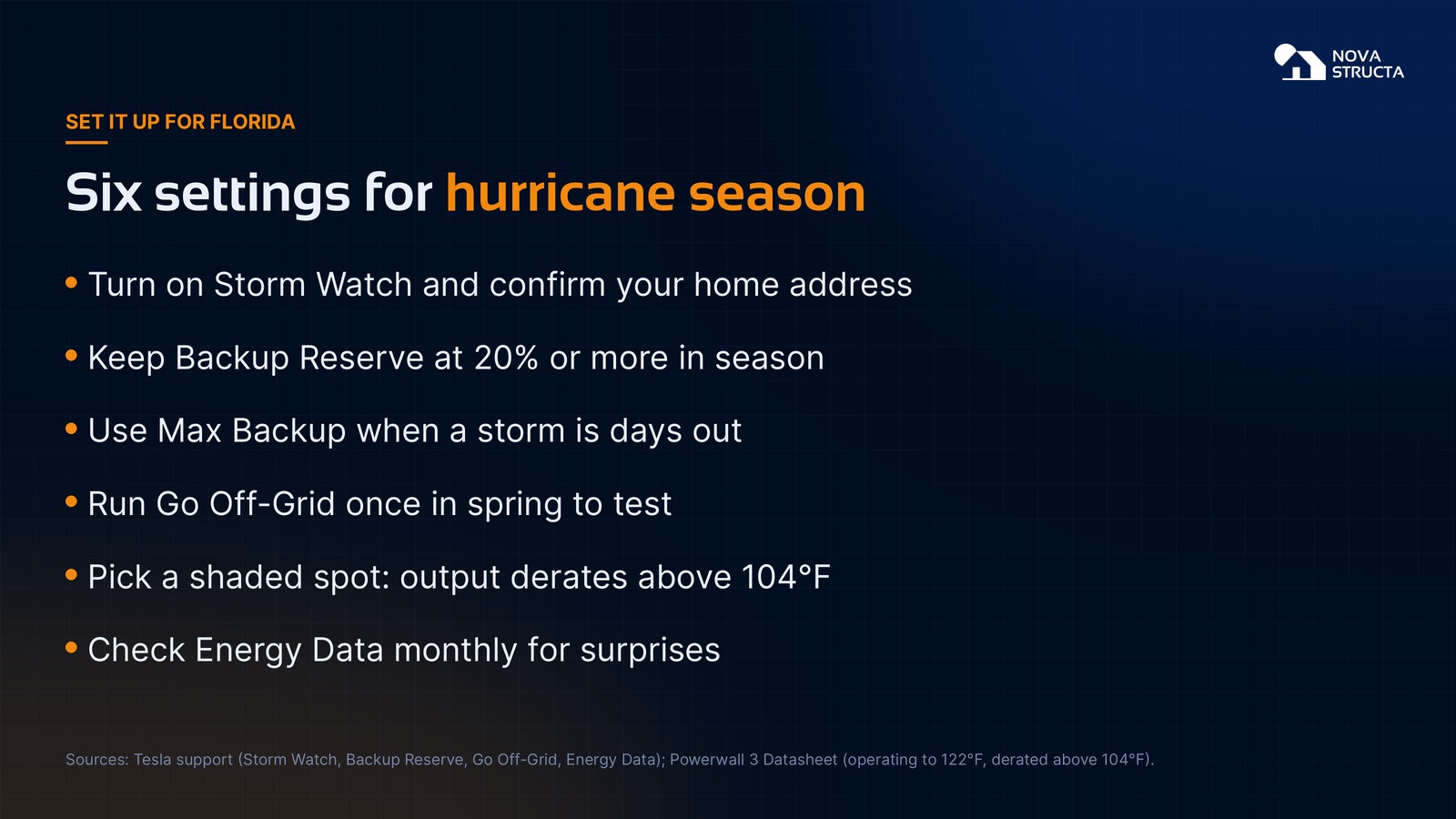
- Turn on Storm Watch and confirm the address on the account, so alerts match where the house actually is [4].
- Keep Backup Reserve at 20% or more during hurricane season, the level below which Tesla warns that backup is limited [3].
- Use Max Backup when a storm is a few days out. It holds the battery at 100% for up to 72 hours [3].
- Run Go Off-Grid once in the spring to see which circuits stay on and how fast the battery drains with your real loads [6].
- Pick a shaded install spot when you can. Powerwall 3 reduces its output above 104°F [1], and a west-facing Florida wall gets hot.
- Check Energy Data once a month for surprises, like a pool pump schedule that runs at night [7].
Questions to ask before you buy
- How many Powerwall units does my home need for the backup I want, whole home or partial [8]?
- Can the system start my AC compressor and pool pump, and how many units does that take [1]?
- Will I have a Gateway 3 or a Backup Switch, and where will it go [1]?
- Will grid charging be enabled so Storm Watch can fill the battery before a storm [4]?
- Which panels are on the quote, and who handles warranty service on the panels and the battery?
- Am I better off on standard net metering or FPL's time-of-use rider [10] [12]?
- Does my roof have enough life left to outlast the panels? See the best roofing materials for Florida homes.
The bottom line
Solar alone powers a Florida home only while the sun is up and the grid is on [9]. Add a Powerwall 3 and the same panels carry the home into the evening, keep it running in an outage, and recharge the battery the next morning [1] [2]. The Tesla app is where you decide how that energy is spent: everyday use, a reserve for storms, or a full charge before the weather turns [3] [4].
The right system depends on your usage, your roof and what you want running when the lights go out. If you would like someone to look at your bills and design the day and night picture for your home, see Tesla Roof and Powerwalls and solar systems, or book a free assessment.
Results vary by home, usage, rate plan and installation. Tesla products may be installed by independent Tesla Certified Installer(s), where applicable. Nova Structa coordinates consultations, project review, and customer support, but does not perform installation work. Installations are performed by independent Florida licensed contractor(s).
Sources
- Tesla, Powerwall 3 Datasheet, North America (2025). energylibrary.tesla.com (PDF)
- Tesla, Powerwall support, "Self-Powered." tesla.com
- Tesla, Powerwall support, "Backup Reserve." tesla.com
- Tesla, Powerwall support, "Storm Watch." tesla.com
- Tesla, Powerwall support, "Savings Mode." tesla.com
- Tesla, Powerwall support, "Go Off-Grid." tesla.com
- Tesla, Powerwall support, "Energy Data." tesla.com
- Tesla, Powerwall support, "What Can Powerwall Back Up." tesla.com
- Tesla, Powerwall support, "Best Practices During Power Outages." tesla.com
- Florida Power & Light, Electric Tariff Section 8, Sheet No. 8.203, Residential Time of Use Rider RTR-1 (Optional), effective January 1, 2026. fpl.com (PDF)
- Florida Power & Light, "Time-of-Use rate." fpl.com
- Florida Power & Light, "Net metering FAQ." fpl.com
- U.S. Energy Information Administration, Electric Sales, Revenue, and Average Price, Table 5A, 2024 Average Monthly Bill, Residential (released October 7, 2025). eia.gov (PDF)
- U.S. Energy Information Administration, Today in Energy, "Hurricanes in 2024 led to the most hours without power in the United States in 10 years," December 1, 2025. eia.gov
- Qcells, "Qcells North America completes Dalton factory expansion," October 18, 2023. us.qcells.com
- Qcells, "Qcells begins solar cell manufacturing at America's first and only vertically integrated solar factory in Cartersville, Georgia," June 9, 2026. us.qcells.com
Savings and utility-bill examples shown are illustrative only, are not guaranteed, and may not reflect typical results. Actual savings depend on your energy usage, system size, roof and site conditions, financing terms, utility rates, net-metering rules, and other factors specific to your home.