Solar Energy
Florida Electric Bills Explained: Every Charge on Your FPL, Duke or TECO Bill
What are you actually paying for on a Florida electric bill?
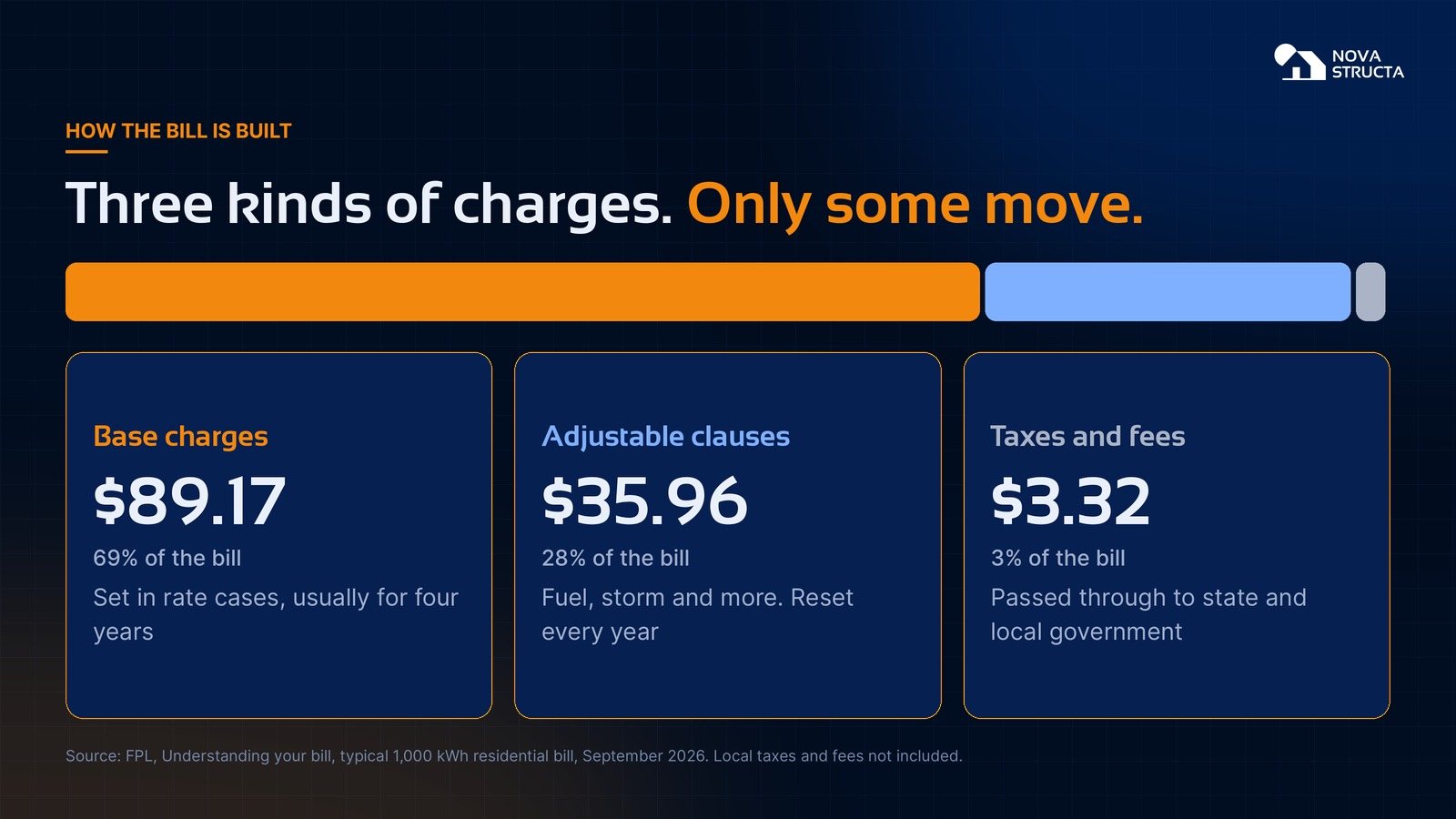
A Florida electric bill has three kinds of charges: base charges set in rate cases, adjustable clauses like fuel and storm costs that reset every year, and taxes and fees. On a typical FPL bill, base charges are about 69% of the total.
If your power bill reads like it was written in code, that is because it partly was. Fixed fees, per-kWh charges, cost recovery clauses with four-letter acronyms and local taxes all land on the same page, and the total is the only number most people look at.
This guide takes one real bill apart, line by line, using FPL's own published breakdown, then shows how Duke Energy Florida and TECO compare, what Florida law adds on top, and how to audit your own bill in about ten minutes. Nova Structa is not affiliated with any utility, and every number links to its source at the bottom of the page.
A real bill, line by line
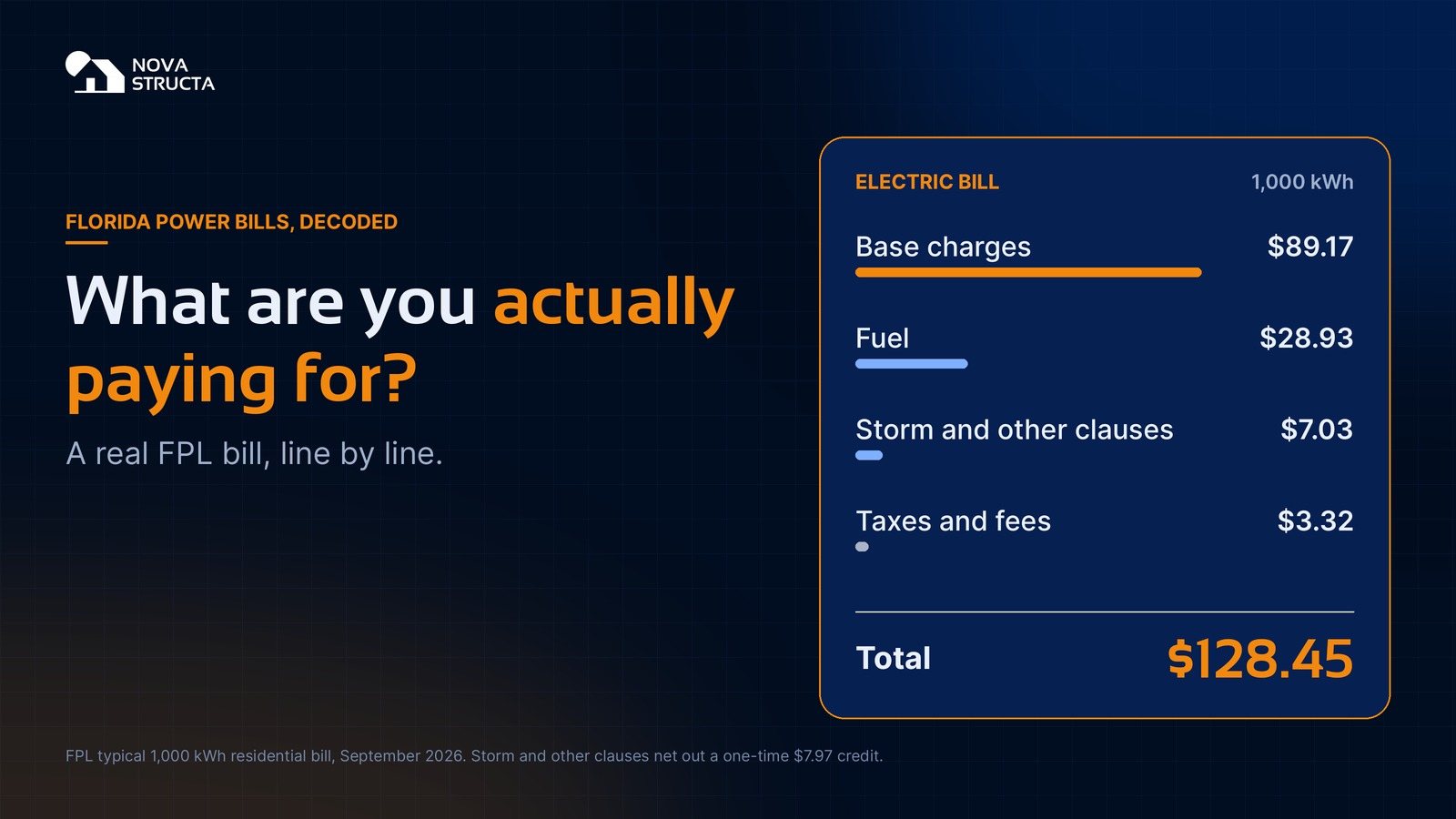
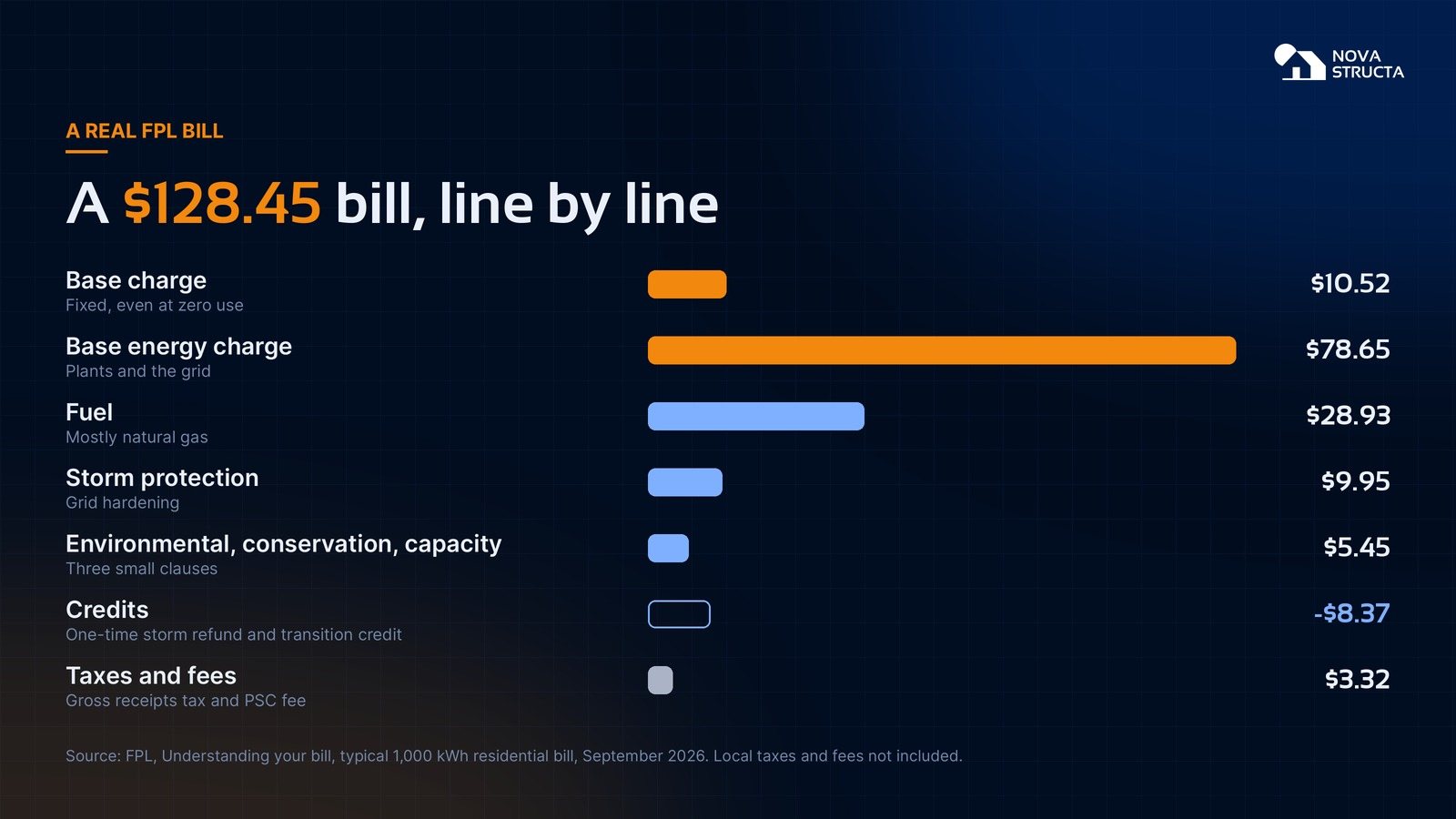
FPL publishes the full breakdown of its "typical" residential bill, which assumes 1,000 kWh of use in a month. Here is September 2026, which totals $128.45 [1].
| Line on the bill | Amount | What it pays for |
|---|---|---|
| Base charge | $10.52 | A fixed monthly amount for the meter, billing and customer service, owed even if you use no power [1] |
| Base energy charge | $78.65 | Everything other than fuel to produce and deliver power, including running power plants and maintaining the grid [1] |
| Fuel charge | $28.93 | The fuel burned to make each kWh, mostly natural gas [1] |
| Storm protection (SPPCRC) | $9.95 | Strengthening the grid to cut outage times and restoration costs [1] |
| Environmental (ECRC) | $3.45 | Meeting environmental laws and regulations [1] |
| Conservation (ECCR) | $1.48 | Programs designed to reduce electric demand [1] |
| Capacity (CCRC) | $0.52 | Power bought from resources FPL does not own, plus certain nuclear costs [1] |
| Transition credit | -$0.40 | Aligns rates for former Gulf Power customers, phasing out in January 2027 [1] |
| Storm cost refund | -$7.97 | A one-time credit in September 2026 after a true-up of 2024 hurricane costs [1][6] |
| Gross receipts tax and regulatory fee | $3.32 | A 2.6% tax and fee paid to the state and the Public Service Commission [1] |
| Total | $128.45 | Before any local taxes or franchise fees |
The two numbers that drive everything
Every bill comes down to two things: how many kilowatt-hours (kWh) you used, and what you pay for each one once every charge is counted. A kWh is 1,000 watts for one hour. Run a 1,000-watt space heater for an hour and you have used one.
The price you hear in a news story is usually just one piece of the per-kWh charge. Your real price is simpler to find and more useful.
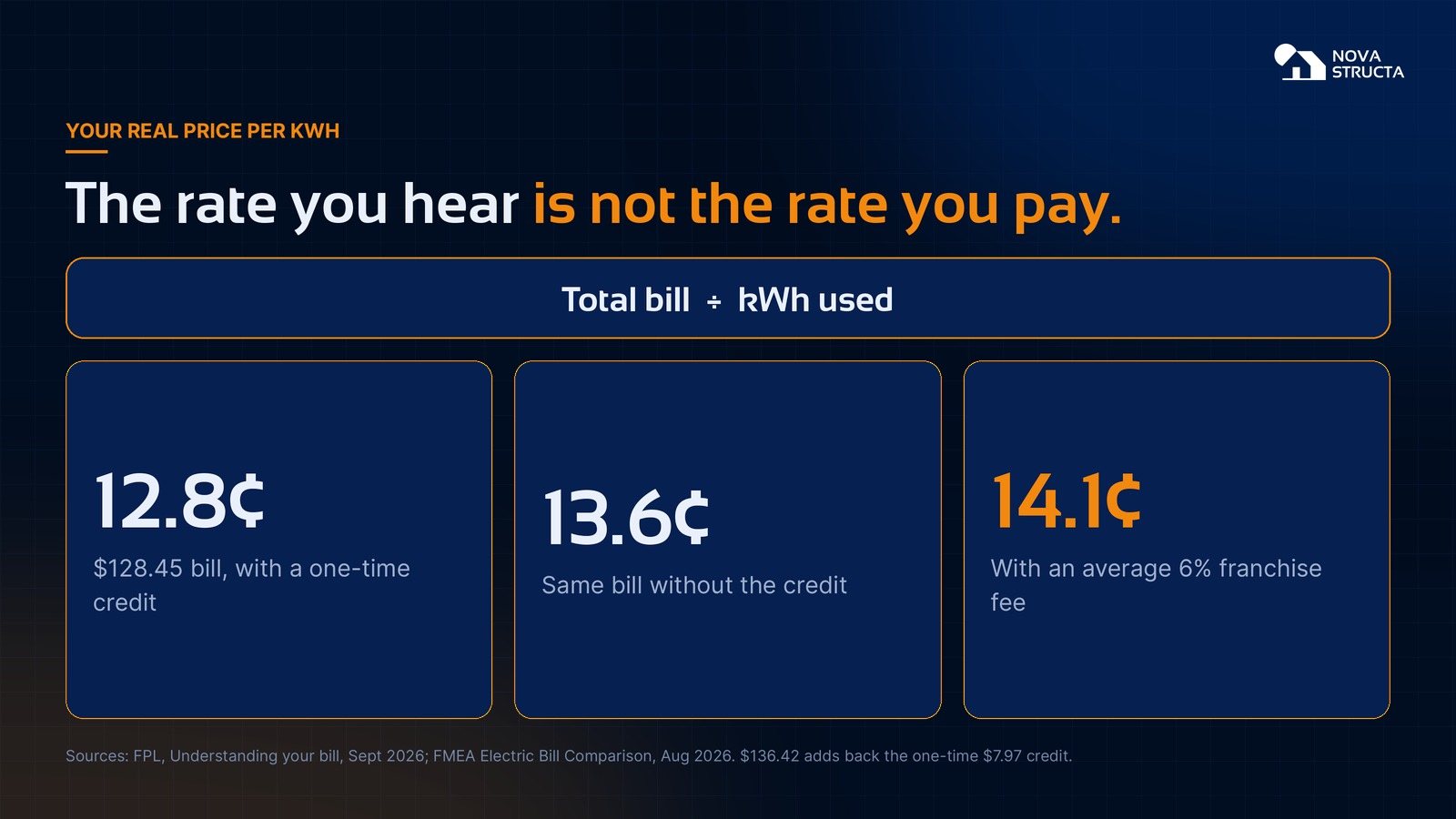
Your real price per kWh = total bill ÷ kWh used.
On FPL's September 2026 bill, that is $128.45 ÷ 1,000, or 12.8 cents. Without the one-time storm credit it would be 13.6 cents. Add an average 6% franchise fee, which FMEA includes in its comparisons, and FPL's August 2026 bill works out to about 14.1 cents [1][3].
Think of it like a phone plan. There is a line access fee you pay no matter what, a usage charge that scales with what you use, and add-ons and taxes stacked on top. Once you see the bill that way, it stops being one mystery number.
Three kinds of charges, and which ones move
Base charges: the cost of being connected
On the September 2026 bill, the base charge and base energy charge add up to $89.17, about 69% of the total [1]. These are set in a rate case before the Florida Public Service Commission, usually for several years at a time. FPL's current plan runs from 2026 through 2029 [2].
The $10.52 base charge is fixed. It does not shrink when you use less, and FPL applies a $30 minimum base bill to residential accounts whose base charges would otherwise fall below that [1]. When you see a headline about a "base rate increase," it usually means one or both of these lines went up. We broke down FPL's current rate case in FPL Rate Hikes 2021 to 2029.
Adjustable clauses: the charges that move
The second group, about 28% of this bill, is a set of cost recovery clauses that regulators review every year, outside of a full rate case [1][2].
Fuel is the big one. It covers the cost of the fuel burned to make your power, mostly natural gas, and utilities pass it through without earning a profit on it. FPL and Duke Energy Florida both say so directly [4][5]. When fuel prices rise, this is usually the first line to jump. When they fall, it can come back down.
Environmental, conservation and capacity charges are smaller. Conservation charges fund the utility's energy efficiency programs, which is a good reason to use them.
Storm charges come in two kinds, and they are easy to confuse.
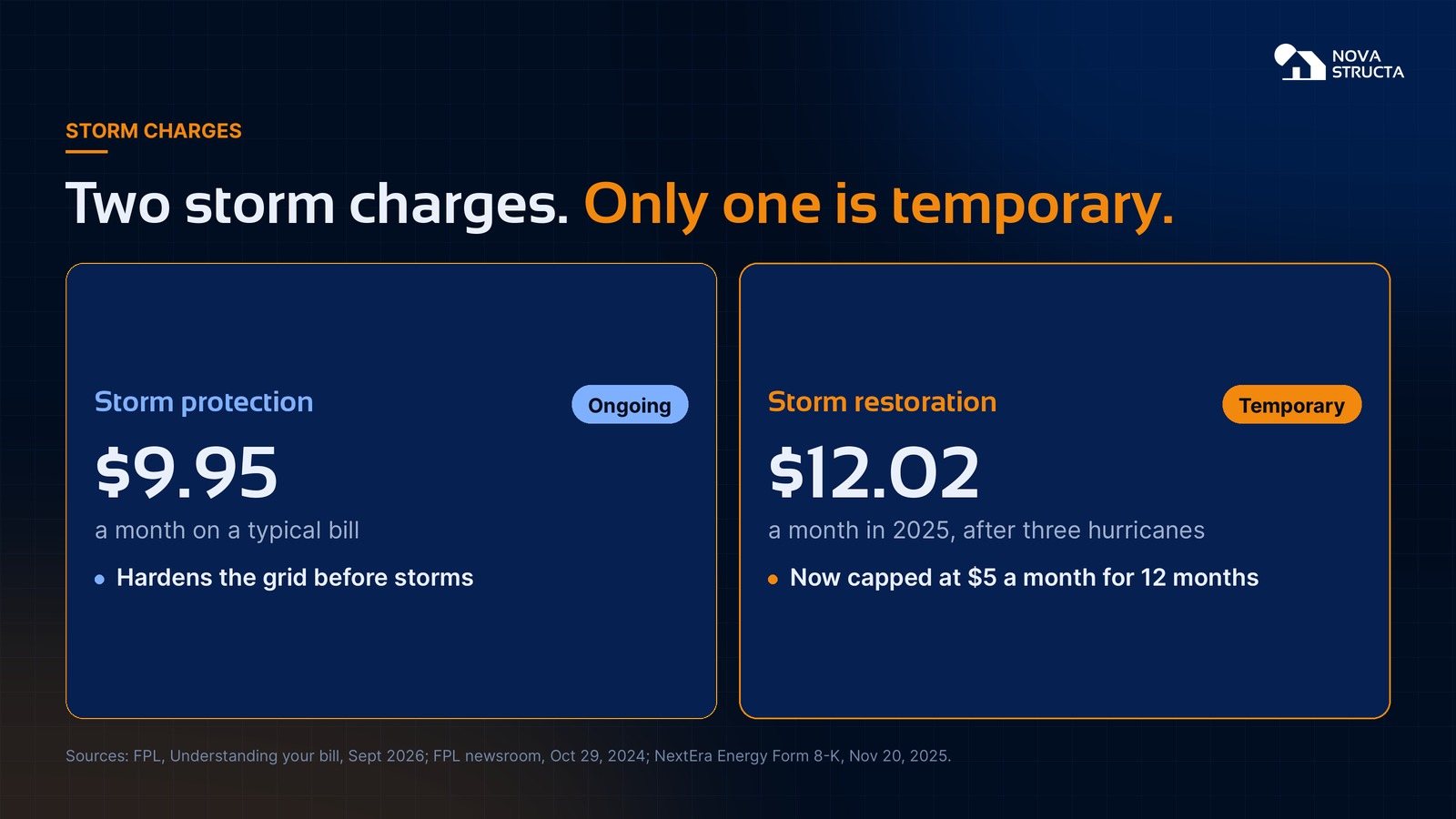
The storm protection charge, $9.95 on a typical FPL bill, is ongoing. It pays to harden the grid before hurricanes [1]. The storm restoration surcharge is temporary. It shows up after a storm to repay the cost of restoring power, then comes off. FPL's was $12.02 a month throughout 2025 after Debby, Helene and Milton [6]. Duke Energy Florida removed its own storm recovery charge for the same hurricanes in March 2026, and said that was the main reason a typical bill would drop by about $44 that month [5].
Under FPL's new rate agreement, any future interim storm surcharge is capped at $5 a month on a typical 1,000 kWh bill for the first 12 months, with remaining costs recovered later [7].
Taxes and fees: the pass-through portion
The last group is collected by the utility for government, not kept by it.
| Tax or fee | Typical rate | Who sets it |
|---|---|---|
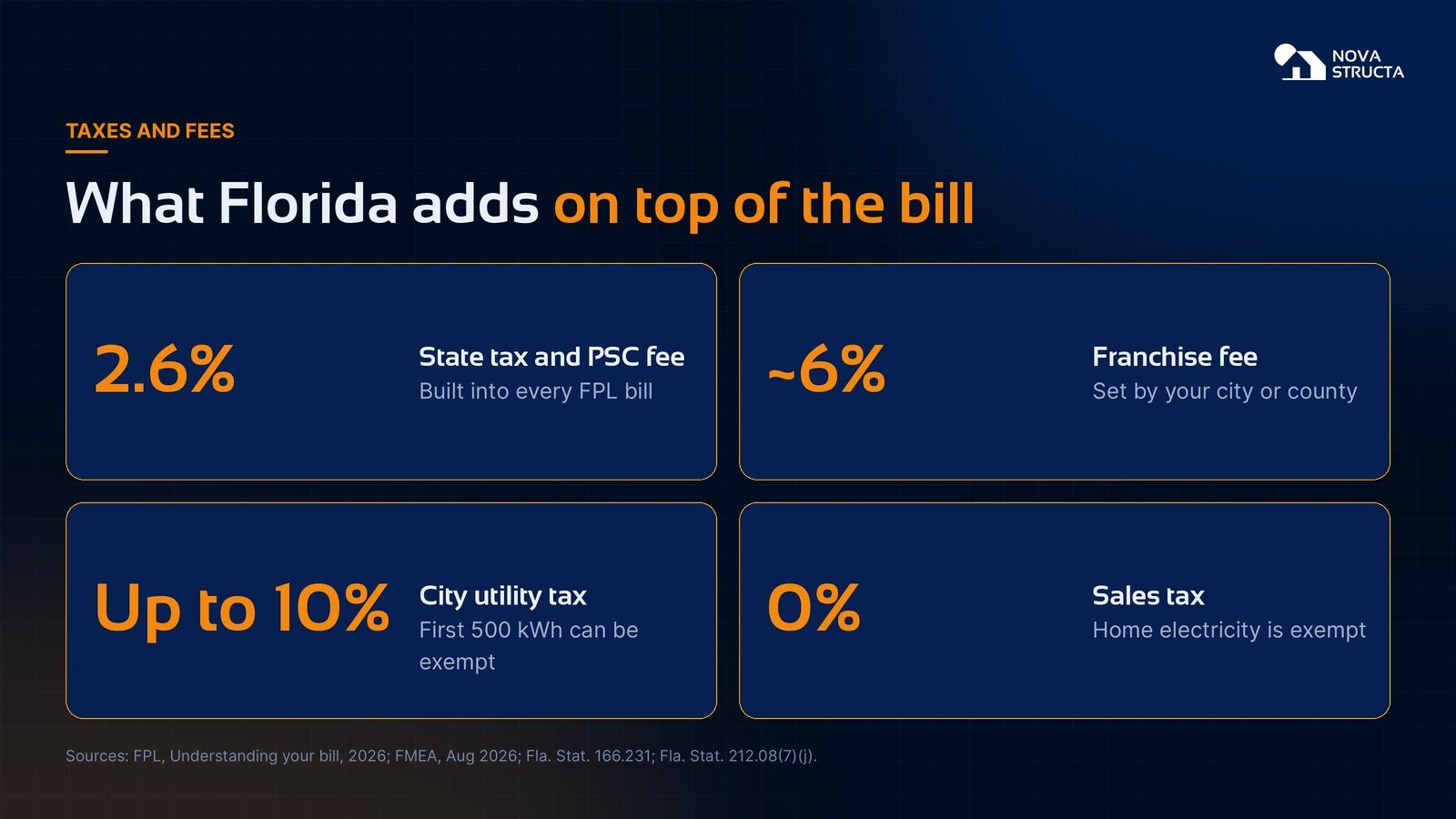
| Gross receipts tax and regulatory assessment fee | 2.6% | The state and the PSC, included in FPL's typical bill [1] |
| Franchise fee | About 6% on average | A contract between the utility and your city or county [1][3] |
| Municipal public service tax | Up to 10% | Your city, which may exempt the first 500 kWh of residential use [8] |
| Sales tax | 0% | Residential electricity is exempt from Florida sales tax [9] |
This is why two neighbors with identical usage can pay different amounts. The utility charges are the same; the city and county lines are not.
Same 1,000 kWh, different bill
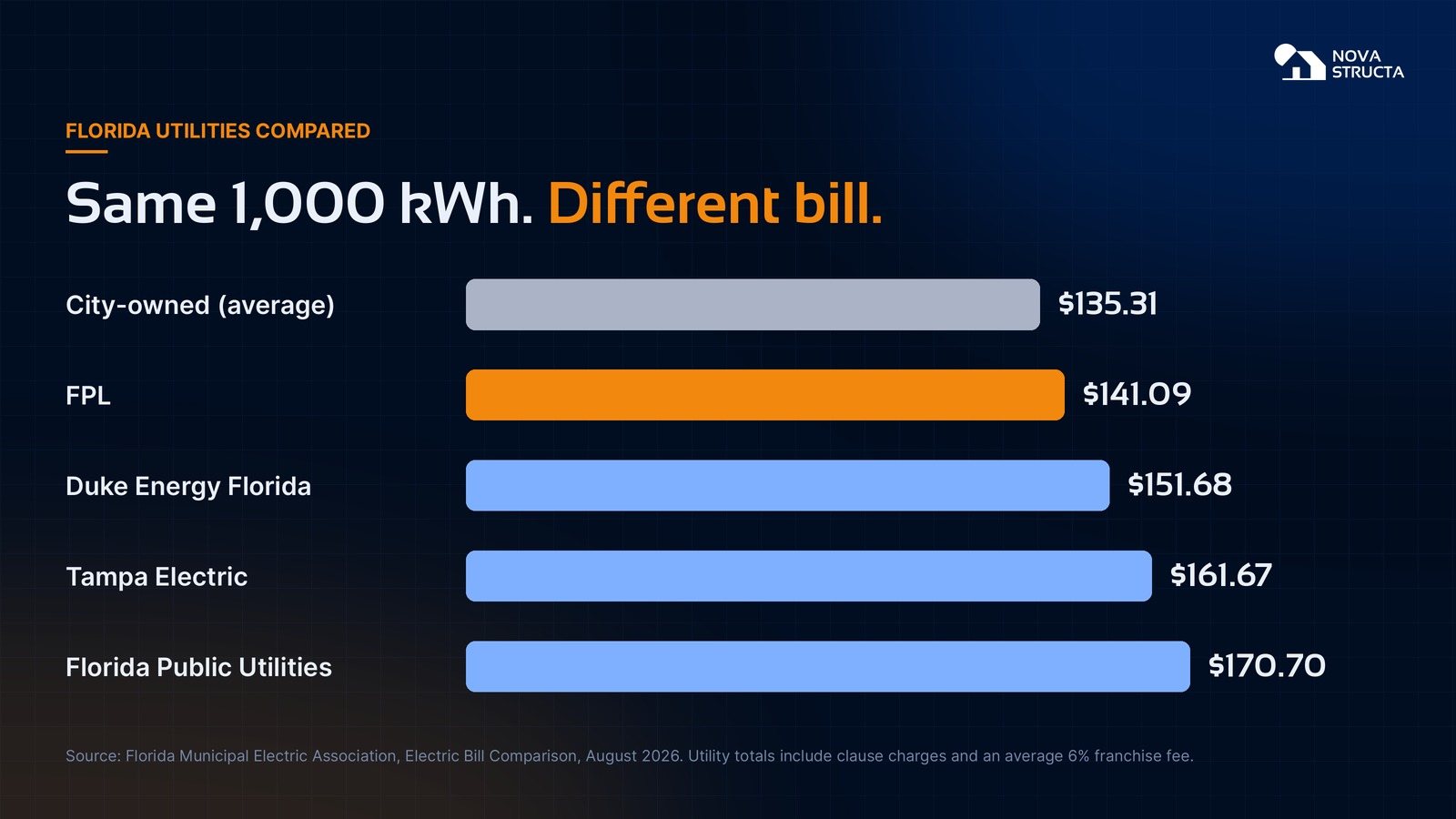
Florida has several large utilities, and the same month of usage costs different amounts depending on which one serves your address. The Florida Municipal Electric Association publishes a monthly comparison that includes every clause charge and an average 6% franchise fee.
| Utility | 1,000 kWh residential bill, August 2026 |
|---|---|
| City-owned utilities (average) | $135.31 |
| FPL | $141.09 |
| Duke Energy Florida | $151.68 |
| Tampa Electric (TECO) | $161.67 |
| Florida Public Utilities | $170.70 |
| Investor-owned utilities (average) | $154.22 |
Source: FMEA [3]. Totals include clause charges and an average 6% franchise fee, so they run a little higher than the utilities' own "typical bill" figures, which leave local fees out.
How to audit your own bill in three steps
You do not need to do this every month. Doing it once tells you most of what you need to know.
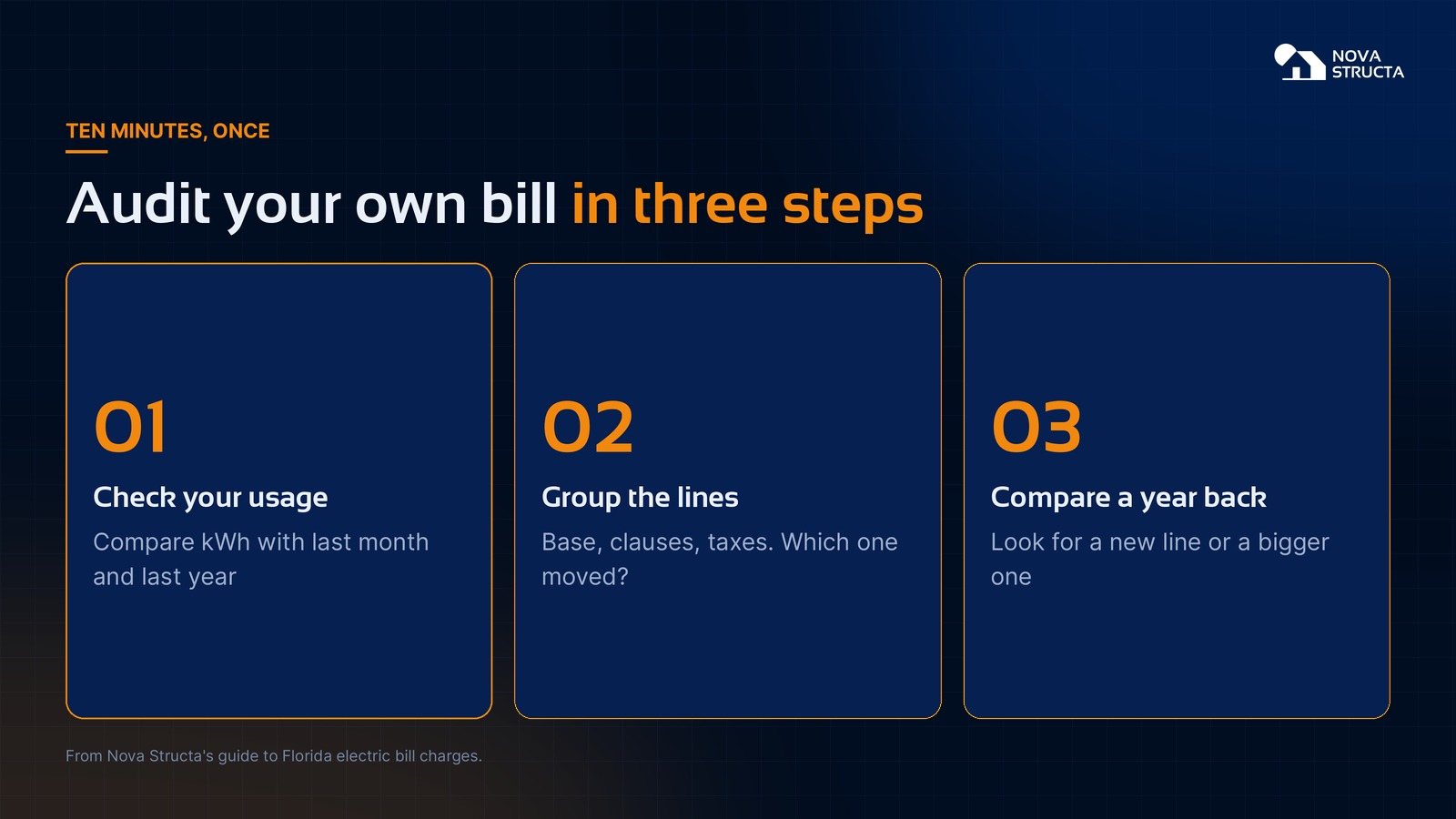
Step 1: Check your usage
Find the kWh used this period and compare it with last month and with the same month last year. In a Florida summer, higher usage alone often explains most of a jump.
Step 2: Group the lines
Sort every charge into base charges, adjustable clauses, or taxes and fees. Now you can see whether you are paying more because you used more, because a rate changed, or both.
Step 3: Compare with a bill from a year ago
Line the two up and look for what moved. Did the base charge or base energy charge go up? Did the fuel line jump? Is there a storm surcharge that was not there before, or one that disappeared?
Three mix-ups that trip people up
Judging a utility by its advertised rate. The rate in a headline is often just the base energy piece. Fuel, storm charges and fixed fees push the real per-kWh price higher. Use total bill ÷ kWh instead.
Ignoring the fixed charge. You can cut your usage in half and the base charge stays the same. That matters most for low-usage homes.
Treating fuel spikes and base increases the same. A fuel increase can reverse when gas prices fall. A base rate increase usually stays until the next rate case.
What you can actually do about it
You cannot rewrite a rate case from your kitchen table, but you can change how exposed your household is to it.
Use less, starting with the big loads. Air conditioning, water heating and older appliances drive most Florida bills. Insulation, duct sealing and thermostat settings make a measurable difference.
Use the programs you already pay for. The conservation charge on your bill funds utility efficiency programs, such as home energy surveys and rebates. You are paying for them either way.
Smooth out the swings. FPL's Budget Billing averages your bills over up to 12 months so you pay about the same each month. FPL is clear that it does not lower what you pay; it spreads it out [10].
Look at solar and other upgrades with real numbers. Solar can reduce how many kWh you buy from the utility, but the power you still buy is billed at whatever the rates are that year, and results depend on your roof, shading, usage and financing terms. Results are not guaranteed. Ask for a written estimate based on your actual bill, and compare any monthly payment against it before deciding. See solar systems for how a consultation works.
Ask for help early if you need it. Utilities offer payment arrangements and assistance programs, and reaching out before you fall behind gives you more options.
The bottom line
Your bill is not random. It is a stack of decisions: some made by regulators in a rate case, some driven by fuel markets and storms, some set by your city and county, and some that are yours, like how much you use. Once you can tell those apart, the next "rate increase" headline becomes something you can read your own bill against.
Sources
- Florida Power & Light, "Understanding your bill: residential customers," typical 1,000 kWh bill for September 2026. fpl.com
- Florida Power & Light, "FPL rate settlement reduces request by nearly a third, limits average annual bill increases to 2%, maintains consumer protections," August 20, 2025. newsroom.fpl.com
- Florida Municipal Electric Association, Electric Bill Comparison, August 2026. Report (PDF) and summary
- Florida Power & Light, "State regulators approve FPL rate decrease in May," April 4, 2023. newsroom.fpl.com
- Duke Energy Florida, "Duke Energy Florida announces significantly lower bills in 2026," September 4, 2025. news.duke-energy.com
- Florida Power & Light, "FPL outlines plan to pay for significant restoration efforts after four hurricanes slam Florida in 14 months," October 29, 2024, and "FPL customers to receive one-time bill reduction in September," July 8, 2026. October 2024, July 2026
- NextEra Energy, Form 8-K on the Florida PSC's approval of the FPL rate agreement, November 20, 2025. sec.gov
- Florida Statutes, Section 166.231, Municipalities; public service tax. leg.state.fl.us
- Florida Statutes, Section 212.08(7)(j), and Florida Administrative Code Rule 12A-1.053, residential electricity exemption. Section 212.08, Rule 12A-1.053
- Florida Power & Light, Budget Billing. fpl.com
Savings and utility-bill examples shown are illustrative only, are not guaranteed, and may not reflect typical results. Actual savings depend on your energy usage, system size, roof and site conditions, financing terms, utility rates, net-metering rules, and other factors specific to your home.