Solar Energy
Do Solar Panels Work in a Hurricane? Wind, Clouds, Outages and Batteries
Do solar panels work during a hurricane?
Solar panels can ride out hurricane winds when the whole system is engineered and fastened for Florida's code wind speeds. During the storm they make little power, and without a battery they shut off whenever the grid goes down, by design.
If you live in Florida, storm prep is part of owning a home. So it is fair to ask what a roof full of glass and aluminum does when a hurricane comes through, and whether it can keep your lights on afterward.
The honest answer has three parts, and they get mixed up a lot. Whether the panels stay on the roof is a question about wind and hardware. How much power they make under storm clouds is a question about light. And whether your house has power during an outage is a question about batteries. This guide takes each one in turn, using federal lab research, Florida code and manufacturer documentation. Nova Structa is not affiliated with any utility or equipment maker.
Can solar panels survive hurricane-force winds?
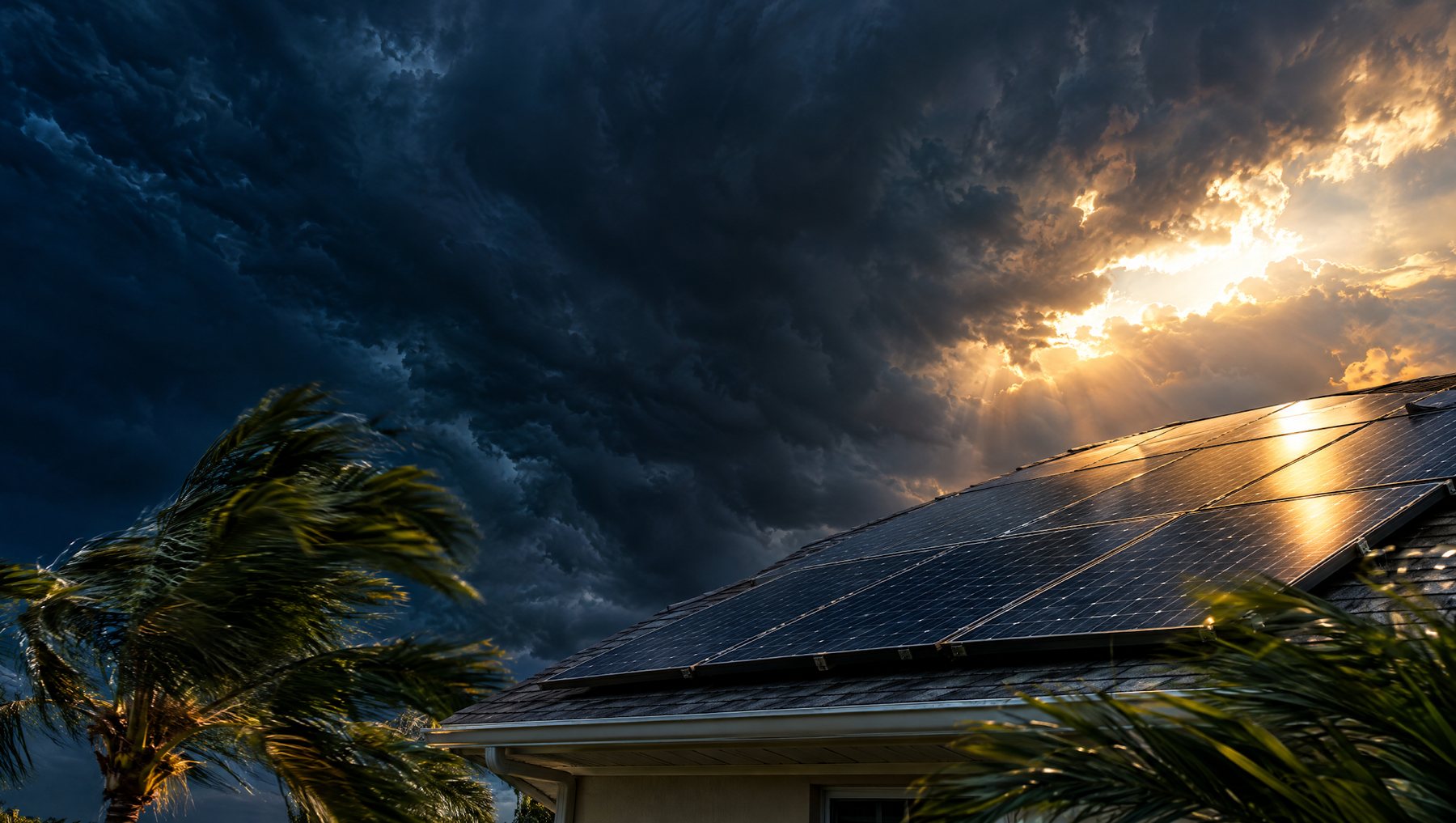
They can, and the reason has less to do with the panels than with everything holding them down.
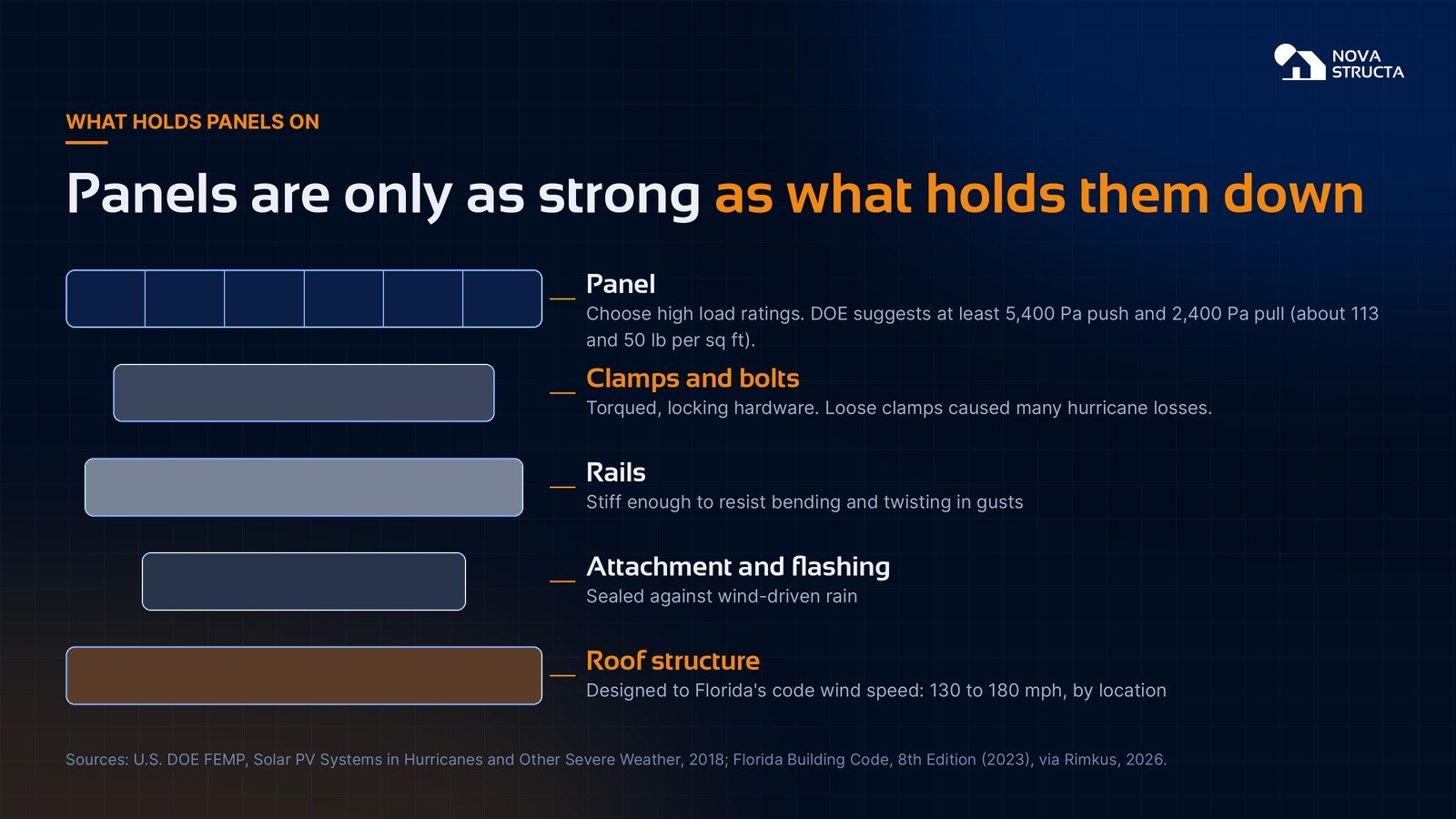
Florida's building code, which adopts the ASCE 7 wind standard, requires structures to be designed for winds of roughly 130 to 180 mph depending on where you live. Miami-Dade and Broward sit in the High-Velocity Hurricane Zone, which adds stricter rules for roofs and attachments [4]. A permitted rooftop system has to be designed to that number for your address.
The panels themselves are tested for load. The U.S. Department of Energy recommends choosing modules rated for at least 5,400 pascals of downward push and 2,400 pascals of upward pull, about 113 and 50 pounds per square foot, and notes that ratings vary a lot between manufacturers [1].
Where solar systems actually fail
After Hurricanes Irma and Maria in 2017, researchers from two national labs inspected damaged solar arrays in Puerto Rico and the U.S. Virgin Islands. Results ranged from total losses to systems with a few debris marks to systems that came through untouched [2].
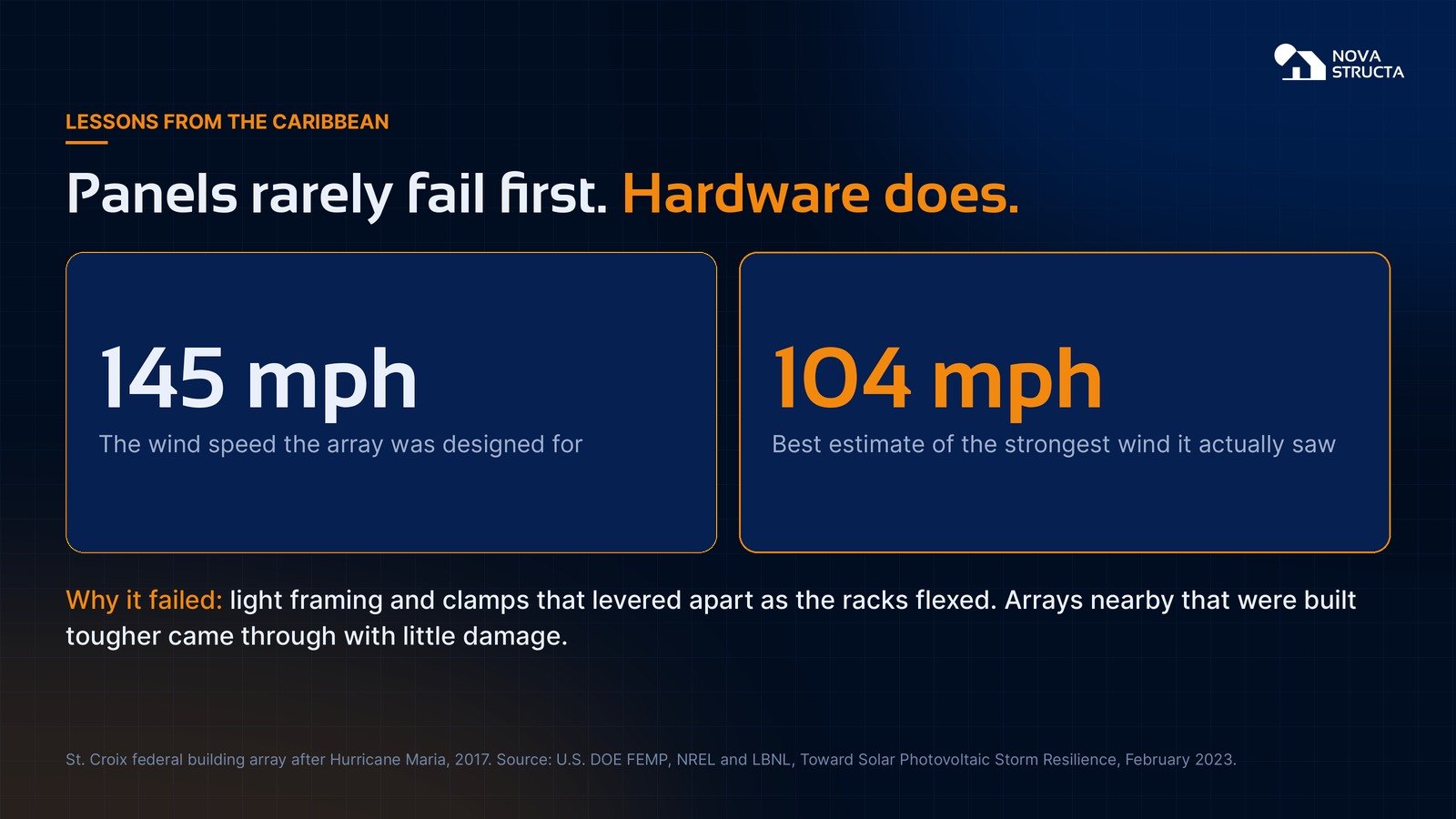
The most telling case was a ground array on St. Croix. It was designed for 145 mph winds, yet it was destroyed by winds estimated at about 104 mph. The panels were not the root cause. Lightweight racking flexed and twisted, the clamps holding the panels were levered apart, and once a few pieces let go the rest followed. A larger array near the airport that saw some of the strongest winds came through with little damage [2].
The Department of Energy's takeaways for storm regions are practical:
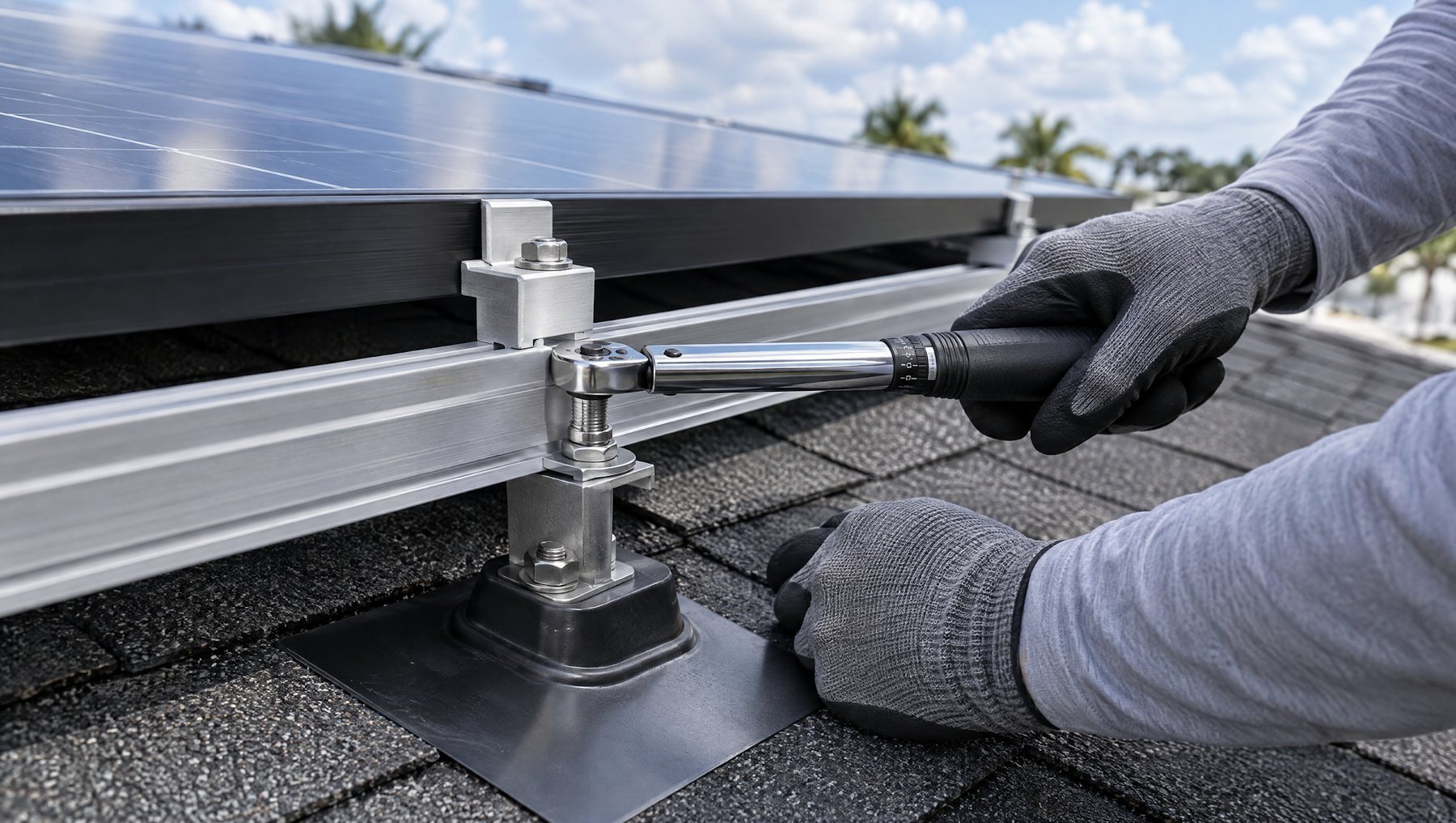
- Fasteners that stay tight. Bolts that loosened under vibration were a common cause of loss. DOE recommends locking hardware torqued to a set value, then checked [1].
- Better module attachment. Friction clamps shared between two panels can fail in a chain. DOE recommends through-bolting modules in severe weather regions [1].
- Corrosion-resistant metal. Common stainless steel corrodes near the coast. DOE suggests 316-grade marine stainless fasteners [1].
- Stiff framing and sealed electrical boxes, so rails do not twist and wind-driven rain stays out [1][2].
The researchers' overall conclusion was encouraging: arrays that are well designed, built and maintained can be expected to deliver a full service life in hurricane regions. They were also candid that survival in the strongest Category 5 storms is still being studied [2].
What a hurricane looks like for solar at scale
Babcock Ranch, a planned community north of Fort Myers, sits beside an 870-acre solar field of about 650,000 panels operated by FPL. When Hurricane Ian came through in 2022, one resident described 100 mph winds, yet the community never lost power or water [9].
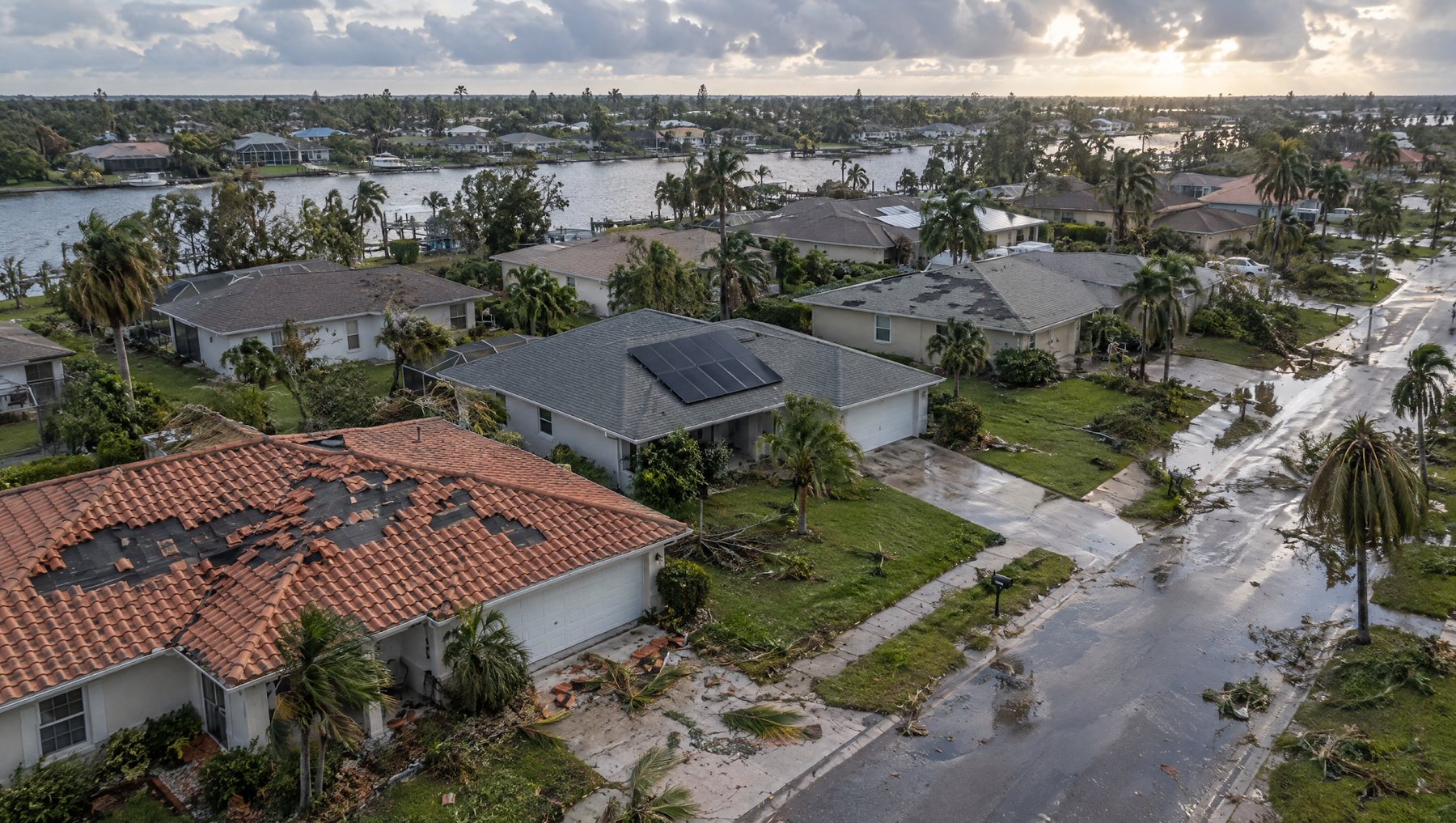
It is worth being precise about why. The town was built 30 miles inland, its power lines run underground, and at night and on cloudy days a natural gas plant fills the gap [9]. It shows what hardened design can do. It is not proof that any single rooftop system will come through a storm untouched.
How do solar panels make power on cloudy days?
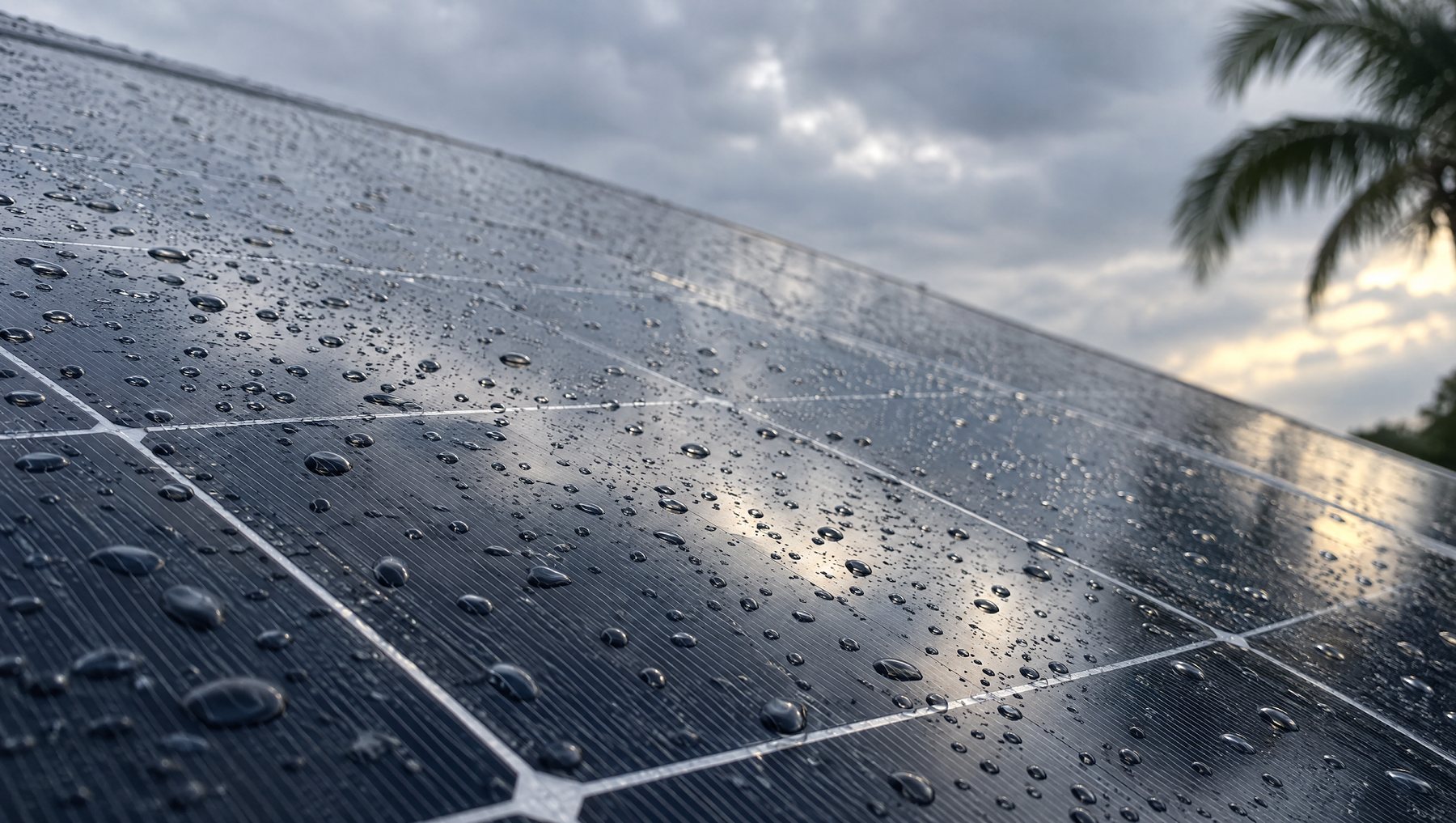
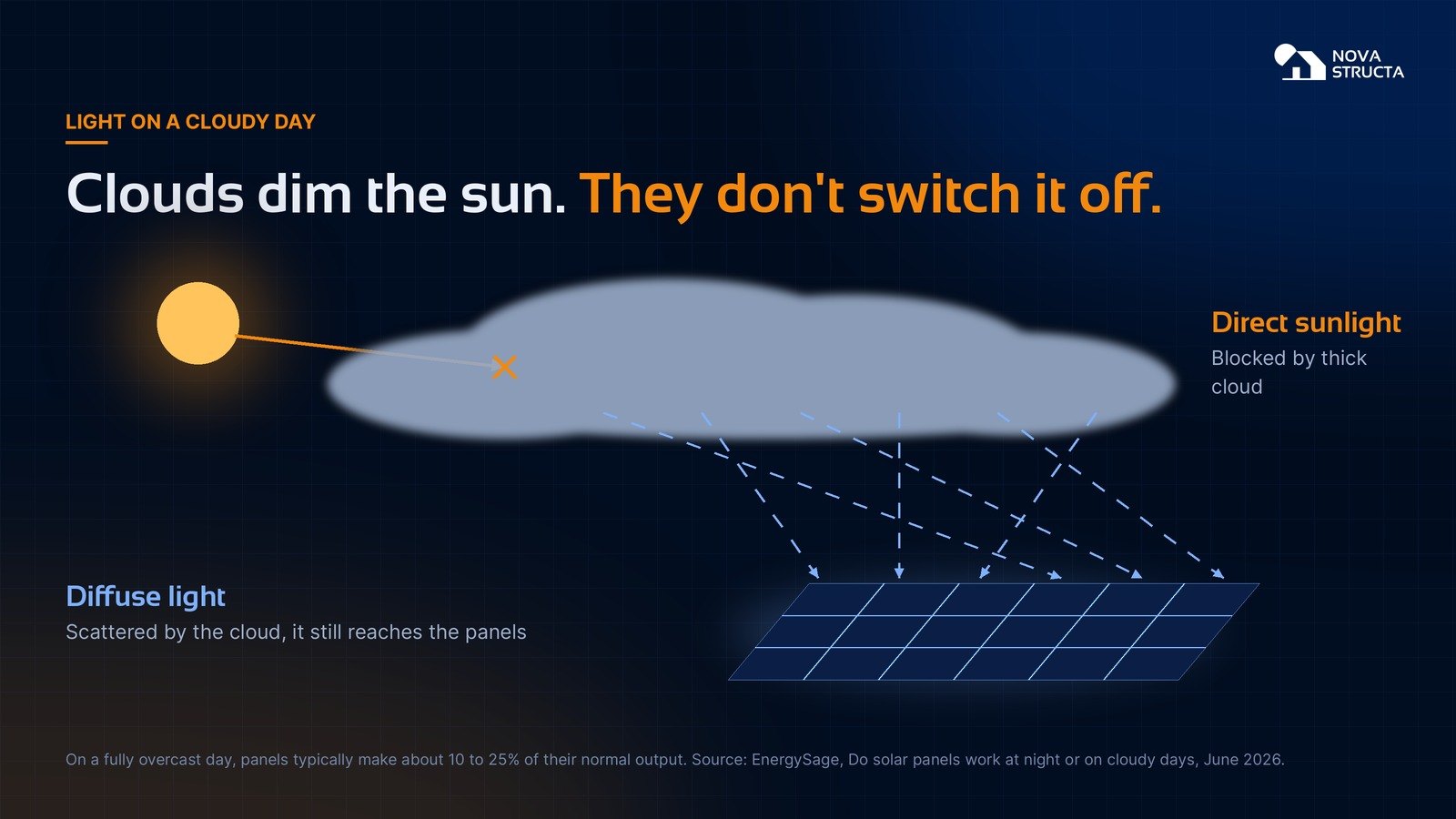
Sunlight reaches your roof two ways. Direct light travels in a straight beam from the sun. Diffuse light is sunlight that has been scattered by clouds, haze and the sky itself, so it arrives from every direction. Solar cells respond to both.
A thick cloud deck blocks most of the direct beam. It does not turn off the diffuse light, which is why the sky is still bright on an overcast afternoon, and why your panels keep producing.
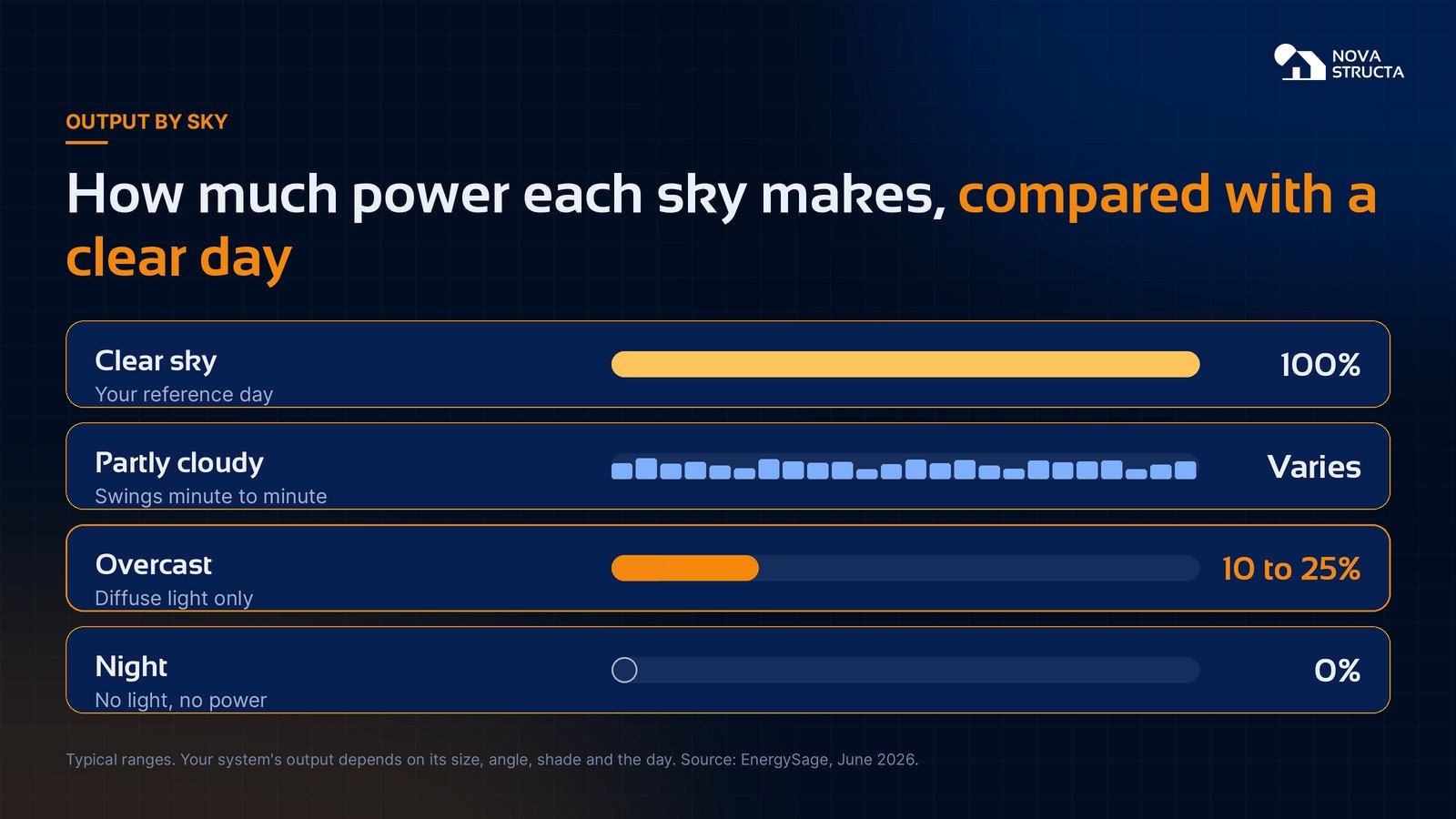
How much do they produce? On a fully overcast day, panels typically make about 10 to 25% of their normal output, depending on how thick the clouds are. Partly cloudy days swing from minute to minute, and the bright edge of a passing cloud can briefly push output higher than a plain sunny moment [5].
What this means in hurricane season.
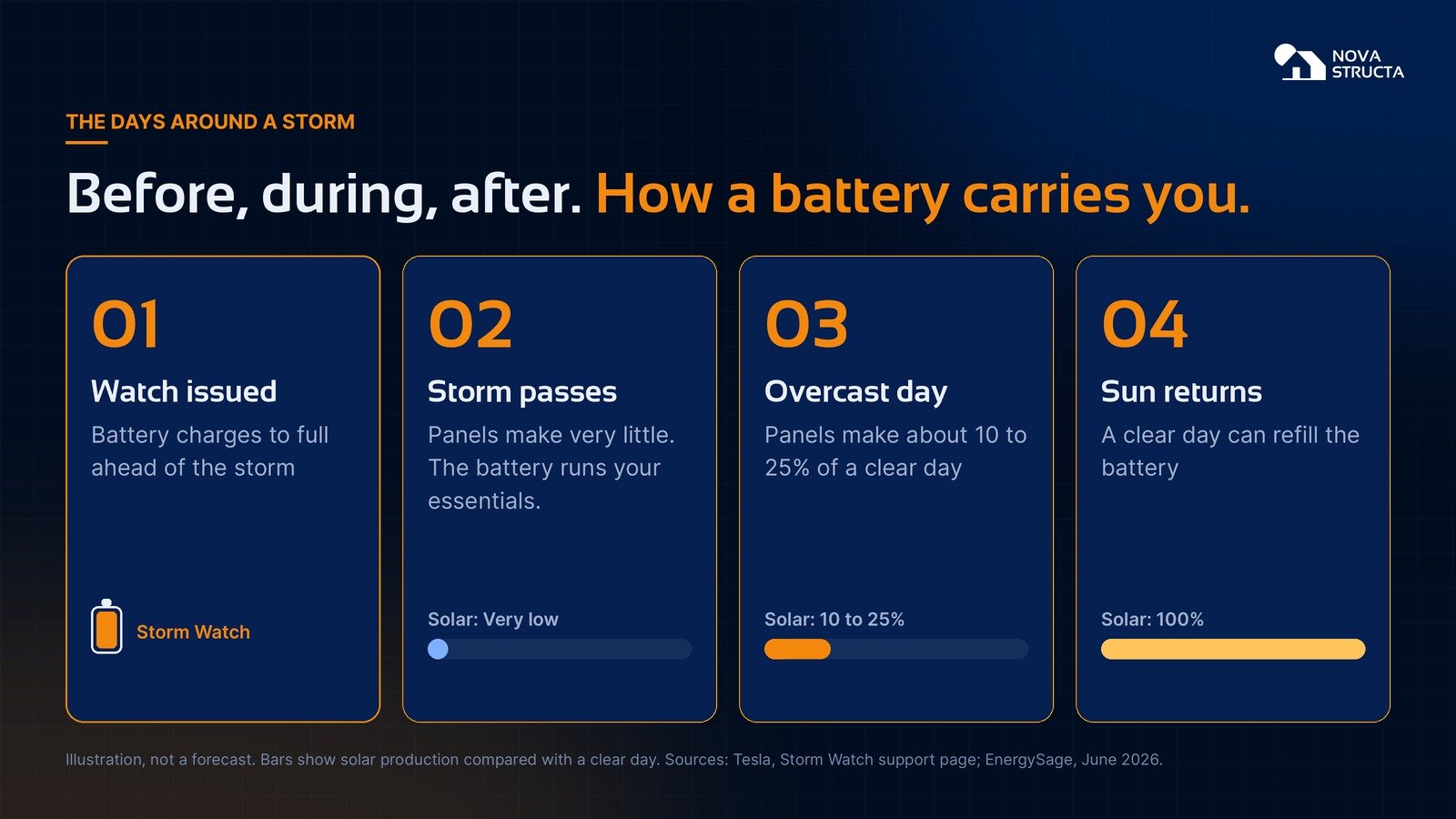
During the storm itself, output is low under thick rain bands. In any gray days that follow, the panels are still working, just at a fraction of a clear day. That matters most if you have a battery, because it sets how quickly the battery refills.
What happens to solar panels when the power goes out?
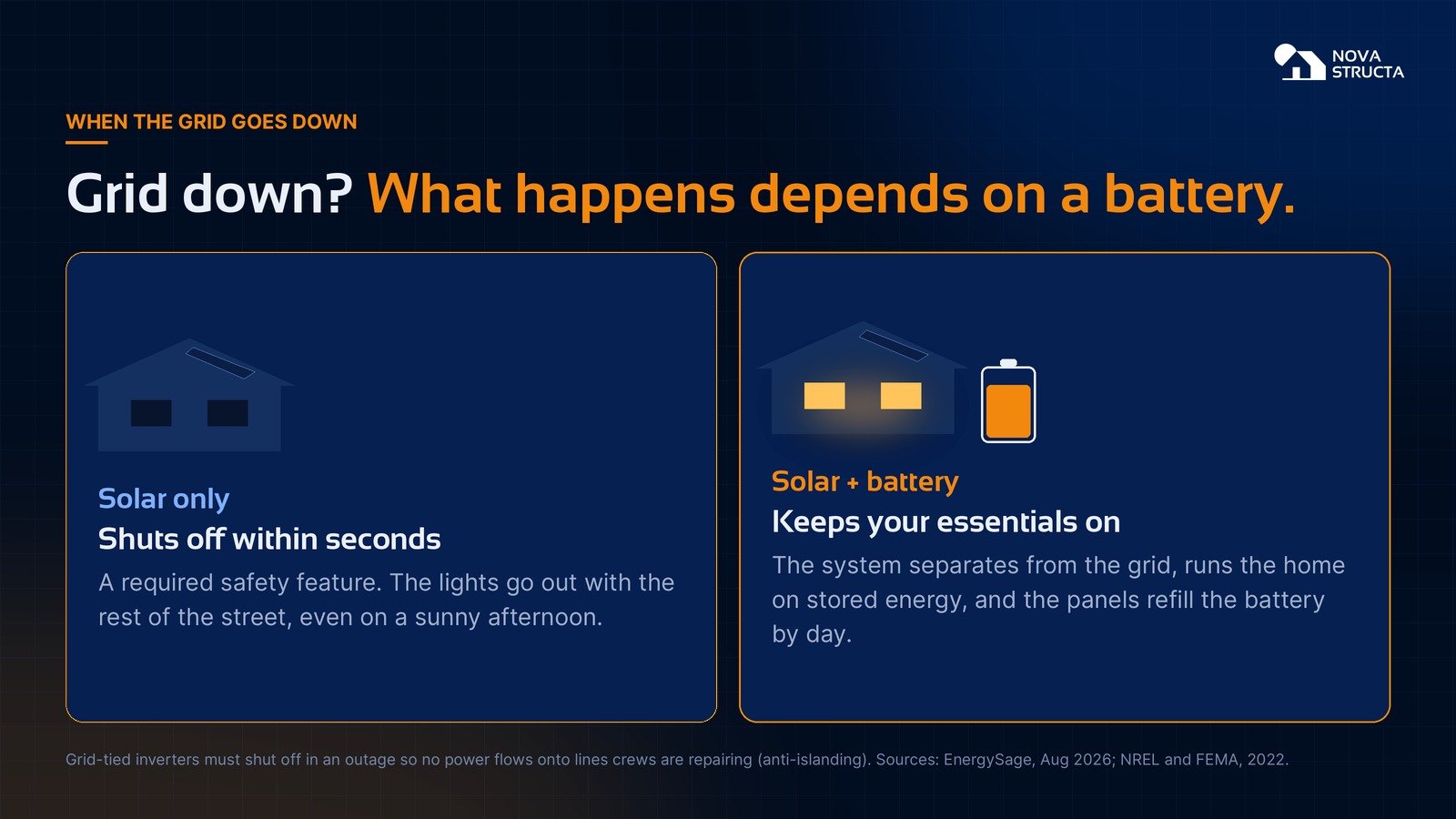
This is the part that surprises most homeowners. If your system is tied to the grid and you have no battery, it shuts off within a couple of seconds when the grid goes down, even at noon on a clear day [6].
That shutoff is a required safety feature called anti-islanding. During an outage, utility crews are working on lines they expect to be dead. A home system that kept pushing power onto those lines could injure a lineworker, so the inverter watches for the grid signal and stops the moment it disappears [6].
How a battery changes the outage
A home battery lets the system separate from the grid safely. The house runs on stored energy plus whatever the panels make in real time, and none of it touches the utility lines, so there is no reason to shut down [6].
How long that lasts depends on design. One battery paired with solar can typically keep essentials like a refrigerator, Wi-Fi and a few lights running for a day or two, and adding central air or other big loads generally takes two or more batteries [6]. Which circuits are wired for backup, how full the battery is when the storm arrives and how much sun follows all change the picture.
That last point is where storm features help. Tesla's Storm Watch, for example, activates when a hurricane or tropical storm watch or warning is issued for your area, then charges Powerwall to full ahead of the weather. It requires grid charging to be enabled in the app [7]. Other battery brands offer similar settings, so check your app before the season starts. For more on how the battery itself works, see Tesla Powerwall: what it does.
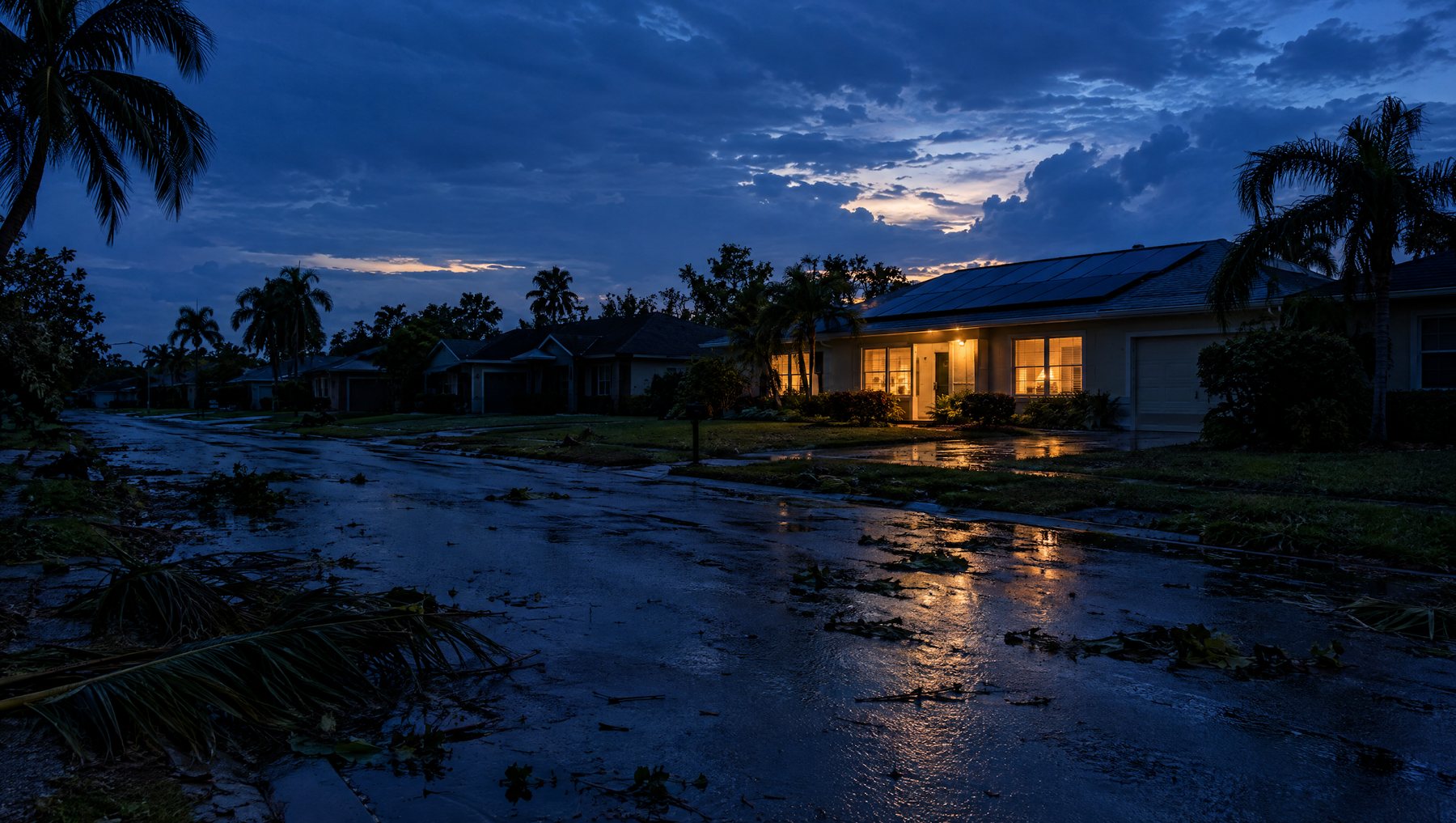
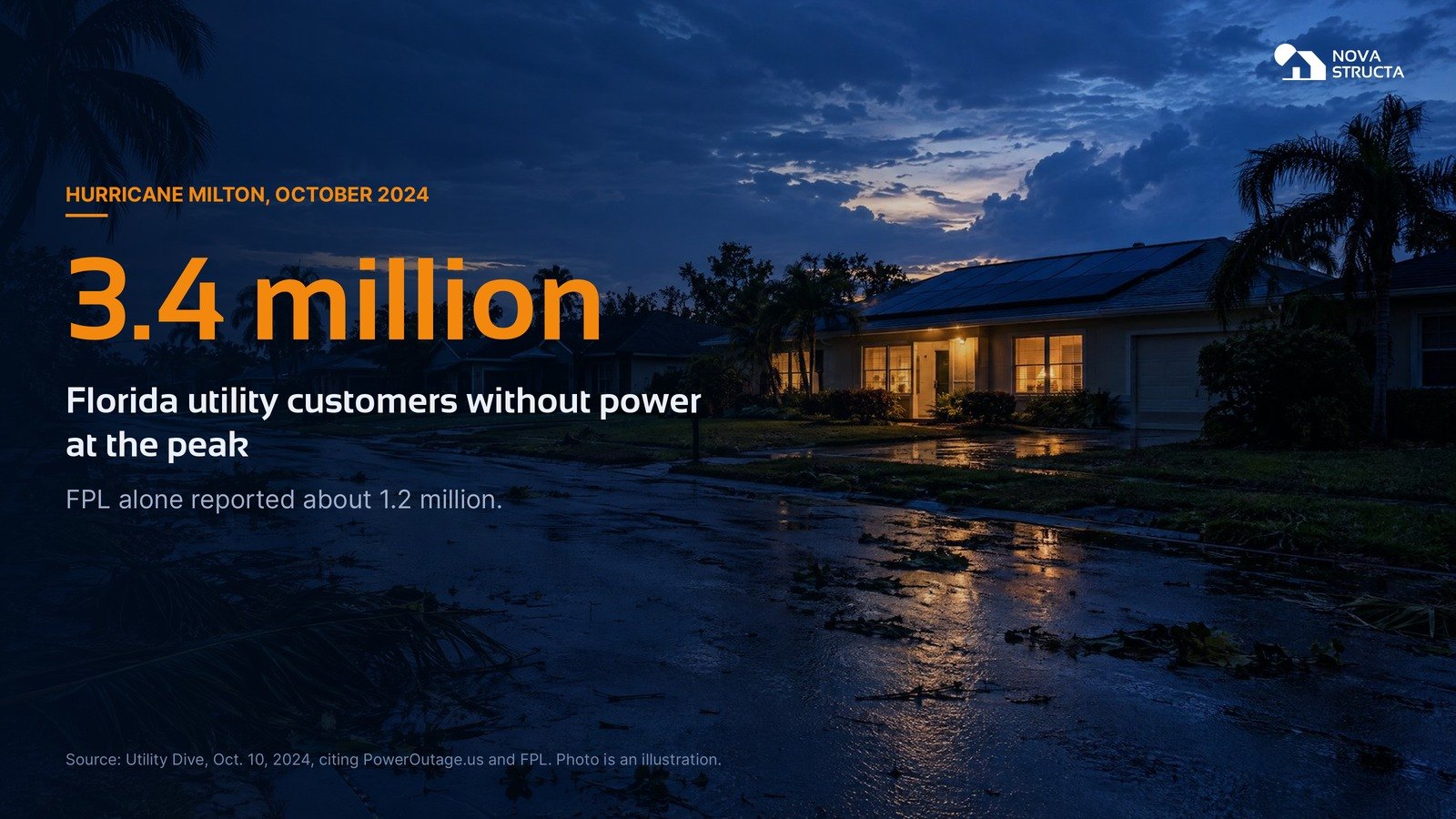
Why plan for this at all? Because Florida outages after major storms are large. At the peak after Hurricane Milton in October 2024, about 3.4 million Florida utility customers were without power, including about 1.2 million FPL customers [8].
What about hail and flying debris?
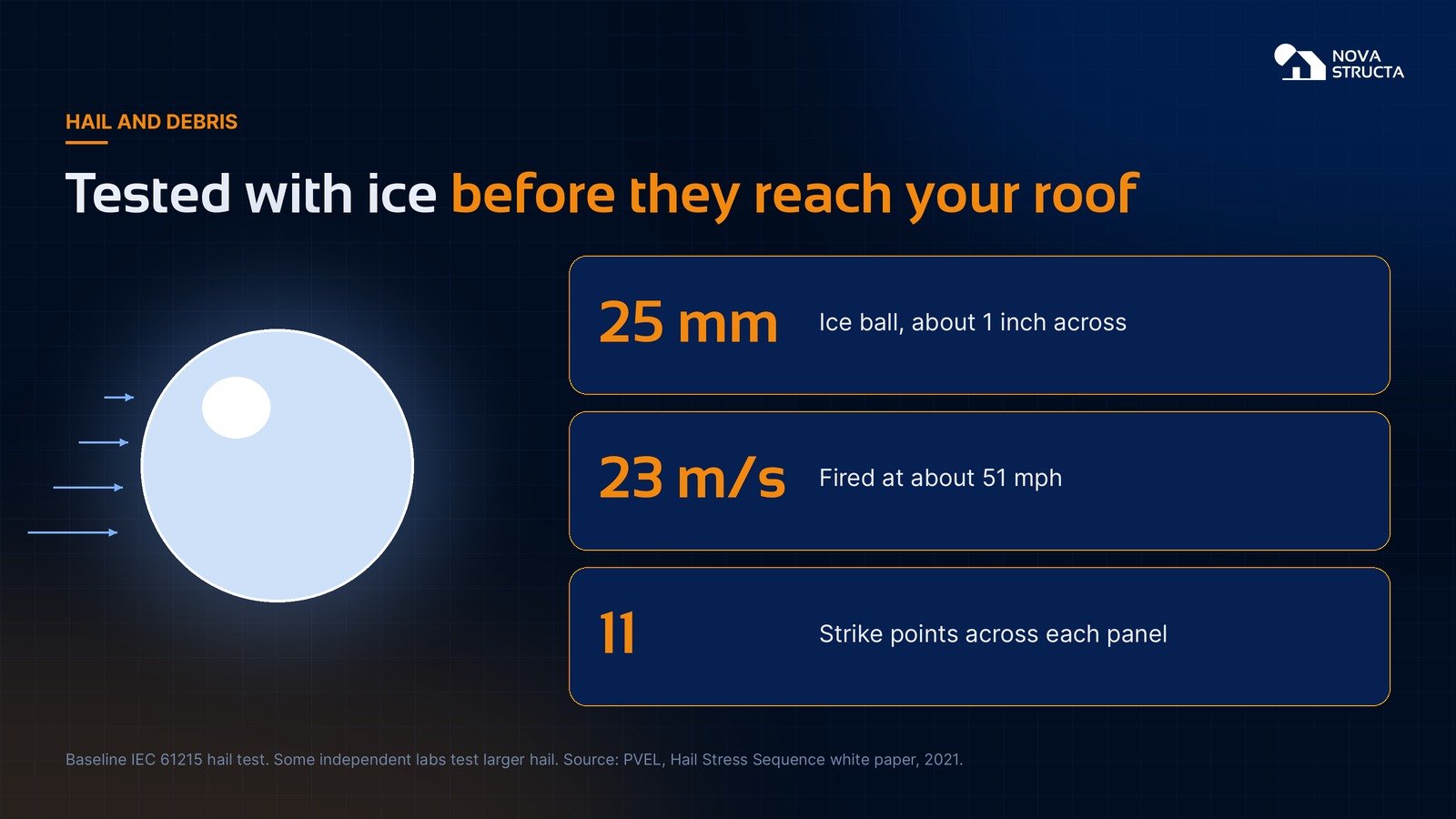
Hurricanes throw things, and thunderstorms can bring hail. Most panels are certified to the IEC 61215 standard, which includes a baseline hail test: 25 mm (about 1 inch) ice balls fired at 23 meters per second, about 51 mph, at 11 points across the panel [10].
The independent lab PVEL reports that it has not seen glass break at that baseline level, but that larger, harder strikes can break some models, which is why it runs tougher tests [10]. DOE also points to an optional "Very Severe Hail" rating, FM 4478, for extra debris protection [1].
No panel is immune to a loose piece of lumber at hurricane speed. Clearing the yard and roof of anything that can fly is part of protecting the system.
How to get your solar system ready for a storm
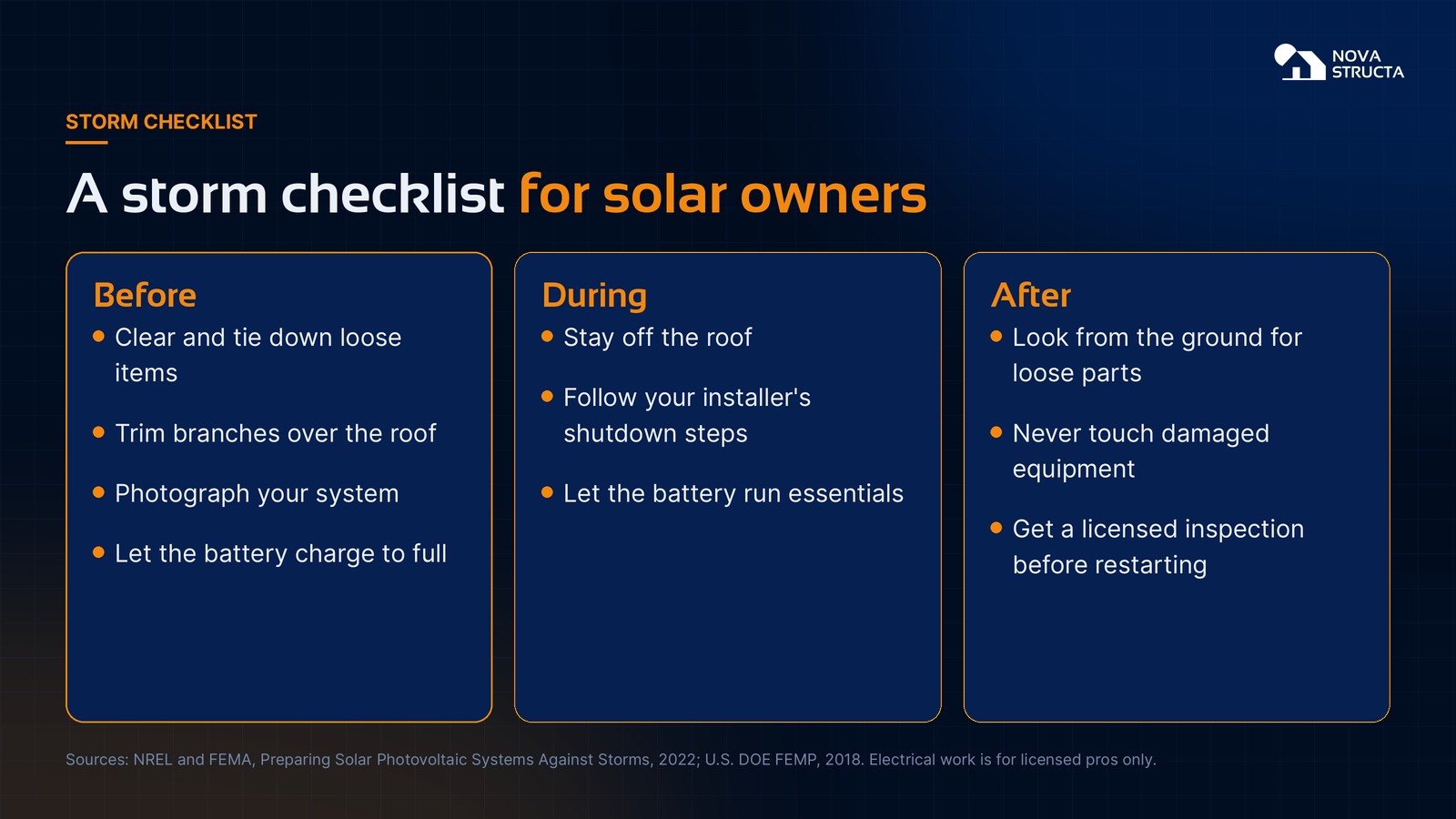
The National Renewable Energy Laboratory and FEMA publish a pre-storm checklist for roof-mounted systems. It is written so owners can do most of it from the ground, and it is clear that electrical work belongs to qualified electricians [3].
Days before the storm
- Clear and tie down anything loose near the array, and trim branches that hang over the roof [3].
- Clear roof drains and gutters so water has somewhere to go [3].
- Take photos of the system so you have a record of its condition before the storm [3].
- If you have a battery, turn on its storm setting or raise its backup reserve [7].
During the storm
- Stay off the roof.
- NREL's checklist recommends powering the system down and opening the disconnects during the storm [3]. If you have battery backup, ask your installer how that applies to your setup, because shutting down also stops backup power.
After the storm
- Look over the system from the ground for loose panels, dangling wires or debris.
- Never touch damaged equipment. DOE's guidance is to dry and check electrical parts, audit fasteners and test for faults before the system is turned back on [1].
- Check your monitoring app. A sudden drop on a clear day is a reason to call your installer. Here is how to read your solar monitoring app.
- If there is damage, photograph it and call your insurer. Ask whether your policy covers the system as part of the home.
Questions to ask before you install in hurricane country
| Ask this | Look for | Why it matters |
|---|---|---|
| What are the panels' push and pull load ratings? | 5,400 / 2,400 Pa or more | Ratings vary widely between manufacturers [1] |
| How are the panels fastened to the rails? | Through-bolts, locking hardware | Shared friction clamps can fail in a chain [1] |
| Is the hardware torqued and checked? | A torque audit | Loosened fasteners were a leading cause of storm losses [1][2] |
| What grade of stainless steel is used? | 316 marine grade | Common stainless corrodes near the coast [1] |
| Is the design engineered for my address? | Your code wind speed | Florida's design wind speed runs from about 130 to 180 mph by location [4] |
| Is my roof ready to carry panels for decades? | A roof check first | Removing panels to fix a roof later adds cost. See will solar void my roof warranty |
| Do I want backup power, and for which circuits? | A battery plan | Without a battery, the system is off during outages [6] |
| Does the battery have a storm mode? | A storm setting | It can charge to full before a storm arrives [7] |
The bottom line
Solar panels and hurricanes can coexist. The panels are tested for load and hail, and the failures researchers have studied mostly trace back to hardware and installation, which is the part you can control when you choose an installer. Clouds dim production but do not stop it. And if keeping the lights on during an outage is the goal, the battery is what makes that possible, not the panels alone.
Every home is different, and results depend on the roof, the design and the equipment. If you would like someone to look at your roof, your existing system or your backup options before the next storm, our team can walk through it with you. See solar systems and Tesla Roof and Powerwalls, or book a free assessment.
Sources
- U.S. Department of Energy, Federal Energy Management Program, "Solar Photovoltaic Systems in Hurricanes and Other Severe Weather," August 2018. energy.gov (PDF)
- U.S. Department of Energy FEMP, National Renewable Energy Laboratory and Lawrence Berkeley National Laboratory, "Toward Solar Photovoltaic Storm Resilience: Learning from Hurricane Loss and Rebuilding Better," February 2023. energy.gov (PDF)
- National Renewable Energy Laboratory and FEMA, "Preparing Solar Photovoltaic Systems Against Storms," May 2022. nrel.gov (PDF)
- Rimkus, "Florida Building Code Requirements (2026 Update)," on the 8th Edition (2023) Florida Building Code wind speed maps and HVHZ rules, updated April 30, 2026. rimkus.com
- EnergySage, "Do solar panels work at night or on cloudy days?" updated June 12, 2026. energysage.com
- EnergySage, "Do solar panels work during a power outage?" updated August 11, 2026. energysage.com
- Tesla, "Storm Watch," Powerwall support documentation. tesla.com
- Utility Dive, "Hurricane Milton slams Florida, leaving 3.4M utility customers without power," October 10, 2024. utilitydive.com
- NPR, "One Florida community built to weather hurricanes endured Ian with barely a scratch," October 5, 2022. npr.org
- PVEL, "From Random to Repeatable: Inside the Hail Stress Sequence for PVEL's PV Module Product Qualification Program," 2021. pvel.com (PDF)
Savings and utility-bill examples shown are illustrative only, are not guaranteed, and may not reflect typical results. Actual savings depend on your energy usage, system size, roof and site conditions, financing terms, utility rates, net-metering rules, and other factors specific to your home.