Solar Energy
Is Solar Worth It in Florida in 2026? The True Cost of the Grid vs Solar
Is solar worth it in Florida in 2026?
For many Florida homeowners with a sunny roof that has years of life left, solar deserves a serious look in 2026. Grid prices are scheduled to keep rising, Florida keeps one-for-one net metering, and a battery adds backup power. The federal credit for buyers has ended.
"Is solar worth it?" is really three questions. What does power from the grid cost you, now and over the next several years? What does a solar system cost, with the rules Florida has today? And what do you get that a bill comparison does not capture, like keeping the lights on when the grid goes down?
This guide answers all three with utility filings, state law and federal data, then shows you how to check the math for your own home. No one can promise you savings, and we will not. What we can do is show you where every number comes from. Nova Structa is not affiliated with any utility or equipment maker.
What does power from the grid really cost?
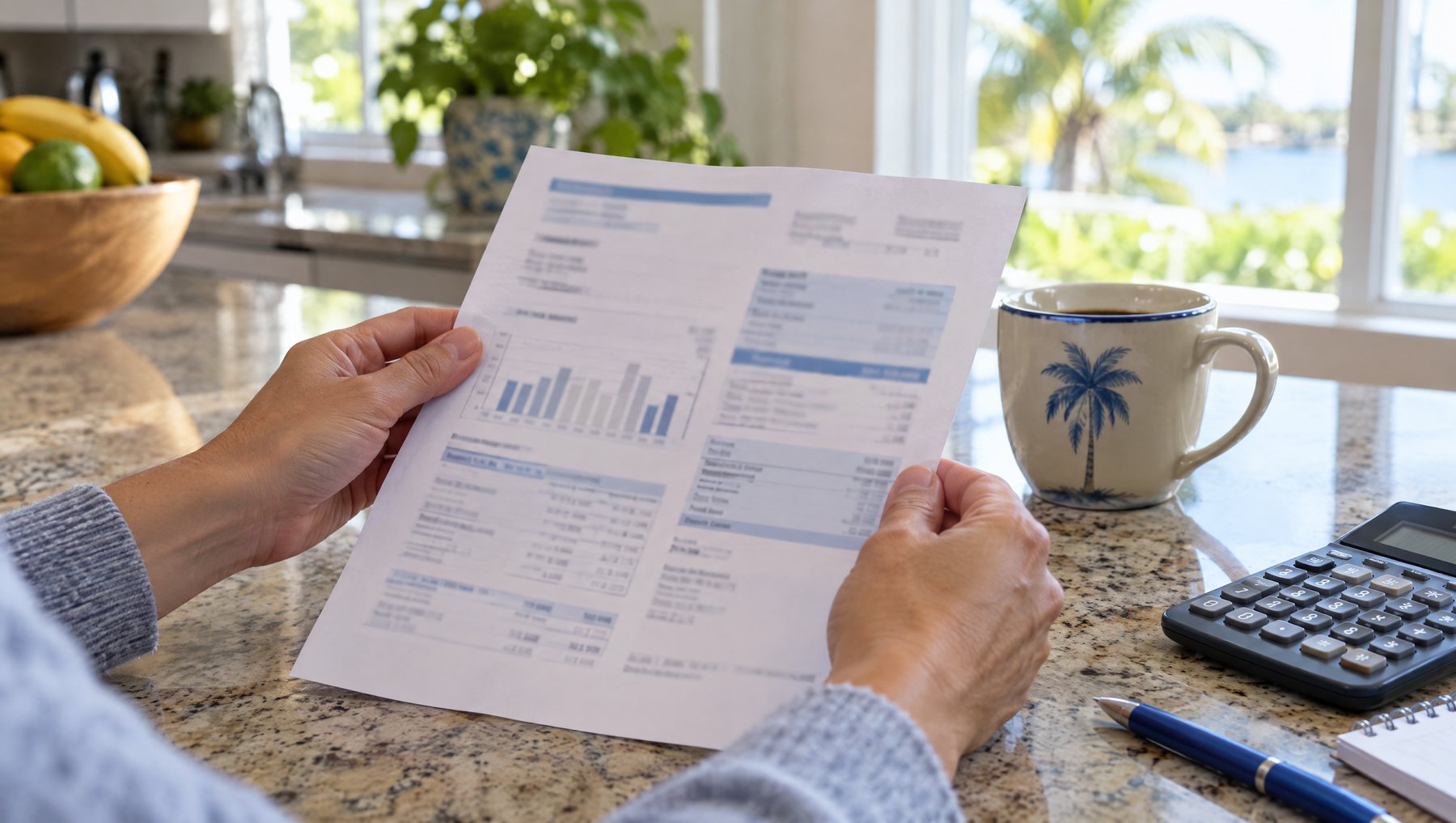
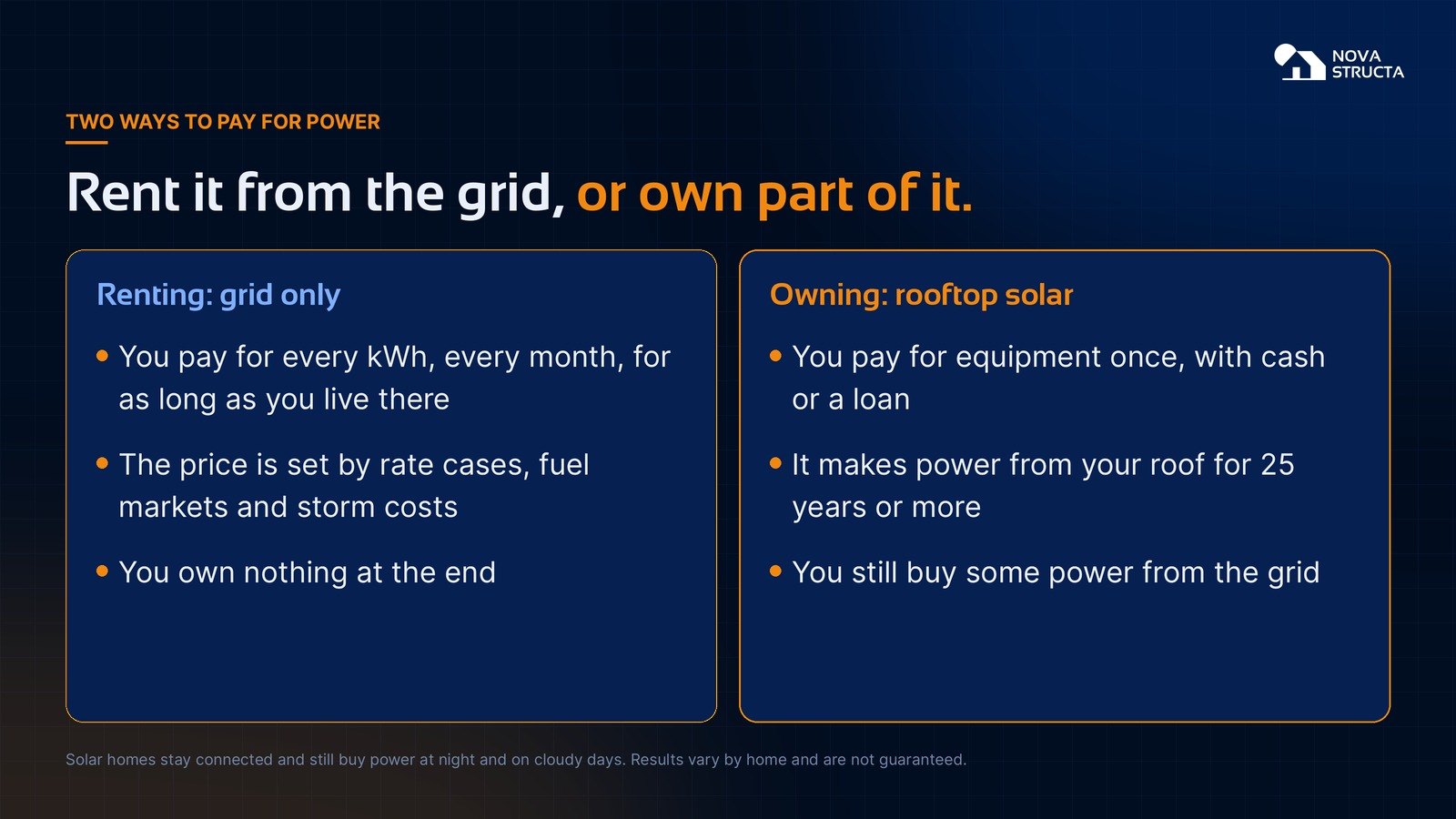
When you buy all your power from the utility, you are renting it. You pay for every kilowatt-hour, every month, at a price someone else sets, and at the end you own nothing. That works, and most Florida homes do it. It is also the baseline every solar decision gets compared against.
The price path, by FPL's own numbers
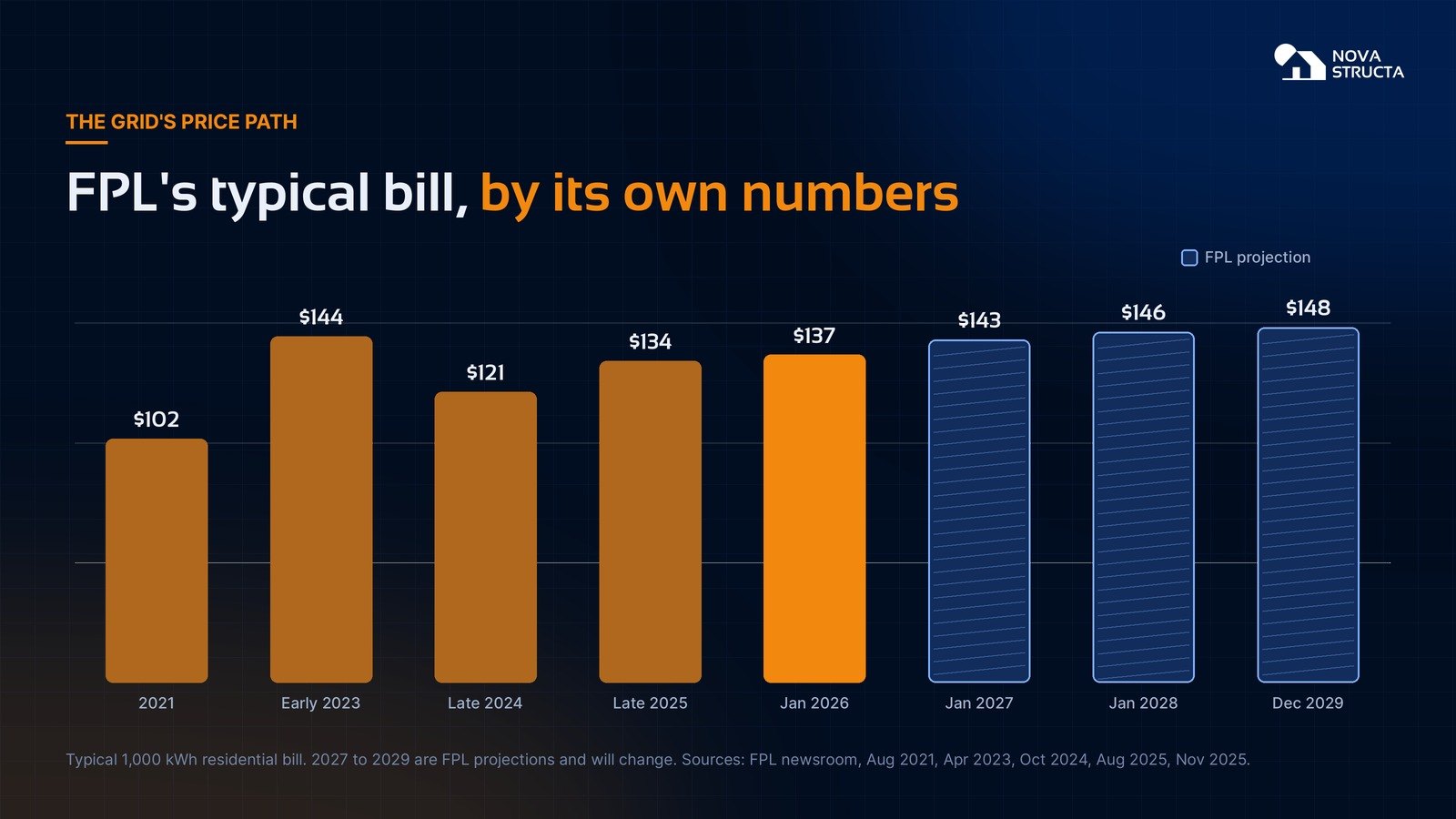
FPL, which serves about half of Florida, publishes a "typical" bill based on 1,000 kWh a month. Under the four-year rate plan approved in November 2025, that bill steps up every year through 2029 [1][2].
| When | Typical FPL bill | Source |
|---|---|---|
| 2021 average | $101.70 | [3] |
| Early 2023 | $144.38 | [4] |
| Late 2024 | $121.19 | [5] |
| January 2026 | $136.64 | [1] |
| January 2027 (projected) | $143.05 | [2] |
| December 2029 (projected) | $148.15 | [2] |
That is FPL's own estimate of about 46% more than the 2021 average by the end of 2029. Notice that the line is not smooth. The 2023 spike and the 2024 dip largely tracked fuel costs, which no rate plan fixes in advance. For the full story behind these numbers, see FPL rate hikes 2021 to 2029.
Three forces you don't control
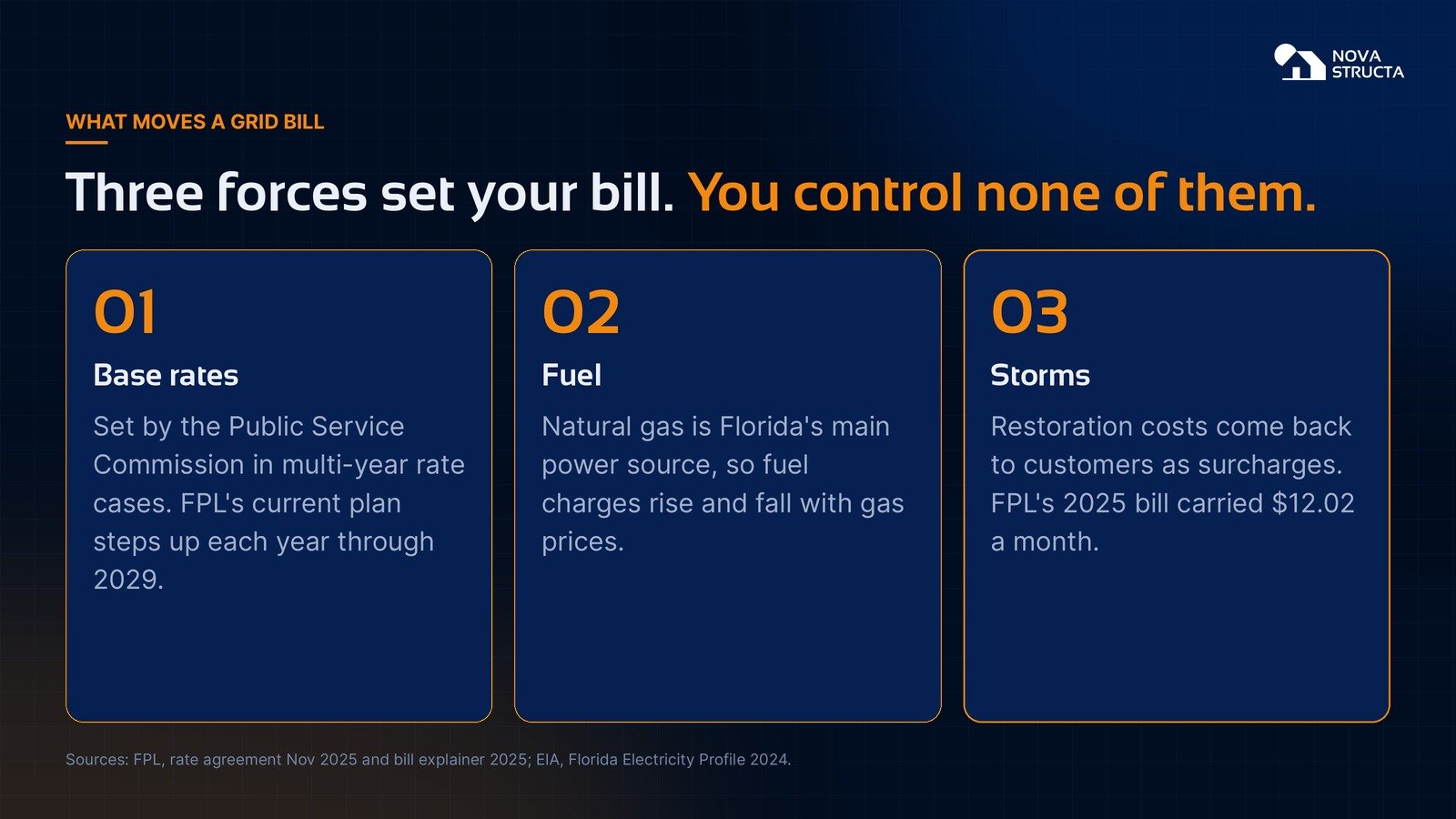
- Base rates are set by the Public Service Commission in multi-year rate cases [1].
- Fuel follows natural gas, which is Florida's primary energy source for making electricity [6].
- Storms come back as surcharges. After the 2024 hurricanes, FPL's typical 2025 bill included $12.02 a month for storm restoration [1][5].
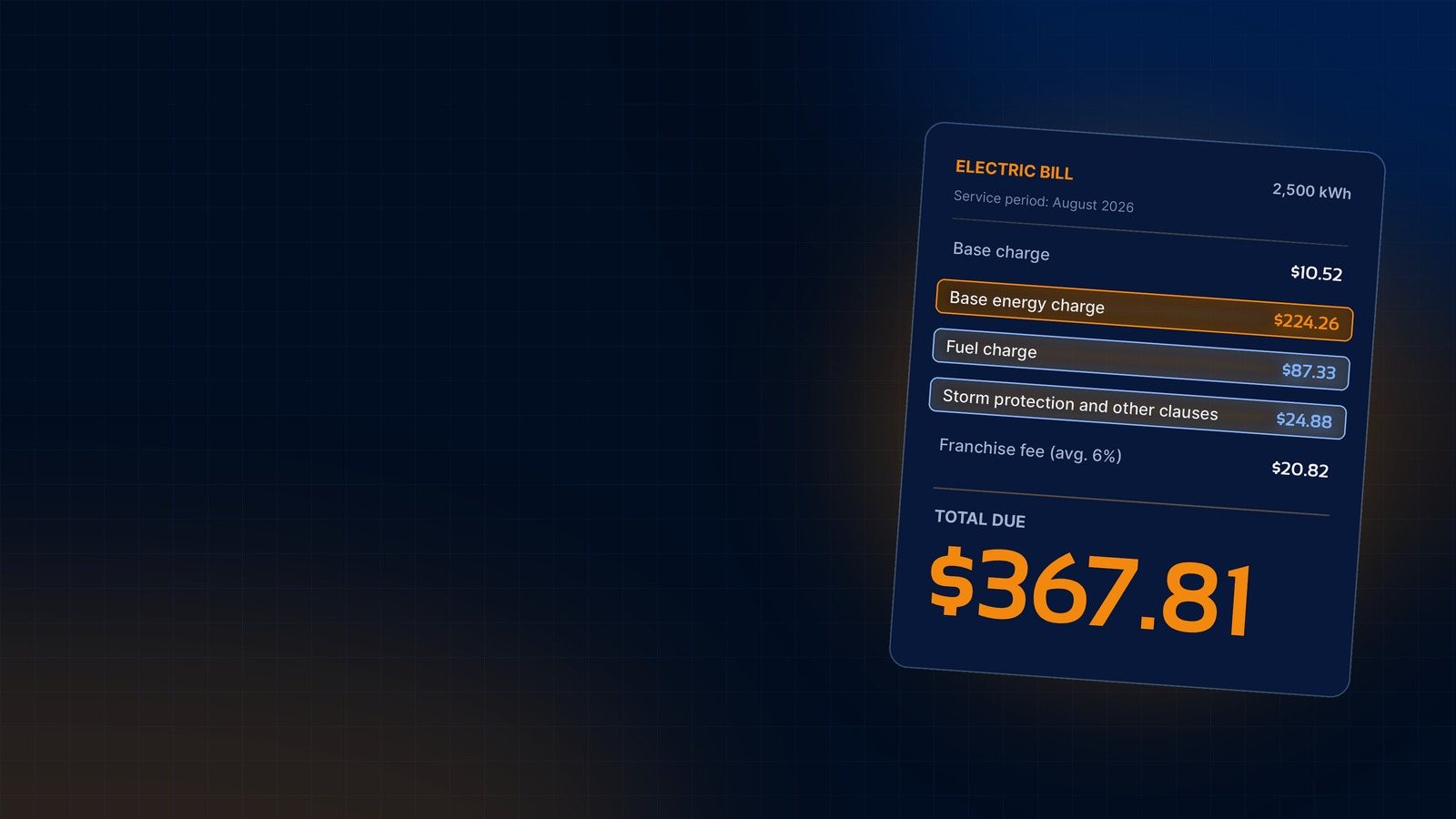
Florida's price per kWh is not unusually high. The state's average retail price was 12.53 cents in 2024, 18th among the states [6]. What makes Florida bills big is how much power homes use, mostly for air conditioning. A home that buys 2,000 kWh in August feels every one of those forces twice. Our guide to every charge on your bill breaks the lines down.
What does solar cost in Florida in 2026?
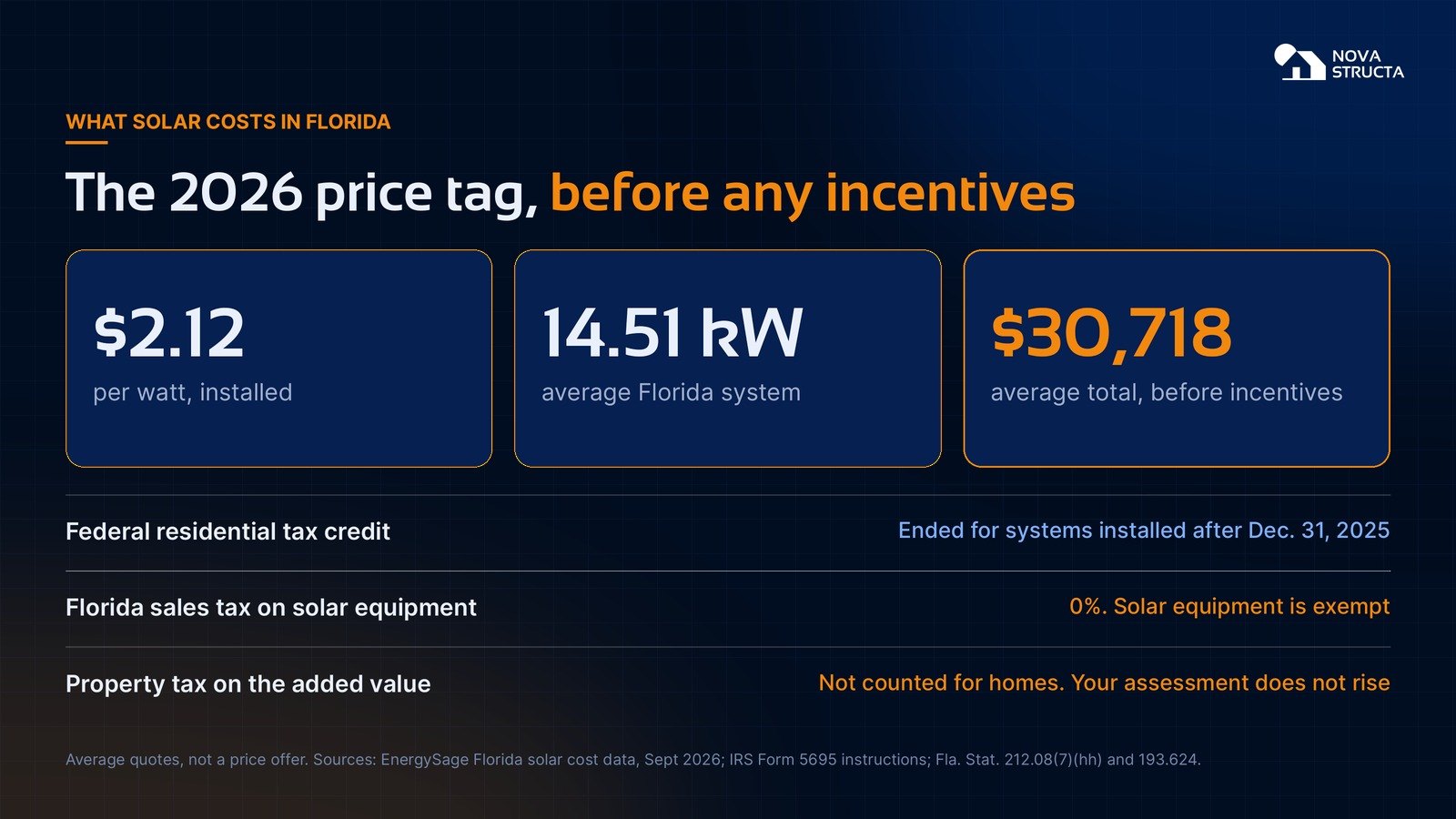
Quote data from the EnergySage marketplace puts the average Florida system at 14.51 kW and $2.12 per watt installed in September 2026. That works out to about $30,718 before incentives, with typical quotes running from about $26,110 to $35,326 [7]. Your number depends on your usage, roof, equipment and installer.
The federal tax credit for buyers has ended.
The residential clean energy credit does not apply to expenditures made after December 31, 2025, and an expenditure generally counts as made when installation is complete [8]. If you buy with cash or a loan in 2026, plan without it. Some lease providers can still use a business tax credit on equipment they own, so if you compare a lease, ask how that shows up in the price [7].
Florida's own incentives still apply:
- No sales tax. Solar energy systems and their components are exempt from Florida sales and use tax [12].
- No property tax bump. For homes, the value a solar system adds is not counted when your property is assessed [11].
What the average does not include: a roof replacement if your roof is near the end of its life, a battery, or an electrical panel upgrade. Ask for each one as its own line on a written quote.
How does net metering work in Florida?
Net metering is what makes rooftop solar work for most Florida homes. Under the Public Service Commission's rule, FPL, Duke Energy Florida and TECO must let customer-owned systems up to 2 MW net meter [9].
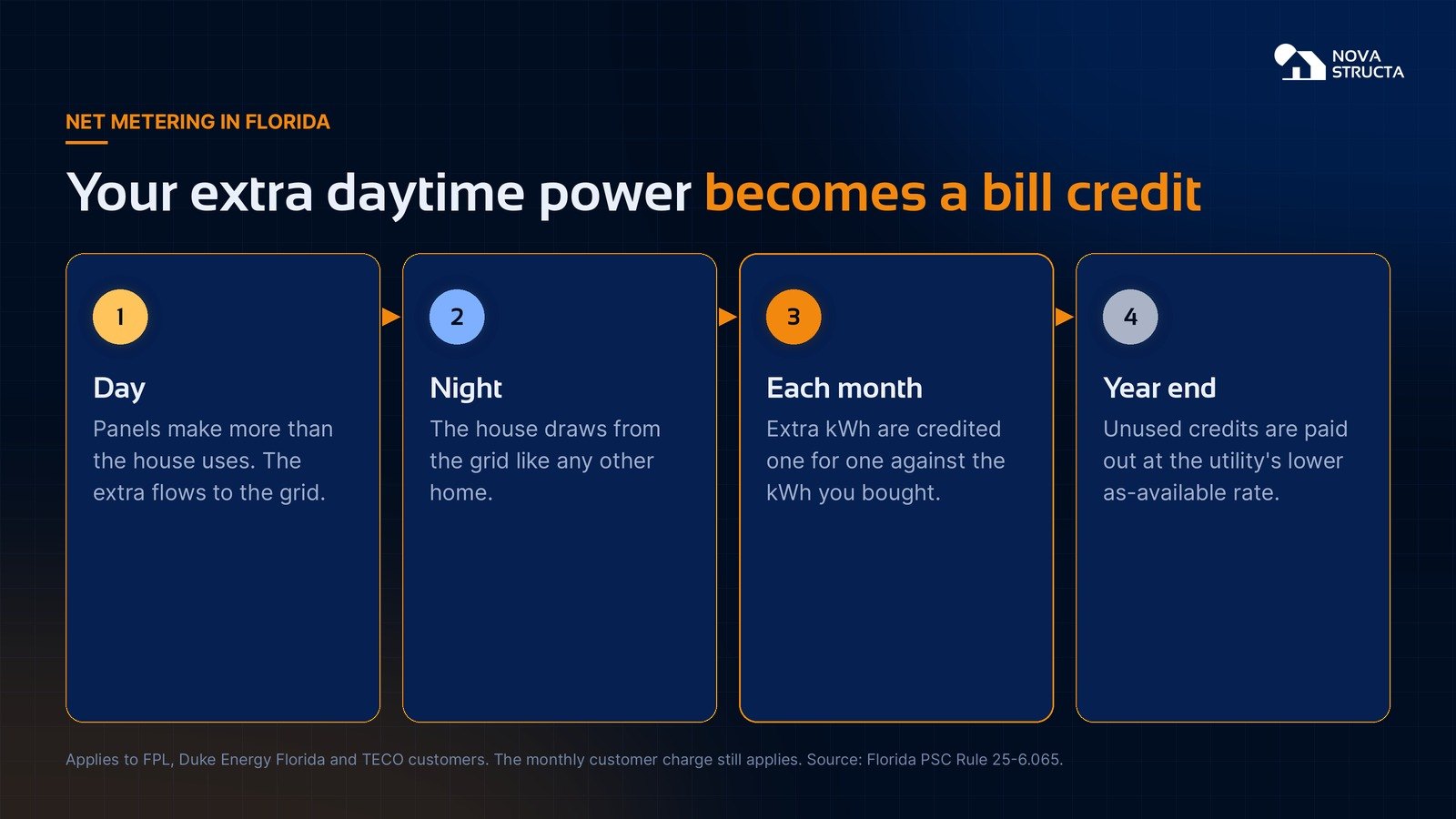
- During the day, your panels can make more than the house uses. The extra flows to the grid.
- At night, you draw from the grid like any other home.
- Each month, extra kWh you sent out are credited against kWh you bought, one for one, and unused credits roll forward [9].
- At the end of the year, any credits left over are paid out at the utility's as-available energy rate, which is much lower than the retail price [9].
Two practical takeaways. A system sized close to your yearly usage tends to make better use of the rule than an oversized one, because leftover credits are worth less. And you still pay the monthly customer charge, even in a month when your panels cover everything [9].
Net metering has been challenged before. In 2022, the Legislature passed a bill that would have phased down its value, and the governor vetoed it [13]. Rules can change, so ask any installer what happens to existing customers if they do.
What Florida law guarantees solar owners
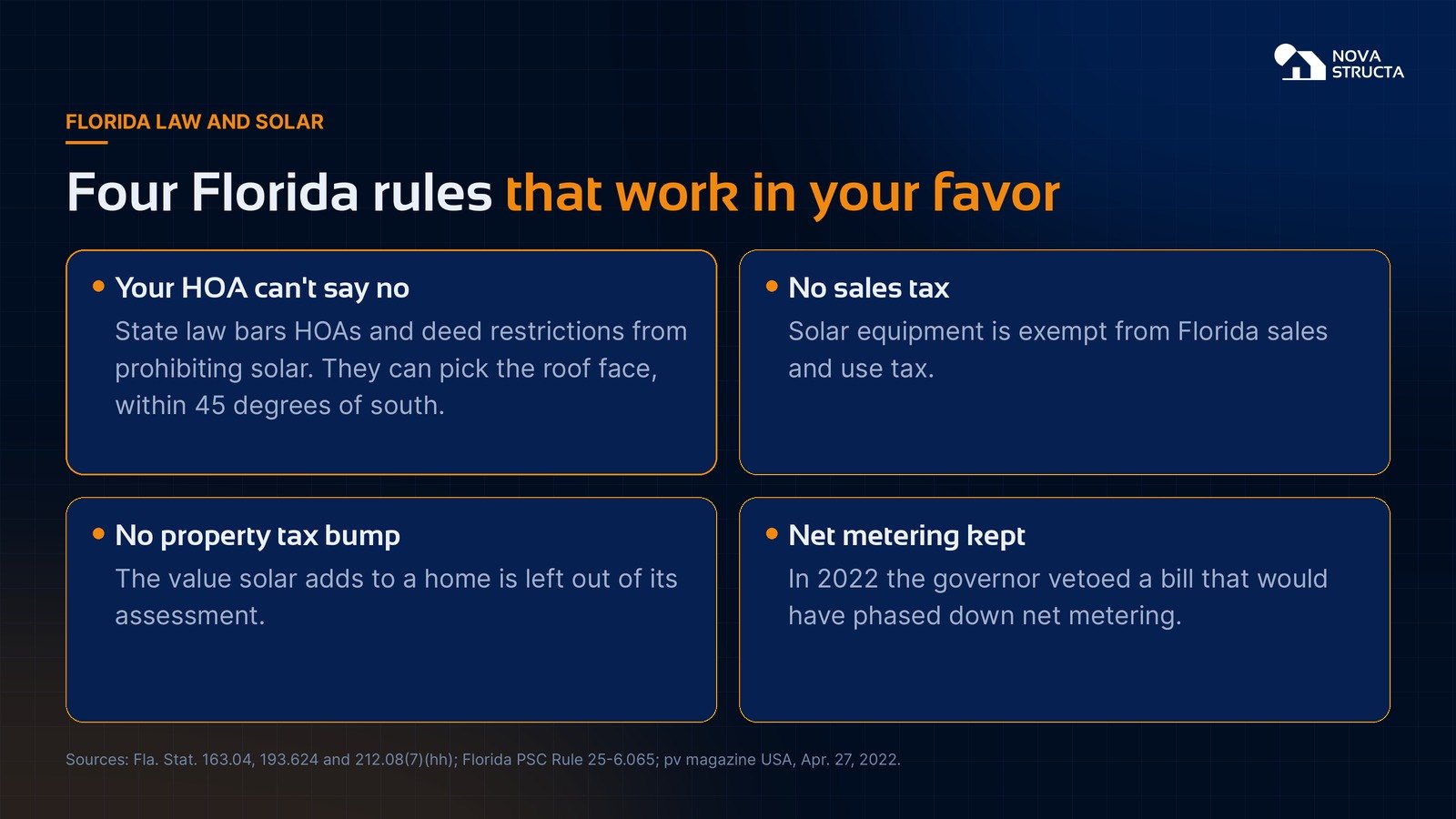
- Your HOA can't say no. Florida law bars deed restrictions, covenants and HOA rules from prohibiting solar collectors. An association can choose where on the roof they go, as long as it is within 45 degrees east or west of due south and does not impair how they work [10].
- No property tax bump on the added value, for homes [11].
- No sales tax on solar equipment [12].
- One-for-one net metering with the big investor-owned utilities [9].
None of this is new or experimental. Florida has nearly 300,000 solar installations and ranks third in the country for installed solar capacity [14].
How long do solar panels last?
Panels slowly lose output as they age. Across nearly 2,000 measurements reviewed by the National Renewable Energy Laboratory, the median loss was about 0.5% a year [15]. At that rate, a panel still makes about 88% of its original output after 25 years. Most panel warranties run 25 years [7].
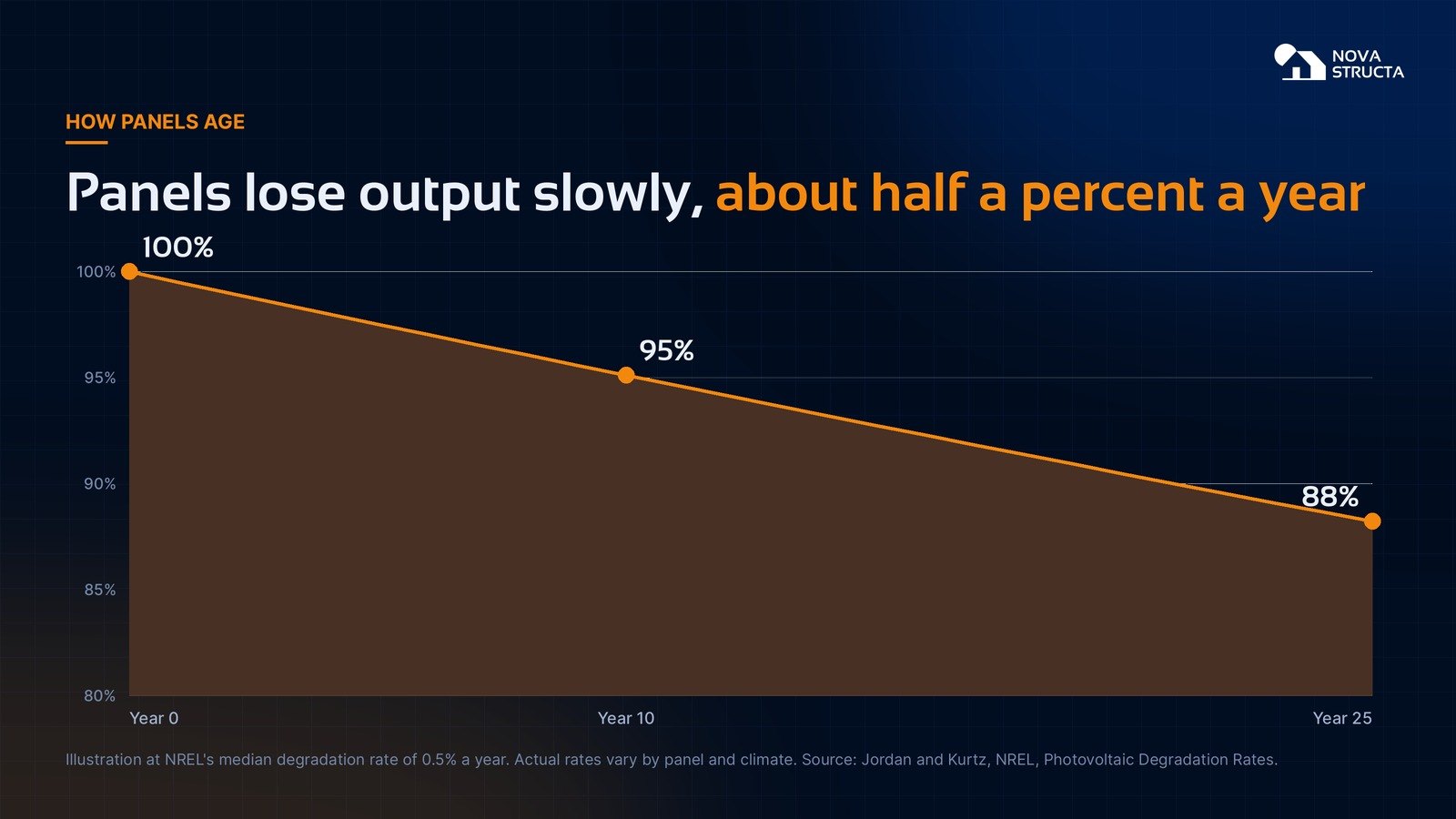
That long life is the point of owning. The equipment is paid for once, then it keeps producing through many rate cases. Inverters and batteries usually have shorter warranties than panels, so ask about each.
Beyond the bill: energy independence
Money is one reason to go solar. Control is the other, and in Florida it matters every hurricane season.
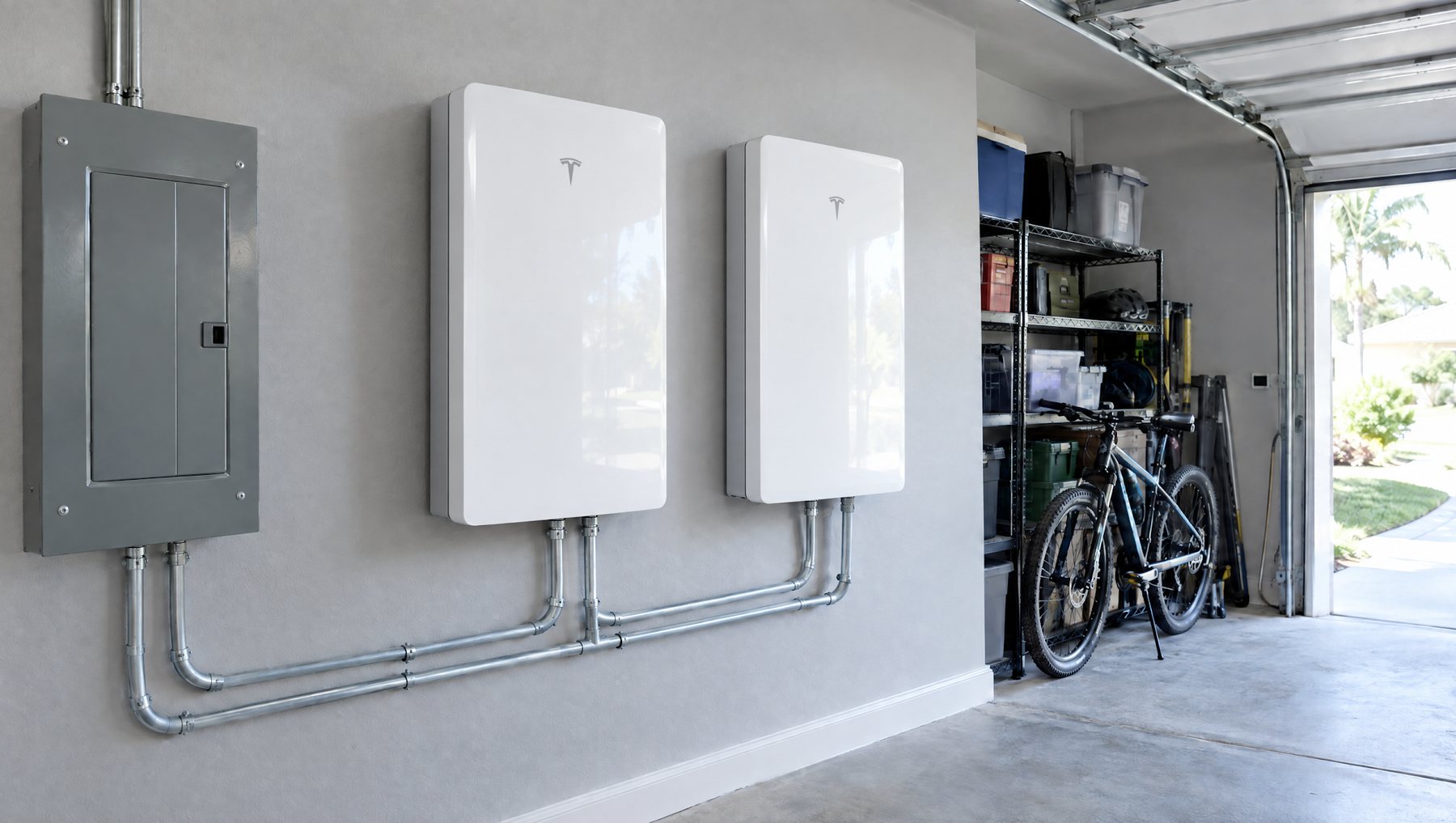
U.S. customers averaged 11 hours without power in 2024, nearly twice the average of the decade before, and hurricanes drove most of it. Hurricane Milton alone left 3.4 million Florida customers in the dark [16].
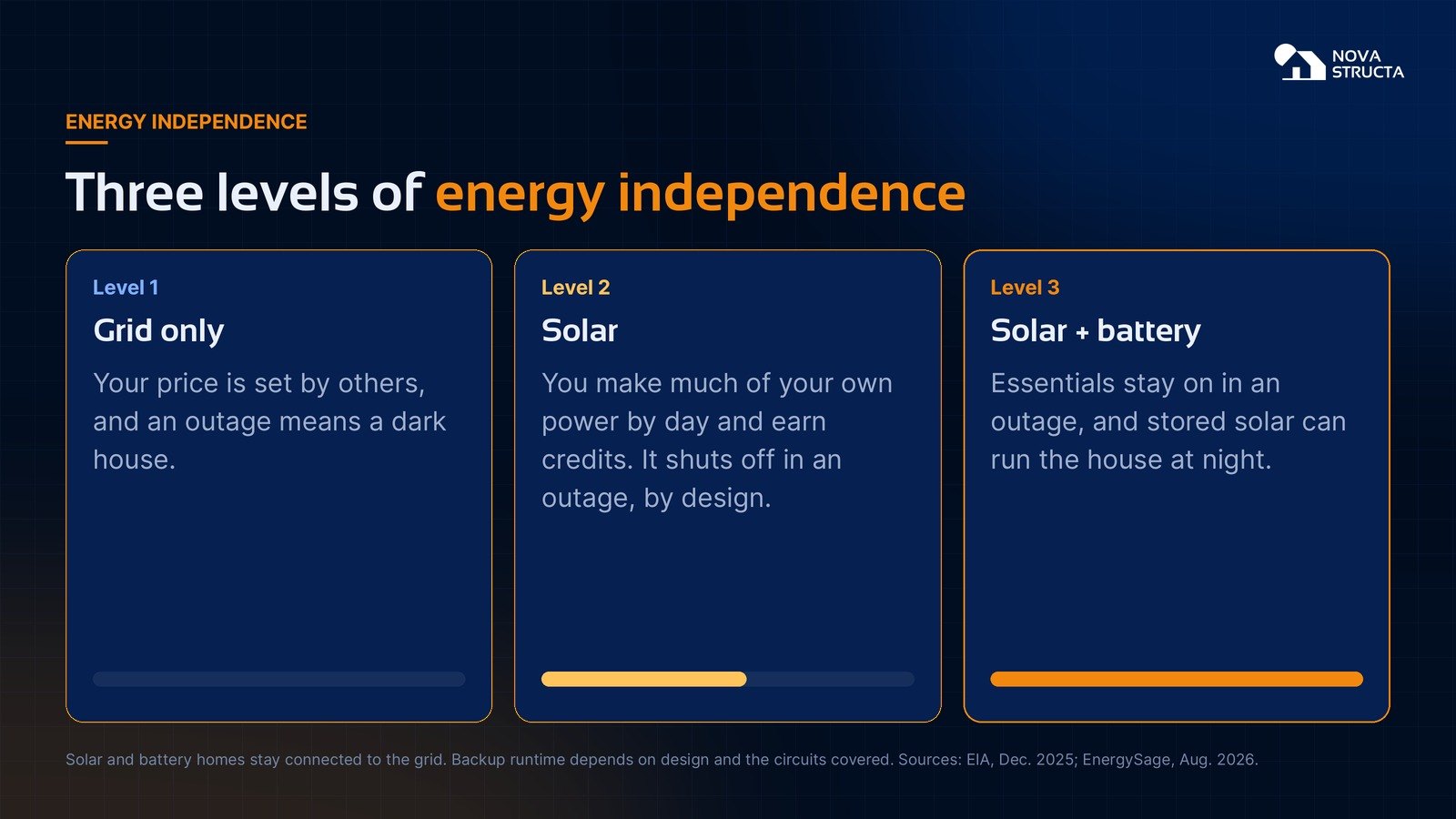
Level 1: grid only. Your price is set for you, and an outage means a dark house.
Level 2: solar. You make much of your own power by day and earn credits for the extra. But a grid-tied system without a battery shuts off within seconds in an outage. That is a required safety feature that protects line crews [17].
Level 3: solar plus battery. The system can separate from the grid and keep your essentials running. One battery with solar can typically run a refrigerator, Wi-Fi and some lights for a day or two, and central air usually takes more than one [17]. The panels refill the battery by day.
Be clear-eyed about one thing. Because Florida credits your extra kWh one for one, a battery usually does little for the bill math by itself. Its value is backup power and peace of mind. For how that plays out in a storm, read do solar panels work in a hurricane?
Is solar a good fit for your home?
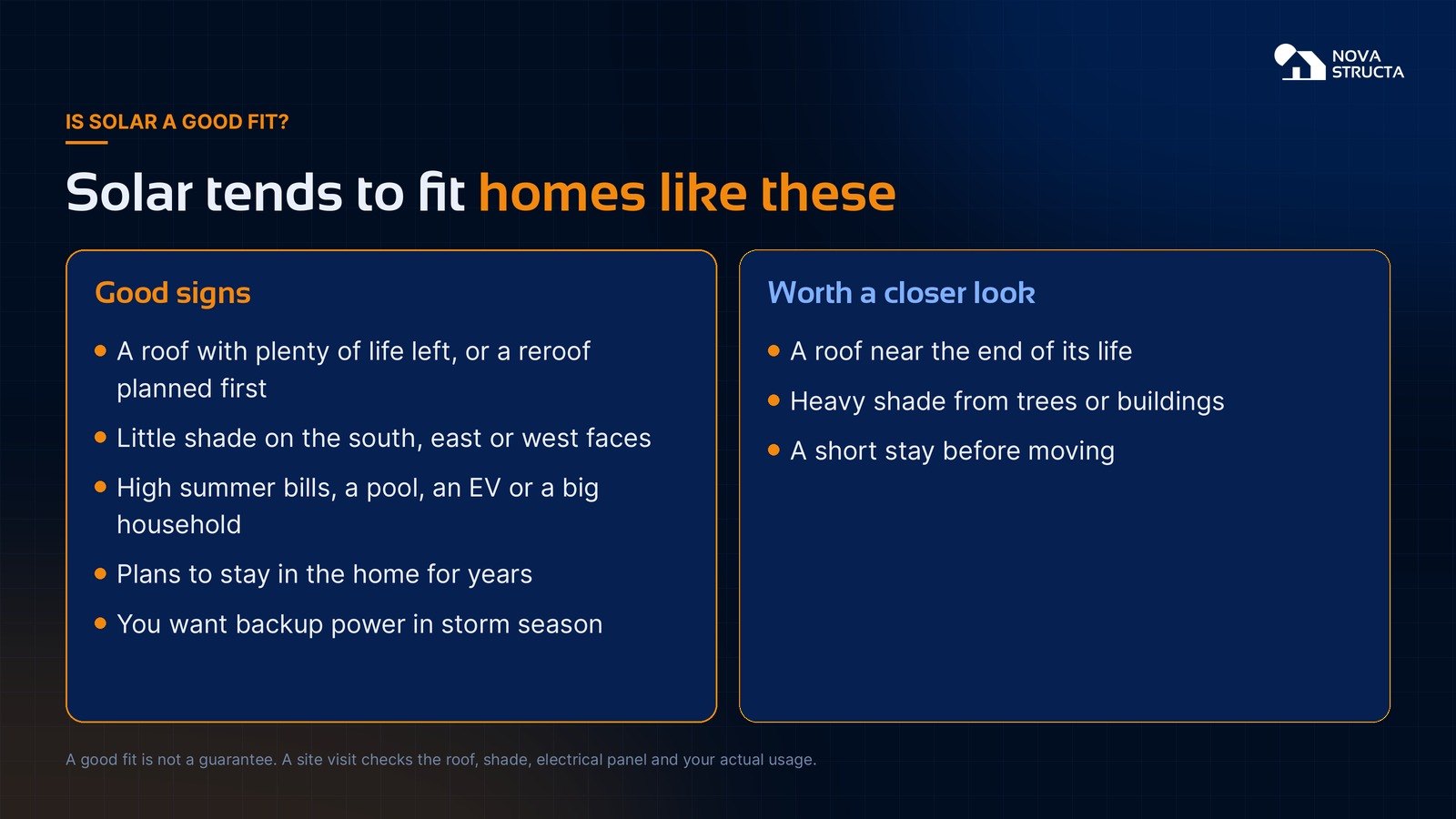
| Factor | Best case | Worth a closer look if |
|---|---|---|
| Roof | Years of life left | It is near the end of its life. Reroof first. See will solar void my roof warranty |
| Shade | Open south, east or west | Trees or buildings shade it most of the day |
| Usage | High summer bills | Usage is very low all year |
| Time in the home | Staying for years | You plan to move in the next year or two |
| Backup | Want outage power | You rarely lose power and don't mind when you do |
How to run your own numbers
You do not need anyone's average to decide. You need four numbers, and all of them should be on paper.
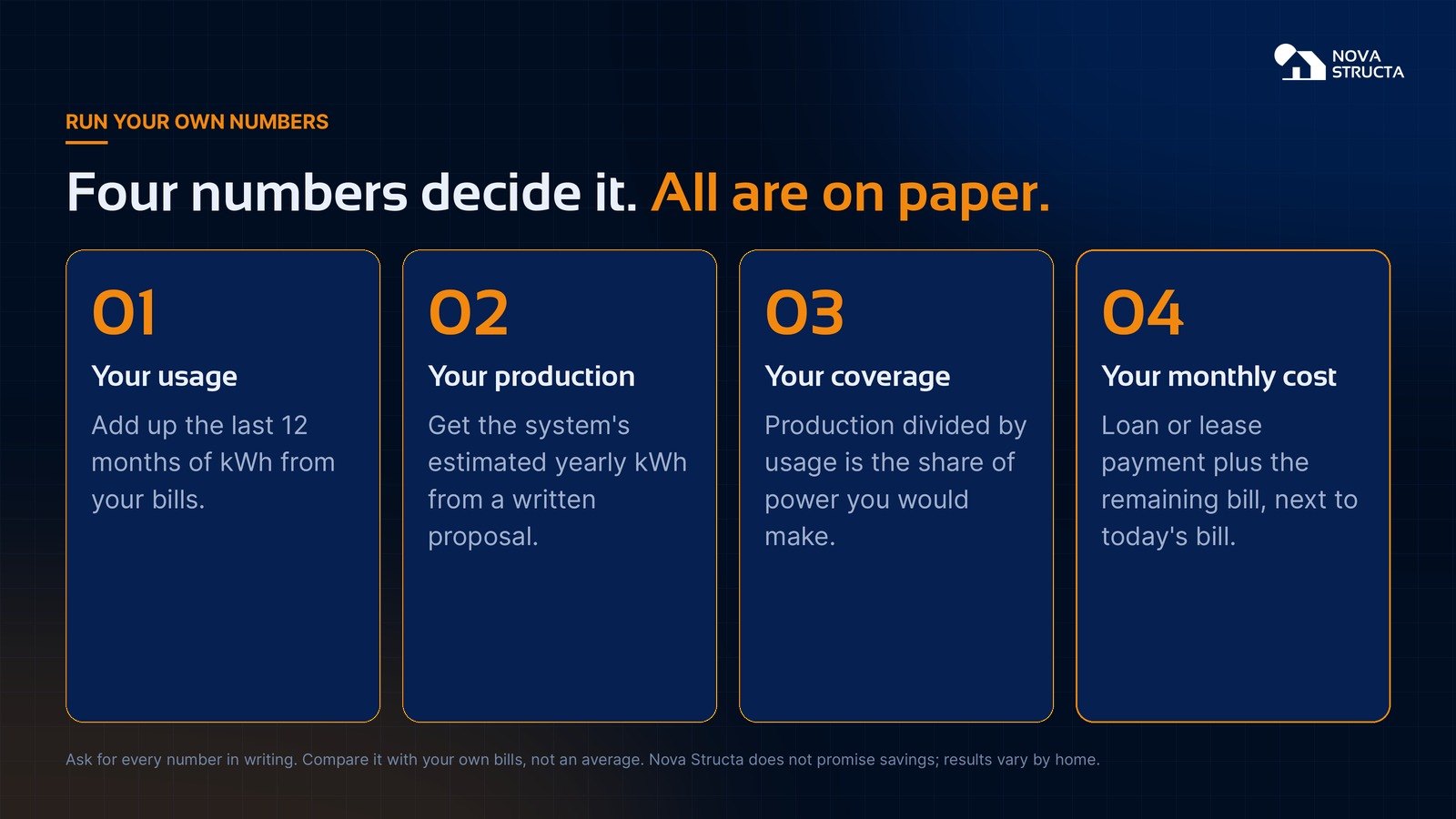
- Your usage. Add up the last 12 months of kWh from your bills. Your utility's online account usually shows it.
- Your production. Get the system's estimated yearly kWh from a written proposal, along with how it was calculated.
- Your coverage. Divide production by usage. That is the share of your power the system is designed to make.
- Your monthly cost. Add the loan or lease payment to the bill you would still pay (the customer charge plus any kWh you still buy). Put it next to today's bill and FPL's projected path above.
Questions to ask any installer:
- What happens to my credits if I make more than I use in a year?
- What does the quote include, line by line: panels, inverters, roof work, permits, battery, panel upgrade?
- Who handles warranty service, and for how long?
- How is the system attached to my roof, and is it engineered for my address's wind speed?
The bottom line
Power from the grid is a bill you will pay for as long as you own your home, at prices set by rate cases, fuel markets and storms. FPL's own projection has it climbing through 2029. Solar changes the shape of that cost: you pay for equipment, it produces for decades, and Florida's net metering, tax exemptions and HOA protections are all on your side. Add a battery and you also gain something no bill shows, which is power when the grid is down.
It is not right for every roof or every family, and results vary by home and are not guaranteed. If you would like someone to run the four numbers above with your actual bills, see solar systems and Tesla Roof and Powerwalls, or book a free assessment.
Sources
- Florida Power & Light, "Florida regulators approve FPL rate agreement that keeps customer bills low, meets needs of growing state," November 20, 2025. newsroom.fpl.com
- Florida Power & Light, "FPL rate settlement reduces request by nearly a third, limits average annual bill increases to 2%, maintains consumer protections," August 20, 2025. newsroom.fpl.com
- Florida Power & Light, "FPL reaches comprehensive four-year rate settlement agreement," August 10, 2021. newsroom.fpl.com
- Florida Power & Light, "State regulators approve FPL rate decrease in May," April 4, 2023. newsroom.fpl.com
- Florida Power & Light, "FPL outlines plan to pay for significant restoration efforts after four hurricanes slam Florida in 14 months," October 29, 2024. newsroom.fpl.com
- U.S. Energy Information Administration, Florida Electricity Profile 2024, Table 1, released November 10, 2025. eia.gov
- EnergySage, "The cost of solar panels in Florida (2026)," updated September 25, 2026. energysage.com
- Internal Revenue Service, Instructions for Form 5695 (2025), Residential Energy Credits. irs.gov
- Florida Public Service Commission, Rule 25-6.065, F.A.C., Interconnection and Net Metering of Customer-Owned Renewable Generation (Order PSC-08-0161-FOF-EI). Rule text (PDF)
- Florida Statutes, Section 163.04, Energy devices based on renewable resources. leg.state.fl.us
- Florida Statutes, Section 193.624, Assessment of renewable energy source devices. leg.state.fl.us
- Florida Statutes, Section 212.08(7)(hh), solar energy systems exemption, as applied in Florida Department of Revenue TAA 15A-008. TAA 15A-008
- pv magazine USA, "Breaking: Florida Governor vetoes anti-rooftop solar bill," April 27, 2022. pv-magazine-usa.com
- Solar Energy Industries Association, Florida Solar and Storage, updated September 2026. seia.org
- D. Jordan and S. Kurtz, National Renewable Energy Laboratory, "Photovoltaic Degradation Rates: An Analytical Review." nrel.gov (PDF)
- U.S. Energy Information Administration, "Hurricanes in 2024 led to the most hours without power in the United States in 10 years," December 1, 2025. eia.gov
- EnergySage, "Do solar panels work during a power outage?" updated August 11, 2026. energysage.com
Savings and utility-bill examples shown are illustrative only, are not guaranteed, and may not reflect typical results. Actual savings depend on your energy usage, system size, roof and site conditions, financing terms, utility rates, net-metering rules, and other factors specific to your home.