HVAC
Best HVAC Systems for Florida Homes in 2026: Carrier, Daikin and Goodman, Matched to Your House
What is the best HVAC system for a Florida home?
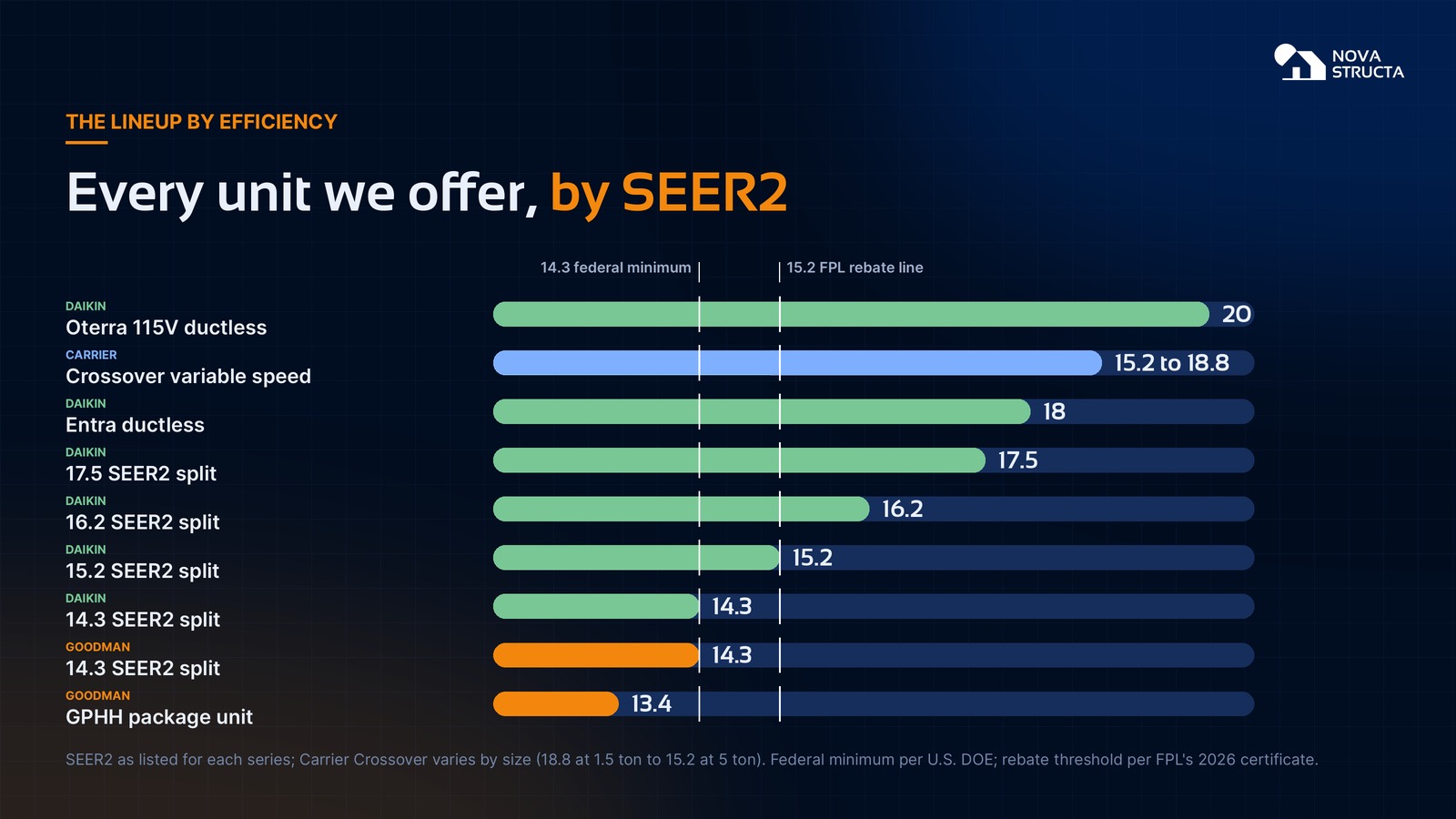
The one that matches how your house is built, is sized to it, and keeps the air dry. For most Florida homes with ducts, that is a central split system. We offer three brands of split systems: Carrier's Crossover variable speed (up to 18.8 SEER2), Daikin at 14.3, 15.2, 16.2 and 17.5 SEER2, and Goodman at 14.3 SEER2. Rooms without ducts get Daikin Entra (18 SEER2) or Daikin Oterra 115V (20 SEER2) ductless units. Homes built around a single outdoor cabinet get the Goodman GPHH package unit (13.4 SEER2).
Brand matters less than you might think. Florida is hard on air conditioning: 96% of Florida households use it [1], and here the system has to pull water out of the air as well as cool it [10]. So the best system is the right type, sized by a load calculation, matched indoors and out, and moving air through tight ducts. This guide walks through each unit we offer and where it fits.
Every unit we offer, at a glance
| Series | Type | SEER2 | Sizes | Best fit |
|---|---|---|---|---|
| Carrier Crossover Variable Speed | Central split | 15.2 to 18.8, by size | 1.5, 2, 2.5, 3, 4, 5 ton | Humid houses, uneven rooms, quiet |
| Daikin 17.5 SEER2 | Central split | 17.5 | 2, 3, 3.5, 4, 5 ton | Top of the Daikin central line |
| Daikin 16.2 SEER2 | Central split | 16.2 | 1.5 to 5 ton | A step up in every common size |
| Daikin 15.2 SEER2 | Central split | 15.2 | 1.5 to 5 ton | At FPL's rebate line |
| Daikin 14.3 SEER2 | Central split | 14.3 | 1.5 to 5 ton | Meets the federal minimum |
| Goodman 14.3 SEER2 | Central split | 14.3 | 1.5 to 5 ton | Meets the federal minimum |
| Daikin Entra | Ductless | 18 | ¾, 1, 1.5, 2 ton | Additions, bonus rooms, garages |
| Daikin Oterra 115V | Ductless | 20 | ¾, 1 ton | Small rooms on a standard circuit |
| Goodman GPHH | Package unit | 13.4 | 2 to 5 ton | Homes built around a package unit |
Sizes and SEER2 ratings are as listed for the systems we offer. A SEER2 rating belongs to a matched combination of outdoor and indoor equipment, so the final rating is on the written proposal. You can also filter the whole lineup by type and size on our HVAC systems page.
Which one fits your house?
01What are you cooling?
02How does the house feel in August?
03What matters more to you?
04Is FPL your electric company?
Answer the four questions to see where you land.
A central split system fits. That opens the widest part of the lineup. Goodman and Daikin at 14.3 SEER2 meet the federal minimum [2]; Daikin at 15.2, 16.2 and 17.5 step up from there; Carrier Crossover adds variable speed.
Stay with a package unit. The Goodman GPHH is a packaged heat pump, heating and cooling in one outdoor cabinet, in 2 to 5 tons, at the 13.4 SEER2 federal minimum for package units [2] [9]. It connects to the ducts you already have.
Go ductless. Daikin Entra wall units come in ¾ to 2 tons at up to 18 SEER2 [7], for additions, bonus rooms, garages and sunrooms, with no new ductwork.
Look at Daikin Oterra first. At 20 SEER2 it is the most efficient unit we offer, and it runs on a standard 115 volt circuit [8]. It comes in ¾ and 1 ton; bigger rooms move to Entra, at up to 18 SEER2 [7].
Shortlist Carrier Crossover and Daikin 17.5. Crossover's inverter adjusts output instead of cycling on and off, which Carrier says keeps temperature steady and the system quiet [5]. In the 1.5 ton size it is rated 18.8 SEER2.
Check the ducts before you upsize. In a typical house, 20 to 30% of the air moving through ducts is lost to leaks and bad connections [13]. New supply or return drops, or sealing, often fix hot rooms better than more tonnage.
Ask about the FPL rebate. Systems at 15.2 SEER2 or higher can qualify for FPL's $200 residential HVAC rebate when installed by an FPL participating contractor under the program standards [3] [4]. In our lineup that is Carrier Crossover and Daikin 15.2, 16.2 and 17.5.
This is a starting point, not a design. The final choice comes from looking at the house: the ducts, the attic, the electrical panel and a load calculation.
Central split, ductless or package: tap to compare
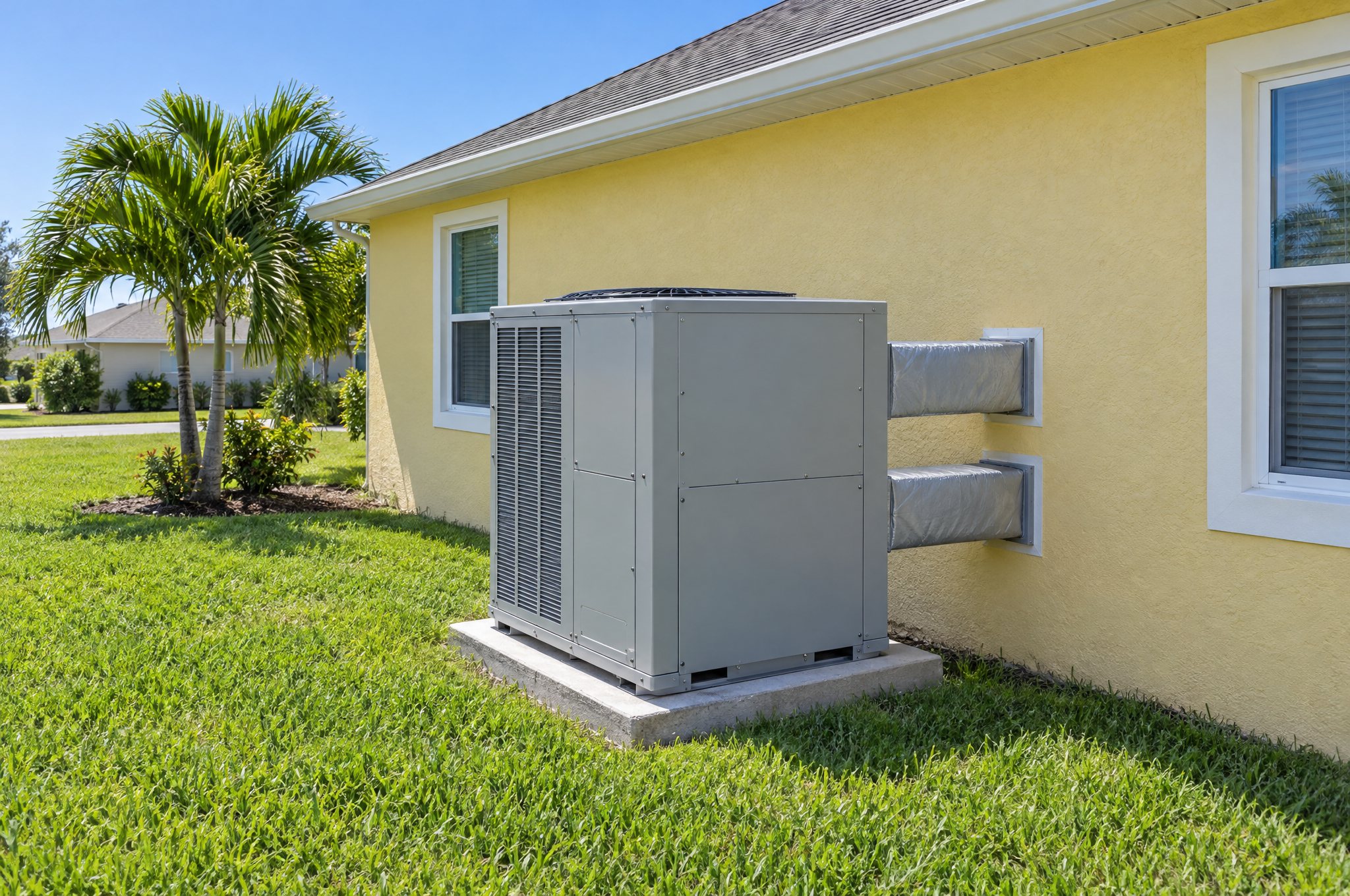
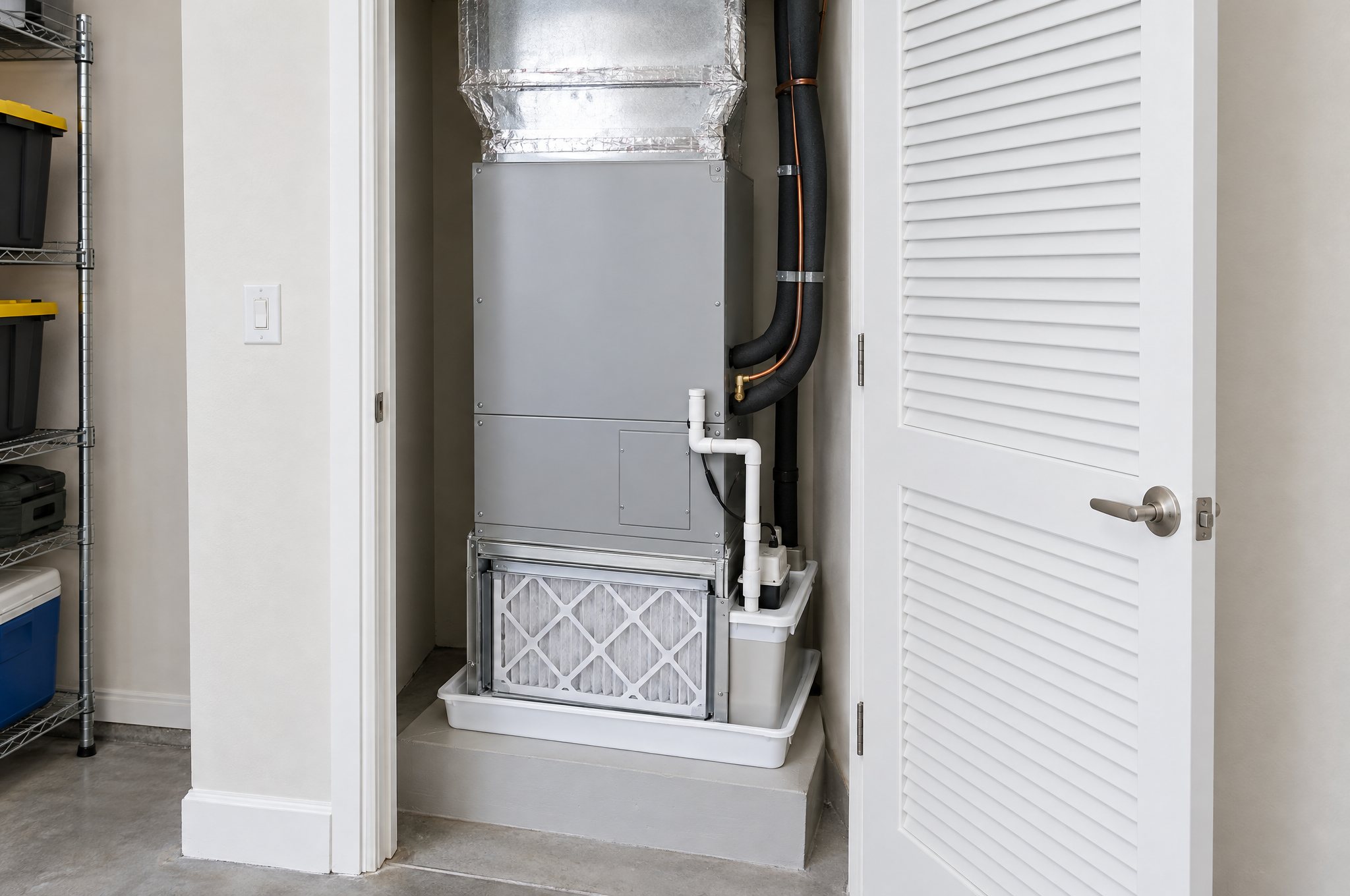 Central split, outsideDuctlessPackage unitCentral split, inside
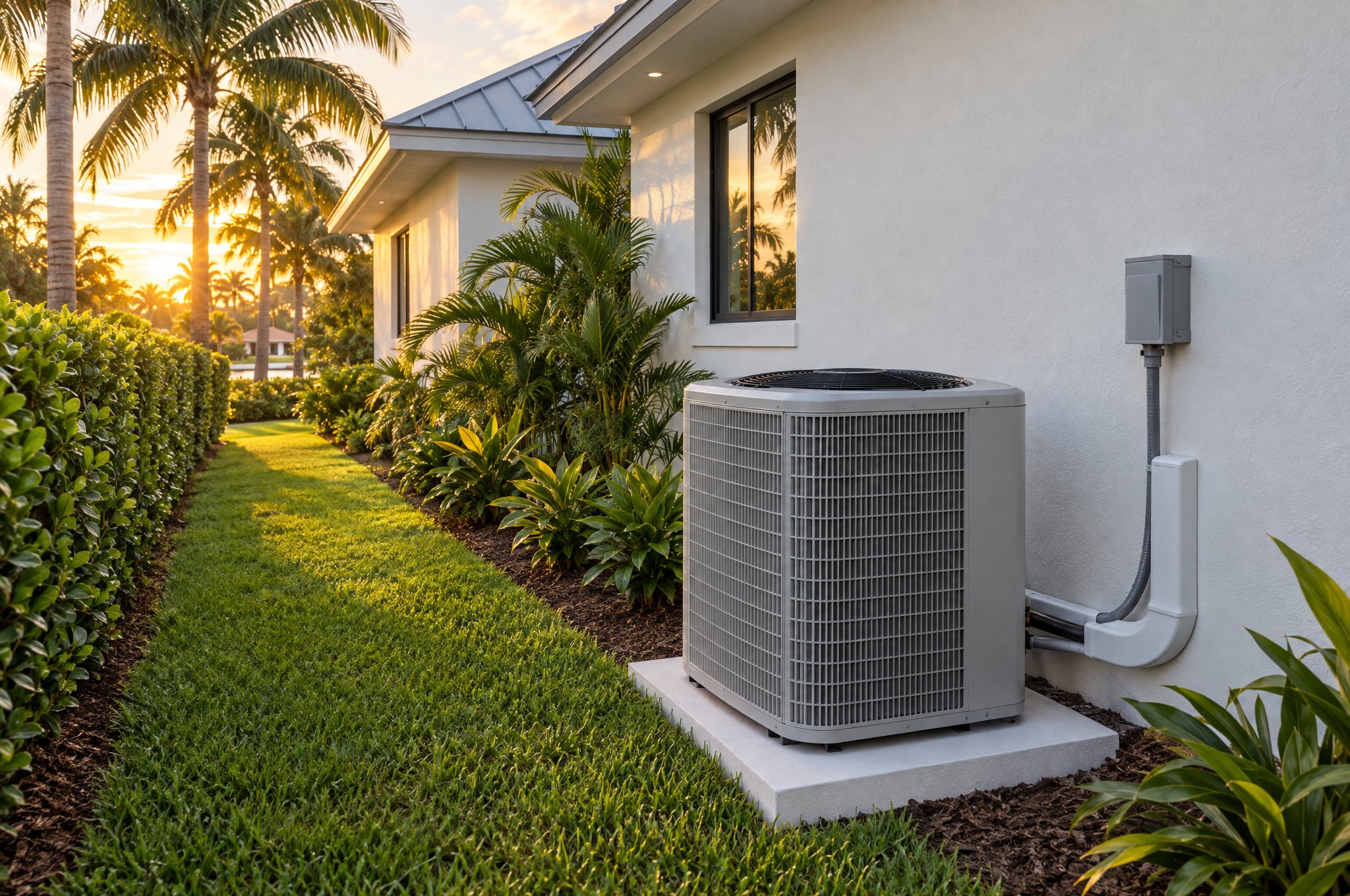
Central split. An outdoor unit and an indoor air handler or coil, connected by refrigerant lines, moving air through your ducts. Most Florida homes with ducts use one. This is where Carrier Crossover and the Daikin and Goodman split systems fit.
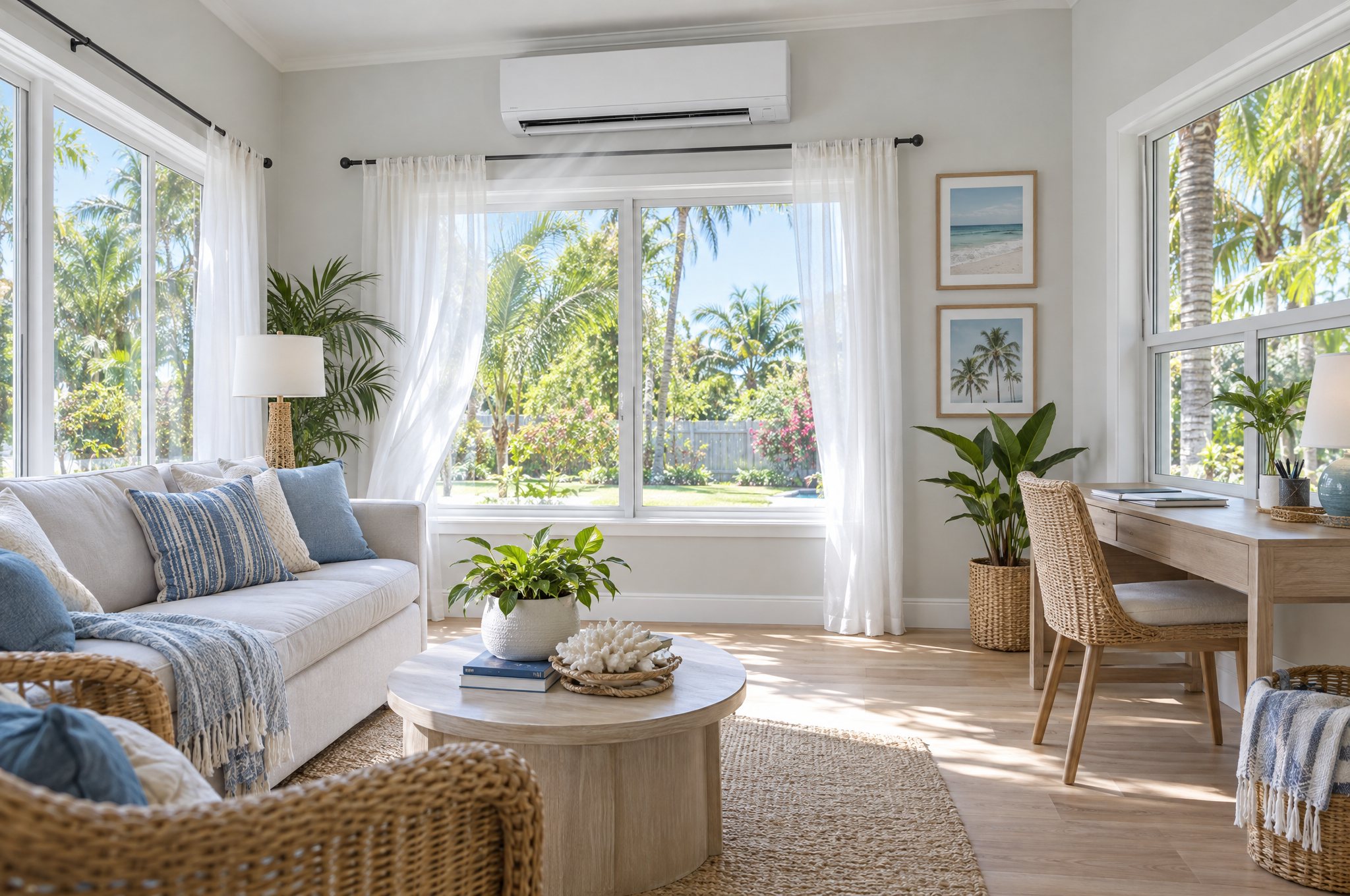
Ductless. A wall unit inside, a small unit outside, and no ductwork. Built for rooms the central system never reached: additions, bonus rooms, garages, converted lanais. Daikin Entra and Oterra 115V.
Package unit. Cooling, heating and the blower in one outdoor cabinet, with ducts running through the wall or slab into the house. Common on slab homes without an indoor equipment closet. Goodman GPHH.
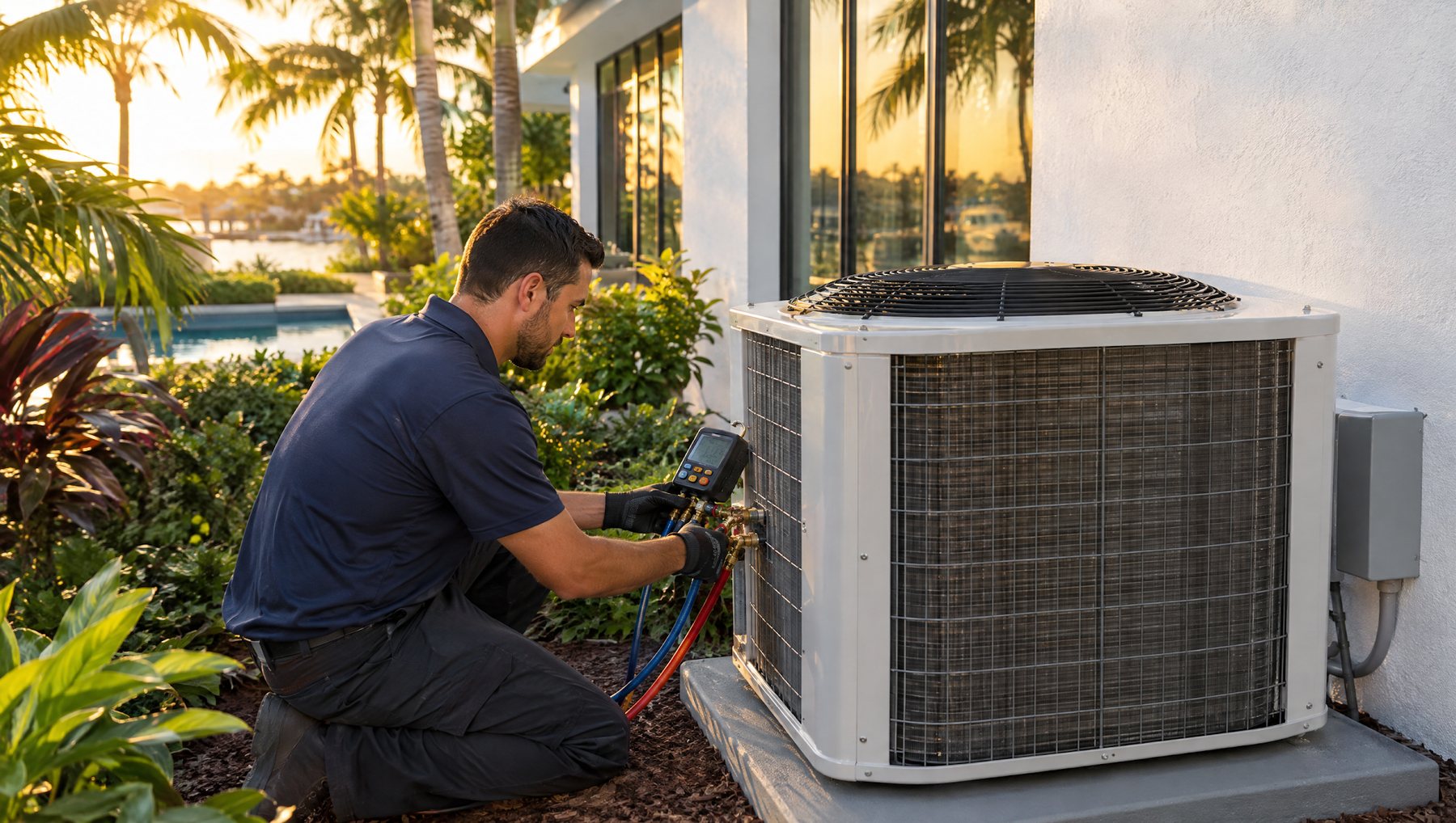
The inside half. In a split system, the air handler is where the moisture comes out: water condenses on the cold coil and drains away. That is why the outdoor unit, coil and air handler should be matched and rated together [11], and why the drain line matters.
Photos are illustrations; equipment shown is generic.
Carrier Crossover: the pick for humid, uneven houses

Carrier's Crossover Solutions combine ductless inverter technology with a traditional ducted system [5]. Instead of switching between full blast and off, the inverter adjusts output to the load, which Carrier says delivers precise temperature control with fewer swings, quiet operation and a small outdoor unit [5]. It works with third-party thermostats [5].
The Performance Crossover air handler uses a variable-speed motor and Carrier's Puron Advance refrigerant, R-454B [6].
Why that matters in Florida: moisture only comes out while the indoor coil is running cold, so long, low runs dry the air better than short blasts [10] [11]. As we offer it, Crossover is rated 18.8 SEER2 at 1.5 tons, 18.2 at 2, 17 at 2.5, 16.2 at 3, 16 at 4 and 15.2 at 5 tons. Every size sits at or above FPL's 15.2 rebate line [4].
Best for: houses that feel cool but clammy, rooms that run hot or cold, and anyone who wants the quietest, steadiest system in the lineup.
Daikin split systems: four efficiency steps
Daikin is the deepest part of our central lineup, with four efficiency levels:
- 17.5 SEER2 in 2, 3, 3.5, 4 and 5 tons. The top of the Daikin central line.
- 16.2 SEER2 in 1.5 to 5 tons. A step up in every common size.
- 15.2 SEER2 in 1.5 to 5 tons. Right at FPL's rebate line [4].
- 14.3 SEER2 in 1.5 to 5 tons. Meets the federal minimum for most split systems in Florida [2].
The value of four steps is choice at the same size. A 3 ton house can pick the efficiency that fits its budget and its bill, without changing the size the load calculation called for. The higher the SEER2, the less electricity it takes to remove the same heat [2].
Best for: most ducted Florida homes, at whichever efficiency level fits the budget.
Goodman: the code-minimum value pick, and the package unit
Goodman 14.3 SEER2 split in 1.5 to 5 tons. Meets the federal minimum [2], for homeowners who want a dependable new system and the lowest upfront cost in the central lineup.
Goodman GPHH residential package unit in 2 to 5 tons. The GPHH is a packaged heat pump rated 13.4 SEER2 that uses R-32 refrigerant [9], which meets the federal minimum for single-package equipment [2]. If your house was built around a package unit, this replaces it without moving equipment indoors.
Add the Goodman AsureCare 10 year labor warranty on heat pump and air handler installs to cover labor as well as parts. Terms are set out in the written proposal.
Best for: budget-first replacements, rentals, and homes built around a package unit.
Daikin ductless: Entra and Oterra 115V
Daikin Entra wall units, in ¾, 1, 1.5 and 2 tons. Up to 18 SEER2, on R-32 refrigerant [7]. Good for an addition, a bonus room over the garage, a converted lanai or a garage workshop.
Daikin Oterra 115V, in ¾ and 1 ton. Rated 20 SEER2 with an inverter compressor and R-32 refrigerant [8], and it runs on a standard 115 volt circuit [8]. That is the most efficient unit we offer, sized for a single room or small space.
Best for: one room or one zone that the central system cannot reach, without adding ducts.
What makes a system the best in Florida
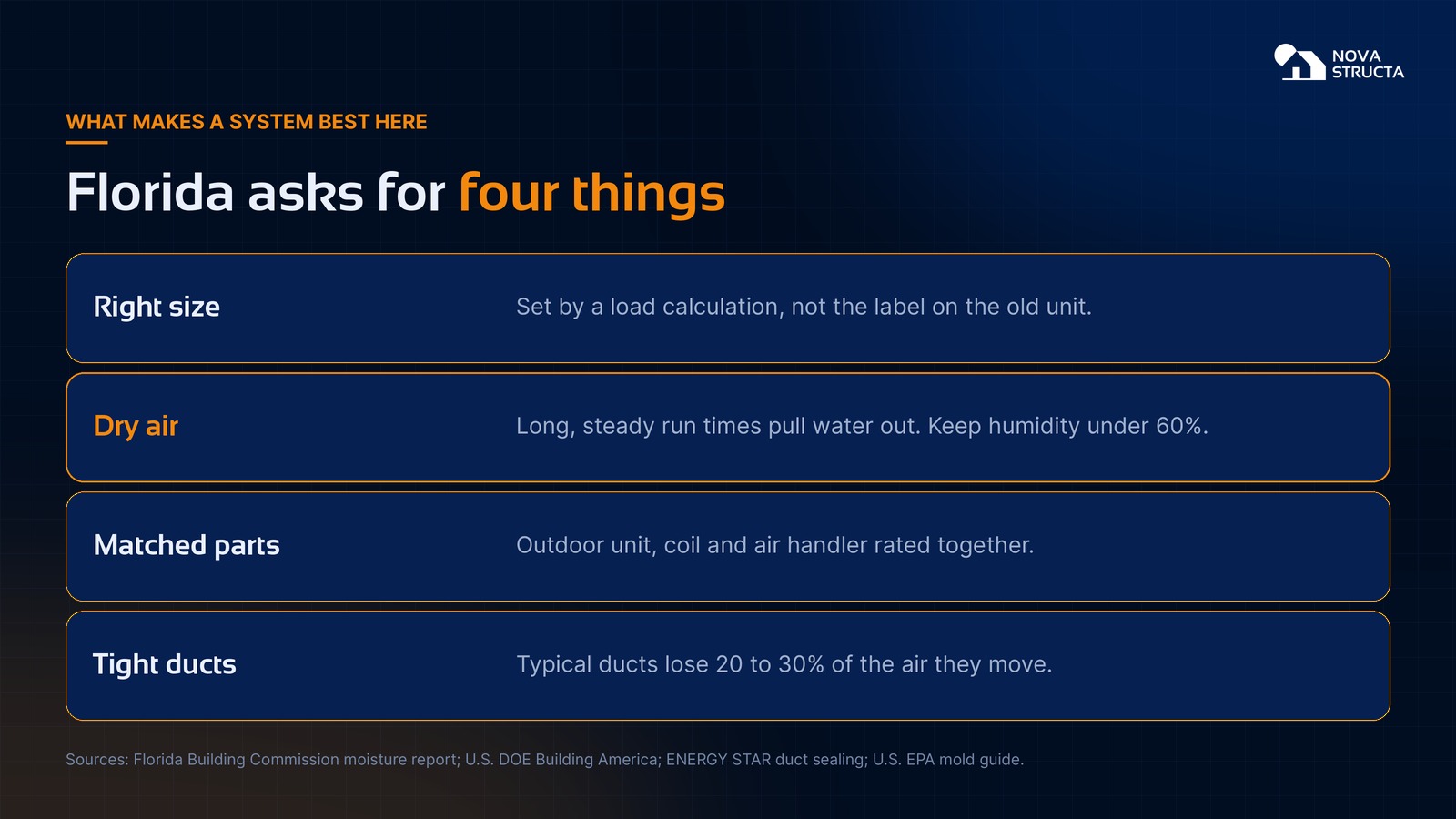
1. The right size. About 20% of the energy used to cool a Florida home goes to removing moisture, and an oversized system short cycles and leaves more of it behind [10]. The size comes from a Manual J load calculation, not the label on the old unit [11]. More in what size AC you need in Florida.
2. Dry air. EPA recommends keeping indoor humidity below 60% [12]. Long, steady run times and variable-speed air handlers help a system dehumidify [11].
3. Matched parts. The outdoor unit, coil and air handler should be rated together, with the charge set and tested [11]. A high-SEER2 outdoor unit on a mismatched old coil does not deliver its rating.
4. Tight ducts. In a typical house, 20 to 30% of the air moving through the ducts is lost to leaks, holes and poorly connected sections [13]. Ducts in a Florida attic lose that air into the hottest part of the house.
The extras that go with a good install, offered with any system in the lineup:
- Attic installs, for air handlers that live in the attic.
- A new drain line. In Florida the condensate line carries a lot of water; a clogged one is a common cause of water damage and shutdowns.
- New supply or return drops for rooms that never got enough air.
- REME HALO ZERO, an in-duct air purifier.
- An HVAC maintenance plan, with the install or on its own.
The 2026 rules that shape your choice
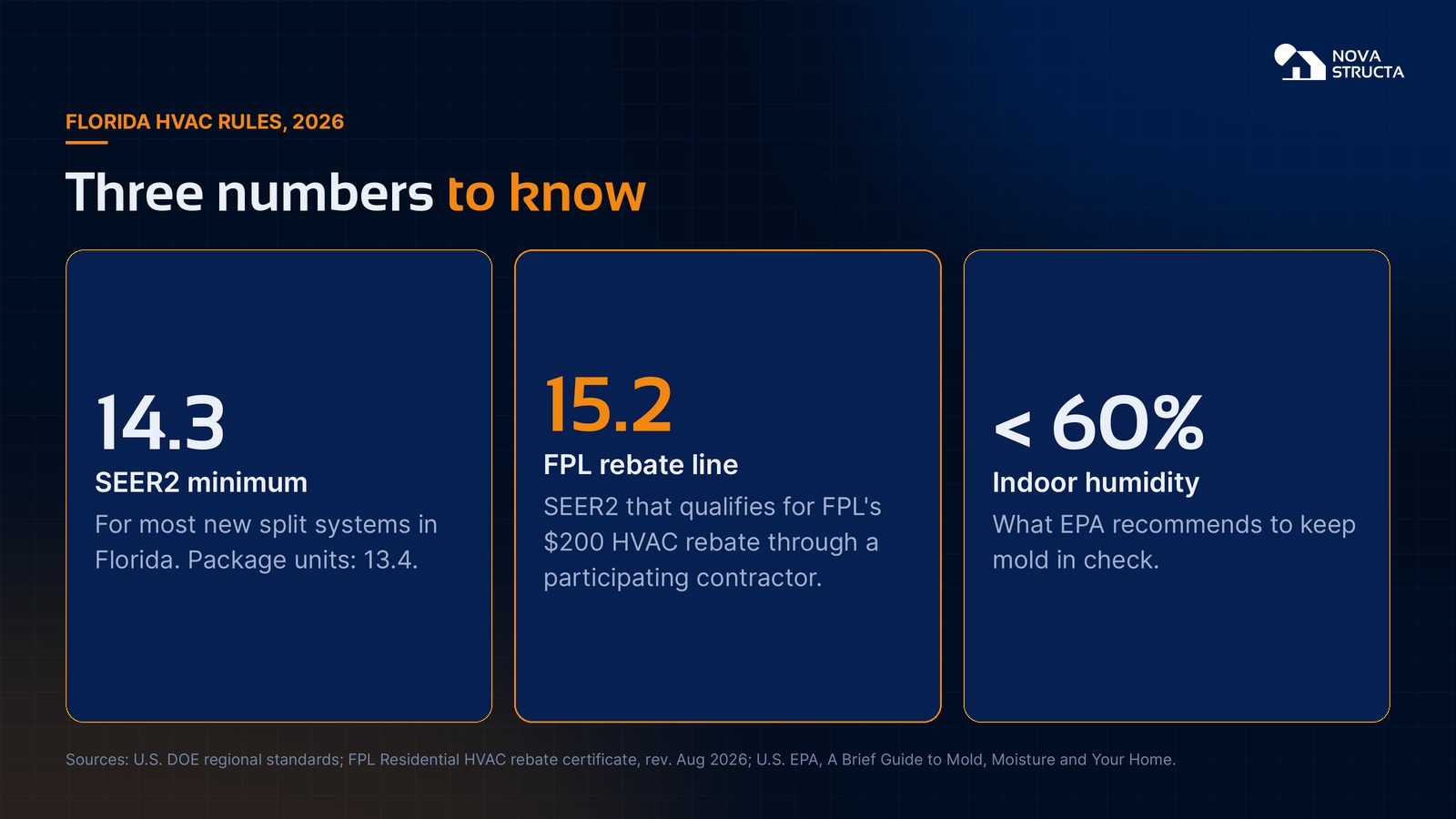
- Efficiency minimums. Since 2023, most new split systems installed in Florida must be at least 14.3 SEER2, and single-package units 13.4 SEER2 [2]. Every unit in our lineup meets the minimum for its type.
- Refrigerant. New systems are moving to lower-impact refrigerants such as R-454B and R-32: Carrier's Crossover uses R-454B [6], and the Daikin Entra, Daikin Oterra and Goodman GPHH use R-32 [7] [8] [9]. In May 2026, EPA removed the installation deadline for R-410A split systems [14], but new equipment lines are moving to the newer refrigerants.
- FPL rebate. FPL's residential HVAC rebate is $200 at 15.2 SEER2 or higher, through an FPL participating contractor, under its program standards [3] [4].
- Federal tax credit. The federal 25C credit for heat pumps and central air ended for equipment placed in service after December 31, 2025 [15].
For what a replacement typically costs, see how much a new AC costs in Florida. Not sure whether to replace yet? See 5 signs it's time to replace your HVAC system.
What to ask before you choose
- Which type fits my house, and why: split, ductless or package?
- A Manual J load calculation before the size is chosen [11].
- The AHRI matched rating for the exact outdoor unit, coil and air handler [11].
- A duct check, and what it would take to fix leaks or add a supply or return [13].
- How the system will keep humidity under 60% [12].
- Whether the system qualifies for the FPL rebate, if FPL is your utility [4].
- The warranty, in writing: parts, labor, and what registration it needs.

Quick answers
What is the best AC brand for Florida?
Carrier, Daikin and Goodman all make systems that work in Florida. Fit matters more than the brand: the right type for the house, sized by a load calculation, matched indoors and out, on tight ducts [10] [11]. For humid or uneven houses, our first pick is the variable-speed Carrier Crossover.
What SEER2 rating should I get in Florida?
At least 14.3 SEER2 for most split systems; that is the federal minimum [2]. If FPL is your utility, 15.2 or higher can qualify for its rebate [4]. Above that, each step uses less electricity for the same cooling.
Is variable speed worth it in Florida?
It is where variable speed helps most. Long, low runs give the coil time to pull moisture out [10] [11], which is the half of the job a single-speed system does worst when it short cycles.
What is the most efficient unit you offer?
The Daikin Oterra 115V ductless, at 20 SEER2 [8]. For whole-house central systems, Carrier Crossover reaches 18.8 SEER2 in the 1.5 ton size, and Daikin's top split is 17.5.
Do I need a package unit or a split system?
Usually whatever the house was built for. If your equipment is all in one cabinet outside and there is no indoor air handler, a package unit like the Goodman GPHH is the direct replacement [9]. If there is an air handler in a closet, garage or attic, it is a split system.
Can I add AC to one room without ducts?
Yes. A ductless wall unit like the Daikin Entra (¾ to 2 tons) or Oterra 115V (¾ and 1 ton) cools one room or zone without new ductwork [7] [8].
The bottom line
The best HVAC system for a Florida home is the right type for the house, sized to it, matched indoors and out, and able to keep humidity under 60%. For ducted homes that means a central split: Carrier Crossover for the driest, steadiest comfort, Daikin across four efficiency steps, or Goodman at code minimum. Rooms without ducts get Daikin Entra or Oterra, and homes built around a package unit get the Goodman GPHH.
To see the whole lineup, filter it by type and size on HVAC systems, or book a free assessment to have it matched to your house.
Results vary by home, equipment, usage and installation. SEER2 ratings and sizes are as listed for the systems Nova Structa offers; final equipment, matched components, ratings and warranties are set out in the written proposal. Rebates are set by the utility and subject to its program rules. Examples and visuals are illustrative only. Nova Structa coordinates consultations, project review, and customer support, but does not perform installation work. Installations are performed by independent Florida licensed contractor(s). Carrier, Crossover and Puron Advance are trademarks of Carrier. Daikin, Entra and Oterra are trademarks of Daikin. Goodman and AsureCare are trademarks of Goodman Manufacturing. REME HALO is a trademark of its owner. ENERGY STAR is a registered trademark of the U.S. Environmental Protection Agency. FPL is a trademark of Florida Power & Light Company. References are for identification only and do not imply sponsorship, endorsement, certification, partnership, or affiliation.
Sources
- U.S. Energy Information Administration, 2020 Residential Energy Consumption Survey, state air conditioning tables. eia.gov (PDF)
- U.S. Department of Energy, Central Air Conditioners: Regional Standards Enforcement Guidance (2023 standards; Southeast split AC under 45,000 Btu/h and split heat pumps: 14.3 SEER2; single-package units: 13.4 SEER2). energy.gov (PDF)
- Florida Power & Light, Residential HVAC Program Standards, effective September 1, 2025. fpl.com (PDF)
- Florida Power & Light, Air Conditioning Rebate Certificate (Residential HVAC, SEER2 15.2, $200), rev. August 1, 2026. fpl.com (PDF)
- Carrier, "Crossover Solutions" (inverter technology, consistent comfort, quiet operation, small outdoor unit, third-party thermostat compatible). carrier.com
- Carrier, Performance Crossover Air Handler, model 45MUHA (variable-speed motor; Puron Advance R-454B refrigerant). carrier.com
- Daikin, Entra wall mount single-zone ductless heat pump (up to 18 SEER2; R-32). daikincomfort.com
- SupplyHouse, Daikin Oterra single-zone 9,000 Btu ductless heat pump, 115V, R-32, 20 SEER2 (retailer listing). supplyhouse.com
- South Mini Splits, Goodman 3 ton 13.4 SEER2 package heat pump, R-32 (retailer listing for the GPHH3 series). southminisplits.com
- Florida Building Commission, "Energy Efficiency and Moisture Control in the Florida Climate," report of the February 28, 2007 symposium (latent load about 20% in Florida; short cycling from oversizing). floridabuilding.org
- U.S. Department of Energy, Building America, "Why Right-Size? Science versus Practicality" (Consortium for Advanced Residential Buildings, 2009). energy.gov (PDF)
- U.S. Environmental Protection Agency, "A Brief Guide to Mold, Moisture and Your Home." epa.gov
- ENERGY STAR, "Duct Sealing" (20 to 30% of air lost through leaks, holes and poorly connected ducts in a typical house). energystar.gov
- ACHR News, "EPA Removes R-410A Installation Deadline," May 21, 2026. achrnews.com
- Internal Revenue Service, Energy Efficient Home Improvement Credit. irs.gov
Savings and utility-bill examples shown are illustrative only, are not guaranteed, and may not reflect typical results. Actual savings depend on your energy usage, system size, roof and site conditions, financing terms, utility rates, net-metering rules, and other factors specific to your home.