How much does a new AC cost in Florida?
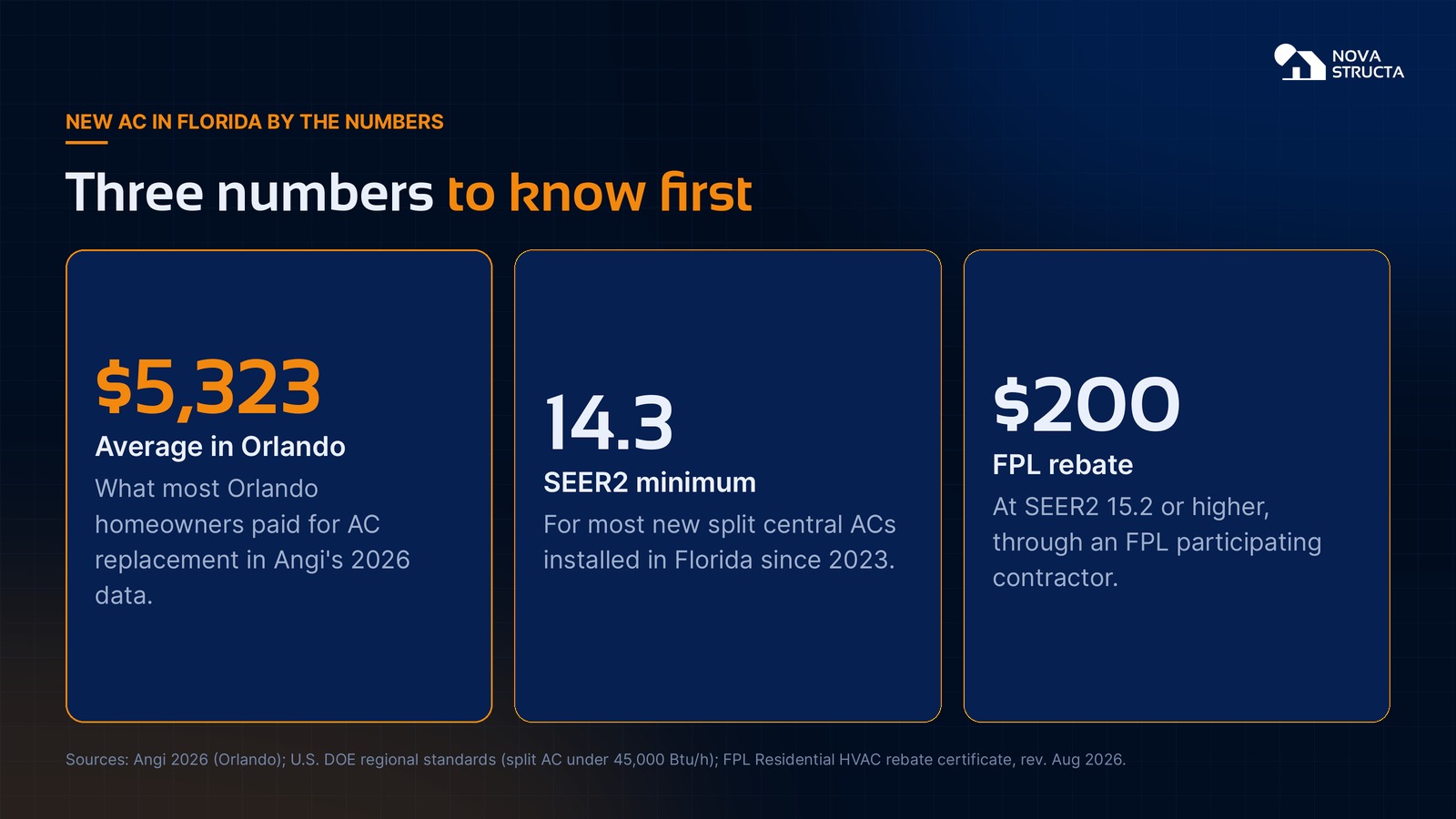
About $5,300 to $5,600 on average. Angi's 2026 cost data puts the average AC replacement at $5,323 in Orlando and $5,552 in Tampa, with most homeowners in those cities paying between roughly $3,900 and $7,000 [2] [3]. Bigger homes, a full indoor and outdoor system, higher efficiency or new ductwork push the total higher, and nationally Angi sees AC replacement jobs run anywhere from $1,400 to $12,500 [1].
Those are averages, not quotes. A real number for your home starts with a load calculation and a look at what you have now: the outdoor unit, the indoor air handler and coil, the ducts and the electrical. The rest of this page walks through what moves the price, what changed in 2026, and how to read a quote.
One side yard, four moments: tap to compare
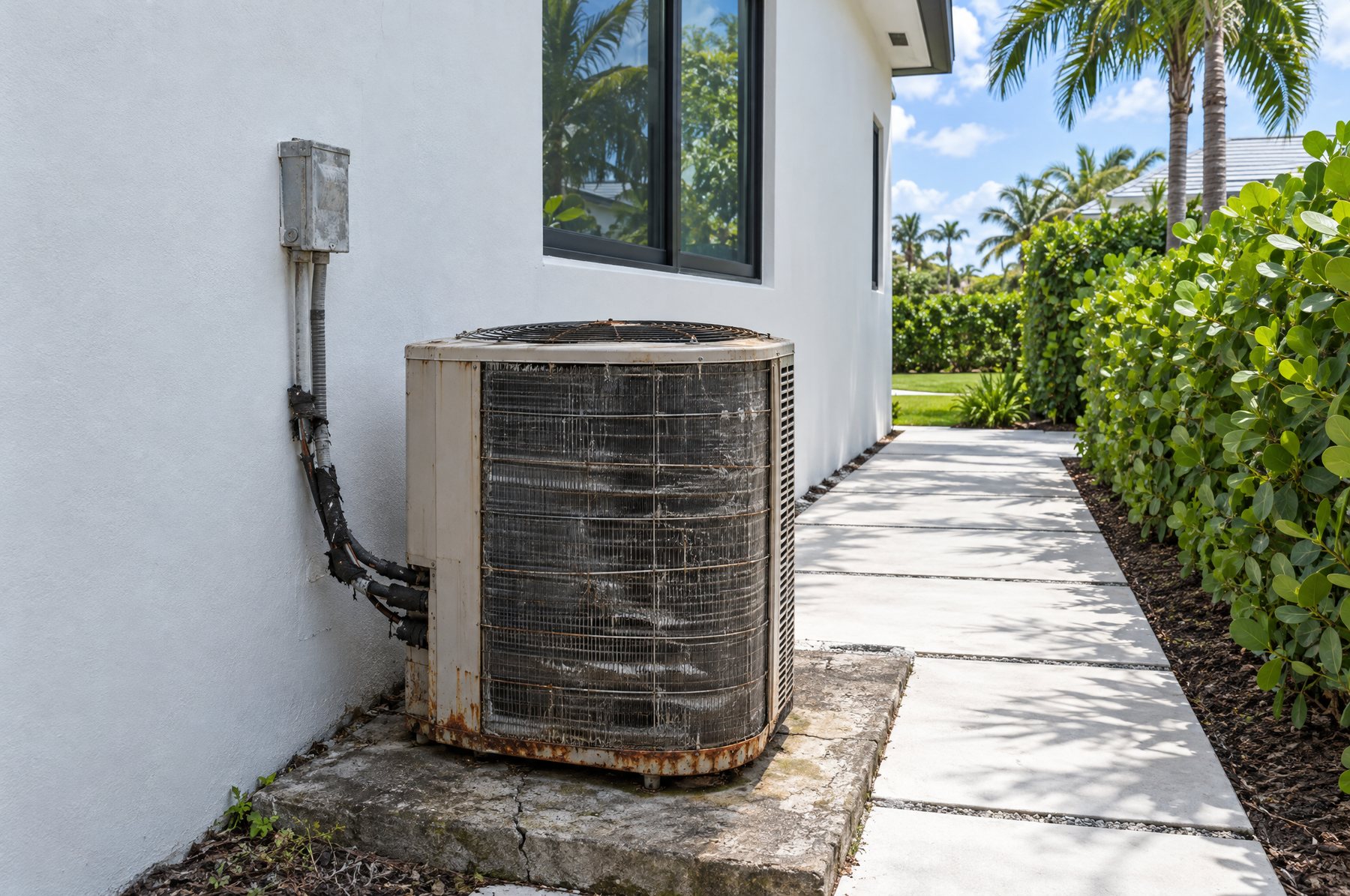
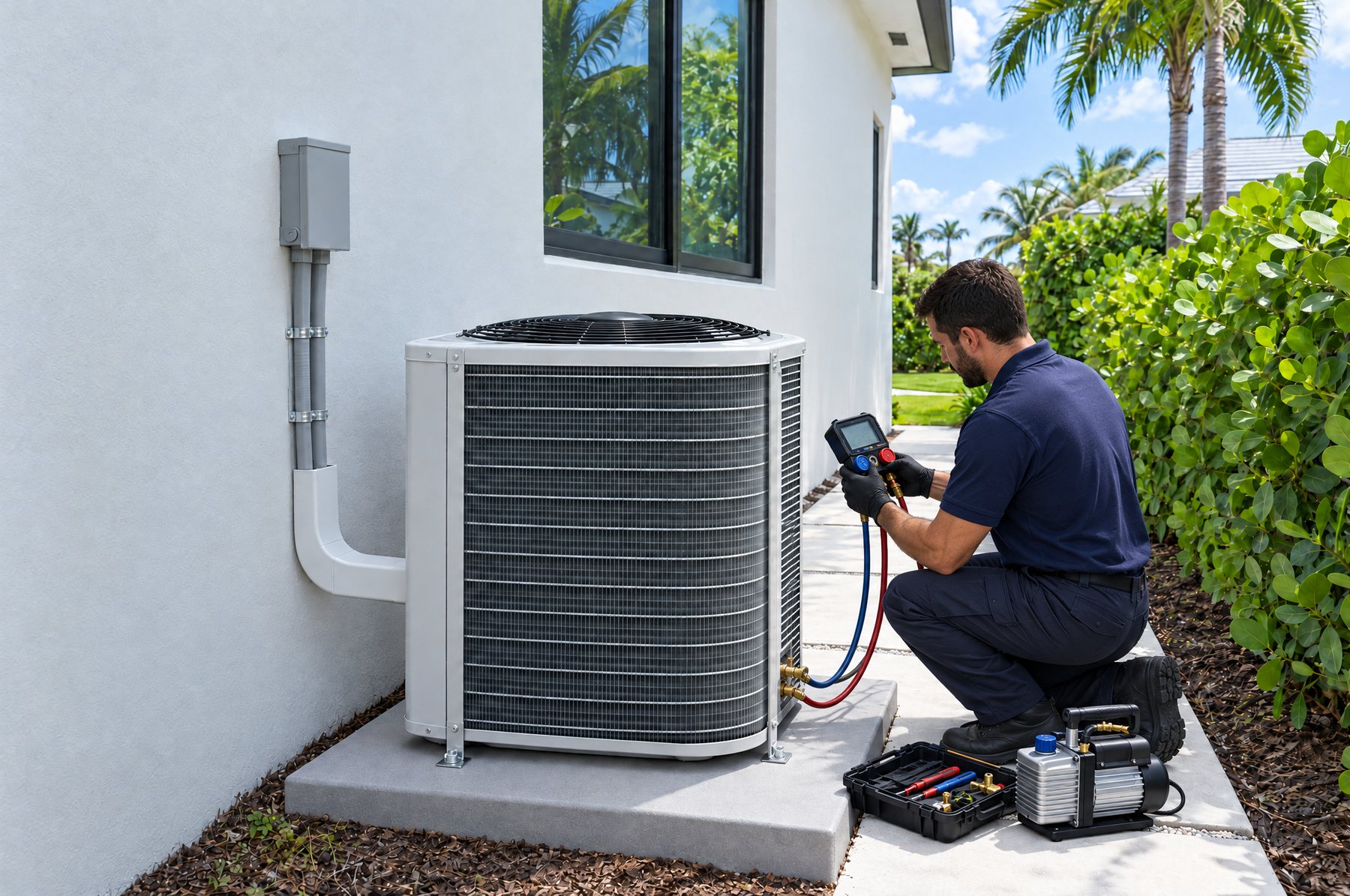
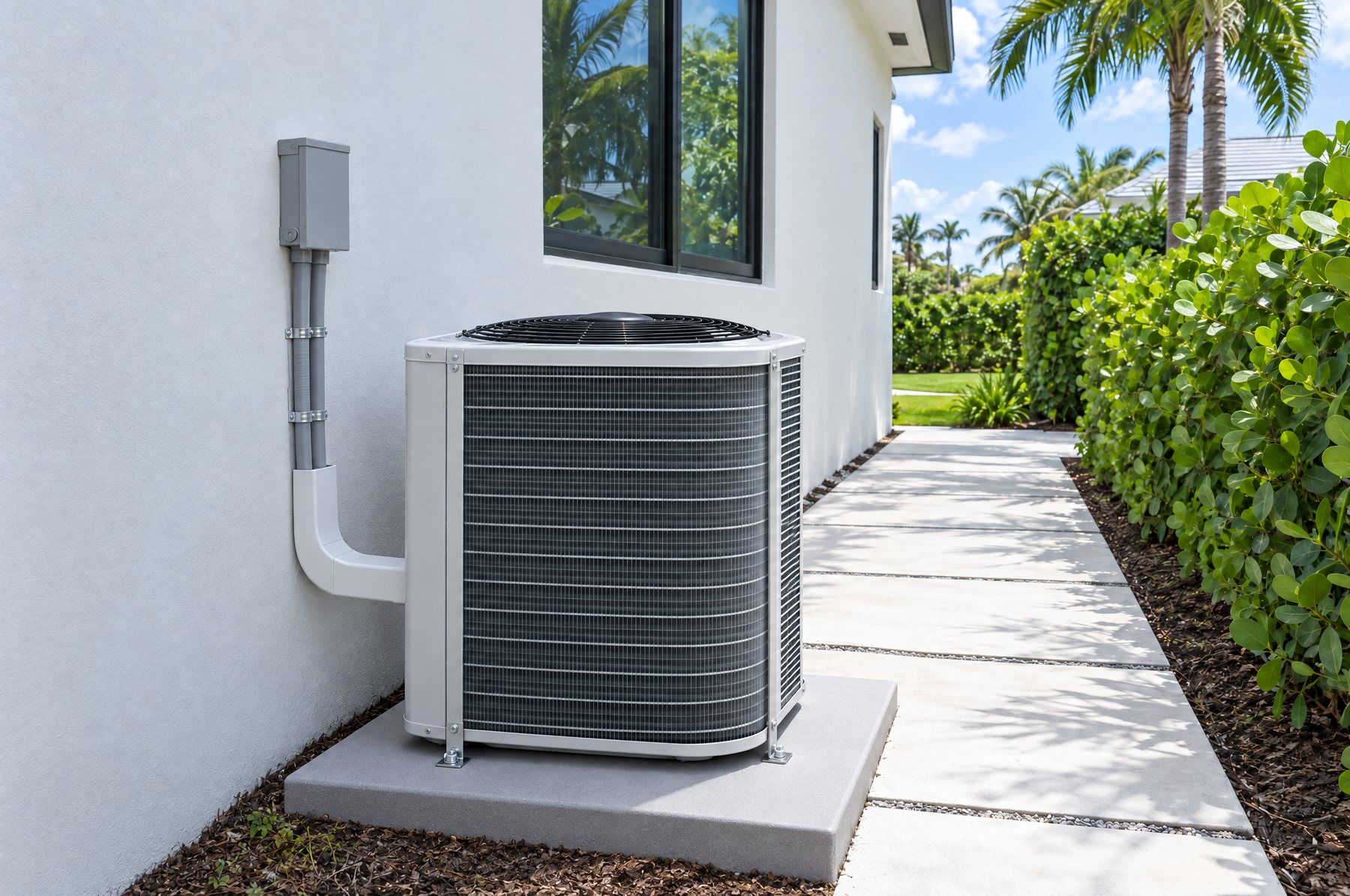
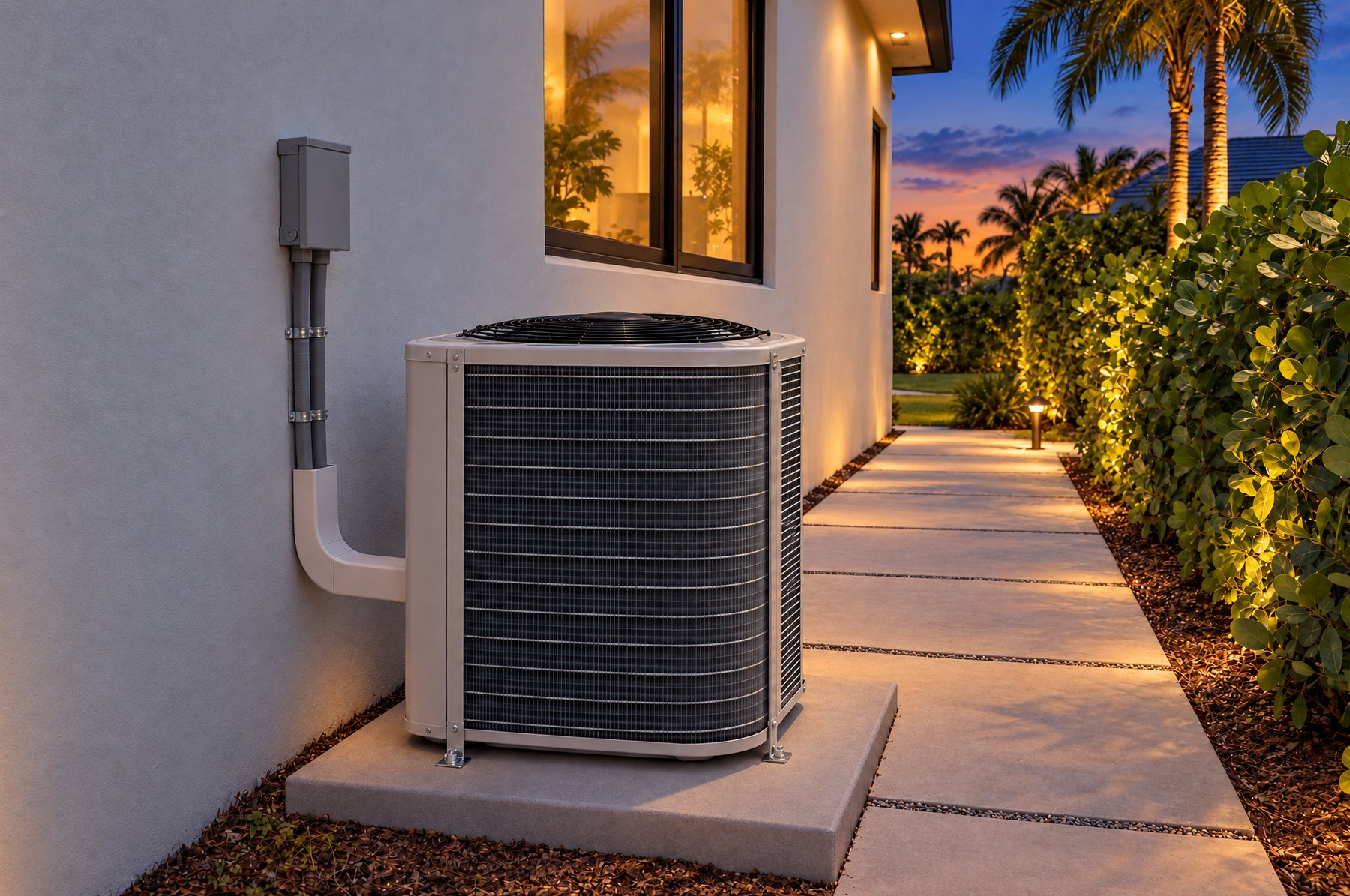 Today: the 15-year-old unitInstall dayThe new systemThat night
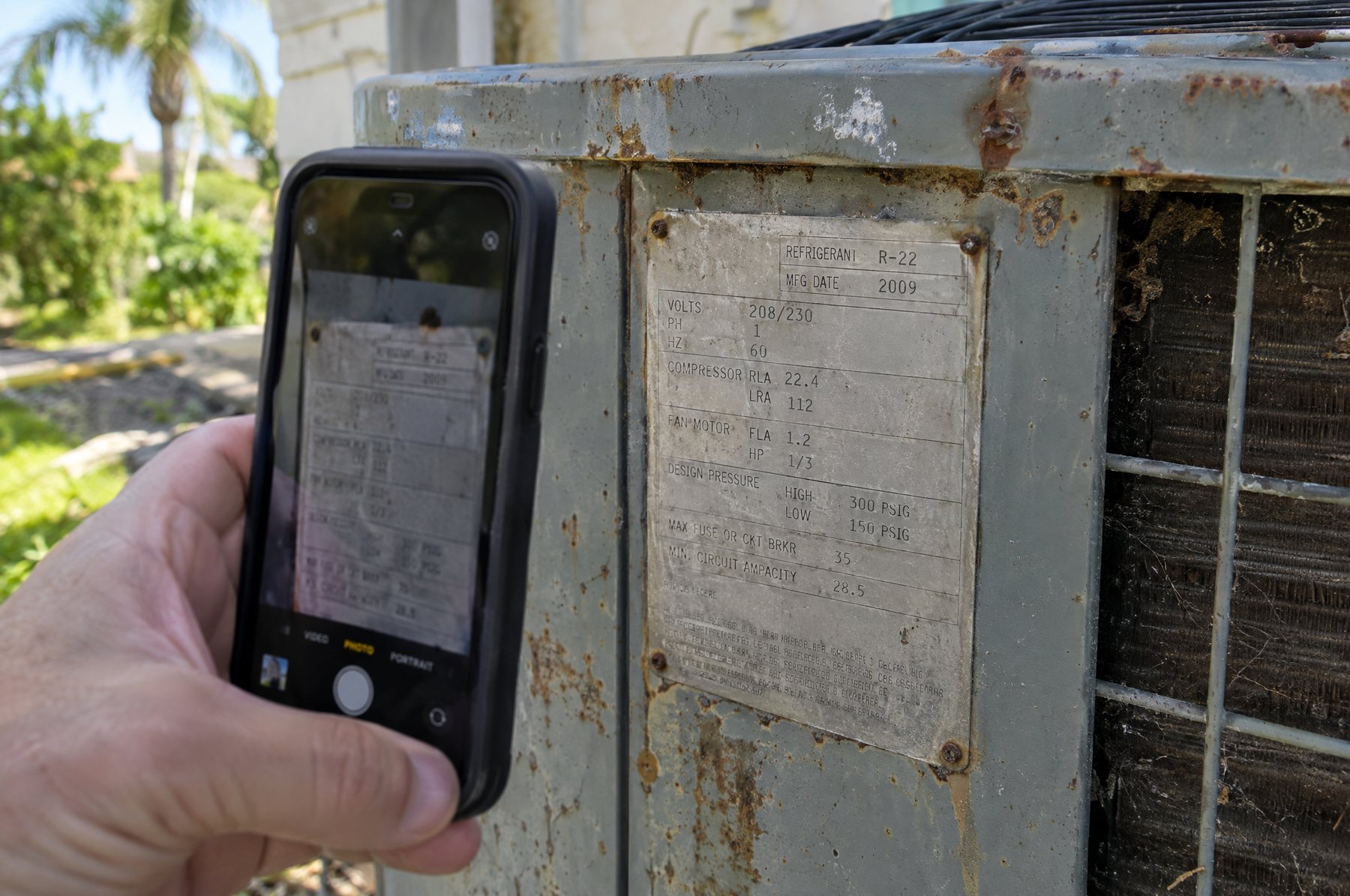
The starting point. A unit past the 10-year mark, which is the first sign ENERGY STAR lists for considering a replacement [10]. Check the data plate: if it says R-22, no new supply of that refrigerant has been made or imported since 2020 [11].
Install day. The old refrigerant is recovered, the new equipment is set and wired, the lines are evacuated with a vacuum pump, and the system is charged and tested against the manufacturer's numbers. Refrigerants are not interchangeable, so the charge has to match the equipment [6].
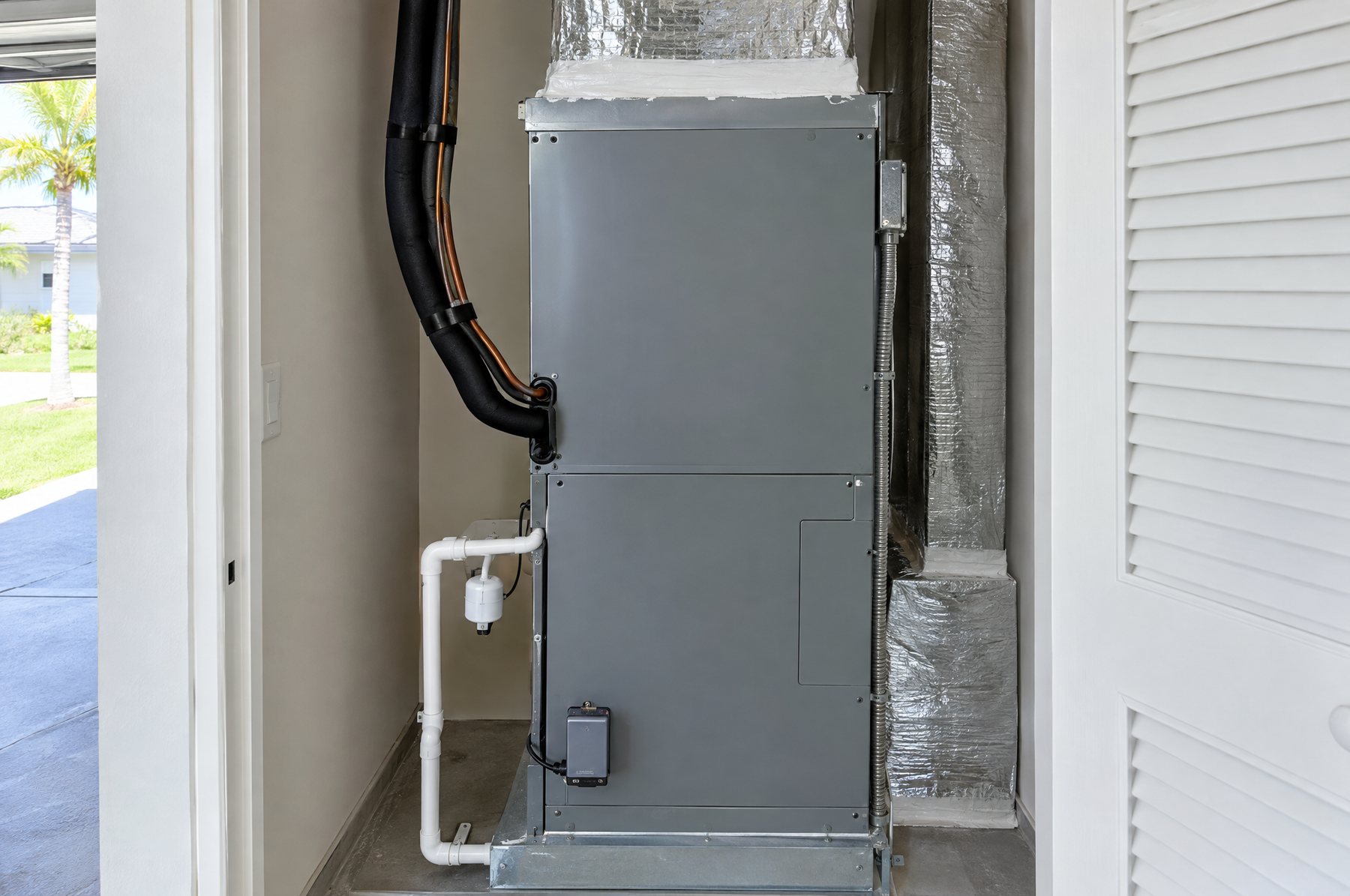
The new system. A matched outdoor unit, indoor coil and air handler, on a new pad with a new disconnect, permitted and inspected. A complete replacement like this is also what FPL's rebate requires [7].
That night. The point of all of it: a house that stays cool and dry through a Florida summer. In Florida, air conditioning is close to universal and most homes cool with central air [12], so this one system does a lot of work.
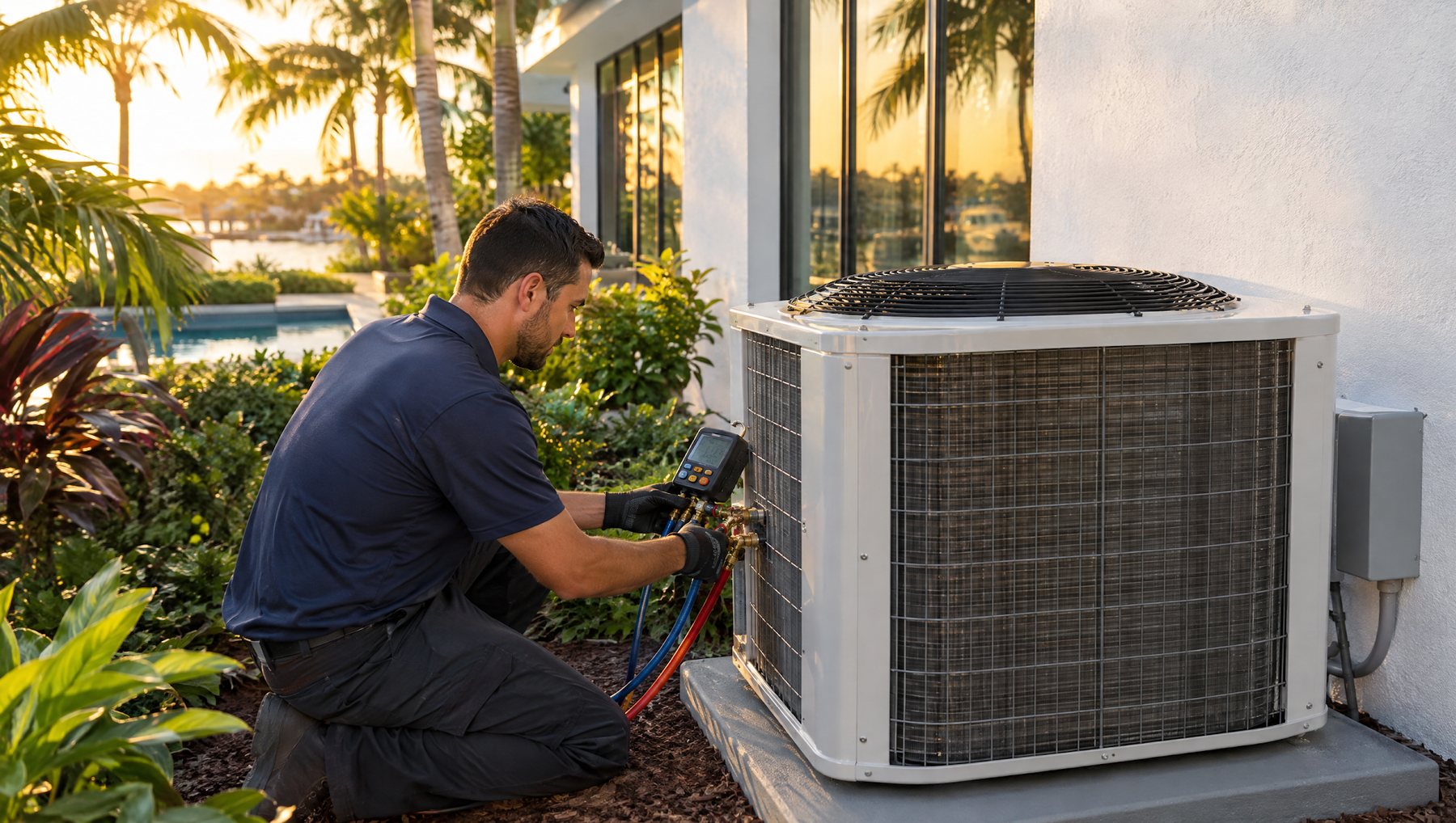
Same side yard, same camera, four moments. Photos are illustrations, not a specific product.
What Florida homeowners pay in 2026
| Average | What most people pay | |
|---|---|---|
| Orlando | $5,323 | $3,874 to $6,798 [2] |
| Tampa | $5,552 | $4,100 to over $7,003 [3] |
| U.S., replacing an existing system | Not listed | $3,887 to $8,073, ducts and wiring already in place [1] |
| U.S., all AC replacement jobs | $5,978 | $1,400 to $12,500 [1] |
All figures are Angi's 2026 cost data. They are a fair starting point for a budget, and they blend many kinds of jobs, from a simple outdoor unit swap to a full system with ductwork. Your quote can land above or below them.
What moves the price
- Size. Systems are sized in tons of cooling. A bigger home needs more, and Angi's tonnage table shows the equipment price climbing with every step up [1]. The right size comes from a load calculation on your house, not from the label on the old unit. Too big is not better: an oversized unit cools fast, shuts off and leaves the air clammy. See what size AC you need.
- Outdoor unit only, or the whole system. Replacing only the condenser is cheaper today, but the new outdoor unit has to be approved to work with the indoor coil it is paired with. Most new equipment now runs on newer refrigerants such as R-454B, and refrigerants are not interchangeable [6], so a matched outdoor unit, coil and air handler is often the cleaner job.
- Efficiency. Most new split central ACs installed in Florida must reach at least 14.3 SEER2 [4]. Higher SEER2 ratings and variable-speed equipment cost more up front and can lower what you spend to run the system, depending on your home and how you use it.
- Ducts. If the ducts are leaking, undersized or falling apart in the attic, fixing them costs extra. New ductwork runs $3,000 to $7,500 for 300 linear feet in Angi's data [1]. Sealing and repairs cost less.
- Everything around the box. A new pad, a disconnect and wiring, the condensate drain and float switch, refrigerant recovery and haul-away, the thermostat, and the permit and inspection. A good quote lists each one.
What changed in 2026
- R-410A did not get banned. In May 2026, EPA finalized a rule removing the January 1, 2026 installation deadline for home AC and heat pump systems that use higher-impact refrigerants like R-410A, as long as the equipment was made or imported before 2025 [5]. In practice that means leftover inventory. Industry groups say over 90% of new residential and light commercial equipment already uses next-generation refrigerants, and they expect refrigerant prices to rise rather than fall [5]. Existing R-410A systems can still be serviced.
- The federal tax credit is over. The federal energy efficient home improvement credit covered qualifying equipment installed through December 31, 2025 [9]. A system installed in 2026 does not qualify. Nova Structa does not provide tax advice, so check with a qualified tax professional about your situation.
- FPL still pays a rebate. FPL's residential HVAC program pays $200 per qualifying unit as an instant credit on the contractor's invoice [7]. The system must be SEER2 15.2 or higher [8], AHRI certified, installed by an FPL participating independent contractor, and it must replace the whole system, outdoor and indoor [7]. Duke Energy Florida, TECO and municipal utilities run their own programs, so check yours before you sign.
Should you repair or replace?
01How old is your AC?
02What refrigerant is on the data plate?
03What is the repair you were quoted?
04Is the house sticky or uneven even when it runs?
Answer the four questions to see where you land.
Repair is usually the first call. A system under 10 years old often has plenty of life left. Fix it, and keep up with maintenance.
Check the warranty before you pay. Major parts on a younger system may still be covered by the manufacturer's parts warranty, which commonly runs five to 10 years [1].
Price both options side by side. At 10 to 15 years, ask for a repair quote and a replacement quote at the same visit, so you are comparing real numbers.
Start planning a replacement. Past 15 years, the question is when, not if. Planning now means you choose the system and the timing instead of a July breakdown choosing for you.
This is where replacing usually wins. A major repair on a system this old buys time on parts that are near the end of their life. Put that money toward the new system.
Take a photo of the data plate. It is on the side of the outdoor unit and lists the refrigerant and usually the manufacture date. Send it with your quote request.
Ask about sizing and ducts. Humidity and hot rooms are signs ENERGY STAR links to equipment, ducts or insulation [10]. Ask for a load calculation and a duct check, not just a bigger unit.
Tap one answer per question. The result is a starting point for a conversation, not a diagnosis. For more warning signs, see 5 signs it's time to replace your HVAC system.
How to read an AC quote
- The load calculation. Proof the size was calculated for your house, not copied from the old unit.
- The exact equipment. Make and model of the outdoor unit, the indoor coil and the air handler, plus the AHRI certificate showing they are rated together. That certificate is also what the FPL rebate needs [7].
- The refrigerant. Which one the system uses, and confirmation the indoor coil is approved for it [6].
- The SEER2 rating. At least 14.3 for most split ACs [4], and 15.2 or higher if you want the FPL rebate [8].
- The line items. Pad, disconnect and wiring, drain line and float switch, line set or flush, thermostat, duct work, permit, refrigerant recovery and haul-away.
- The rebate. Whether the contractor is an FPL participating independent contractor and shows the rebate as a credit on the invoice [7].
- The warranties. Manufacturer parts warranty, registration deadline, and the labor warranty, in writing.
- The license. Florida requires a licensed mechanical or air conditioning contractor for FPL's program [7], and you should expect one on any system replacement.
Comparing two or three itemized quotes built on the same size and SEER2 rating is the fastest way to see which one is the real deal.
Quick answers
How much is a new AC unit in Florida?
Angi's 2026 data puts the average AC replacement at $5,323 in Orlando and $5,552 in Tampa [2] [3]. A full matched system, a larger home, higher efficiency or new ducts can push a quote well past that.
How long does an AC last in Florida?
Angi puts the typical life of an AC at 10 to 20 years [1]. In Florida, where the system runs most of the year, plan for the shorter end, and start pricing a replacement once yours passes 10 years [10].
Is there a tax credit for a new AC in 2026?
No. The federal energy efficient home improvement credit covered qualifying equipment installed through December 31, 2025 [9]. Utility rebates, such as FPL's $200, are still available [7].
Can I still buy an R-410A system?
Only from leftover inventory made or imported before 2025, which EPA now lets contractors install with no cutoff date [5]. Most new systems use newer refrigerants such as R-454B.
Do I need a permit to replace my AC in Florida?
Yes. The Florida Building Code requires a permit to install or replace mechanical equipment like a central AC [13], followed by an inspection from your local building department. Your licensed contractor pulls it, and the permit should be listed on the quote.
Should I replace the indoor unit too?
Usually, yes. FPL's rebate requires replacing the whole system [7], and the new outdoor unit has to be approved to work with the indoor coil and refrigerant [6]. Ask to see the AHRI certificate for the exact pairing.
The bottom line
A new AC in Florida averages around $5,300 to $5,600 in Angi's 2026 data for Orlando and Tampa, and the real number depends on the size of your home, whether you replace the whole system, the efficiency you choose and the shape of your ducts. 2026 brought two changes worth knowing: the federal tax credit is gone, and FPL's $200 rebate is still there for qualifying systems.
If you would like a quote built on your house, with the load calculation and every line item in writing, see HVAC systems or book a free assessment.
Results vary by home, equipment, usage, rate plan and installation. Prices shown are third-party averages, not a Nova Structa quote. Examples and visuals are illustrative only. Nova Structa coordinates consultations, project review, and customer support, but does not perform installation work. Installations are performed by independent Florida licensed contractor(s). ENERGY STAR is a registered trademark of the U.S. Environmental Protection Agency. Angi is a trademark of its owner. References are for identification only and do not imply sponsorship, endorsement, certification, partnership, or affiliation.
Sources
- Angi, "How Much Does AC Replacement Cost? [2026 Data]," updated July 20, 2026. angi.com
- Angi, "How Much Does AC Replacement Cost in Orlando? [2026 Data]," updated July 9, 2026. angi.com
- Angi, "How Much Does AC Replacement Cost in Tampa? [2026 Data]," updated August 4, 2026. angi.com
- U.S. Department of Energy, Central Air Conditioners: Regional Standards Enforcement Guidance (2023 standards; Southeast split AC under 45,000 Btu/h: 14.3 SEER2). energy.gov (PDF)
- ACHR News, "EPA Removes R-410A Installation Deadline," May 21, 2026, on EPA's final Technology Transitions rule (Docket EPA-HQ-OAR-2026-2905). achrnews.com
- ACHR News (republished from HARDI), "Why Substituting R-410A for R-454B Is a Bad Idea," August 26, 2025. achrnews.com
- Florida Power & Light, Residential HVAC Program Standards, effective September 1, 2025. fpl.com (PDF)
- Florida Power & Light, Air Conditioning Rebate Certificate (Residential HVAC, SEER2 15.2, $200), rev. August 1, 2026. fpl.com (PDF)
- Internal Revenue Service, Energy Efficient Home Improvement Credit. irs.gov
- ENERGY STAR, "When is it time to replace?" energystar.gov
- U.S. Environmental Protection Agency, Homeowners and Consumers: Frequently Asked Questions (HCFC-22 phaseout). epa.gov
- U.S. Energy Information Administration, 2020 Residential Energy Consumption Survey, state air conditioning tables. eia.gov (PDF)
- Florida Building Code, 8th Edition (2023), Building, Chapter 1 Scope and Administration, Section 105 Permits. codes.iccsafe.org
Savings and utility-bill examples shown are illustrative only, are not guaranteed, and may not reflect typical results. Actual savings depend on your energy usage, system size, roof and site conditions, financing terms, utility rates, net-metering rules, and other factors specific to your home.