Water
Tank vs. Tankless Water Heaters in Florida (2026): The Third Option Most Homes Miss
Is a tank or tankless water heater better for a Florida home?
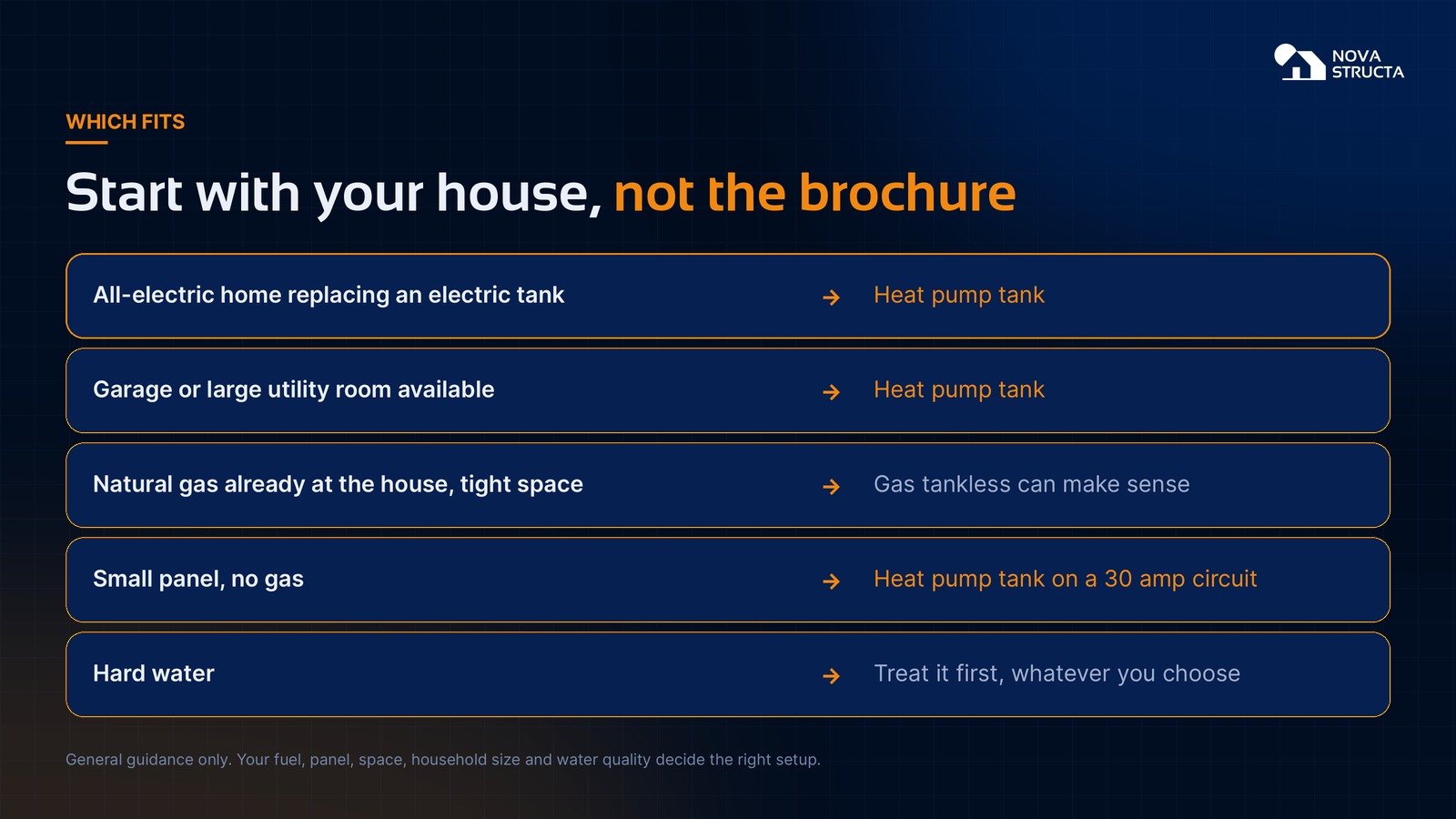
For most all-electric Florida homes, the strongest choice is neither a standard tank nor tankless. It is a heat pump (hybrid) tank. It is rated about four times as efficient as a whole-home electric tankless heater, it runs on the same 30 amp circuit a typical electric tank uses, and it is built for the warm garages most Florida water heaters already sit in. Gas tankless still makes sense for some homes that already have natural gas and little floor space.
Most people frame this as tank vs. tankless, two choices. In Florida that framing leaves out the option that fits the most homes. Close to four in five Florida homes run entirely on electricity [1], so for most families the real comparison is between three electric options: a standard electric tank, an electric tankless unit and a heat pump tank. Each one has a place. They just ask very different things of your house.
Full disclosure: the water heater we offer is the Rheem ProTerra heat pump tank, in 50 and 80 gallon sizes. We have tried to be fair to tankless anyway, and we say plainly where it is the better fit. Every claim links to a source. This is general information, not a promise about any specific home.
What are the three ways to heat water at home?
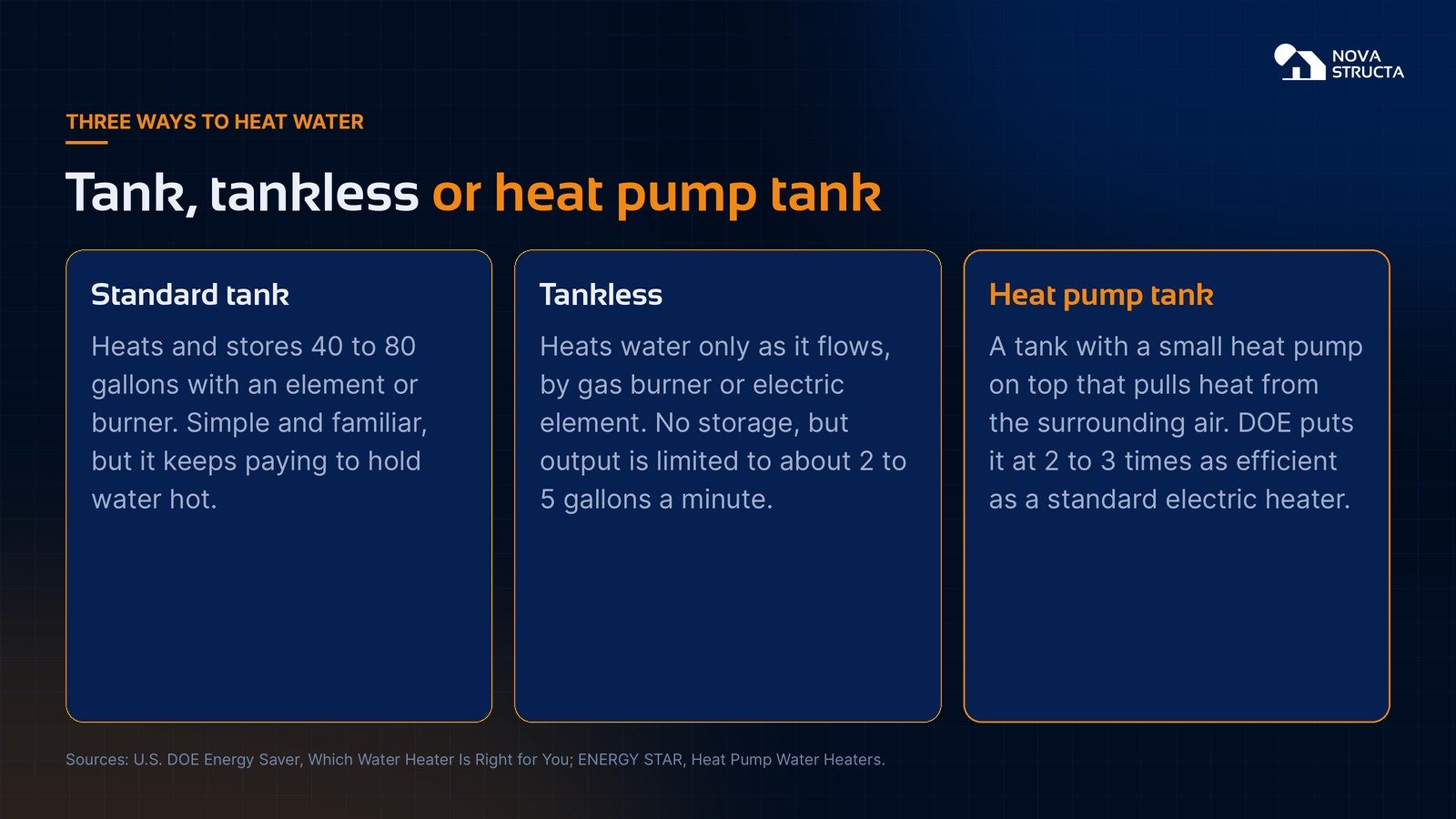
- Standard storage tank. An electric element or gas burner heats a tank of water and keeps it hot until you use it. It is simple and familiar, but it loses some heat just standing by. The U.S. Department of Energy (DOE) puts typical life at 10 to 15 years [2].
- Tankless (on demand). Water is heated only as it flows through the unit, by a gas burner or electric elements. There is no tank to keep hot. DOE estimates tankless units are 8% to 34% more energy efficient than conventional storage tanks, depending on how much hot water a home uses, and that they deliver about 2 to 5 gallons a minute [2].
- Heat pump (hybrid) tank. A tank with a small heat pump on top. Instead of making heat with an element, it moves heat out of the surrounding air into the water, the way a refrigerator works in reverse. DOE says these units can be 2 to 3 times more energy efficient than conventional electric resistance water heaters [2]. Most also carry backup electric elements for heavy demand.
What makes Florida different?
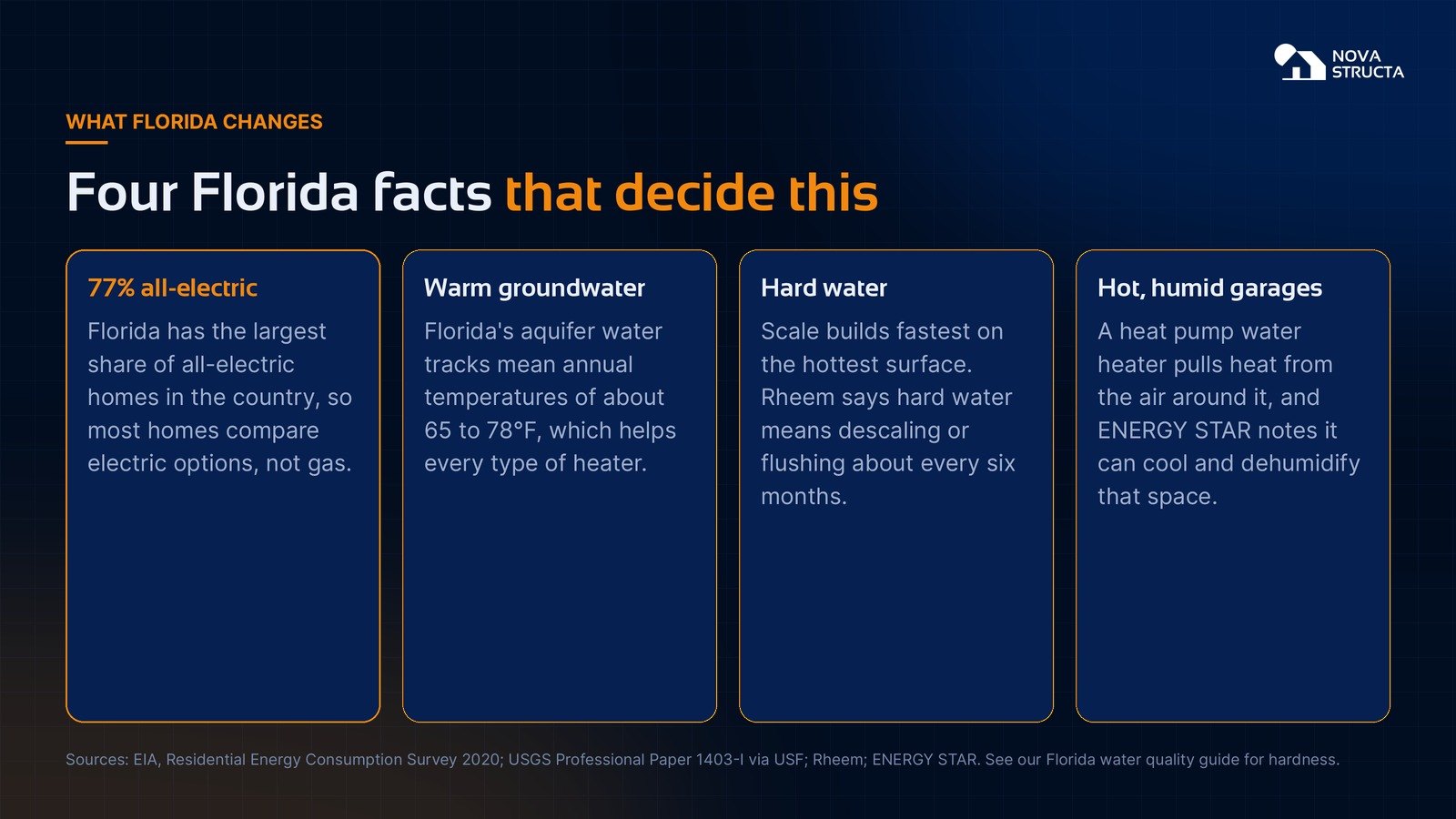
Four things about Florida tilt this decision:
- Most homes are all-electric. Florida had the largest share of all-electric homes of any state in 2020, at 77% (6.2 million homes) [1]. Gas tankless is only on the table if gas already reaches the house, and for most homes it does not.
- The climate is warm, and so is the water. Mean annual temperatures across the area the USGS studied range from about 65 to 78°F, and that mildness shows up in groundwater from the Upper Floridan aquifer [12]. Warmer incoming water means less heating work for every type of heater.
- Garages are hot and humid much of the year. A heat pump water heater pulls its heat from the air around it, and ENERGY STAR notes it can cool and dehumidify the space it sits in [3]. In a Florida garage, that is the kind of air a heat pump works well in.
- Hard water is common. Scale builds up inside any water heater, and Rheem advises descaling or flushing a tankless unit about every six months where water is hard [8]. See our Florida water quality guide and whole-home water filtration explainer for how to check yours.
Which type is the most efficient?
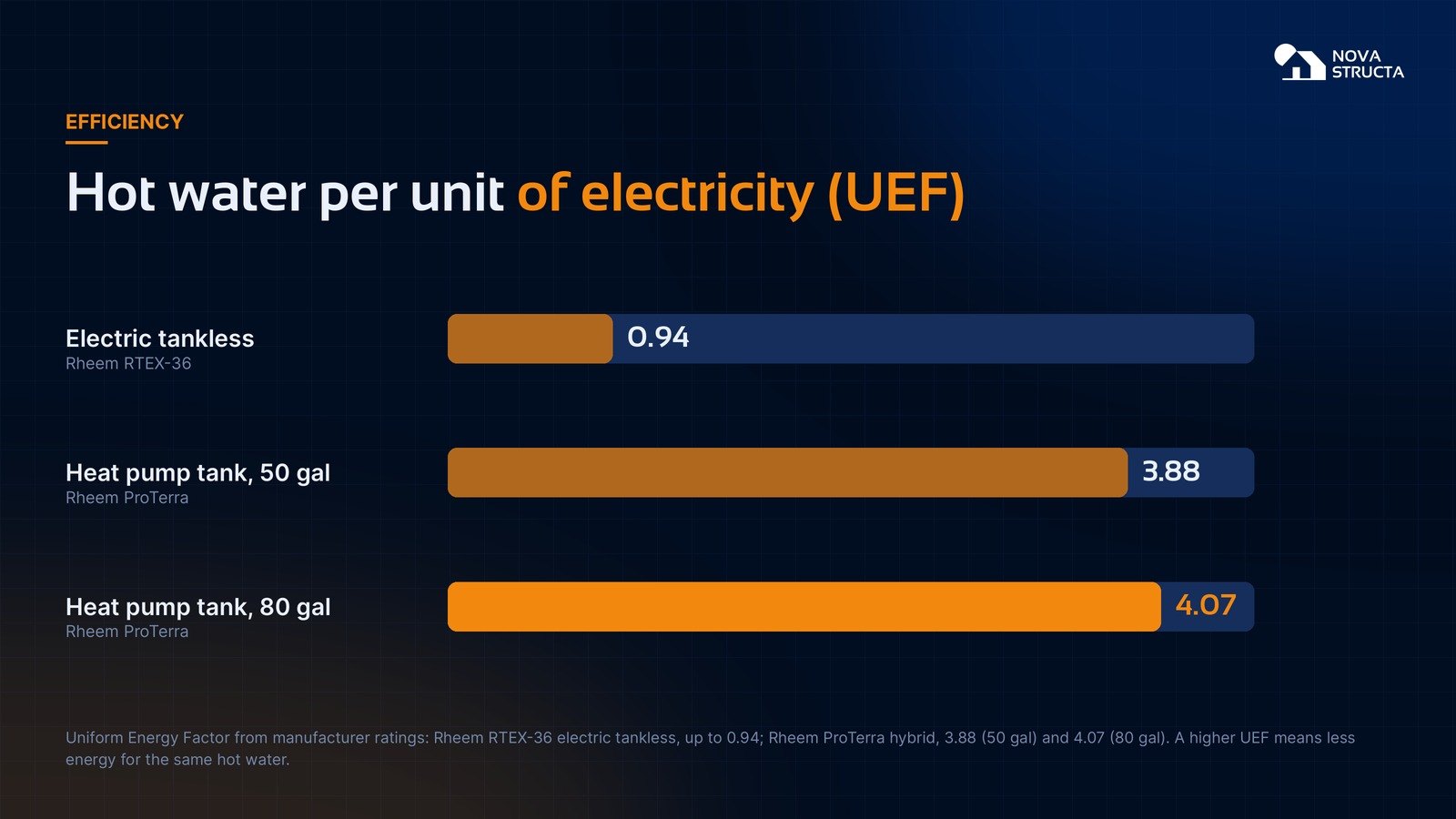
Water heaters are rated by Uniform Energy Factor (UEF), a federal test number for how much hot water you get per unit of energy. Higher is better. An electric element can never beat 1.0 on this scale, because it can only turn electricity into an equal amount of heat. A heat pump moves heat that is already in the air, so it can go well past 1.0.
| Water heater | Rated UEF | Source |
|---|---|---|
| Rheem RTEX-36 whole-home electric tankless | Up to 0.94 | Rheem [6] |
| Rheem ProTerra 50 gallon heat pump tank | 3.88 | Rheem [5] |
| Rheem ProTerra 80 gallon heat pump tank | 4.07 | Rheem [5] |
On paper, the heat pump tank gets roughly four times as much hot water from the same electricity as an electric tankless unit. ENERGY STAR estimates a family of four that switches from a standard electric water heater to a certified heat pump model saves about 3,760 kWh a year [4]. That is ENERGY STAR's estimate, not a promise. Your result depends on how much hot water you use, where the unit sits and how it is set up.
What does each one need from your electrical panel?
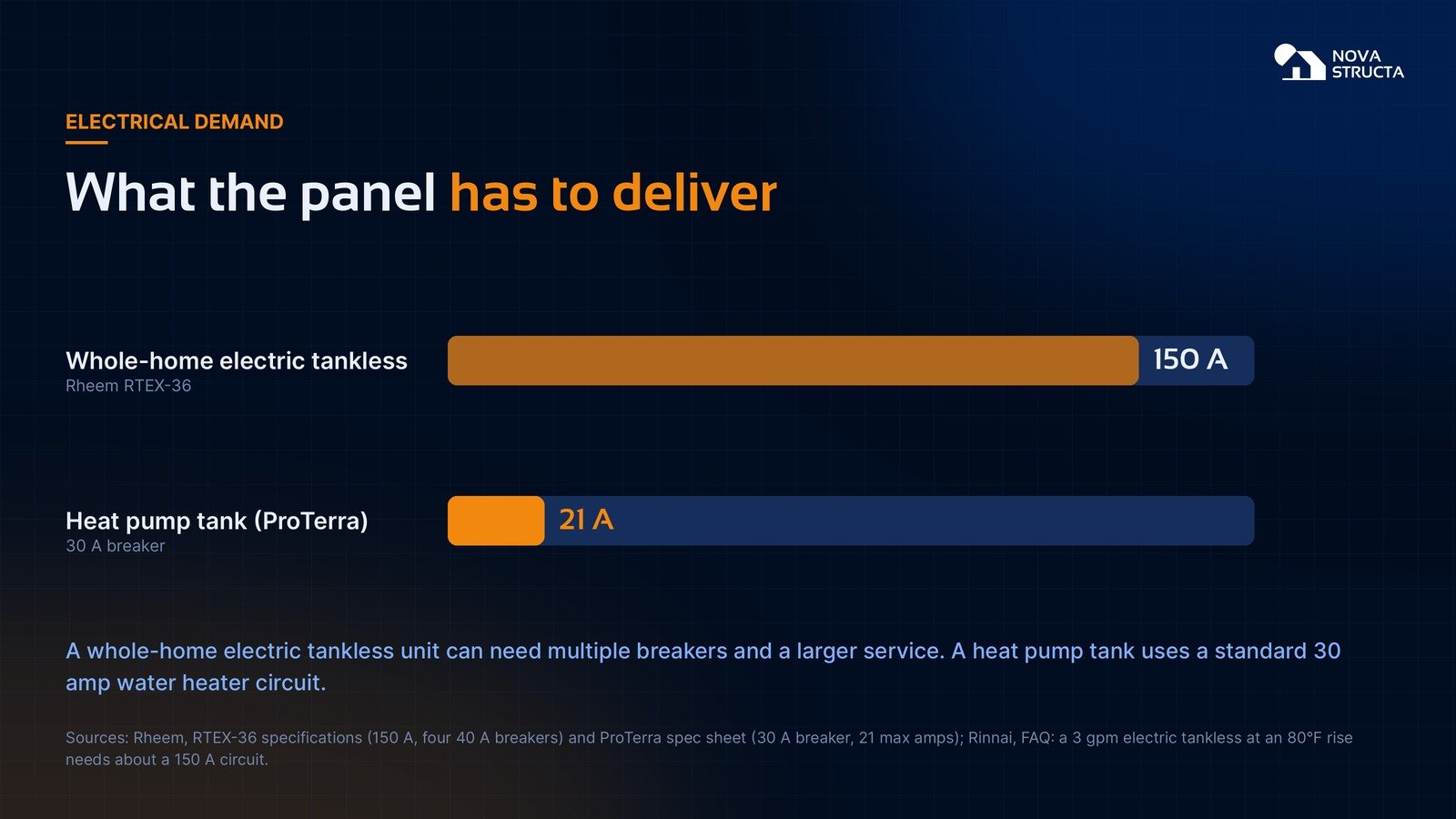
This is the number that surprises people. To heat water instantly at whole-home flow rates, an electric tankless unit draws a lot of power at once. Rheem's RTEX-36 needs 150 amps, split across four 40 amp breakers [6]. Rinnai gives a similar figure: an electric tankless heater delivering 3 gallons a minute with an 80°F temperature rise needs roughly a 150 amp circuit [7]. For many homes that means a panel or service upgrade before the water heater ever goes in.
The ProTerra heat pump tank, by contrast, is specified for a 30 amp breaker with a maximum draw of 21 amps [5], the same size circuit a typical electric tank uses. In most replacements, it is a swap rather than an electrical project.
Gas tankless is different again. Its own electrical draw is small, under 3 amps at 120 volts for Rinnai units [7], but it needs a gas supply sized for the burner and proper venting.
Endless hot water vs. first-hour rating: which matters more?
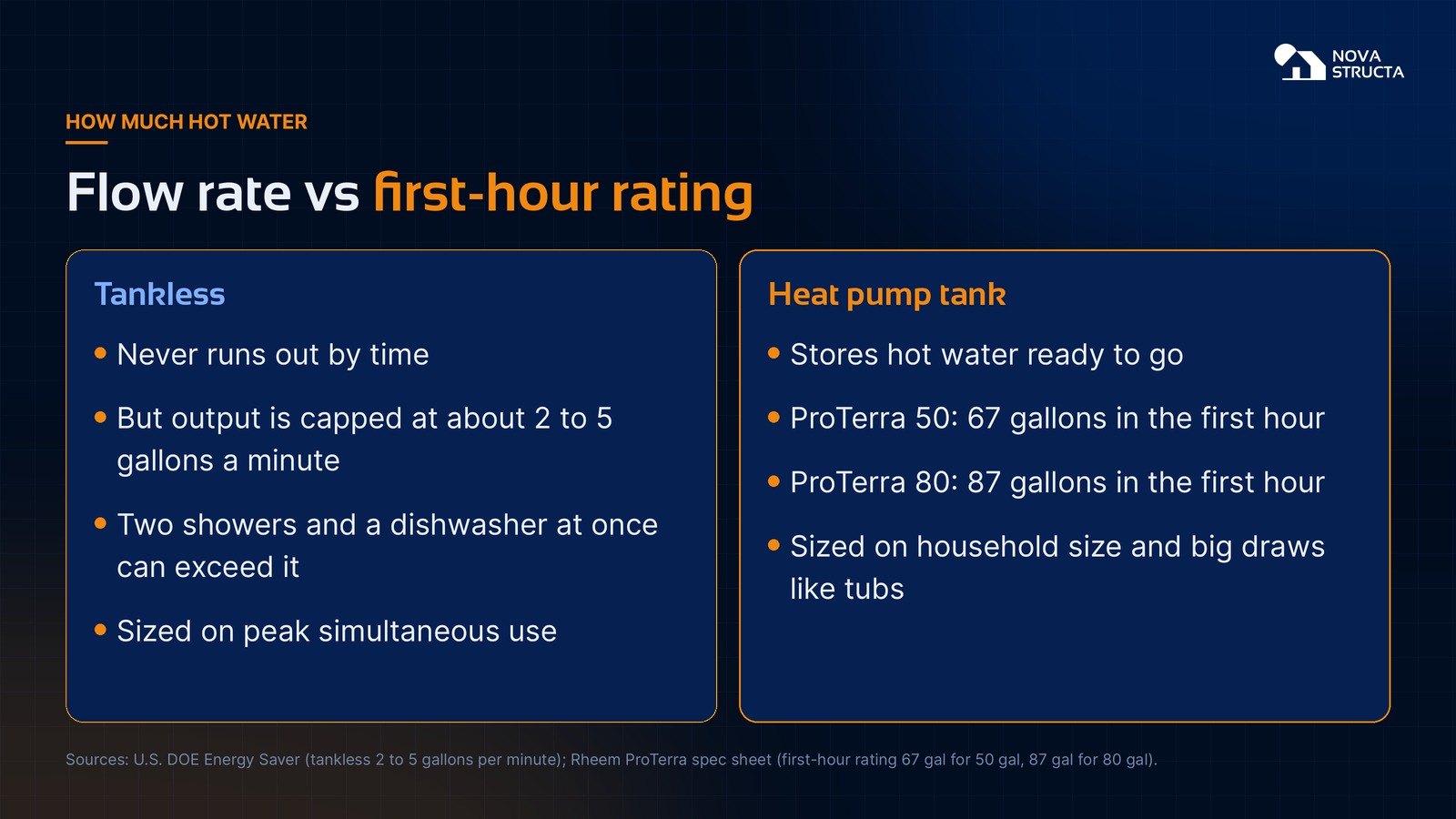
Tankless is often sold as endless hot water, and in one sense it is: it never runs out over time. But it is limited by how much it can heat at once, about 2 to 5 gallons a minute according to DOE [2]. Two showers and a dishwasher running together can ask for more than a smaller unit delivers. Tankless units also need a minimum flow to turn on, about 0.4 to 0.6 gallons a minute for Rinnai models [7], so a very low trickle may stay cold.
A tank works the other way. It has a reserve ready to go, and its key number is the first-hour rating: how much hot water it can deliver in an hour starting full. The ProTerra is rated at 67 gallons for the 50 gallon model and 87 gallons for the 80 gallon model [5], and it has a High Demand mode for busy stretches.
What happens to hot water when the power goes out?
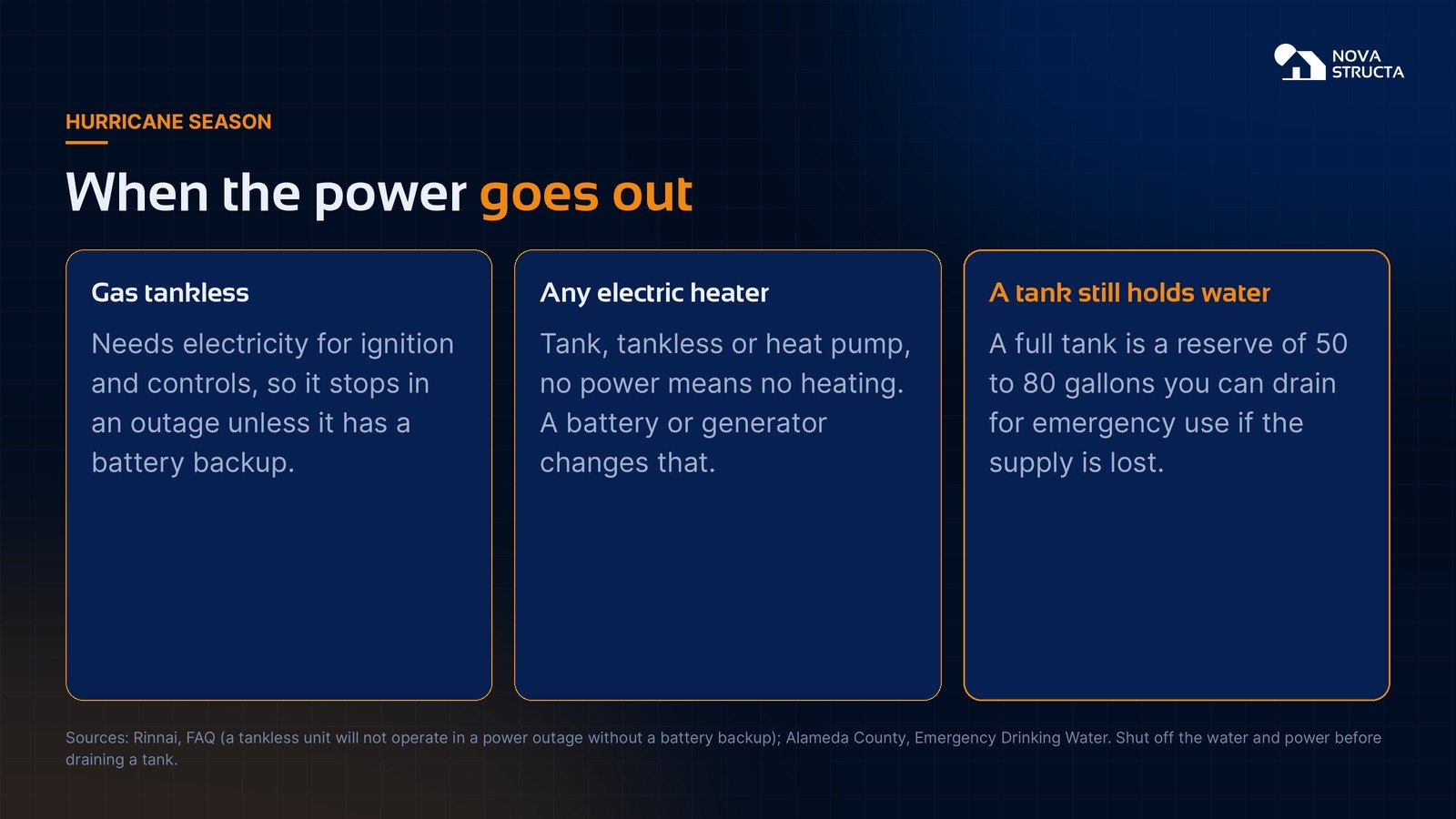
In hurricane season this matters. A gas tankless unit still needs electricity for its controls and ignition, so Rinnai notes it will not run during an outage without a battery backup [7]. Any electric water heater, tank, tankless or heat pump, stops heating when the power is out.
A tank has one advantage here: it is still full. Emergency guidance treats the water heater tank as a reserve of drinking water if the supply is lost or unsafe, and says to shut off the power and the water supply to the heater before draining any [13]. A 50 or 80 gallon tank holds a lot of water. Let it cool first, and check your owner's manual.
If you plan to back up your home with a battery or generator, a heat pump tank's 21 amp maximum draw [5] is far easier to carry than a 150 amp tankless load. See how Powerwalls work during a hurricane.
What does each one ask of you, and how long does it last?
| Type | Typical life | Routine upkeep |
|---|---|---|
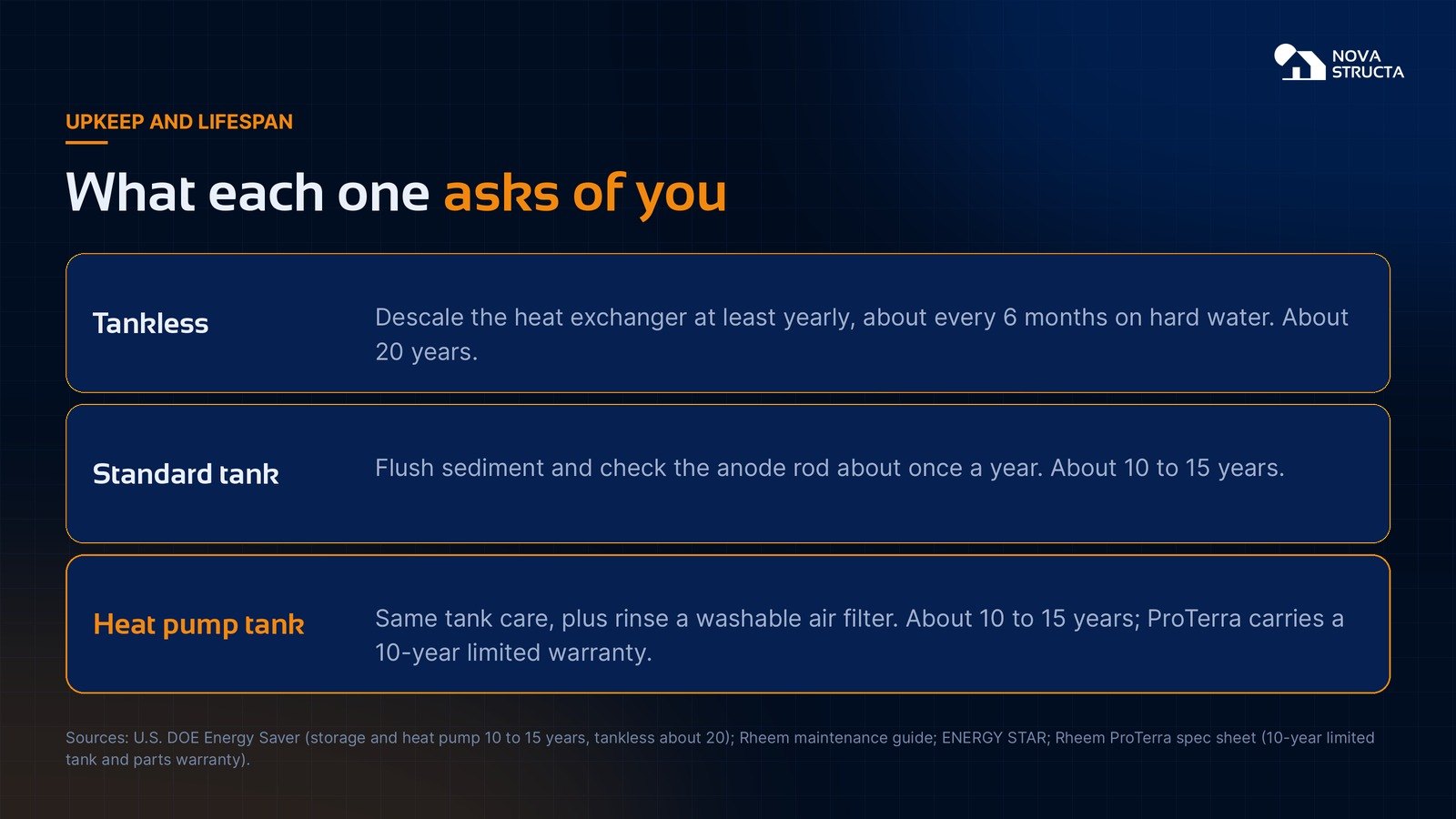
| Standard tank | 10 to 15 years | Flush sediment and check the anode rod about once a year [2] [8] |
| Tankless | About 20 years | Descale at least yearly, about every 6 months on hard water [7] [8] |
| Heat pump tank | 10 to 15 years | Tank care plus rinsing a washable air filter [2] [3] [5] |
Tankless has the edge on lifespan, roughly 20 years per DOE and Rinnai [2] [7], but it needs regular descaling to get there, and Florida's hard water makes that more frequent. Heat pump tanks last about as long as standard tanks [2]. The ProTerra carries a 10-year limited tank and parts warranty [5]. For any tank, Rheem suggests a setting of 120 to 125°F [8].
What changed in the rules and credits for 2026?
Three federal changes worth knowing.
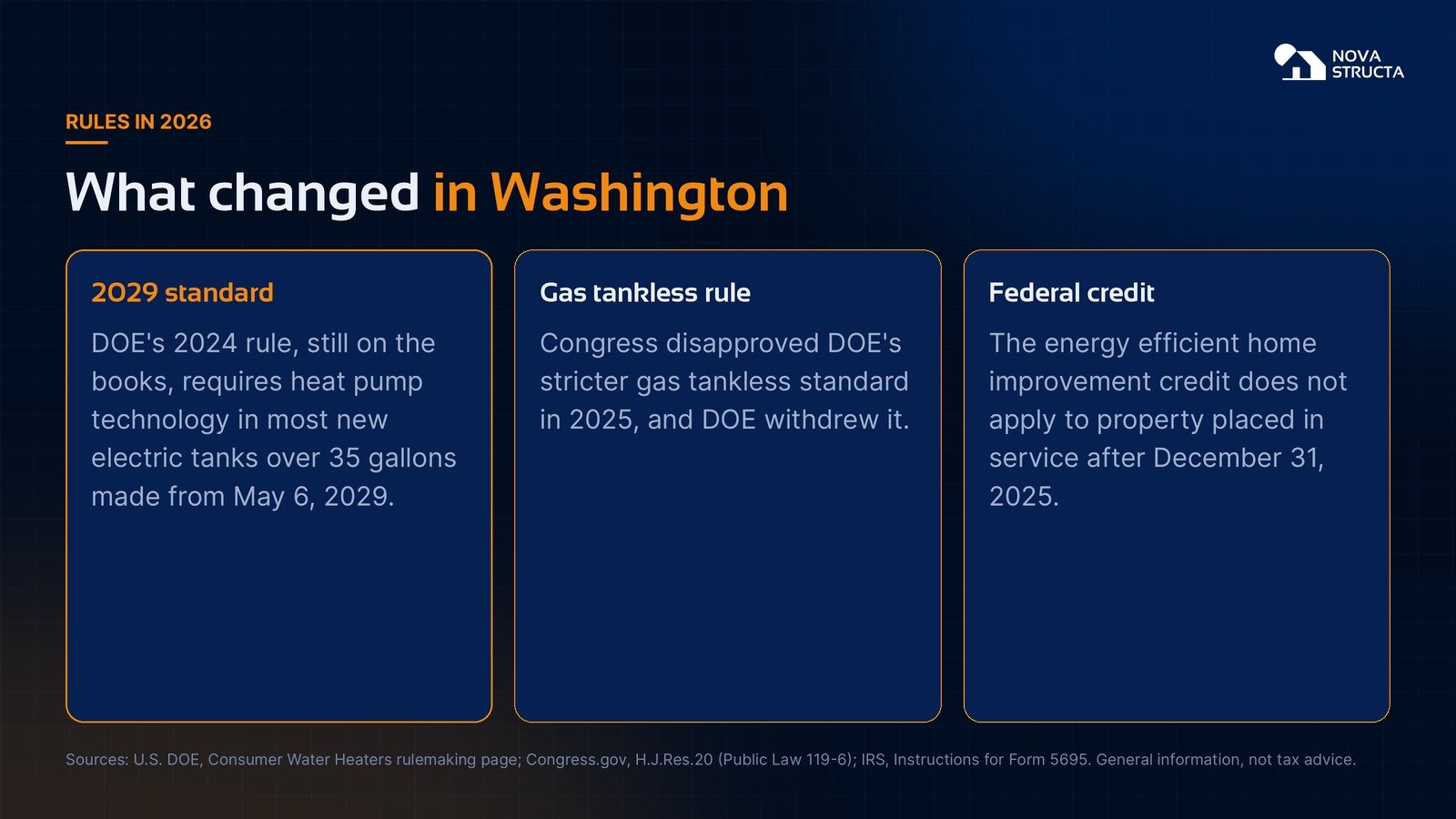
A 2029 standard for electric tanks. DOE's 2024 water heater rule, with compliance starting May 6, 2029, effectively requires heat pump technology in most new electric storage water heaters over 35 gallons [9]. Buying a heat pump tank now puts you on the technology the market is moving to.
The gas tankless rule is gone. Congress disapproved DOE's stricter efficiency standard for gas instantaneous water heaters, and the resolution was signed into law on May 9, 2025 [10]. DOE withdrew the rule [9].
The federal home improvement credit ended. The energy efficient home improvement credit, which used to cover qualifying heat pump water heaters, does not apply to property placed in service after December 31, 2025 [11]. Check with a tax professional about your situation.
When is tankless the better choice?

Tankless is a good product. It is the better fit when:
- Natural gas already reaches your home and you want a unit sized for back-to-back showers.
- Space is tight. A wall-mounted tankless unit frees floor space. A heat pump tank needs room to breathe: Rheem specifies more than 700 cubic feet of space around a ProTerra without extra ventilation, or louvers or ducting in a smaller room [5], and DOE suggests at least 1,000 cubic feet for heat pump water heaters in general [2].
- You plan to stay 20 years or more and will keep up with descaling [2] [8].
Whole-home electric tankless is a harder case in most Florida homes, because of the 150 amp demand [6] and an efficiency rating that stays below 1.0. If your home is all-electric and you are replacing an electric tank, a heat pump tank usually asks the least of your house.
What we install: Rheem ProTerra 50 and 80 gallon
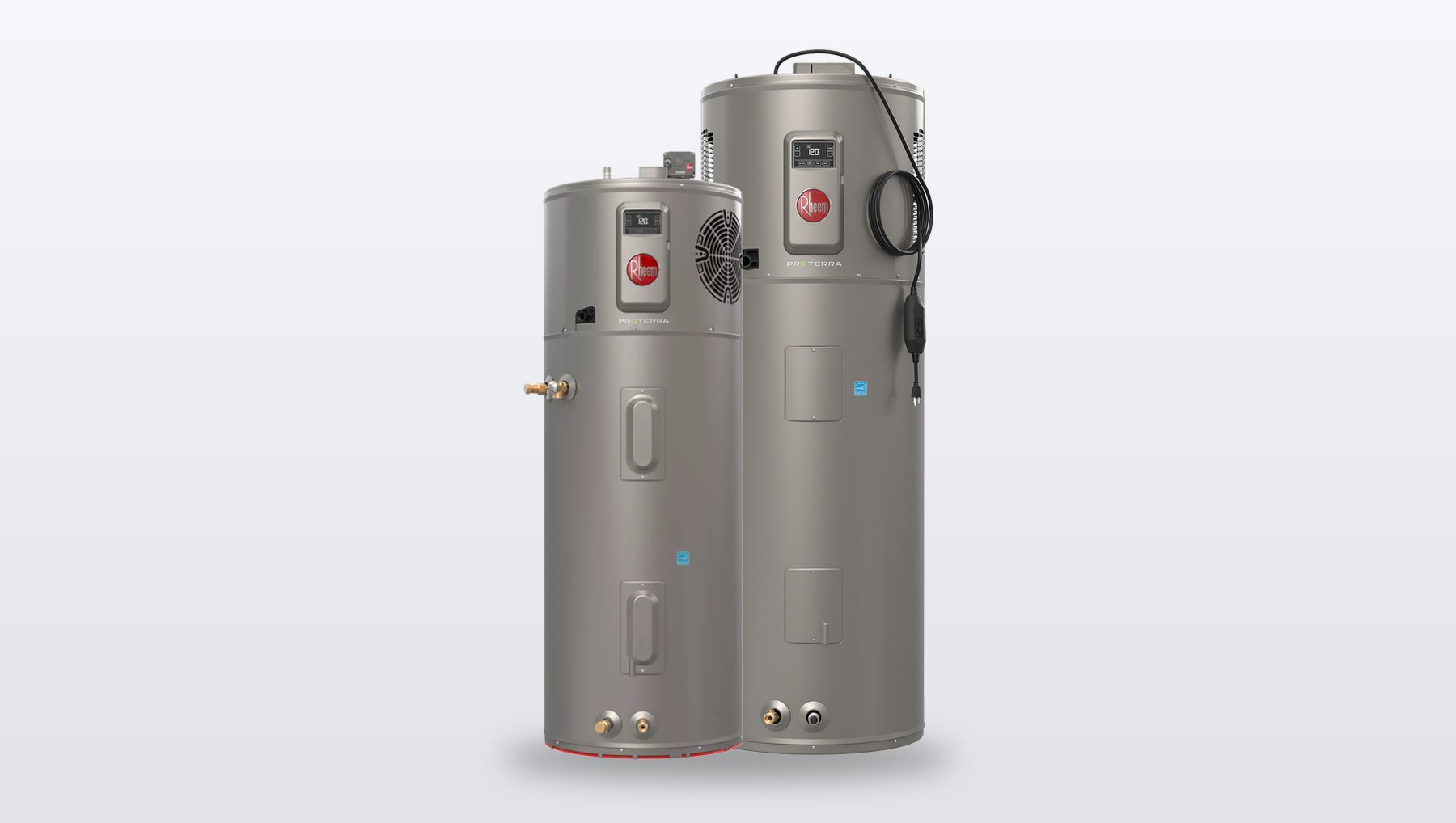
The water heater we offer is the Rheem Professional Prestige ProTerra hybrid electric heat pump water heater with LeakGuard, in two sizes. Here is how they compare, from Rheem's spec sheet [5]:
| Spec | 50 gallon | 80 gallon |
|---|---|---|
| Uniform Energy Factor | 3.88 | 4.07 |
| First-hour rating | 67 gallons | 87 gallons |
| Breaker size | 30 A | 30 A |
| Operating air range | 37 to 145°F | 37 to 145°F |
| Warranty | 10-yr limited | 10-yr limited |
Both are ENERGY STAR certified and share the same features [5]:
- Five modes: Energy Saver, Heat Pump, High Demand, Electric and Vacation.
- LeakGuard leak detection with automatic water shutoff.
- EcoNet Wi-Fi for settings and alerts from your phone.
- Demand response ready (CTA-2045), for utility programs that support it.
- A washable air filter you rinse periodically [3].
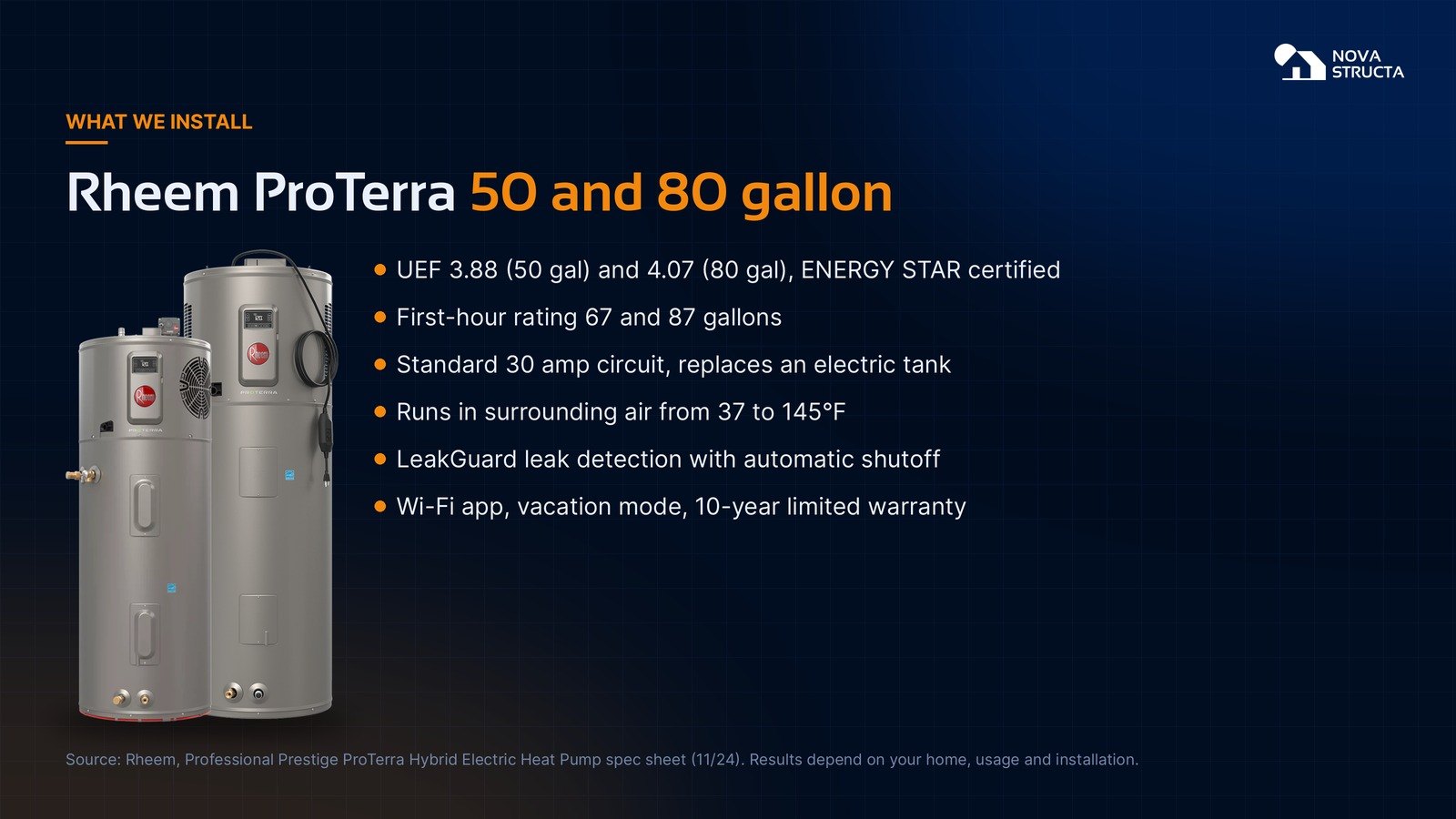
Should you choose 50 or 80 gallons?

Start with your busiest hour of hot water, not your average day. Think about the morning rush: how many showers run back to back, whether the dishwasher or washer runs at the same time, and whether anyone fills a large tub. Then compare that to the first-hour ratings above [5].
- The 50 gallon (67 gallon first-hour rating) suits smaller households and tighter spaces.
- The 80 gallon (87 gallon first-hour rating) suits larger households, big soaking tubs and long back-to-back showers, and it has the higher efficiency rating of the two.
Space matters too. Either size needs enough air around it, as noted above [5]. We check the space as part of the assessment.
Questions to ask before you replace a water heater
- Is my home all-electric, or does natural gas already reach it?
- How many amps does my panel have, and how much is already in use?
- Where will the unit go, and is there at least 700 cubic feet of air around it, or a way to vent or duct it?
- What is the first-hour rating, and does it cover my busiest hour?
- How hard is my water, and should I treat it before the new heater goes in?
- What does the warranty cover, and who handles warranty service?
- Is the new unit ENERGY STAR certified?
The bottom line
Tank vs. tankless is the wrong question for most Florida homes. With 77% of homes all-electric [1], the comparison that matters is between electric options, and on that scale a heat pump tank stands out: a rated UEF of 3.88 to 4.07 vs up to 0.94 for electric tankless [5] [6], a 30 amp circuit instead of 150 amps [5] [6], and a full tank of water on hand when a storm knocks the power out [13]. Gas tankless remains a fine choice where gas is already at the house and space is tight.
Results vary by home, usage and installation. If you would like help choosing, see water heaters and filtration, compare the basics in our tankless vs. tank guide, or book a free assessment. Installations are performed by independent Florida licensed contractor(s).
Sources
- U.S. Energy Information Administration, Today in Energy, "Over one-quarter of U.S. households use electricity as the only source of energy," July 12, 2022, from the 2020 Residential Energy Consumption Survey. eia.gov
- U.S. Department of Energy, Energy Saver, "Which Water Heater Is Right for You?" February 28, 2022. energy.gov
- ENERGY STAR, Heat Pump Water Heaters. energystar.gov
- ENERGY STAR, Heat Pump Water Heaters: Benefits and Savings. energystar.gov
- Rheem, Professional Prestige ProTerra Hybrid Electric Heat Pump Water Heater with LeakGuard, specification sheet (11/24). rheem.com (PDF)
- Rheem, Professional Classic Series Tankless Electric, RTEX-36, product specifications. rheem.com
- Rinnai, Residential FAQ. rinnai.us
- Rheem, "How to Keep Your Tank and Tankless Water Heaters Running at Peak Performance," December 22, 2025. rheem.com
- U.S. Department of Energy, Consumer Water Heaters, appliance and equipment standards rulemaking page. energy.gov
- Congress.gov, H.J.Res.20, 119th Congress, disapproving the DOE rule on energy conservation standards for consumer gas-fired instantaneous water heaters, became Public Law 119-6 on May 9, 2025. congress.gov
- Internal Revenue Service, Instructions for Form 5695, Residential Energy Credits. irs.gov
- U.S. Geological Survey, Professional Paper 1403-I, "Temperatures from the Upper Floridan Aquifer," Fig. 2 (1989), via the Florida Center for Instructional Technology, University of South Florida. fcit.usf.edu
- Alameda County, Emergency Drinking Water handout. acgov.org (PDF)
Savings and utility-bill examples shown are illustrative only, are not guaranteed, and may not reflect typical results. Actual savings depend on your energy usage, system size, roof and site conditions, financing terms, utility rates, net-metering rules, and other factors specific to your home.