Water
Do You Really Need a Whole Home Water Filtration System in Florida?
Do you need a whole-home water filtration system in Florida?
Not always. It depends on your water source and what you want to fix. A whole-home carbon filter handles chlorine taste, odor and sediment at every tap. A softener handles hard water. For PFAS, lead or fluoride in the water you drink, a certified reverse osmosis system at the kitchen tap is the usual answer. If you are on a private well, test the water first.
The CDC puts it plainly: if your tap water does not contain harmful chemicals or germs, you may not need a home water treatment system [1]. The trouble is that most people have never looked. They notice white crust on the shower head, a pool smell from the kitchen tap, or a headline about "forever chemicals," and they are not sure which of those problems is real in their house or which equipment solves it.
This guide walks through what is actually in Florida water, what each type of system does and does not do, and how to read your own water report before you spend anything. It uses state and federal sources, and every claim links to one. Nova Structa is not affiliated with any utility. We install Puronics equipment, covered in its own section below, but the advice here applies whatever brand you choose, and no system fits every home.
Where does Florida tap water come from?
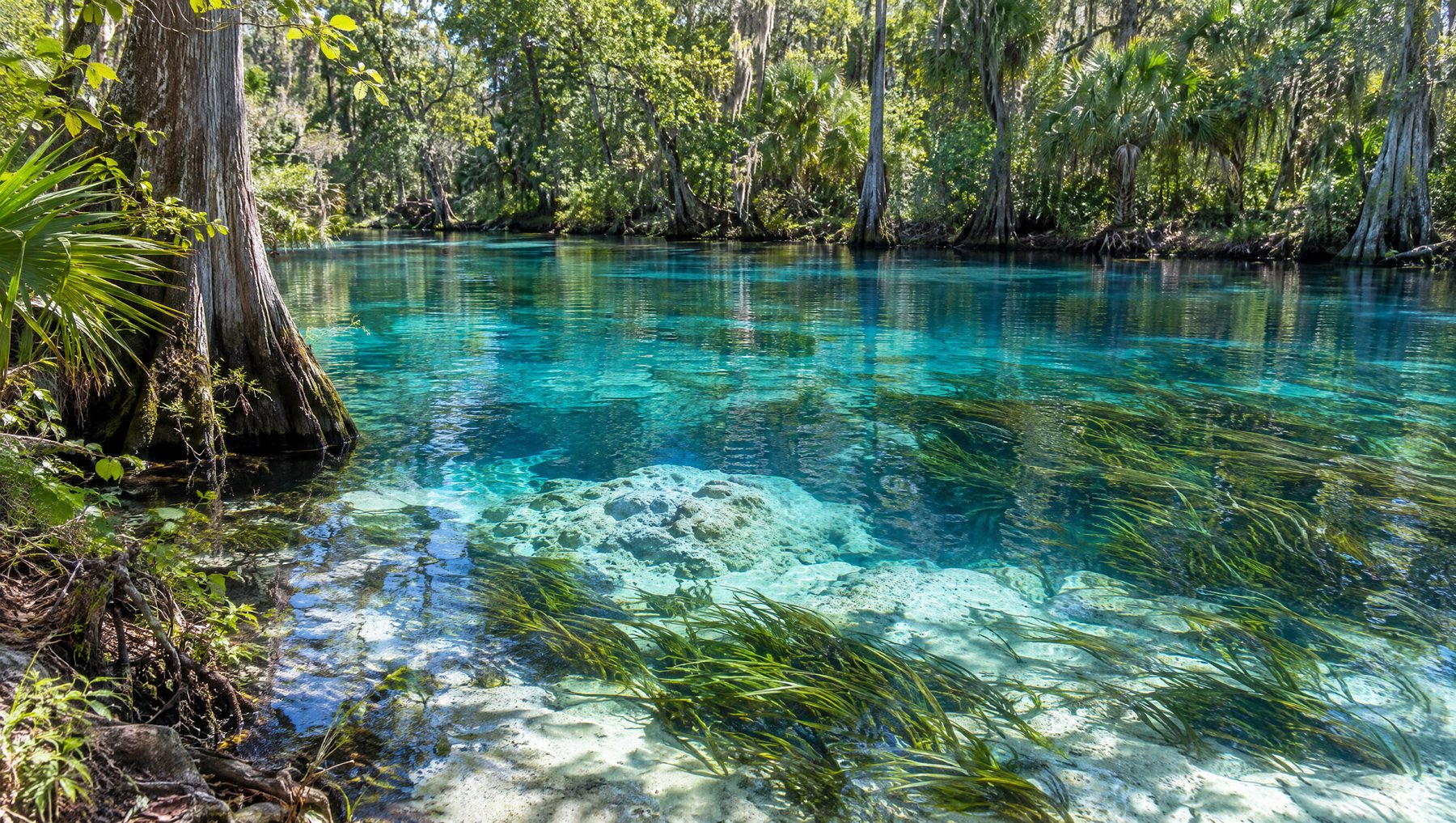
Most Florida homes drink groundwater. Much of it comes from the Floridan aquifer, a huge layer of limestone and dolomite that soaks up rain like a sponge. In 2015 it supplied about 2,360 million gallons a day [2]. Rain is slightly acidic, so as it moves through the rock it slowly dissolves limestone and picks up minerals along the way [2].
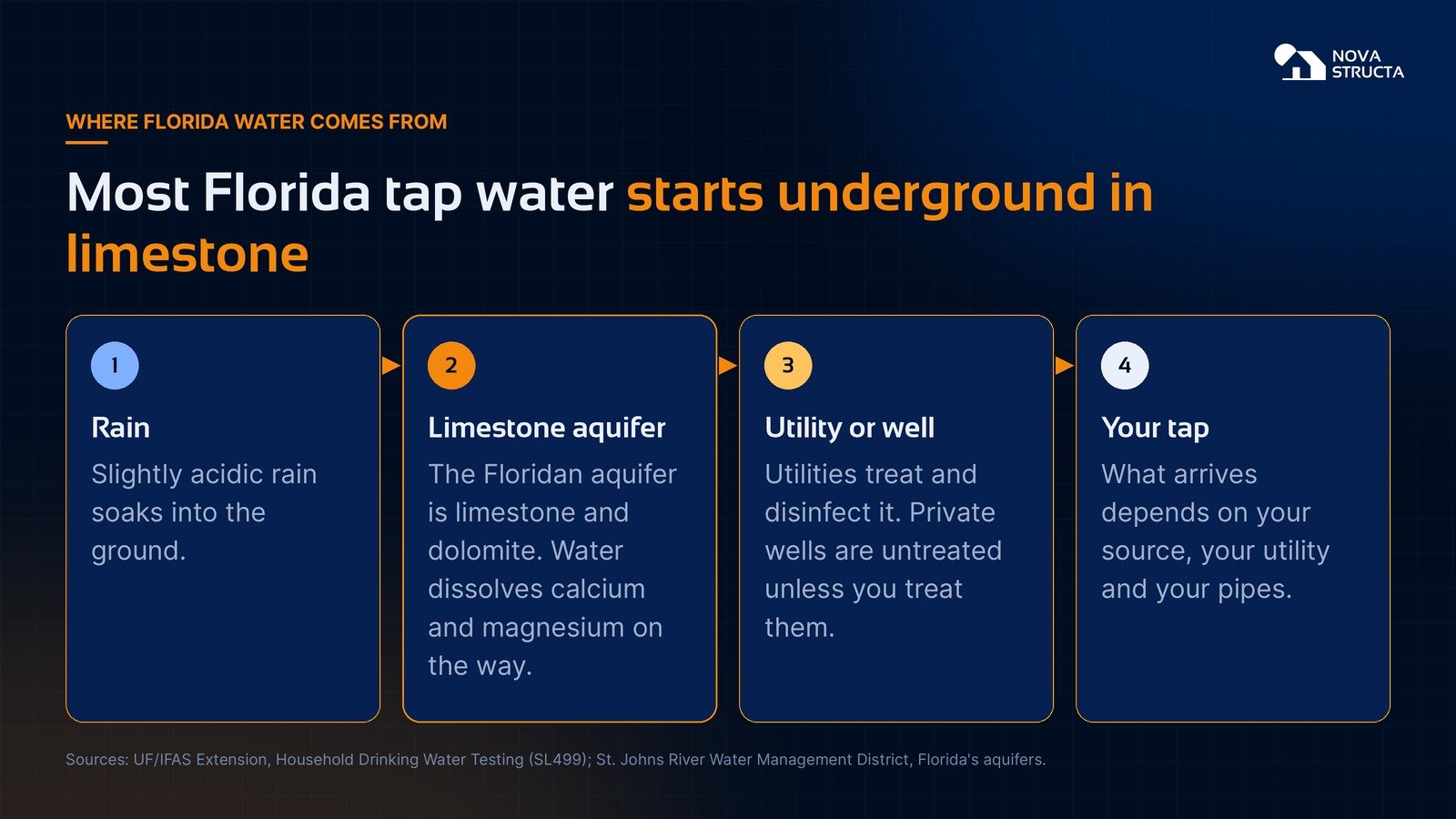
From there, the path splits. City and county utilities treat and disinfect the water and are regulated under the Safe Drinking Water Act. Private wells are not regulated, so the owner is responsible for testing and treating the water [16]. That one difference decides most of what comes next.
Is Florida water hard?
Often, yes. Hardness is mostly dissolved calcium and magnesium, and it comes from the geology the water passes through [3]. In a limestone state, that adds up. Hardness is reported in milligrams per liter as calcium carbonate, and EPA's classification looks like this [3]:
| Classification | mg/L as CaCO3 |
|---|---|
| Soft | Under 75 |
| Moderately hard | 75 to 150 |
| Hard | 150 to 300 |
| Very hard | Over 300 |
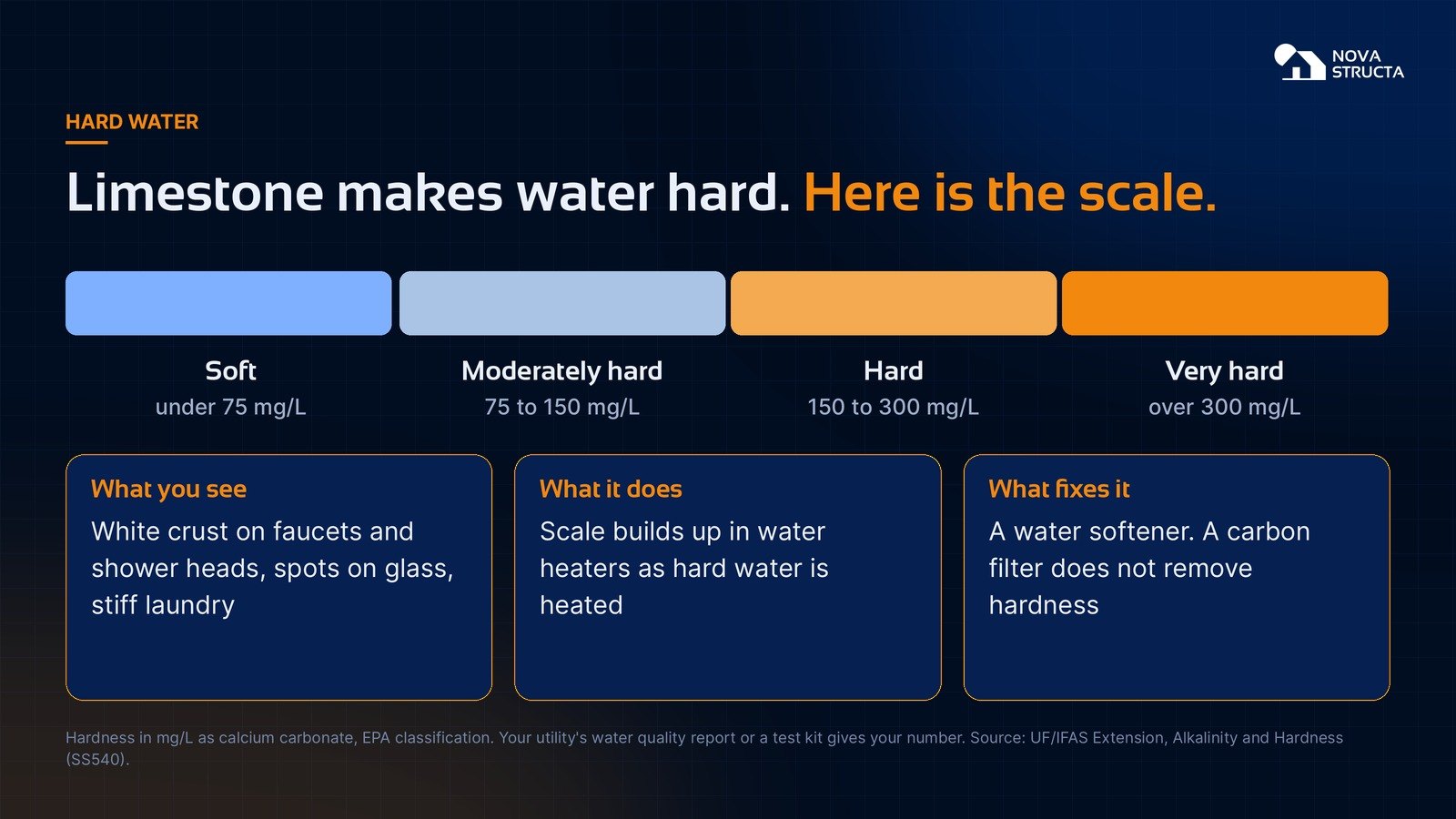
Hard water is not a health problem. It is a cleaning and maintenance problem. It takes more soap to get the same lather [3], and it leaves scaly buildup on fixtures [1]. You see it as white crust on faucets, spots on glasses and a shower head that slowly clogs.
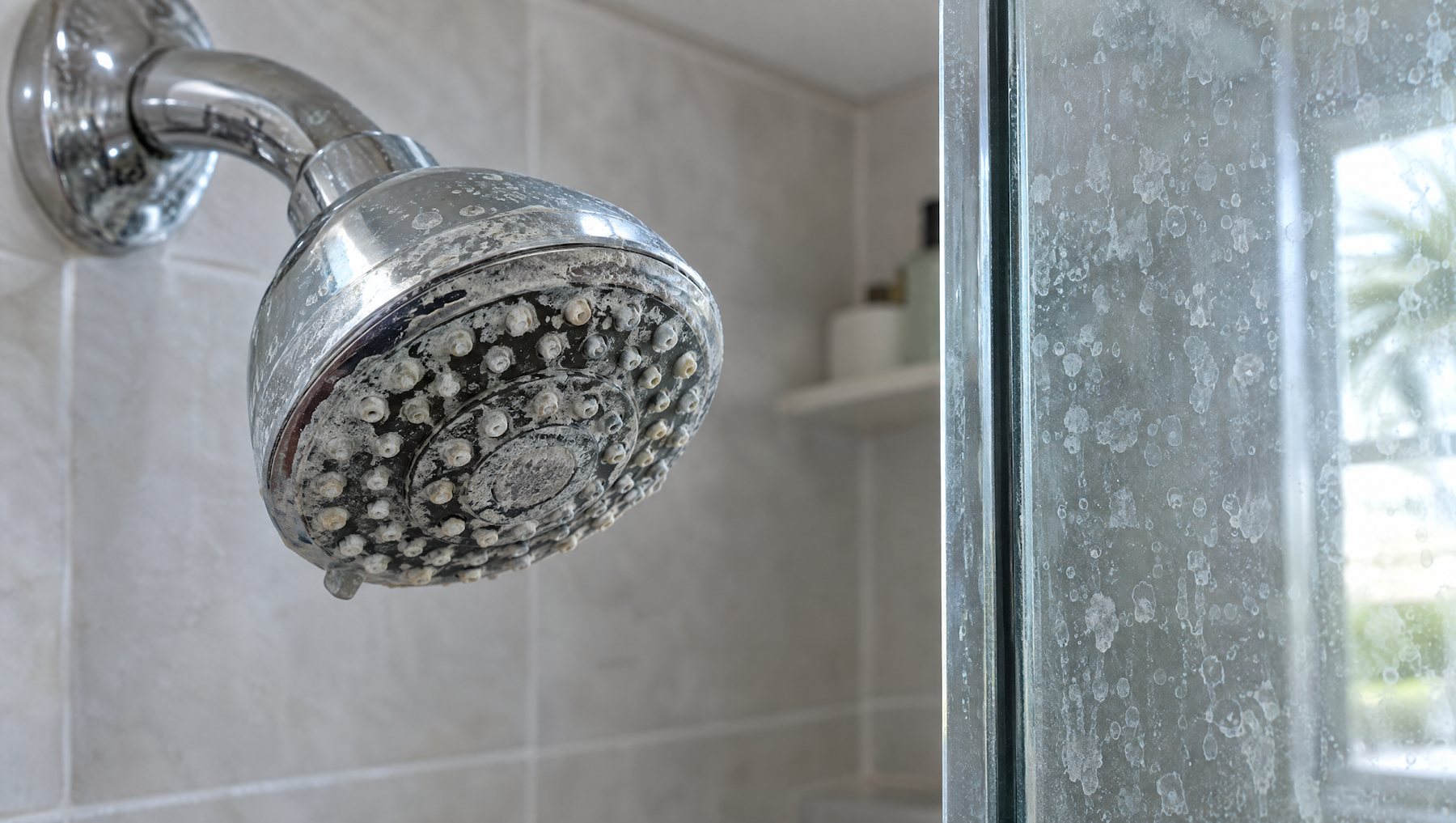
The fix for hardness is a water softener. A carbon filter, however good, is not built to remove calcium and magnesium [13].
What about PFAS in Florida water?
PFAS are a family of man-made "forever chemicals" used in nonstick, stain-resistant and firefighting products. EPA lists long-term exposure to PFOA, the best known of them, with effects on the liver, immune system and heart and higher rates of certain cancers, and it set the health goal for PFOA at zero [9].
What Florida testing found
A University of Florida team collected 448 drinking water samples from taps in all 67 counties and tested them for 31 PFAS [4].
- 107 taps had PFOA or PFOS above 4 parts per trillion (ppt) [4].
- 16% of samples were above 4 ppt for PFOS, and 8% for PFOA [4].
- City water averaged 15.6 ppt of total PFAS, compared with 4.5 ppt in well water [4].
- The highest total in a single tap was 219 ppt [4].
A separate UF study of 50 freshwater springs found PFAS in 63% of spring vent samples, where water from the aquifer first reaches the surface [5].
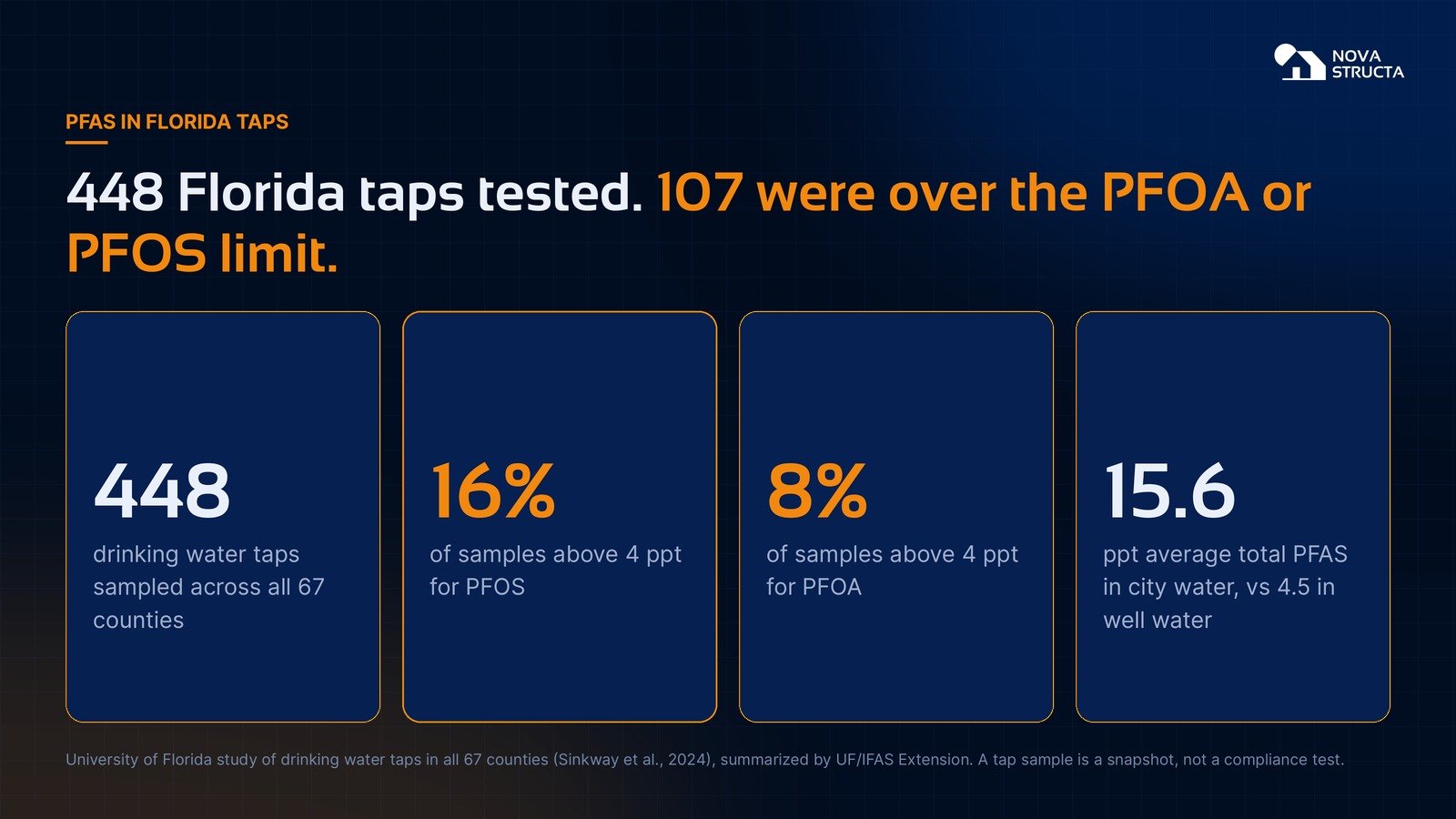
Keep that in perspective. A tap sample is one moment at one faucet. Your utility's own results, taken on a schedule, are a better guide to your water.
What the national data says
Utilities across the country tested for 29 PFAS from 2023 through 2025 under EPA's fifth Unregulated Contaminant Monitoring Rule (UCMR 5). In Florida, 414 public water systems were scheduled to take part [7]. EPA released the final data in July 2026, covering about 10,130 systems [6]:
| System size | Averaged above a PFAS limit |
|---|---|
| Serving under 3,300 people | 7.1% |
| Serving 3,300 to 10,000 | 8.3% |
| Serving over 10,000 | 15.5% |
| All systems, weighted | 7.8% |
In other words, most systems tested below the limits, and larger systems were more likely to have a problem. Your results are listed by system, which is why your own water report matters more than any average.
Where the federal rule stands
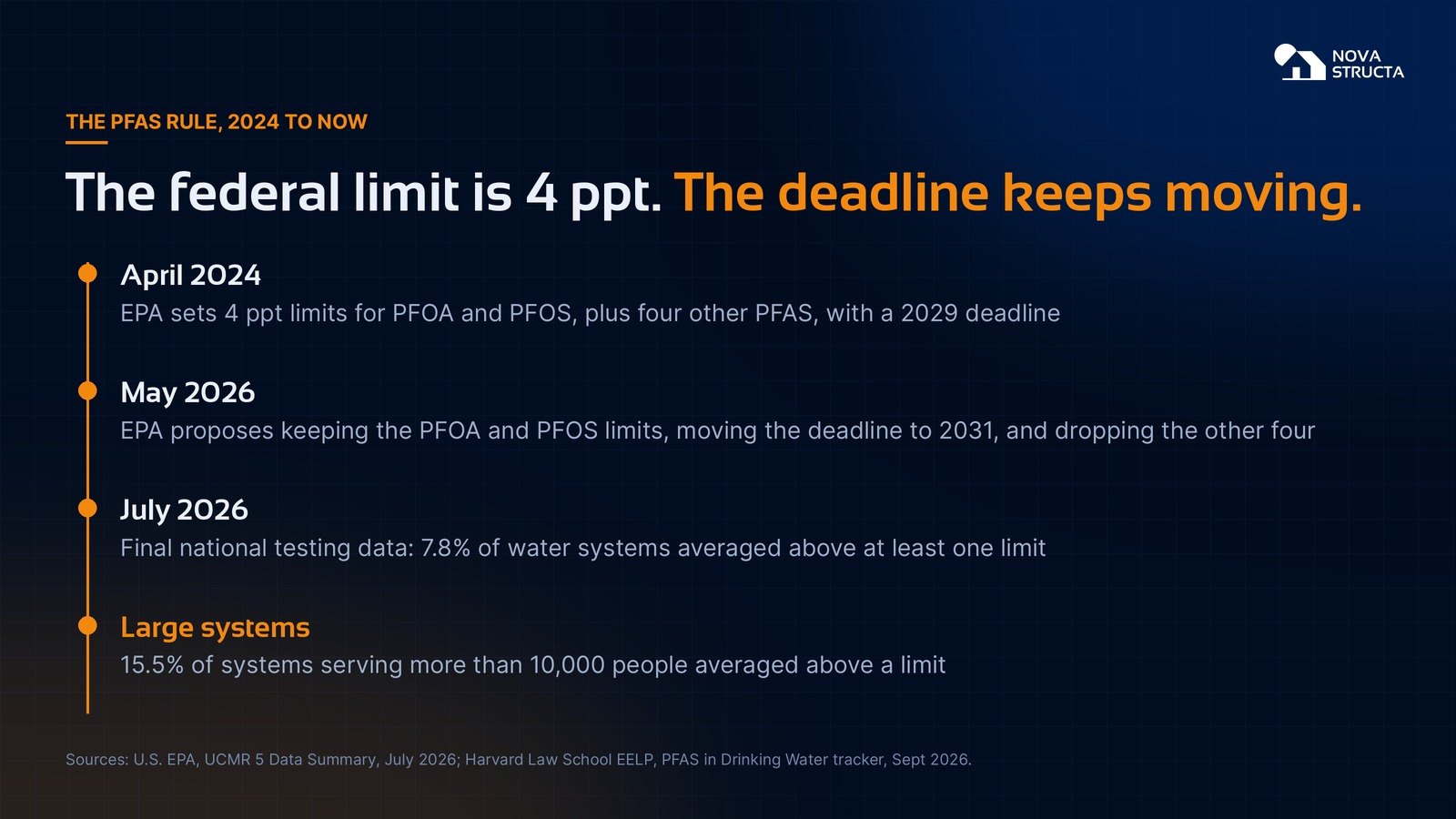
In April 2024, EPA set enforceable limits of 4.0 ppt each for PFOA and PFOS, plus limits for four other PFAS, with a 2029 deadline [8][9]. On May 18, 2026, EPA proposed two changes: keep the PFOA and PFOS limits but move the deadline to 2031, and rescind the limits for the other four [8]. Comments closed July 20, 2026. As of the tracker's September 18, 2026 update, those proposals were not final [8].
For a homeowner, the takeaway is simple. The 4 ppt limits for PFOA and PFOS are expected to stay, but a utility may have until 2031 to meet them. If your report shows results above 4 ppt and you do not want to wait, treatment at the kitchen tap is the common approach.
What actually reduces PFAS at home
Look for a product certified to NSF/ANSI 53 or NSF/ANSI 58 with a PFAS (or PFOA and PFOS) reduction claim [10]. Standard 58 covers reverse osmosis systems; Standard 53 covers filters with a health-related claim [13]. Michigan's PFAS program notes that the older NSF P473 protocol was replaced in 2019, so a P473 label on a new product is outdated [10].
Does Florida water still have fluoride?
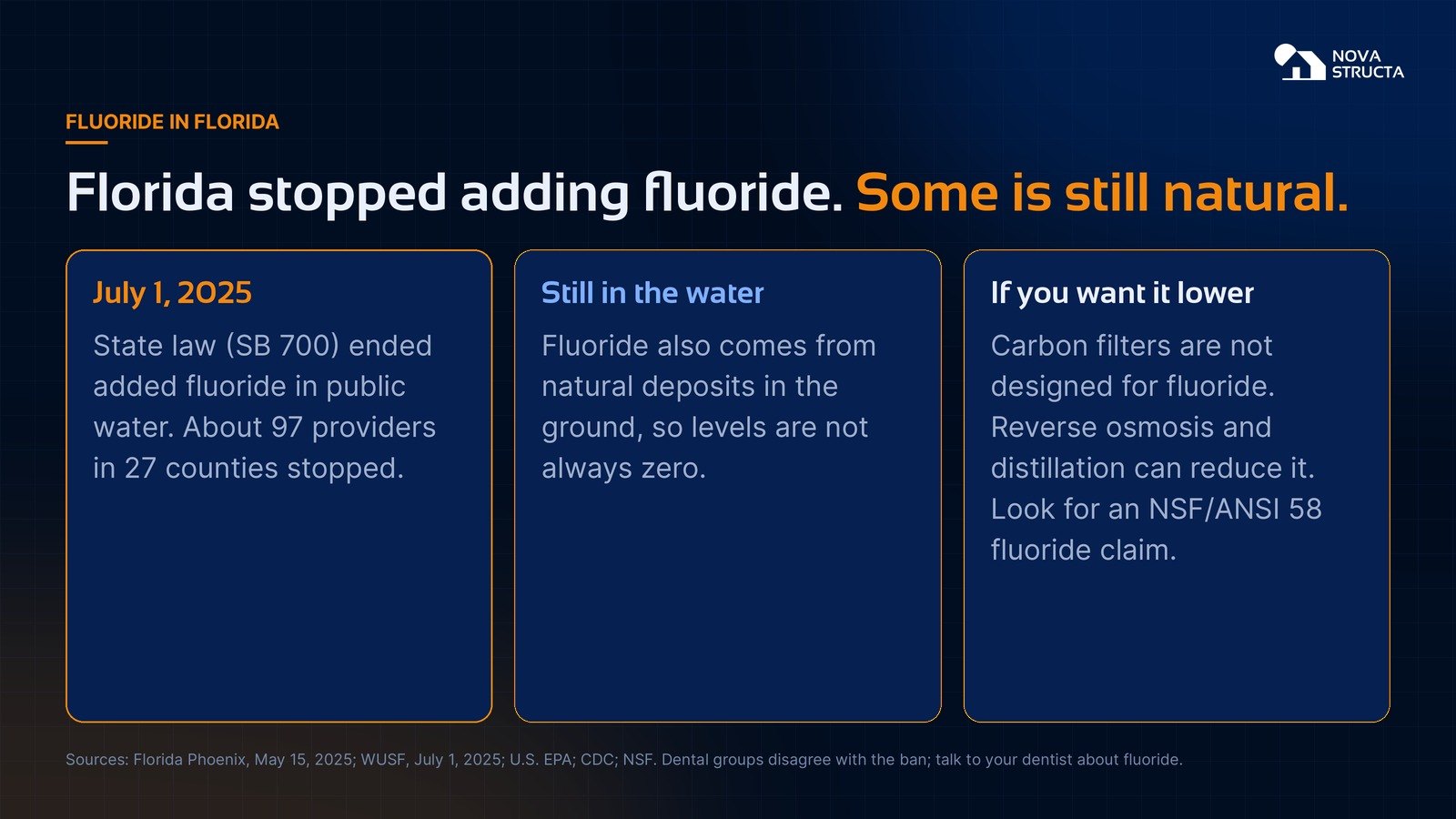
Less of it. Governor DeSantis signed SB 700 on May 15, 2025, making Florida the second state after Utah to stop public water systems from adding fluoride. The law does not name fluoride; it bars additives that are not on an approved list, and fluoride is not on it [11]. When it took effect on July 1, 2025, 97 water providers in 27 counties stopped fluoridating, according to the Florida Department of Health [12].
There are two sides to this, and both are worth knowing:
- Supporters, led by Florida Surgeon General Joseph Ladapo, cited concerns about the risks of fluoride exposure [12].
- Dental groups opposed it. The American Dental Association pointed to the CDC estimate that community fluoridation reduces tooth decay by about 25% [12].
Two practical points either way. First, "no added fluoride" does not mean zero. EPA lists erosion of natural deposits as a source of fluoride in drinking water, and it still enforces a limit of 4.0 mg/L [9]. Your water report will show your level. Second, if you want less fluoride, a carbon filter will not do it. Reverse osmosis can reduce fluoride, and so can distillation [1]. For a certified product, look for a fluoride reduction claim under NSF/ANSI 58 [13]. If you have kids, it is worth asking your dentist how the change affects them.
Chlorine or chloramine: which does your utility use?
Utilities disinfect water so it stays safe all the way to your tap. Some use chlorine. Others use chloramine, which is chlorine combined with ammonia. Pinellas County, for example, switched to chloramines, in part because they form fewer regulated byproducts such as trihalomethanes [14].
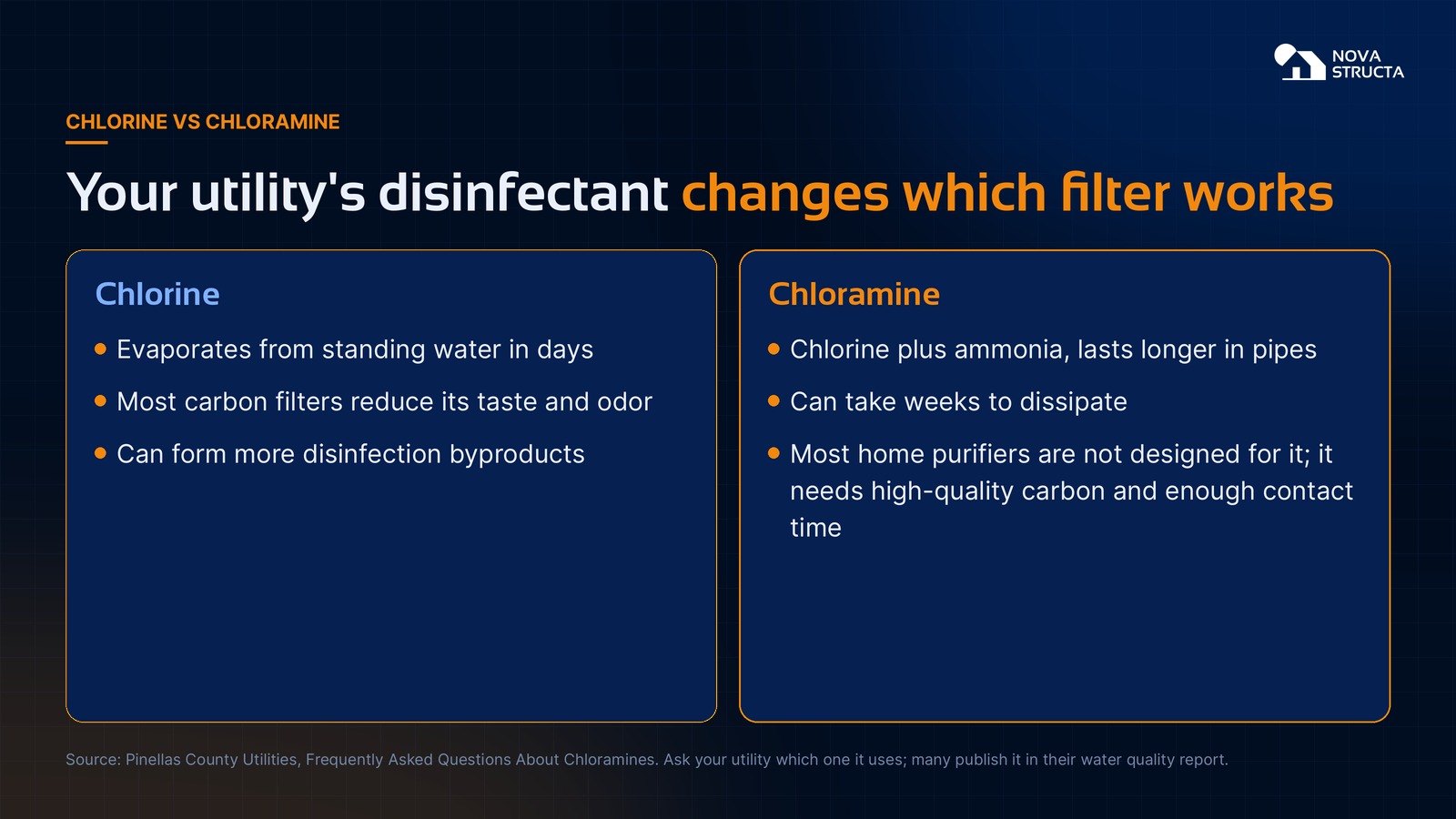
The difference matters when you shop for a filter:
- Chlorine evaporates when water sits for a few days, and most carbon filters reduce its taste and smell.
- Chloramine can take weeks to dissipate. Pinellas County notes that most home purifiers are not designed to remove it, though high-quality granular activated carbon may, with enough contact time [14].
So before you buy a whole-home carbon system, find out which disinfectant your utility uses and confirm the system is rated for it.
Filtration vs softening vs reverse osmosis: what is the difference?
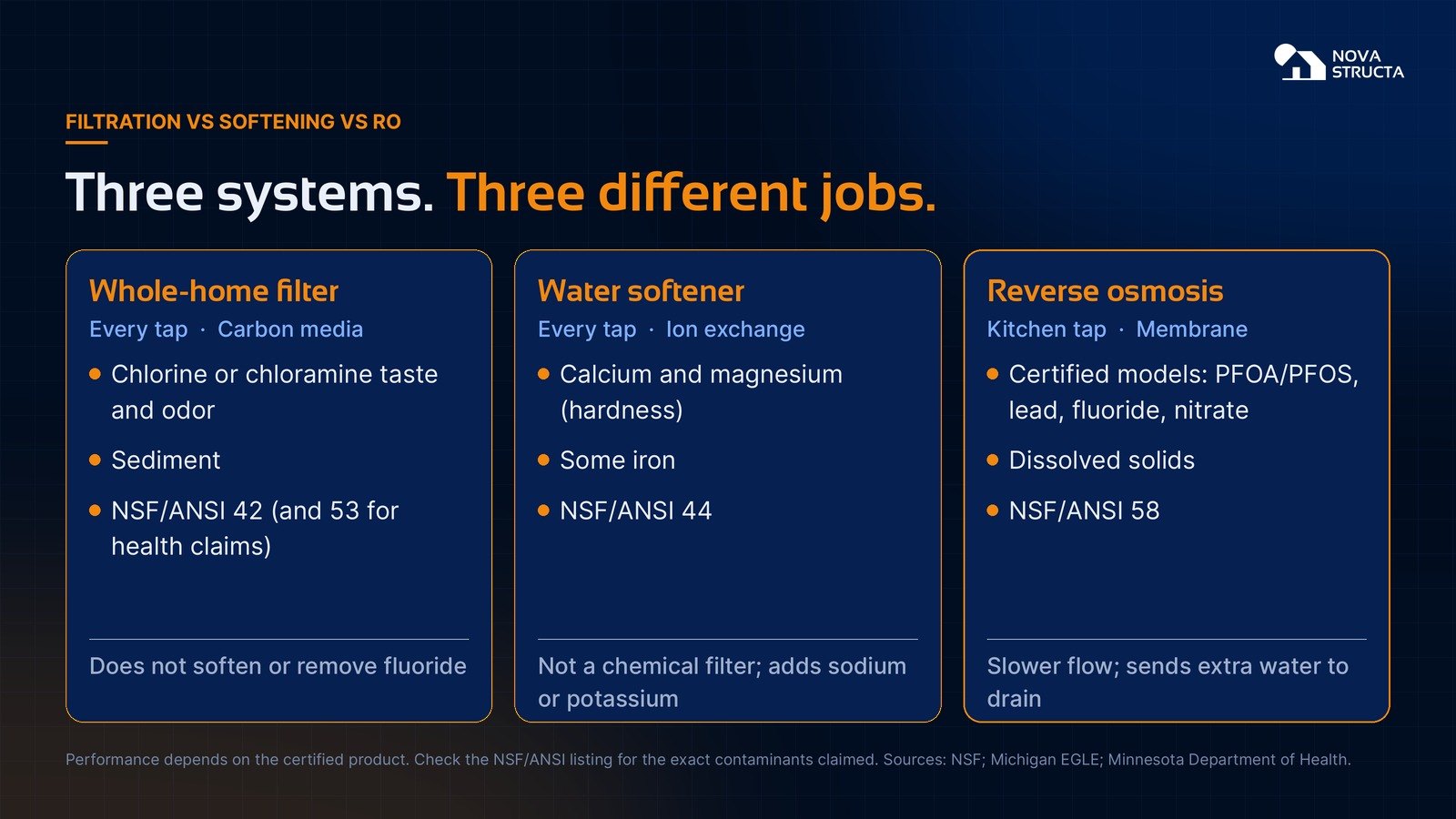
These three get lumped together as "water filtration," but they are different machines solving different problems. The CDC sorts home systems by where they work: whole-home (point-of-entry) systems treat most or all of the water entering the house, and point-of-use systems treat water for a single tap, like the kitchen sink [1].
Whole-home filtration
A whole-home filter usually uses carbon media to catch sediment and reduce chlorine taste and odor at every faucet, shower and appliance. NSF/ANSI 42 covers these aesthetic claims for both whole-house and point-of-use filters, and NSF/ANSI 53 covers claims for contaminants with a health effect [13]. It does not soften water.
Water softening
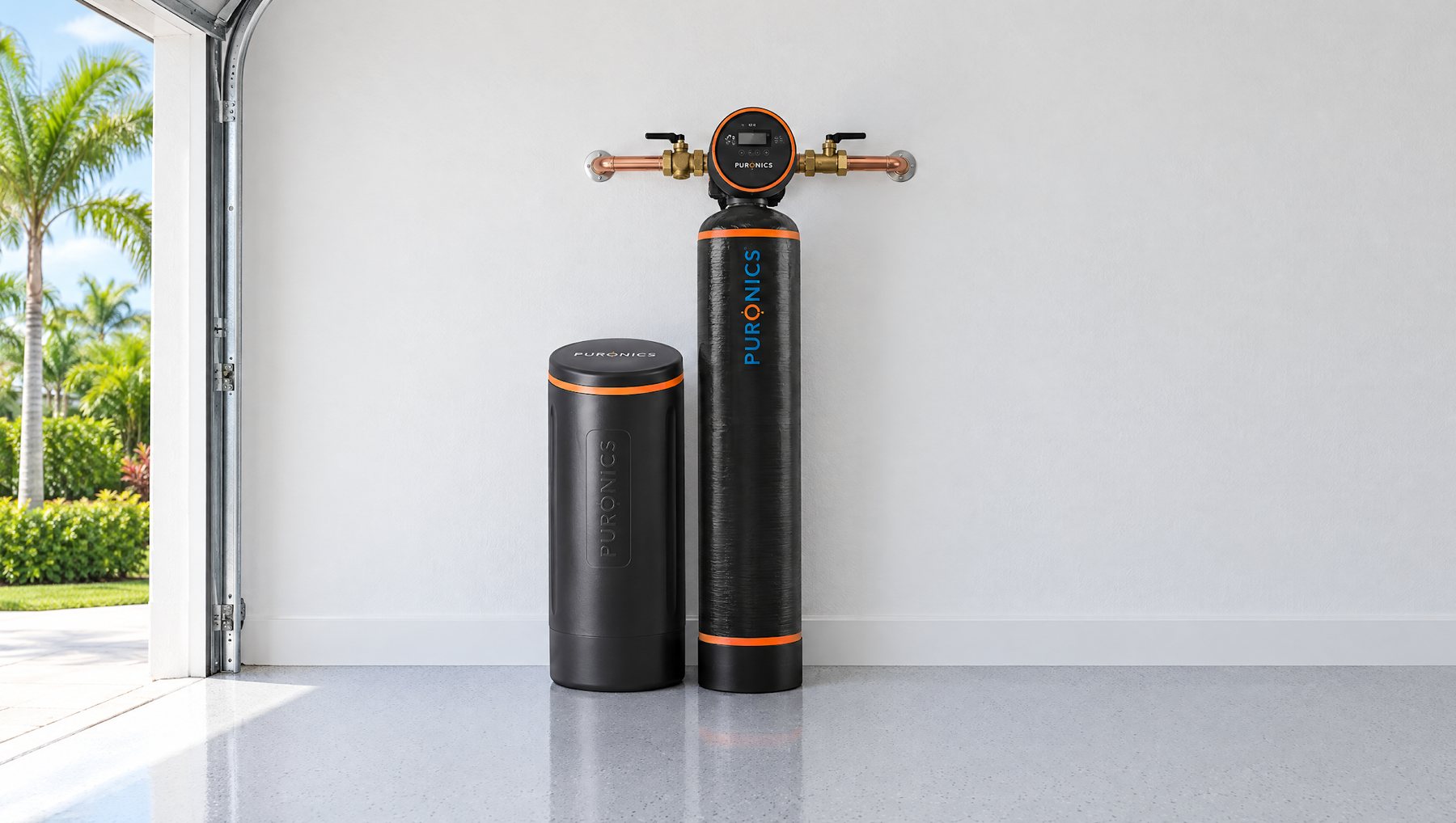
A softener is an ion exchange unit. Resin beads trap calcium and magnesium and swap them for sodium or potassium [15][13]. It removes hardness and, to a lesser extent, iron [15]. It is not a chemical filter and does not remove germs [1]. A salt-based softener adds sodium to the water you drink [15], which is worth knowing if you watch your sodium. Softeners are certified under NSF/ANSI 44 [13].
Reverse osmosis
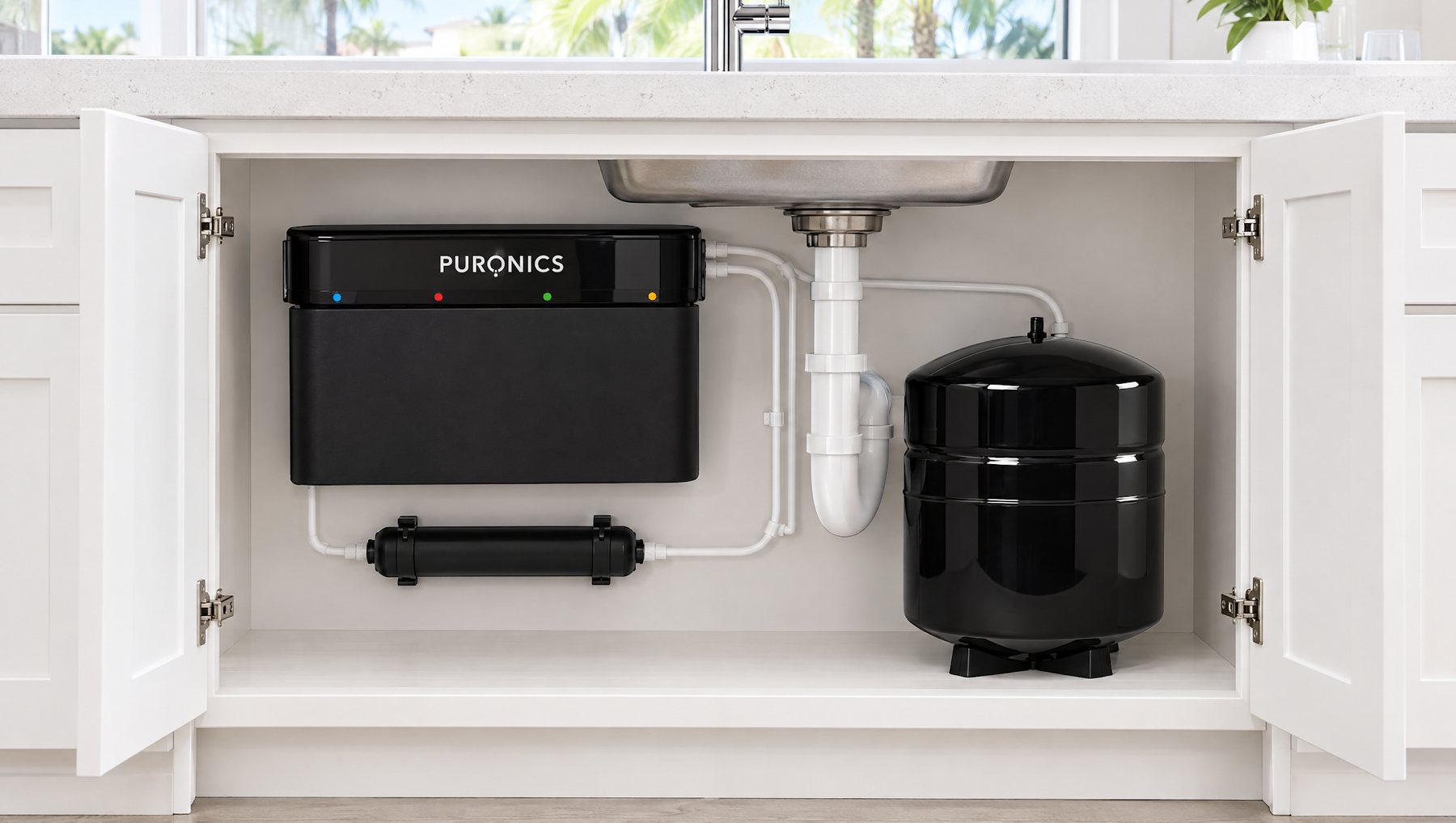
Reverse osmosis (RO) pushes water through a very fine membrane. The CDC says RO removes some chemicals, including lead, copper and sodium, and may also reduce arsenic, fluoride, nitrate and others [1]. Certified RO models can carry PFAS reduction claims as well [10]. RO systems are certified under NSF/ANSI 58 [13]. The tradeoffs: they make water slowly, so most store it in a small tank for one tap, and they send part of the water they treat down the drain.
Side by side
| Whole-home carbon | Softener | Reverse osmosis | |
|---|---|---|---|
| Where it works | Every tap | Every tap | Usually one kitchen tap |
| How it works | Carbon media | Ion exchange resin | Pressure through a membrane |
| Main job | Taste, odor, sediment | Hardness (calcium, magnesium) | Dissolved contaminants in drinking water |
| PFAS or lead | Check NSF/ANSI 53 | Not its job | Check NSF/ANSI 58 or 53 |
| Fluoride | Not designed for it | Some models; check the label | Check for an NSF/ANSI 58 claim |
| Certification | NSF/ANSI 42, 53 | NSF/ANSI 44 | NSF/ANSI 58 |
| Tradeoff | Media changes | Adds sodium or potassium | Slower; water to drain |
Sources: NSF [13]; CDC [1]; Michigan EGLE [10]; Minnesota Department of Health [15]. For a deeper look at the first two, see water softener vs filtration.
"Removes PFAS" on a box is not the same as a certified claim.
Check the product's NSF/ANSI standard and the exact contaminant on the label or in the certifier's listing. A certification covers the specific model tested, and results in your home also depend on your water and on changing filters on schedule [10][13].
Which setup fits your home?
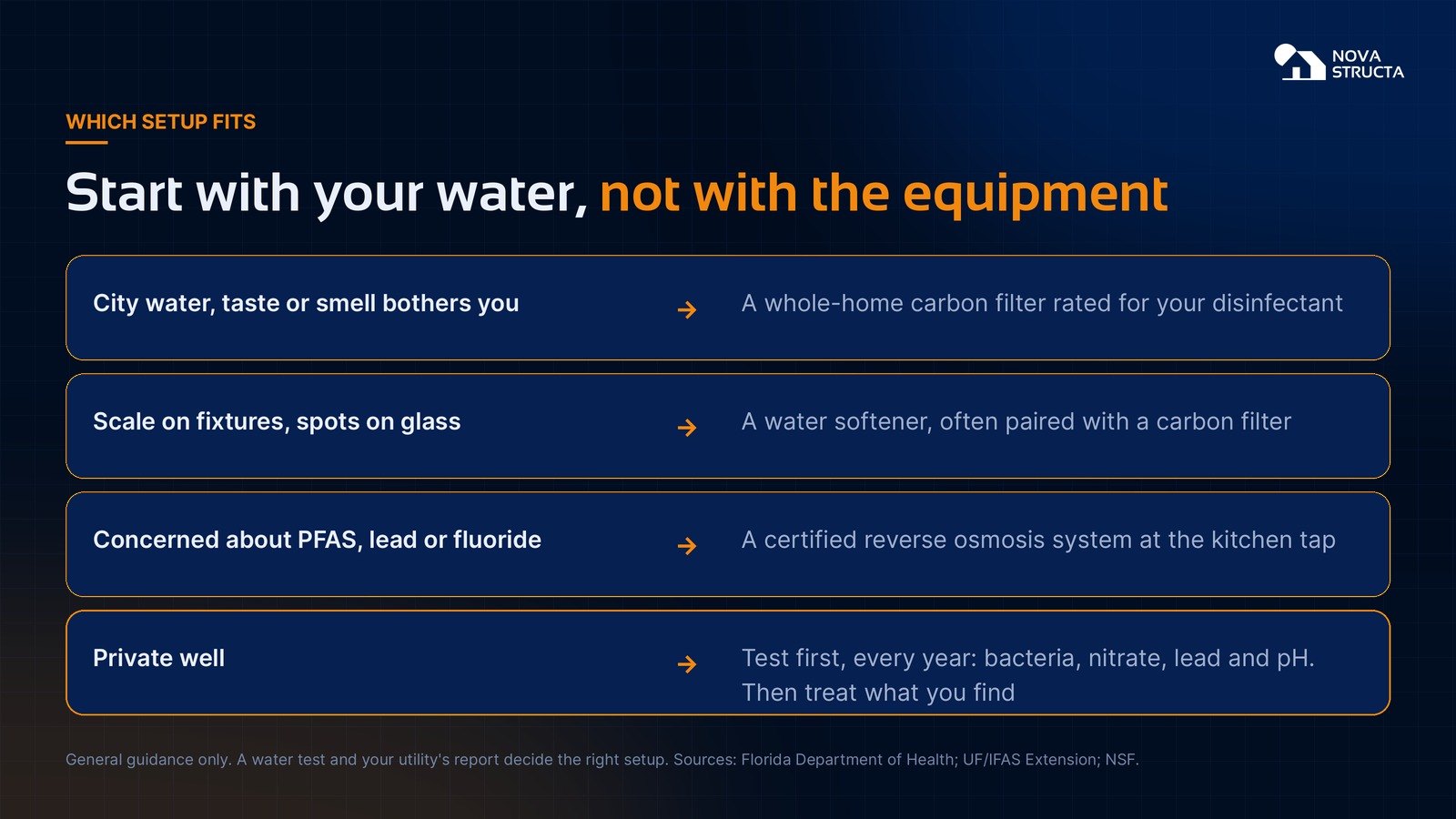
Start with your water, not with the equipment:
- City water, and the taste or smell bothers you. A whole-home carbon filter rated for your utility's disinfectant.
- Scale on fixtures and spots on glass. A water softener, often paired with a carbon filter.
- Your report shows PFAS above 4 ppt, or you are concerned about lead or fluoride. A certified reverse osmosis system at the kitchen tap, where you drink and cook.
- Private well. Test first, every year. Then treat what the test finds.
Many Florida homes end up with a combination, such as a softener and carbon filter for the whole house plus RO at the kitchen sink. Many others need only one piece, or nothing at all. The CDC's advice is to test first and pick a system that removes what you are actually concerned about [1].
What does Nova Structa install?
When a home's water calls for treatment, we install two Puronics systems. You do not need either one to use this guide, but here is what each is certified for, straight from the manufacturer, so you can hold it up against your own water report.
Whole house: Puronics Defender iGen 3.20 softener
- Its job is hardness. It is certified by the Water Quality Association (WQA) to NSF/ANSI 44 for reducing hardness minerals, barium and radium 226/228, and to NSF/ANSI 372 for low lead compliance [21].
- It regenerates based on use, not a fixed timer. The iGen control valve keeps 60 days of water use history and adjusts regeneration to how your household uses water, with a double backwash and downflow brining designed for efficient salt and water use [21].
- Salt or potassium. It runs on either one [21], which matters if you want to keep sodium down.
- Where it goes. In the garage, on the main water line where it enters the house, so every faucet, shower and appliance gets softened water.
Kitchen tap: Puronics Micromax 8500 reverse osmosis
- Five stages. A sediment filter, activated carbon, ultrafiltration, the reverse osmosis membrane and a final carbon block [22].
- Certified for the concerns above. WQA tested and certified to NSF/ANSI 58 for arsenic, barium, cadmium, hexavalent and trivalent chromium, copper, fluoride, lead, radium 226/228, selenium, turbidity and total dissolved solids; to NSF/ANSI 53 for VOCs and PFOA/PFOS; to NSF/ANSI 42 for chlorine taste and odor; and to NSF/ANSI 401 for BPA, estrone, ibuprofen, naproxen and nonylphenol [22].
- Simple upkeep. It runs on household water pressure with no electricity, and its cartridges shut off the water automatically when removed, so filter changes do not leak [22].
- How we set it up. Under the sink with a remineralizing cartridge after the RO stage to add back a small amount of minerals, a black cover over the cartridges, and its own long-neck faucet beside your main faucet.
Together they split the work the way this guide describes: the softener handles hardness for the whole house, and the RO system handles drinking and cooking water at the kitchen tap.
Certified does not mean it is in your water.
Puronics notes that the contaminants its systems can reduce are not necessarily in your water, and that maintenance and filter replacement are essential for the product to perform as advertised [21][22]. Results depend on your water source and on keeping up with service.
What if you are on a private well?
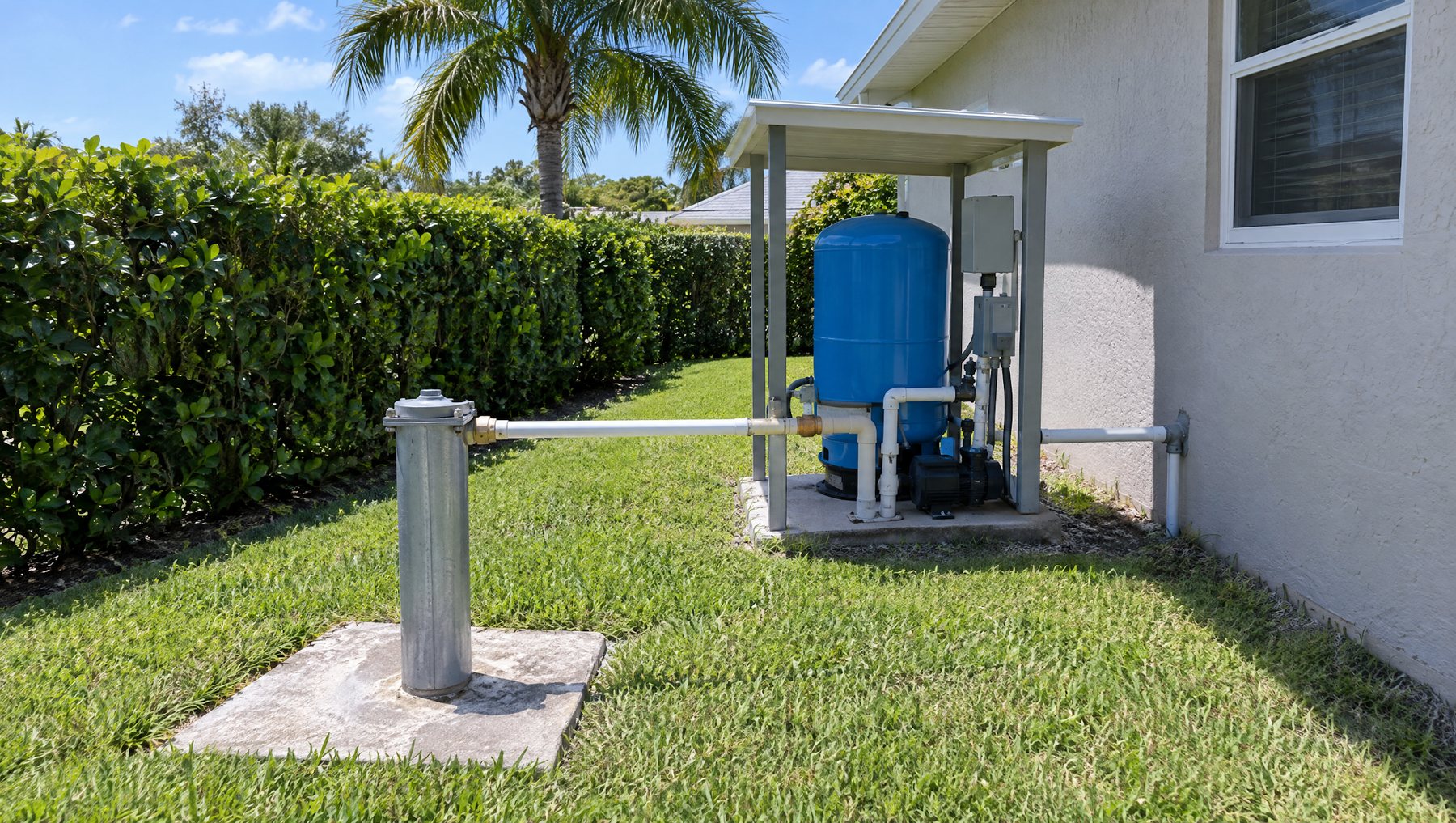
No one tests a private well for you. The Florida Department of Health recommends testing well water every year [16][17]:
| Test | How often |
|---|---|
| Coliform bacteria | Every year |
| Nitrate | Every year |
| Lead | Every year |
| pH | Every year |
UF/IFAS also suggests testing right away if you repair any part of the well system, and adding tests for iron, hardness, sulfate and other items when buying a home [16]. If your well is near the coast and the water tastes salty, test for chloride, total dissolved solids and sodium [16]. Your county health department or a state-certified lab can run these tests.
After a hurricane or flood
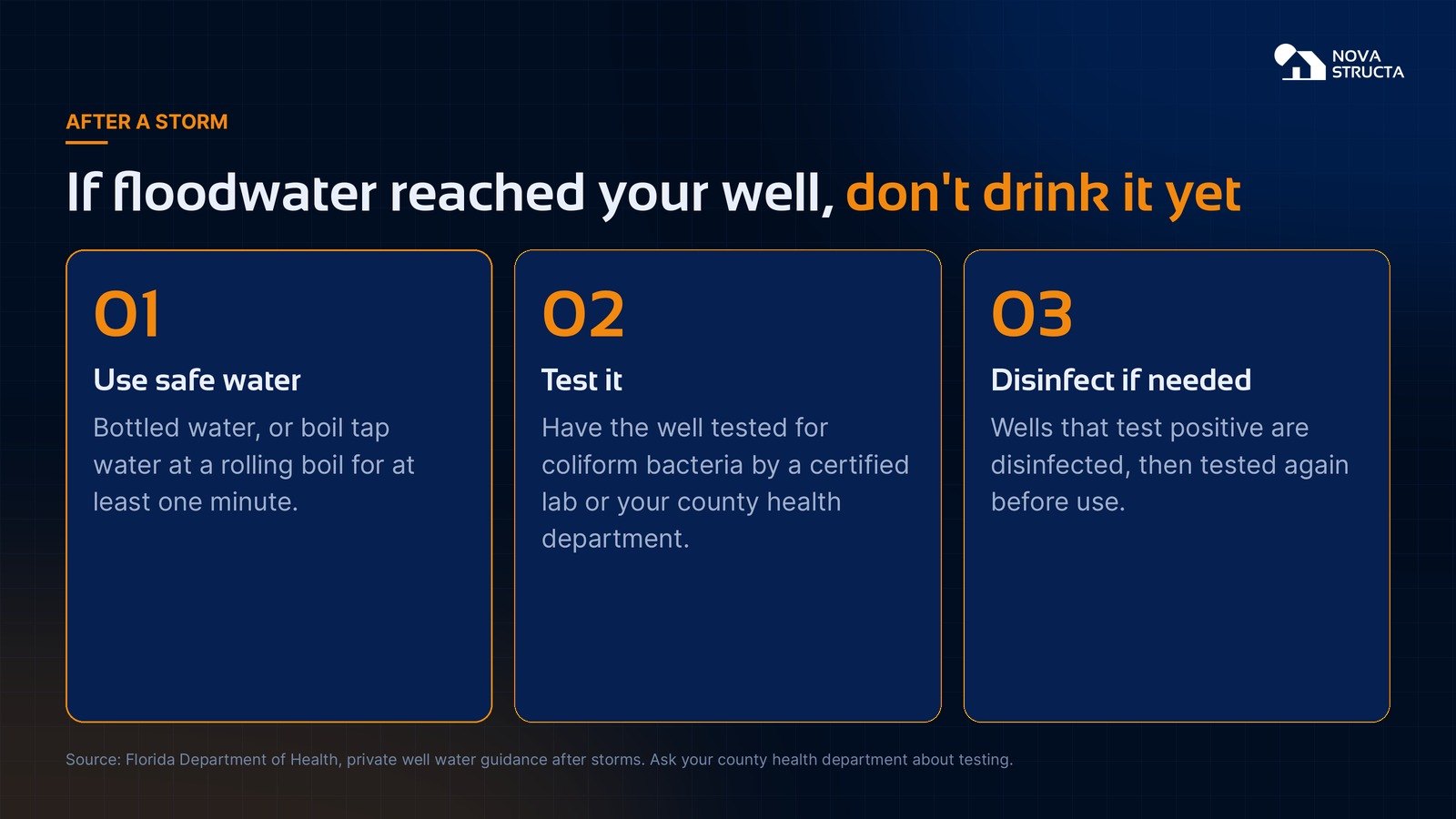
If floodwater reached your well, do not drink the water until it has been tested [18]:
- Use safe water. Drink bottled water, or boil tap water at a rolling boil for at least one minute.
- Test it. Have the water tested for coliform bacteria by your county health department or a state-certified lab.
- Disinfect if needed. The Department of Health recommends disinfecting the well if samples test positive for coliform bacteria, then testing again.
Note that a softener does nothing for bacteria [1], and most carbon filters are not built for it either. A storm is a reason to test, not a reason to trust the equipment you already have. For more on getting through a storm, see how Powerwalls work during a hurricane.
What about lead pipes?
Lead usually enters water from older pipes and service lines, not from the source. Under EPA's 2024 Lead and Copper Rule Improvements, water systems are required to replace lead service lines within 10 years [19]. Utilities keep inventories of service line materials, so you can ask yours whether your line is lead or unknown. In the meantime, a certified RO system or an NSF/ANSI 53 filter with a lead reduction claim is the common kitchen-tap option [1][13].
How do you read your water quality report?
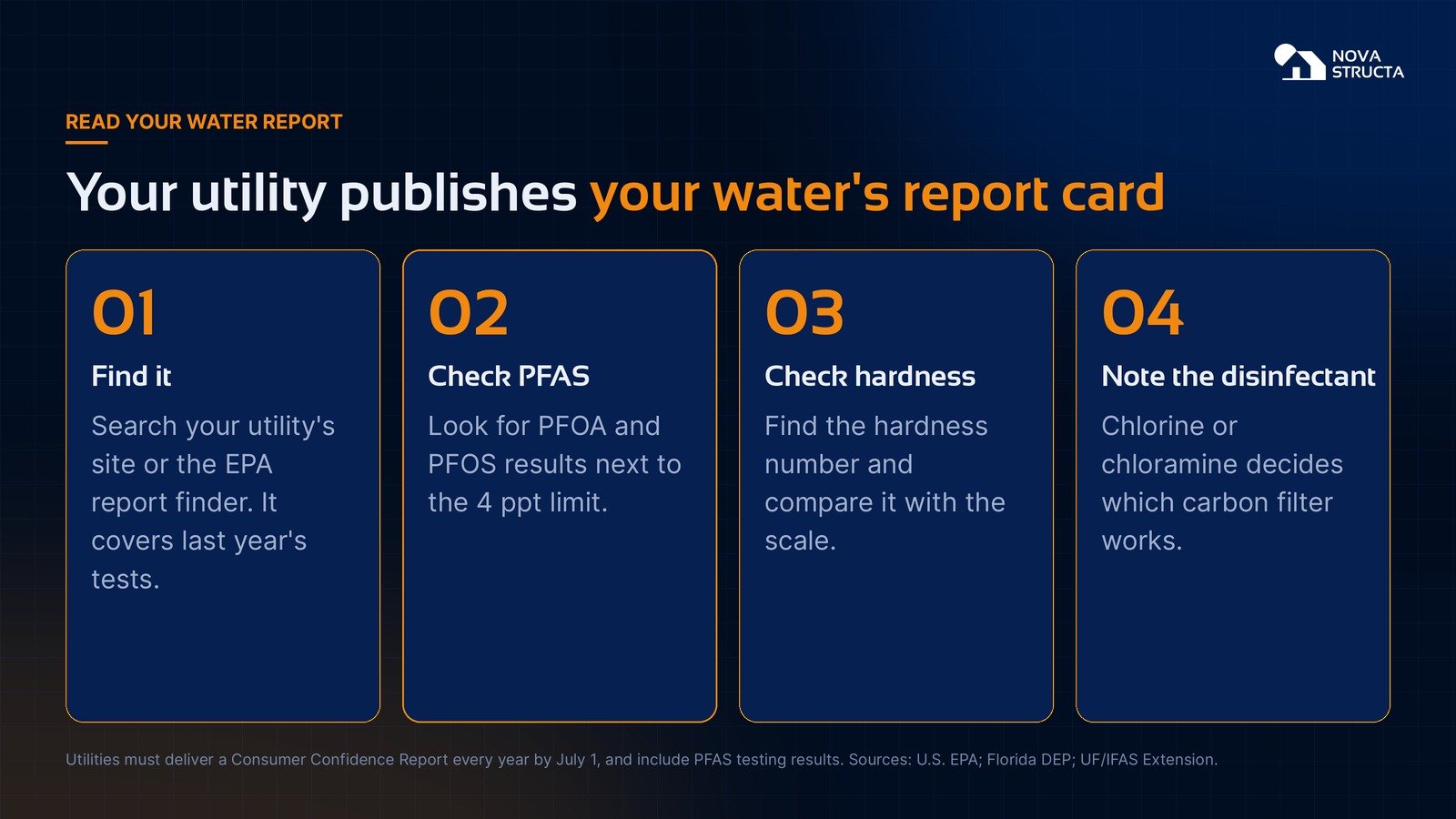
If you are on city or county water, your utility must deliver an annual water quality report, called a Consumer Confidence Report, by July 1 each year. It covers the previous year's testing [20]. You can usually find it on your utility's website or through EPA's report finder [16].
- Find it. Search your utility's name plus "water quality report."
- Check PFAS. Look for PFOA and PFOS results and compare them with the 4 ppt limit.
- Check hardness. Find the number and compare it with the scale above.
- Note the disinfectant. Chlorine or chloramine decides which carbon filter works.
For a broader look at water around the state, see our guide to Florida water quality.
Questions to ask before you buy any system
- What did my water report or water test actually show, and which result is this system for?
- What is the exact NSF/ANSI standard and contaminant claim for this model?
- Is the carbon rated for chloramine, if my utility uses it?
- How often do filters, membranes or salt need replacing, and what does that cost each year?
- For a softener: how much sodium will it add, and is a potassium option available?
- For RO: how much water goes to the drain, and where will the faucet and tank go?
The bottom line
Florida water is generally treated and tested, but "treated" does not answer every question a homeowner has. Limestone makes a lot of it hard. Statewide sampling has found PFAS in many taps, the federal deadline to fix that has been proposed for 2031, and fluoride is no longer added. None of that means every home needs a whole-home system. It means every home deserves a look at its own numbers.
Start with your water report or a test. Match the equipment to what you find: carbon for taste and odor, a softener for hardness, certified RO at the kitchen tap for PFAS, lead or fluoride, and a yearly test if you are on a well. Results depend on the specific certified equipment and your water source. If you would like help reading your report and talking through options, see water filtration and water heaters or book a free water assessment.
Sources
- Centers for Disease Control and Prevention, About Home Water Treatment Systems, April 10, 2024. cdc.gov
- St. Johns River Water Management District, "Florida's aquifers: Water beneath our feet." sjrwmd.com
- C. Wilson, UF/IFAS Extension, Water Quality Notes: Alkalinity and Hardness (SL332/SS540), including the EPA hardness classification. ask.ifas.ufl.edu
- UF/IFAS Extension Walton County, "Are PFAS in Walton County's drinking and surface waters?" summarizing the University of Florida statewide tap water study. ufl.edu (PDF)
- UF Health, "New research map shows levels of forever chemicals in Florida's water," 2025. ufhealth.org
- U.S. Environmental Protection Agency, The Fifth Unregulated Contaminant Monitoring Rule (UCMR 5) Data Summary, July 2026 (EPA 815-S-26-007). epa.gov (PDF)
- Florida Department of Environmental Protection, Unregulated Contaminant Monitoring Rule. floridadep.gov
- Harvard Law School Environmental and Energy Law Program, PFAS in Drinking Water tracker, updated September 18, 2026. eelp.law.harvard.edu
- U.S. Environmental Protection Agency, National Primary Drinking Water Regulations. epa.gov
- Michigan Department of Environment, Great Lakes, and Energy, PFAS Response: Drinking Water Filters. michigan.gov
- Florida Phoenix, "Florida bans municipalities from fluoridating water supplies," May 15, 2025. floridaphoenix.com
- WUSF, "Florida stops fluoridating its water. Here's what you should know," July 1, 2025. wusf.org
- NSF, Standards for Water Treatment Systems. nsf.org
- Pinellas County Utilities, Frequently Asked Questions About Chloramines. pinellas.gov
- Minnesota Department of Health, Home Water Softening Frequently Asked Questions. health.state.mn.us
- UF/IFAS Extension, Household Drinking Water Testing for Public and Private Water Supplies (SL499/SS712). ask.ifas.ufl.edu
- Florida Department of Health, Private Well Testing. floridahealth.gov
- Florida Department of Health in St. Johns County, Private Well Water (before, during and after a storm). floridahealth.gov
- U.S. Environmental Protection Agency, Lead and Copper Rule Improvements, public fact sheet, October 2024. epa.gov (PDF)
- U.S. Environmental Protection Agency, Consumer Confidence Reports. epa.gov
- Puronics, Defender iGen Whole-house Water Softener (certifications and control valve features). puronics.com
- Puronics, Micromax 8500 drinking water system product brochure (S2-11/21), including WQA certifications. puronics.com
Savings and utility-bill examples shown are illustrative only, are not guaranteed, and may not reflect typical results. Actual savings depend on your energy usage, system size, roof and site conditions, financing terms, utility rates, net-metering rules, and other factors specific to your home.