Roofing
Roof Repair vs. Replacement in Florida (2026): The Signs, the Rules and How to Decide
Should you repair or replace your roof?
Repair a roof when the damage is limited, the roof is well inside its expected life and the deck underneath is sound. Replace it when wear is spread across the roof, leaks keep coming back, the deck is soft, or it is near the end of its life, about 20 years for asphalt shingles. In Florida, roof age also shapes what insurers will write.
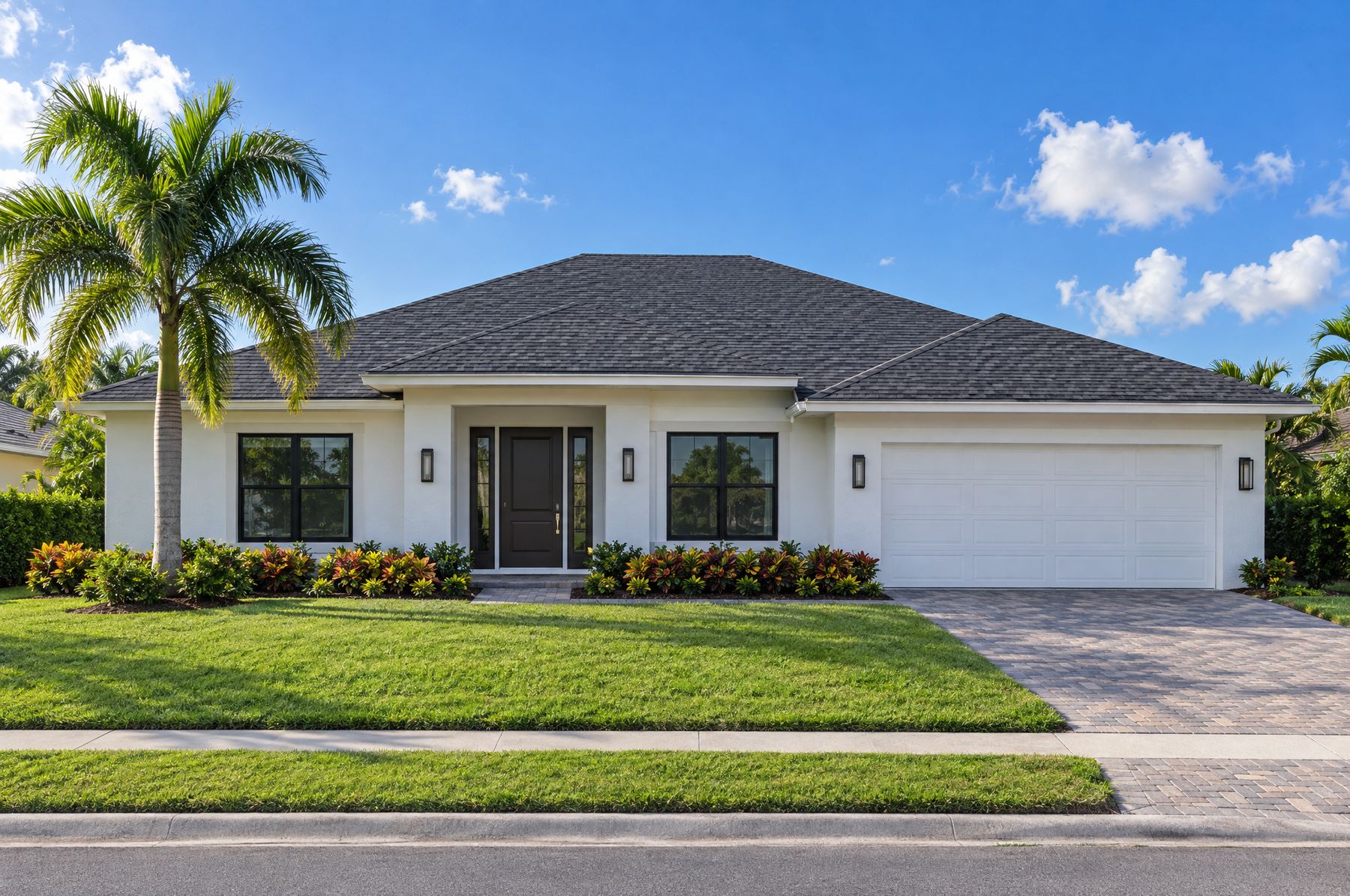
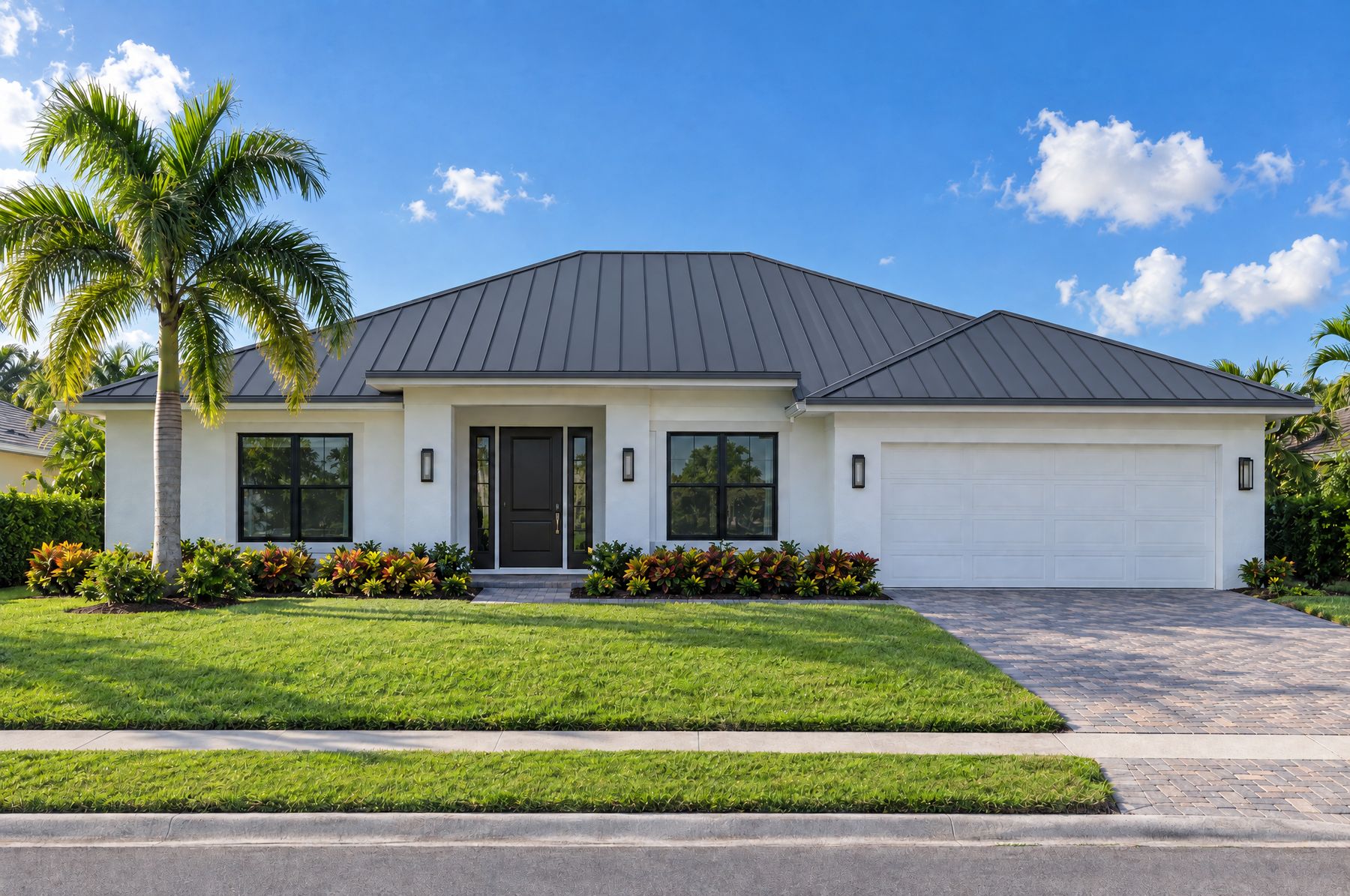
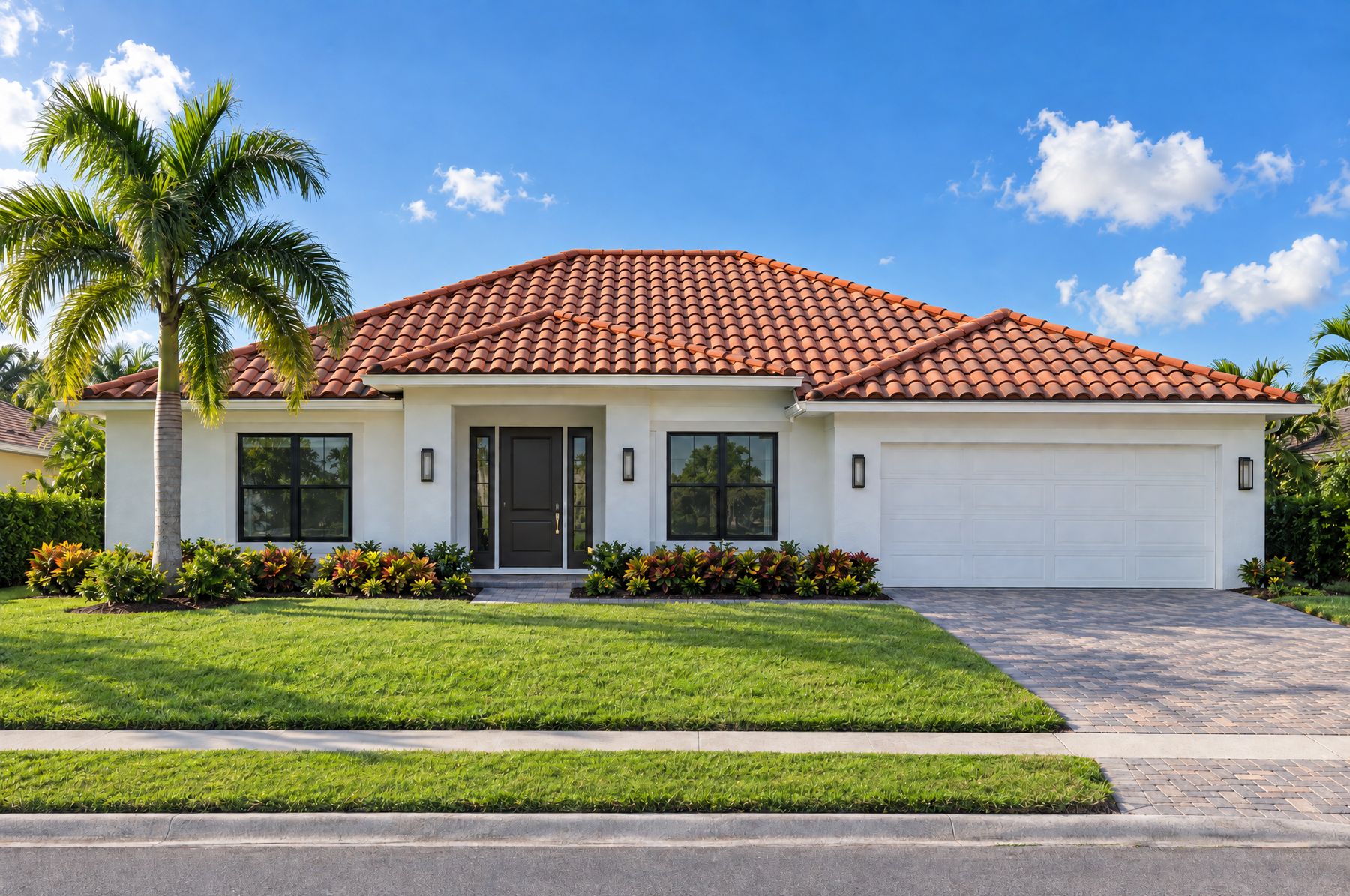 Architectural shingleConcrete barrel tile
Typical life. About 20 years, by national estimates [2] [4]. Florida sun and storms are hard on it.
In Hurricane Ian. About half of shingle roofs had damage, and roofs 10 or more years old were especially vulnerable [1].
Repair or replace. Easy to patch a few shingles, but new ones rarely match an aged roof, and widespread wear means replacement.
Typical life. National data lists clay and concrete tile as lasting a lifetime [2].
In Hurricane Ian. About 40% had some damage, but significant damage was rare except on tile roofs more than 20 years old [1].
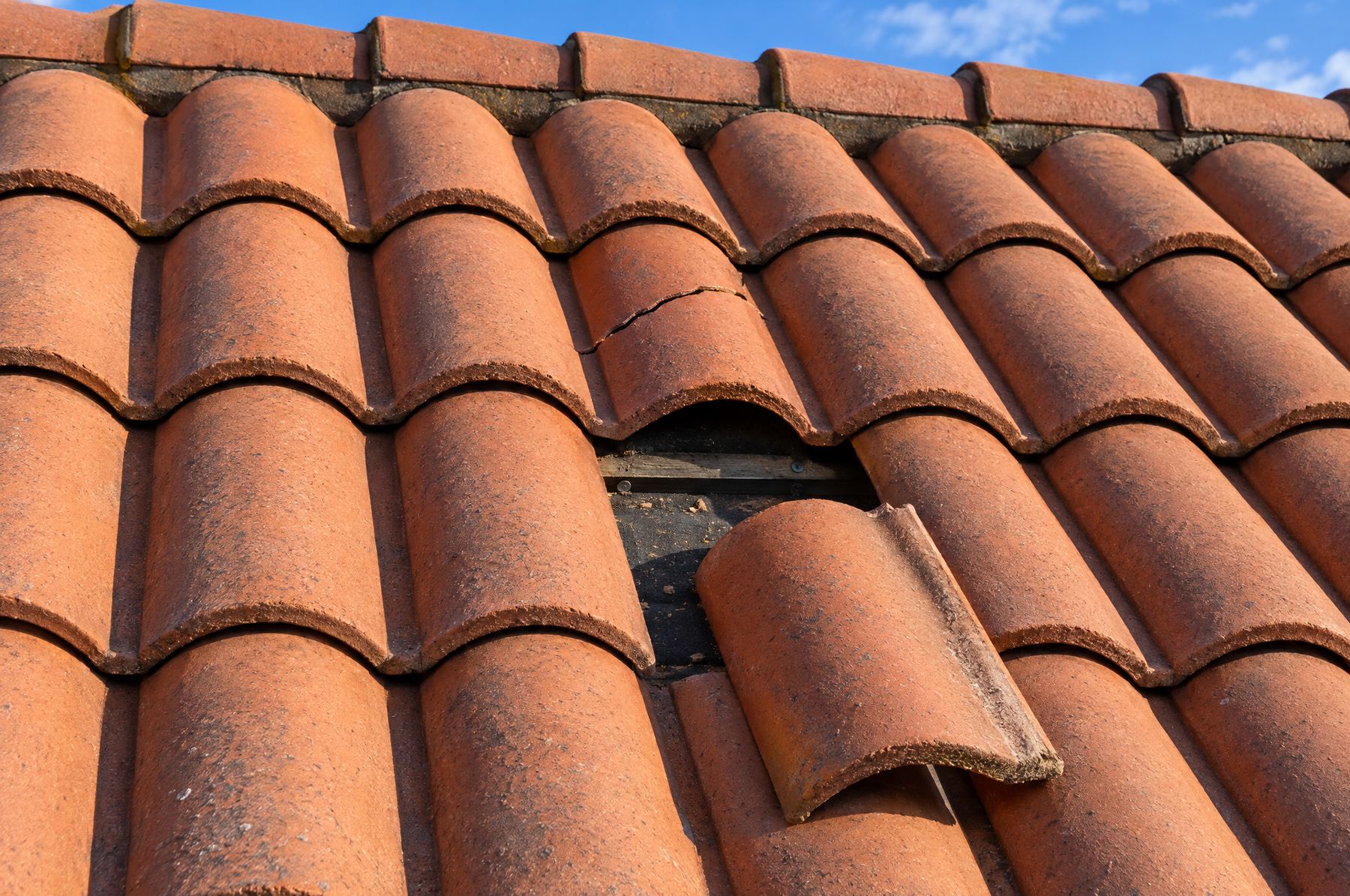
Repair or replace. Cracked or slipped tiles can be replaced one by one. Matching an older tile profile can be the hard part.
Tap a roof to put it on the house. Same home, same light, three very different answers to the repair or replace question. Photos are illustrations.
Most roof questions start the same way: a stain on the ceiling, shingles in the yard after a storm, or a letter from the insurance company. The answer depends on three things: how much of the roof is affected, how old it is, and what Florida's rules and your insurer require.
This guide brings both halves of the question into one place: the signs to look for, and how to decide between repair and replacement. You can inspect a real-looking roof, run a quick checklist, and walk through the Florida rules that decide more than most people expect. Every claim links to a source. It is general information, not legal or insurance advice.
Inspect this roof: tap the pins
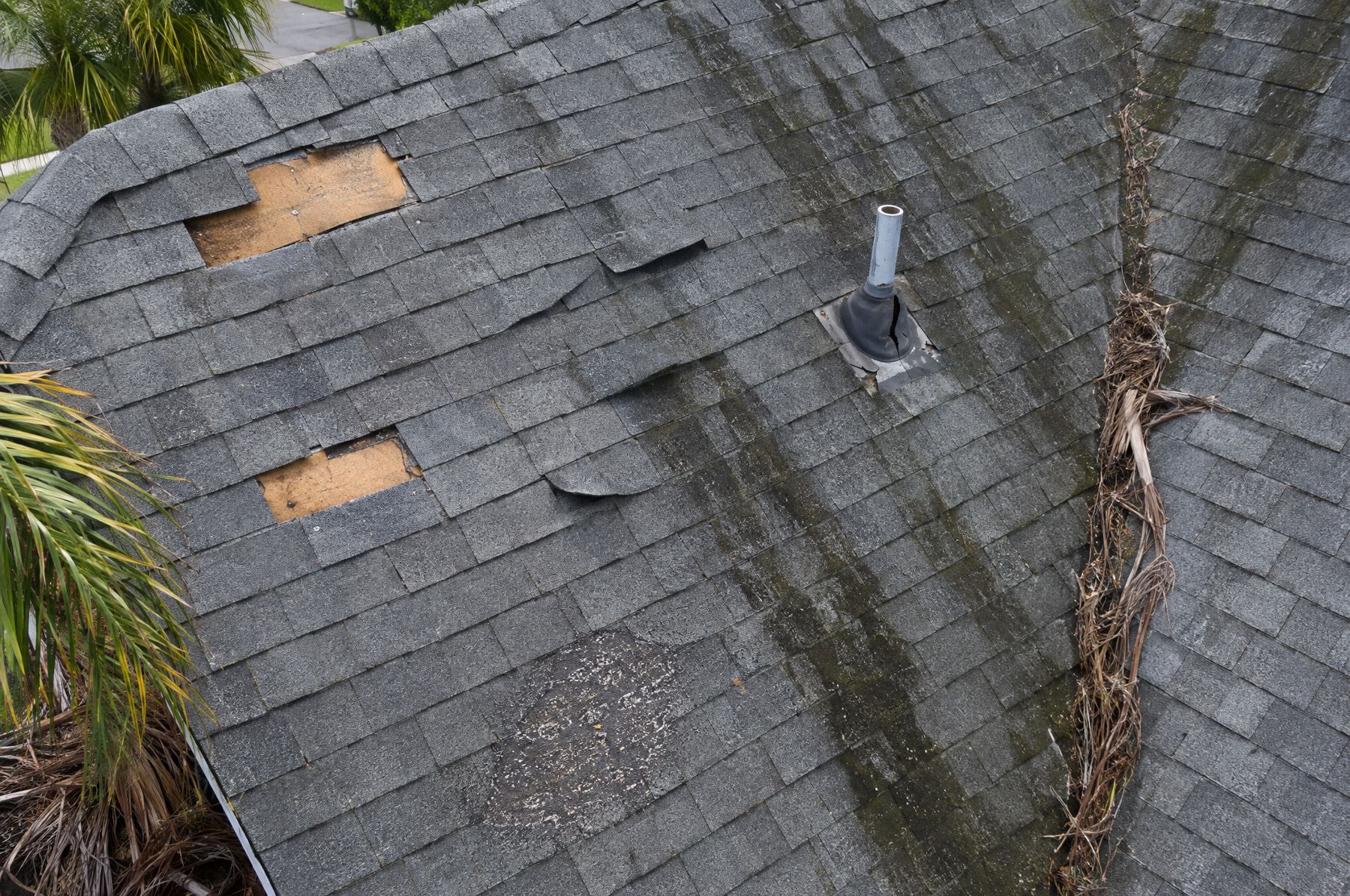
1
2
3
4
5
6
Read the pins together and a picture forms. Pins 1 through 3 are repairs a roofer can make. Pin 4 is cosmetic. Pin 5 is the one that matters most for the big decision: granule loss across a roof means the shingles themselves are aging out [8]. On a roof like this, a repair buys time, not years.
Six signs your roof needs attention
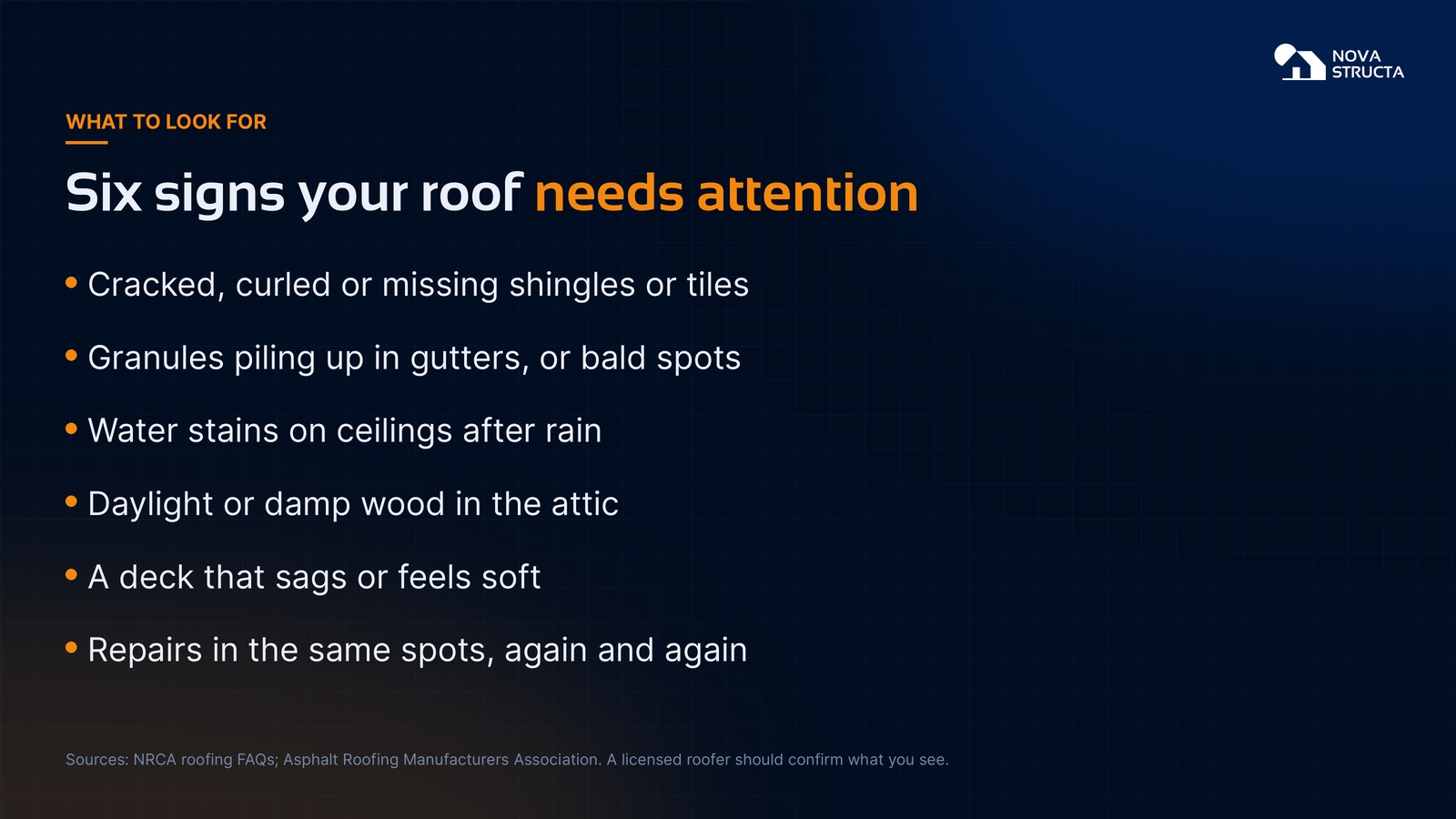
The National Roofing Contractors Association says regular inspections often catch cracked, warped or missing shingles, loose seams, deteriorated flashing and excess granules in gutters [4]. Here is what to look for, from the yard and from inside.
- Cracked, curled or missing shingles or tiles. The asphalt roofing industry lists these, along with heavy granule loss, as the things to inspect for [6].
- Granules in gutters or downspouts. A few after a new roof is normal. Piles of them, plus bald spots, mean the shingles are wearing out [4] [8].
- Water stains on ceilings. Brown rings after rain mean water is getting past the roof somewhere.
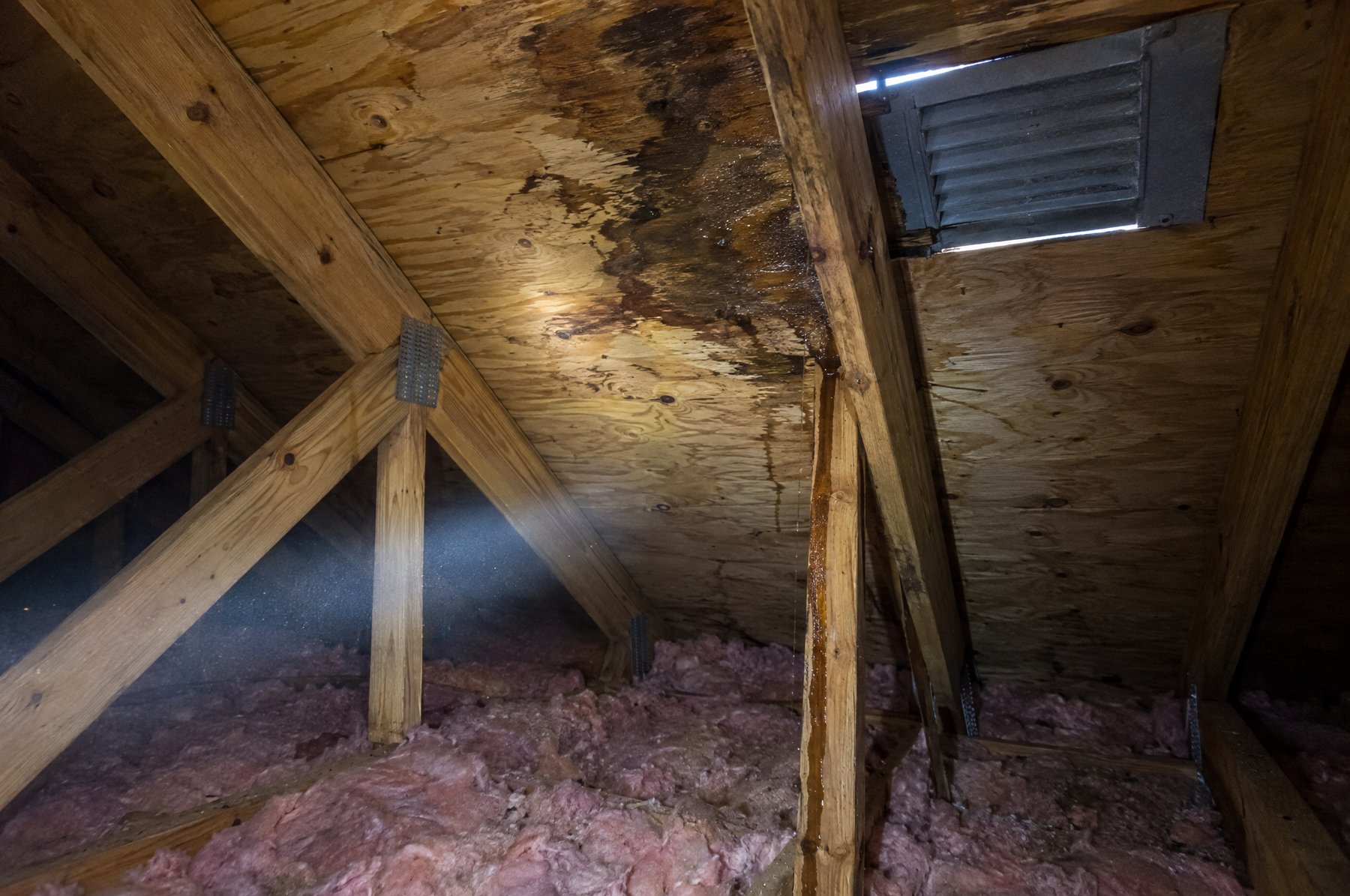
- Daylight or damp wood in the attic. Look on a sunny day and after rain, with a flashlight.
- A sagging or soft deck. From the street, the roofline should be straight.
- Repairs in the same spots. Patching the same area again and again is a sign the roof around it is failing.
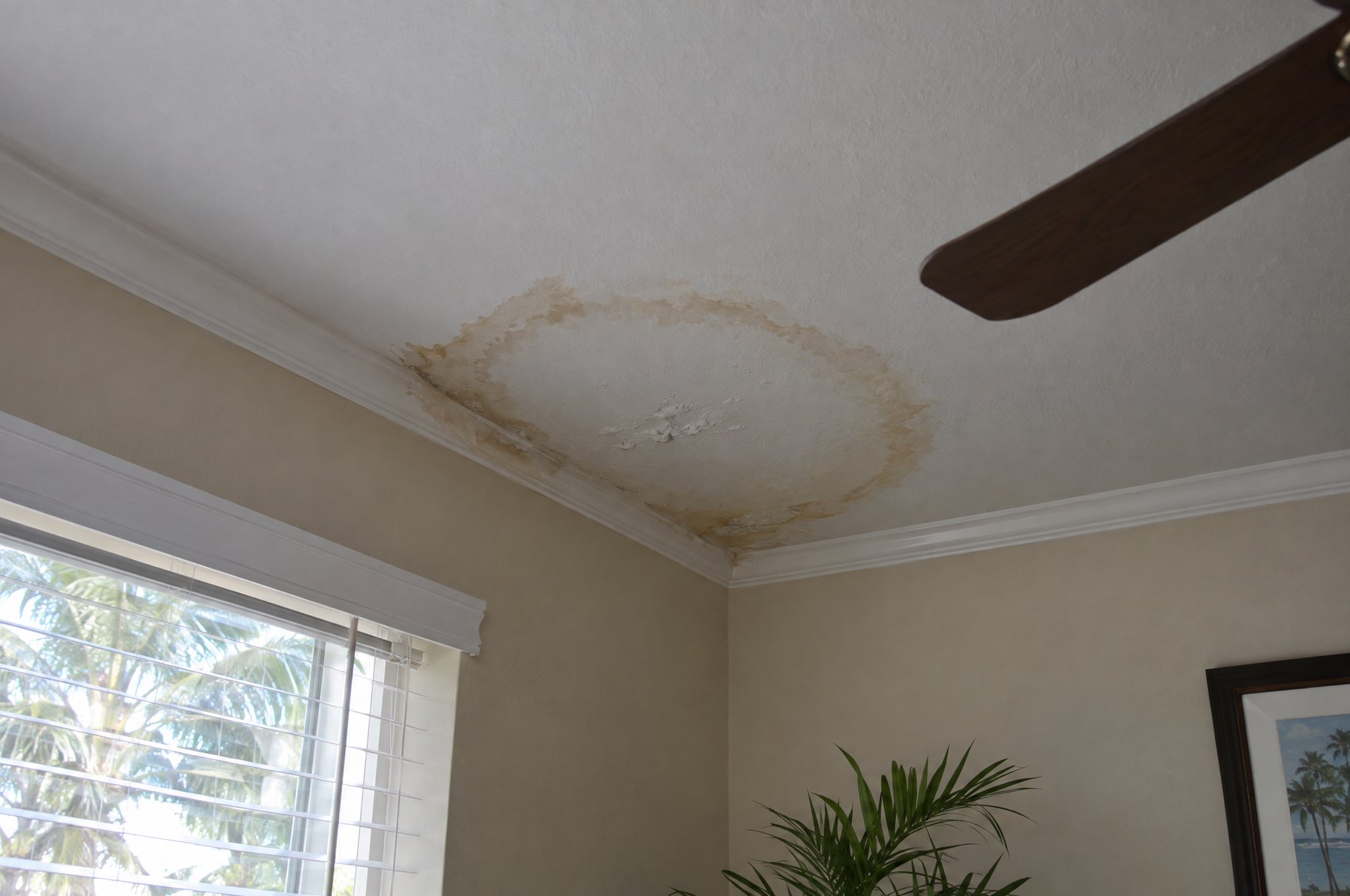
One leak does not automatically mean a new roof. NRCA notes that leaks can come from flashing that has worked loose or from one damaged section [4]. The attic tells you more than the ceiling.
Repair or replace? Check what you see
Check everything that applies to your roof. The verdict updates as you go.
Points to a repair
Points to a replacement
replacement signs checked
Check what you see above. Your result shows here.
Likely a repair. Damage that is limited to one area on a roof with life left is usually worth fixing. Have a licensed roofer confirm it, and ask for a written, itemized estimate.
Get an inspection soon. One sign of a roof near the end of its life is worth a closer look. A roofer can tell you whether a repair buys real time or just delays a replacement.
Replacement is likely on the table. Two or more of these signs together usually point to a roof that is wearing out. Get written estimates for both repair and replacement, and ask how Florida's 25% rule and your insurer's requirements apply.
This is a starting point, not a diagnosis. Only an inspection can tell what is happening under the surface.
When a repair makes sense
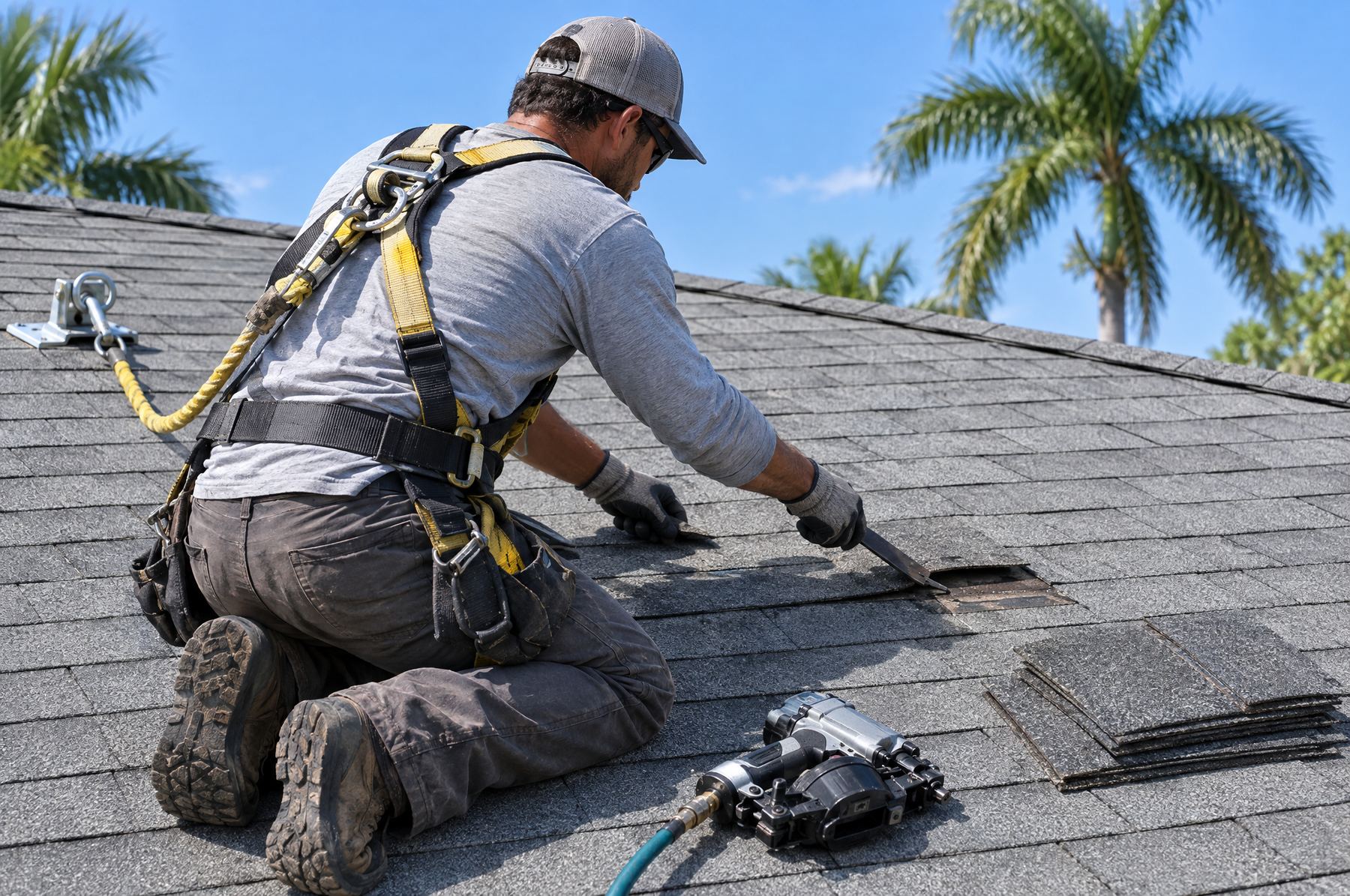
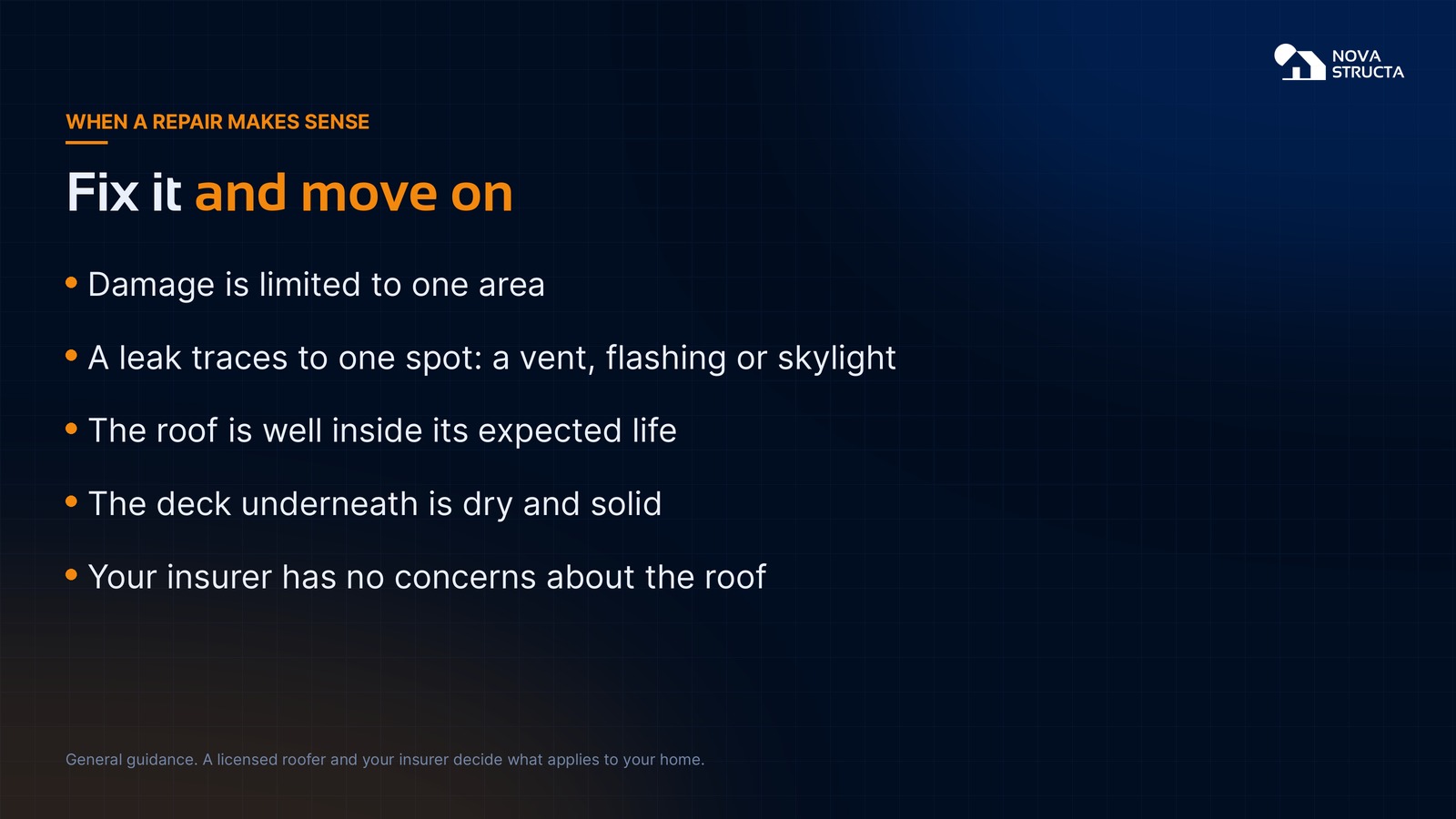
A repair is the right call when the problem is local and the roof around it is healthy:
- The damage is in one area, such as a few shingles lost at an edge, where most wind damage begins [5].
- A leak traces to one spot. Vent boots, flashing and skylights fail long before the roof does [4].
- The roof is well inside its expected life, so a fix protects years of remaining service.
- The deck is dry and solid when the roofer looks underneath.
Even then, ask about Florida's 25% rule before work starts. On an older roof, a repair over a certain size can trigger more work than you planned [9].
When replacement makes sense
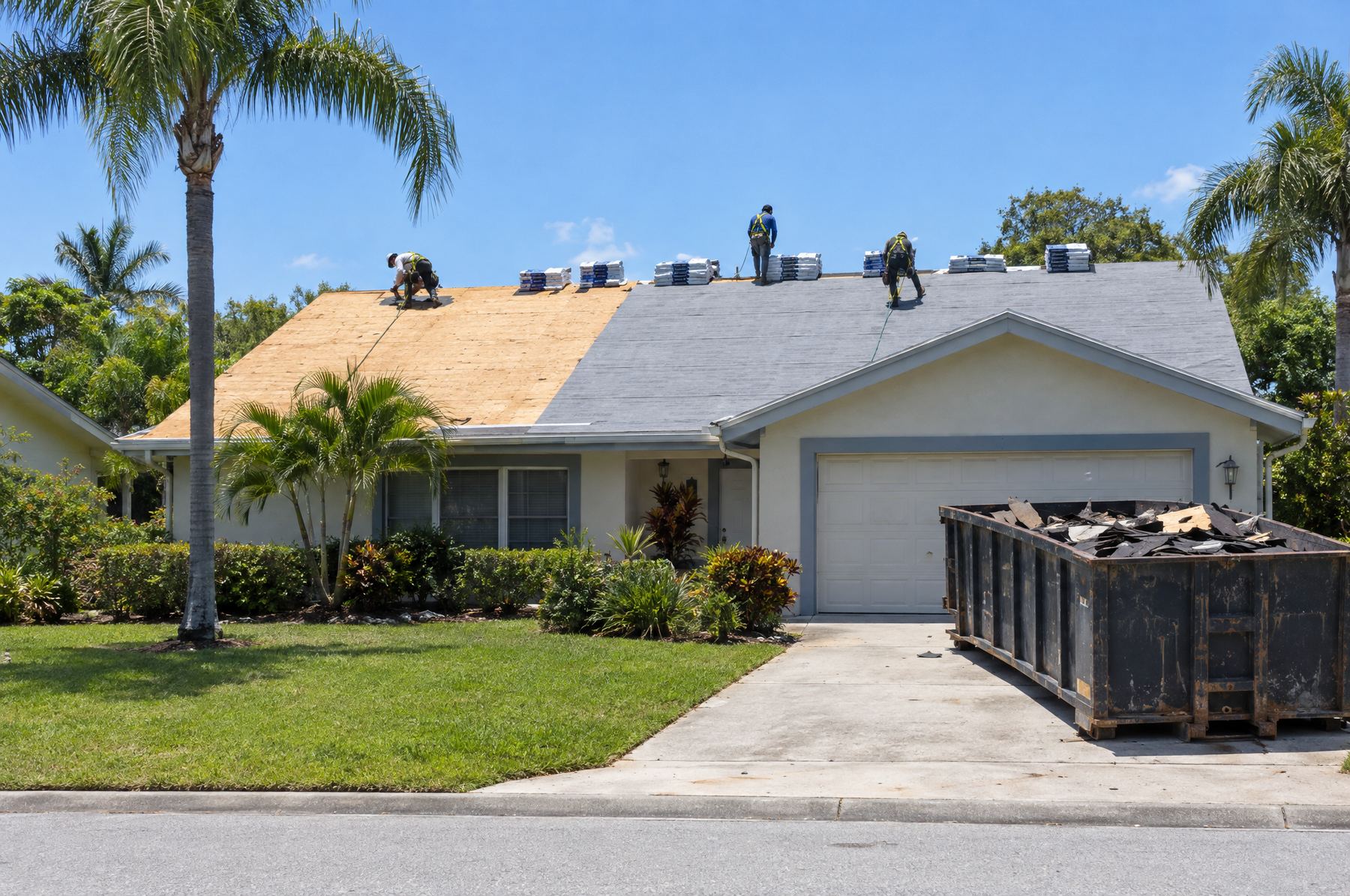
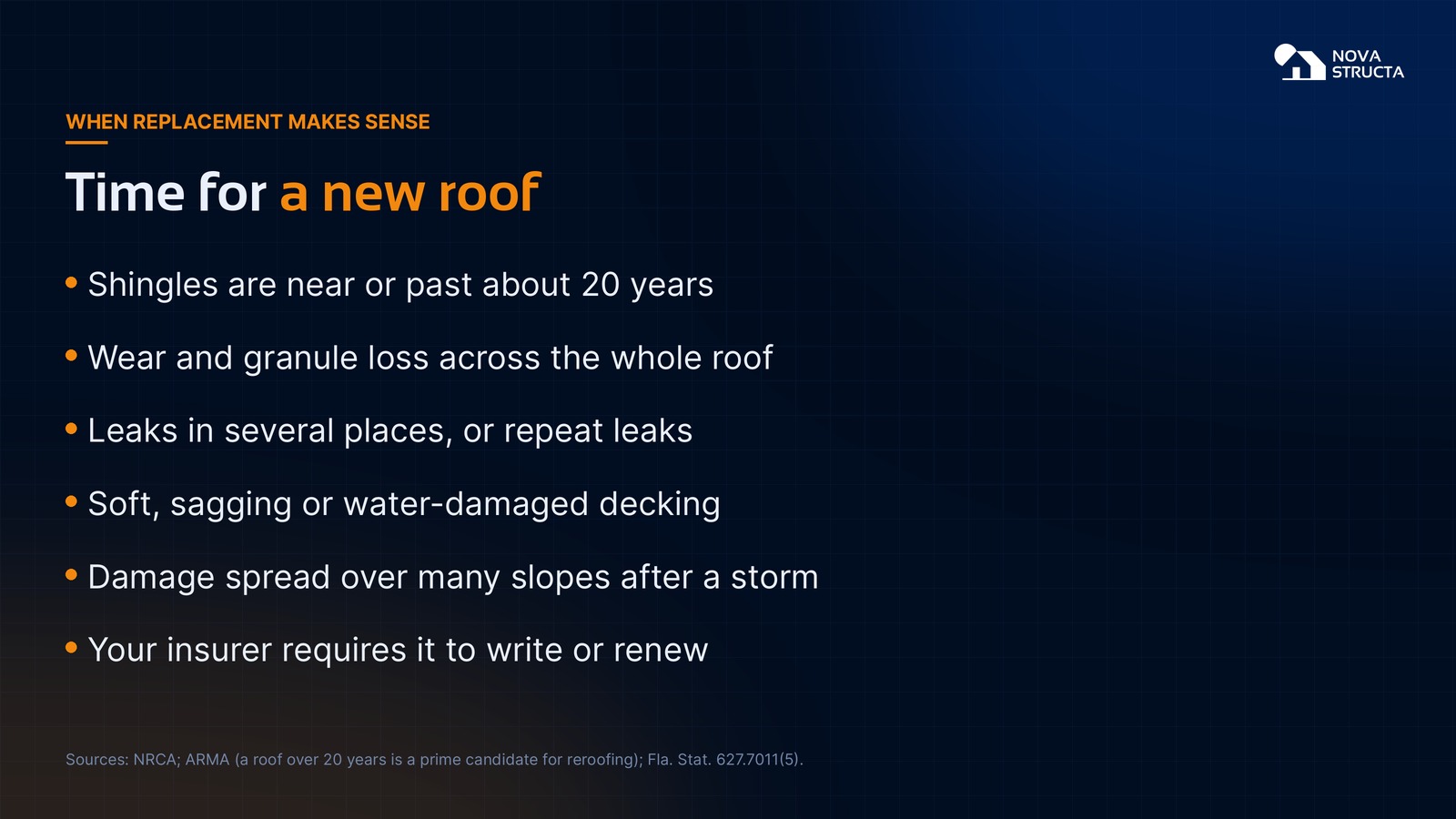
Replacement starts to make sense when the problem is the roof itself, not one spot on it. The asphalt roofing industry says a residential roof more than 20 years old is a prime candidate for reroofing [6], and NRCA says most new roofs are designed for about 20 years of useful service [4]. Add widespread granule loss, curling, repeat leaks or a soft deck, and repairs stop being a bargain.
What does it cost? The Remodeling 2025 Cost vs. Value Report puts the average South Atlantic asphalt shingle roof replacement at $32,253, with 69.9% of the cost recouped at resale, and a metal roof replacement at $50,181, with 56.5% recouped [22]. Those are regional averages for a specific project size; your roof will differ. For Florida pricing factors, see the cost of a new roof.
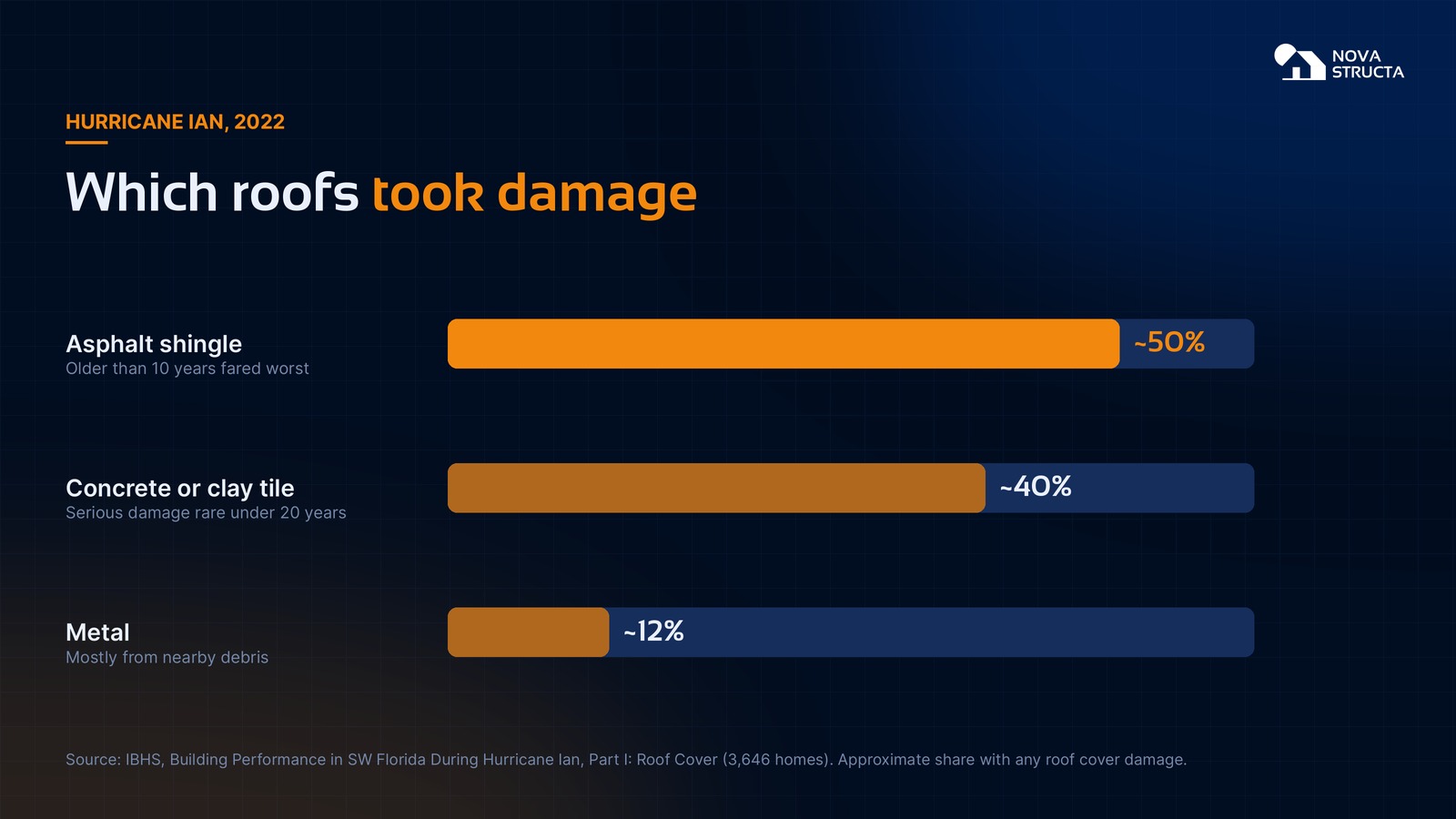
If you are replacing anyway, the material decision is worth a fresh look. In the Insurance Institute for Business & Home Safety's review of 3,646 homes after Hurricane Ian, about half of shingle roofs had damage, compared with about 40% of tile roofs and around 12% of metal roofs [1]. For the full comparison, see the best roofing materials for Florida homes.
What roof age means for your insurance
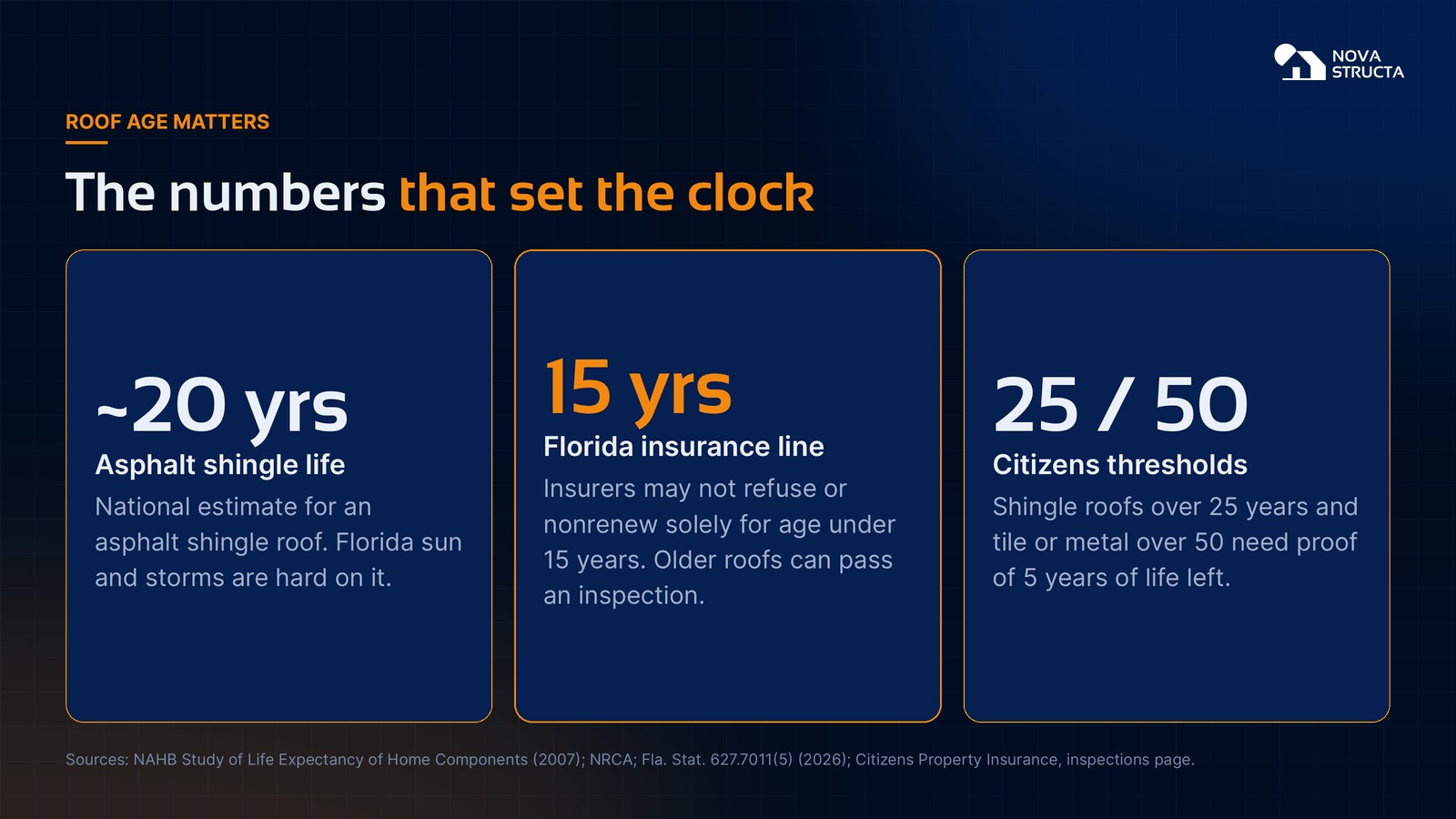
Four insurance rules tied to your roof.
Under 15 years. An insurer may not refuse to issue or renew a homeowners policy solely because of the age of a roof less than 15 years old [12].
15 years and older. The insurer must allow an inspection by an authorized inspector, which can be a roofing contractor, at your expense. If it shows at least 5 years of useful life left, the insurer may not refuse solely because of roof age [12]. Roof age counts from the last time 100% of the roof was replaced [12].
Citizens Property Insurance. Shingle roofs older than 25 years, and tile or metal roofs older than 50, need documentation of at least 5 years of remaining life [14].
Roof deductibles. A separate roof deductible may not exceed the lesser of 2% of the dwelling limit or 50% of the cost to replace the roof, and it does not apply to hurricane losses [13].
For more on how roofs affect coverage, see roof insurance in Florida. Nova Structa is not a public adjuster and does not interpret insurance policies; your insurer or a licensed public adjuster can answer coverage questions.
Florida's 25% rule, and when the old roof must come off
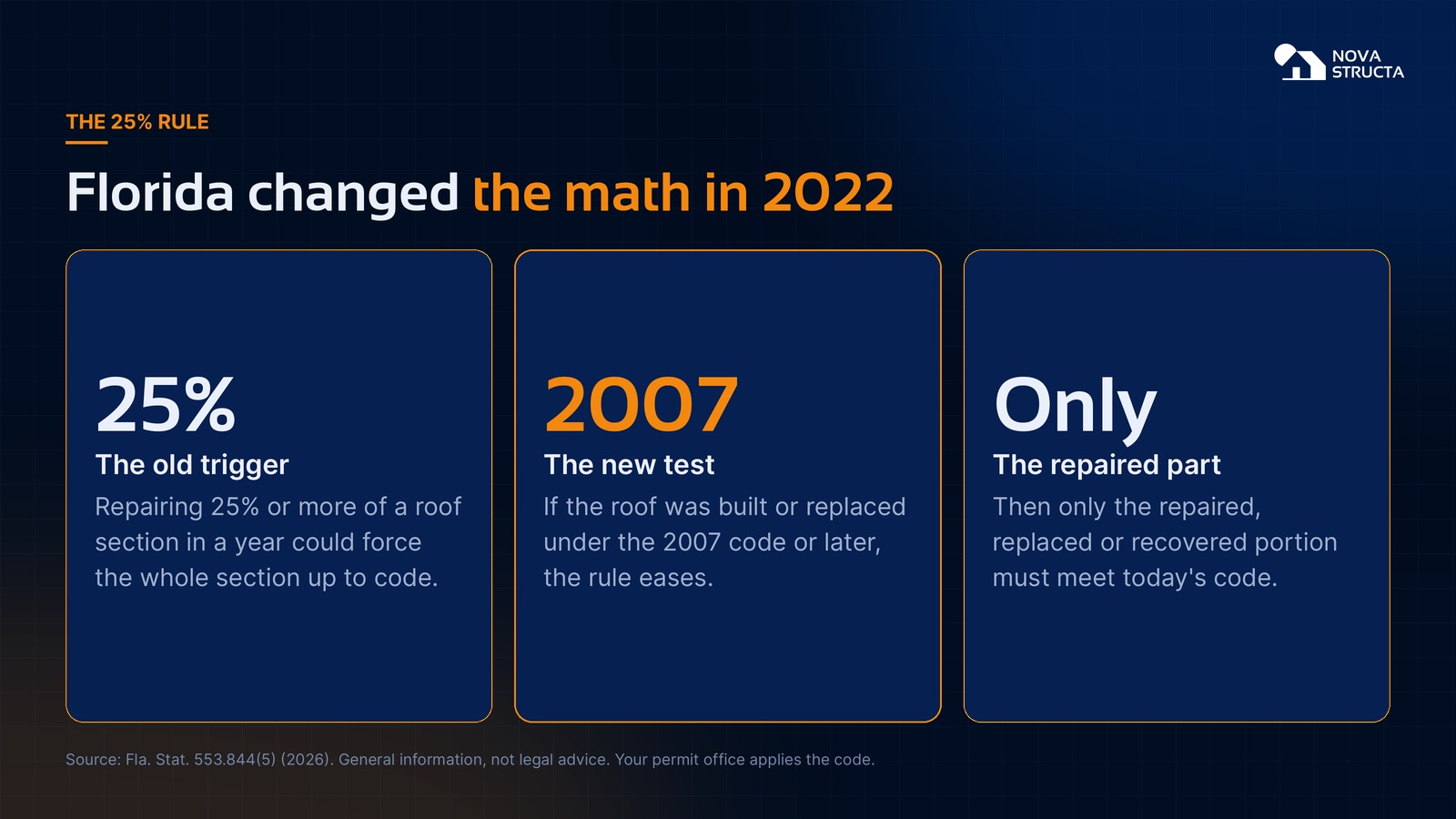
For years, Florida's building code said that if 25% or more of a roof section was repaired or replaced within 12 months, the whole section had to be brought up to current code. The Florida Building Commission's notes on the 2023 code say the rule now applies to both roof replacement and roof recover [11].
In 2022, the Legislature added an important exception. If your roof was built, repaired or replaced under the 2007 Florida Building Code or later, and 25% or more of it is being repaired, replaced or recovered, only the repaired, replaced or recovered portion has to meet the current code [9]. Local governments cannot change that [9]. Older roofs can still trigger a full replacement, which is why your roof's permit history matters.
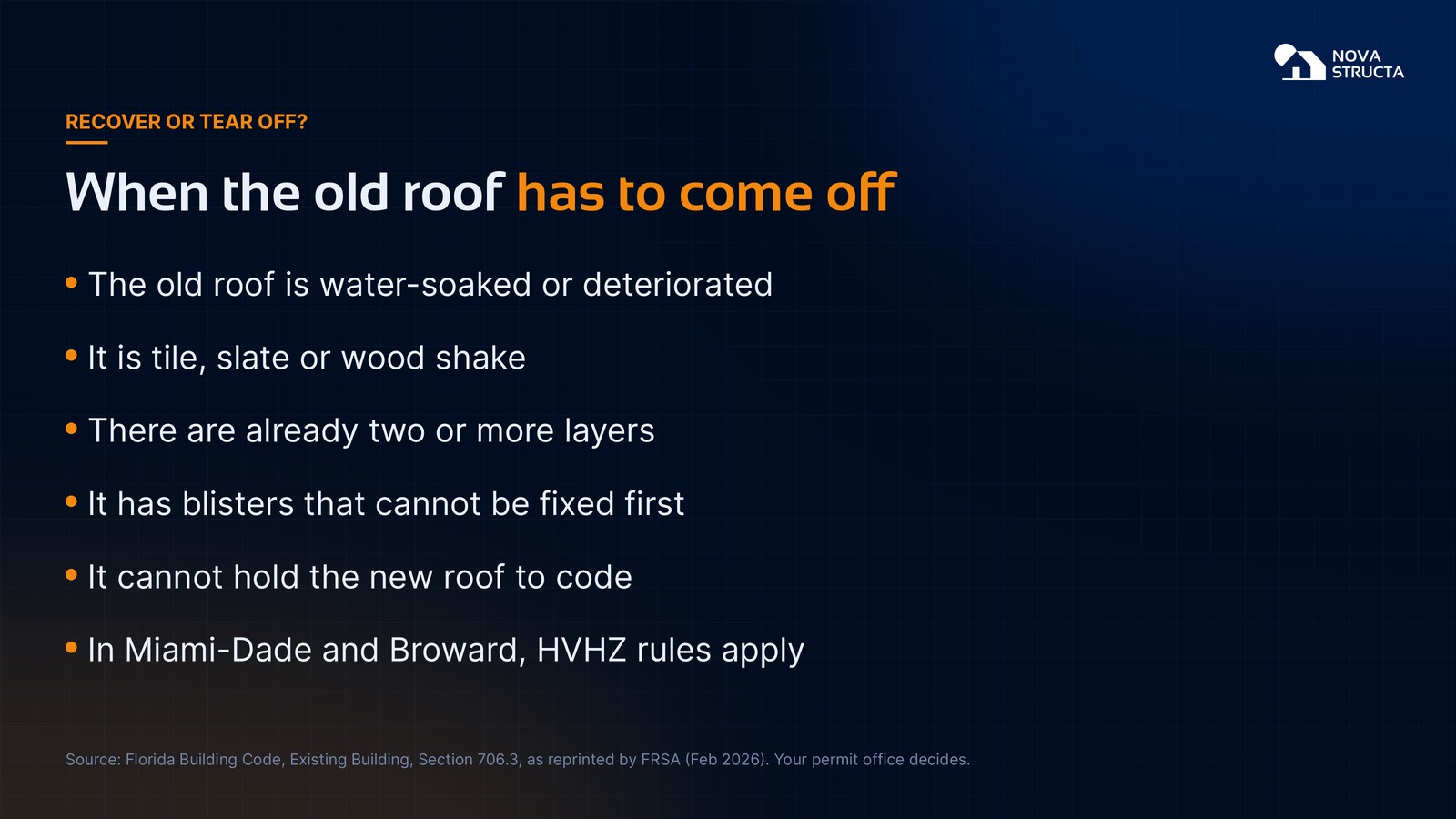
Can you put a new roof over the old one? Often not. Under the existing building code, all layers must be removed down to the deck when the old roof is water-soaked or deteriorated, when it is wood shake, slate, clay, cement or asbestos-cement tile, when it already has two or more layers, or when it cannot hold the new roof to code [10]. Homes in the High-Velocity Hurricane Zone follow their own set of rules [10]. NRCA notes that codes generally allow no more than one recover before a full replacement [4]. The 9th edition of the Florida Building Code takes effect December 31, 2026 [10], so ask your roofer which edition your permit will fall under.
After a storm: what to do first
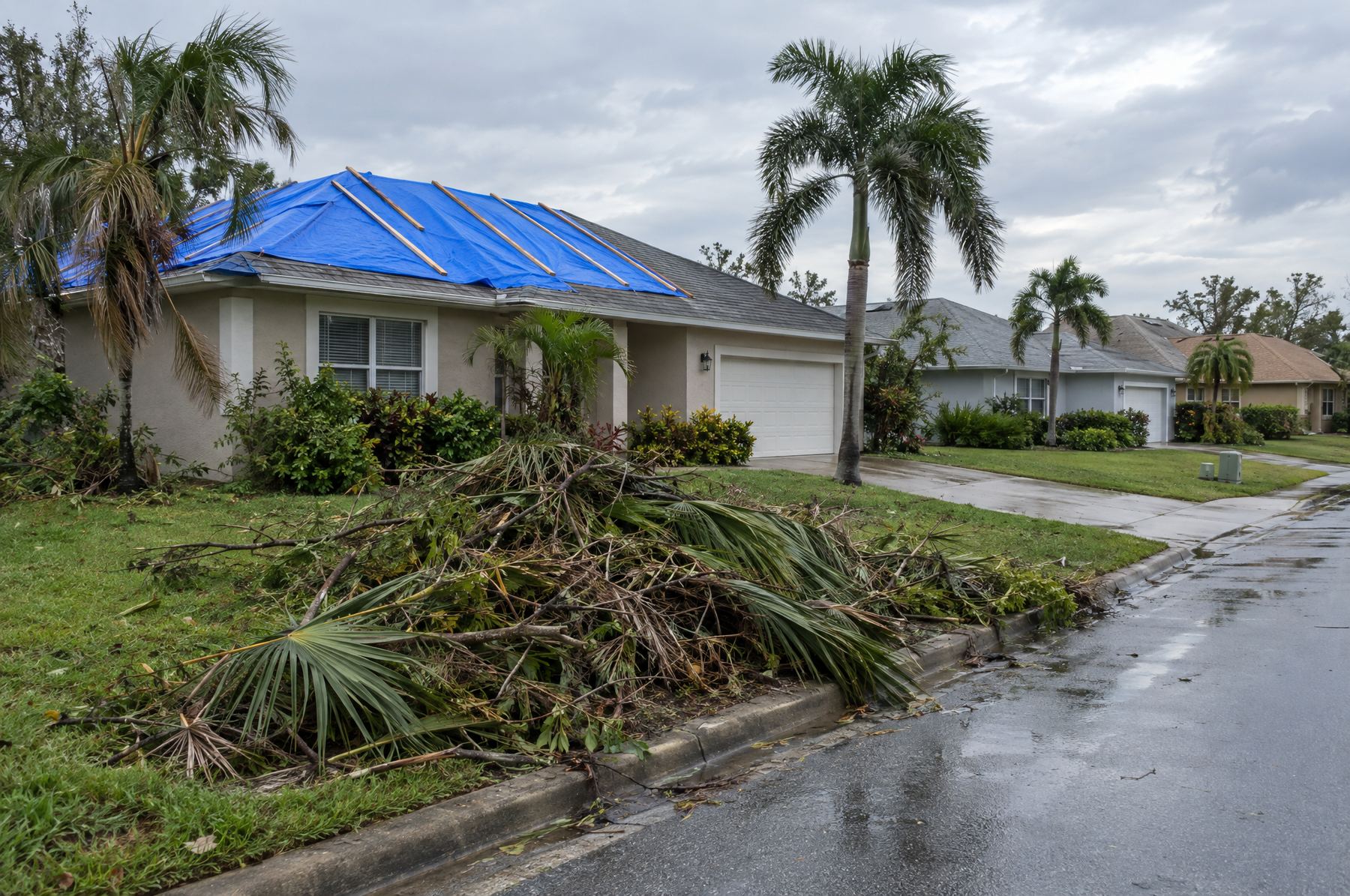
- Stay off the roof. NRCA advises against do-it-yourself roof repairs after a hurricane and says openings should be temporarily covered with tarps [5].
- Ask about Operation Blue Roof. After some declared disasters, the U.S. Army Corps of Engineers installs blue tarps at no cost on qualifying primary homes with less than 50% structural damage. Flat, metal, clay, slate and asbestos tile roofs do not qualify [20].
- Document everything. Photos of the roof, the ceilings and the yard, before anything is cleaned up.
- Watch the clock. Notice of a new or reopened claim must reach your insurer within 1 year of the date of loss, and a supplemental claim within 18 months. For hurricanes, the date of loss is landfall [15].
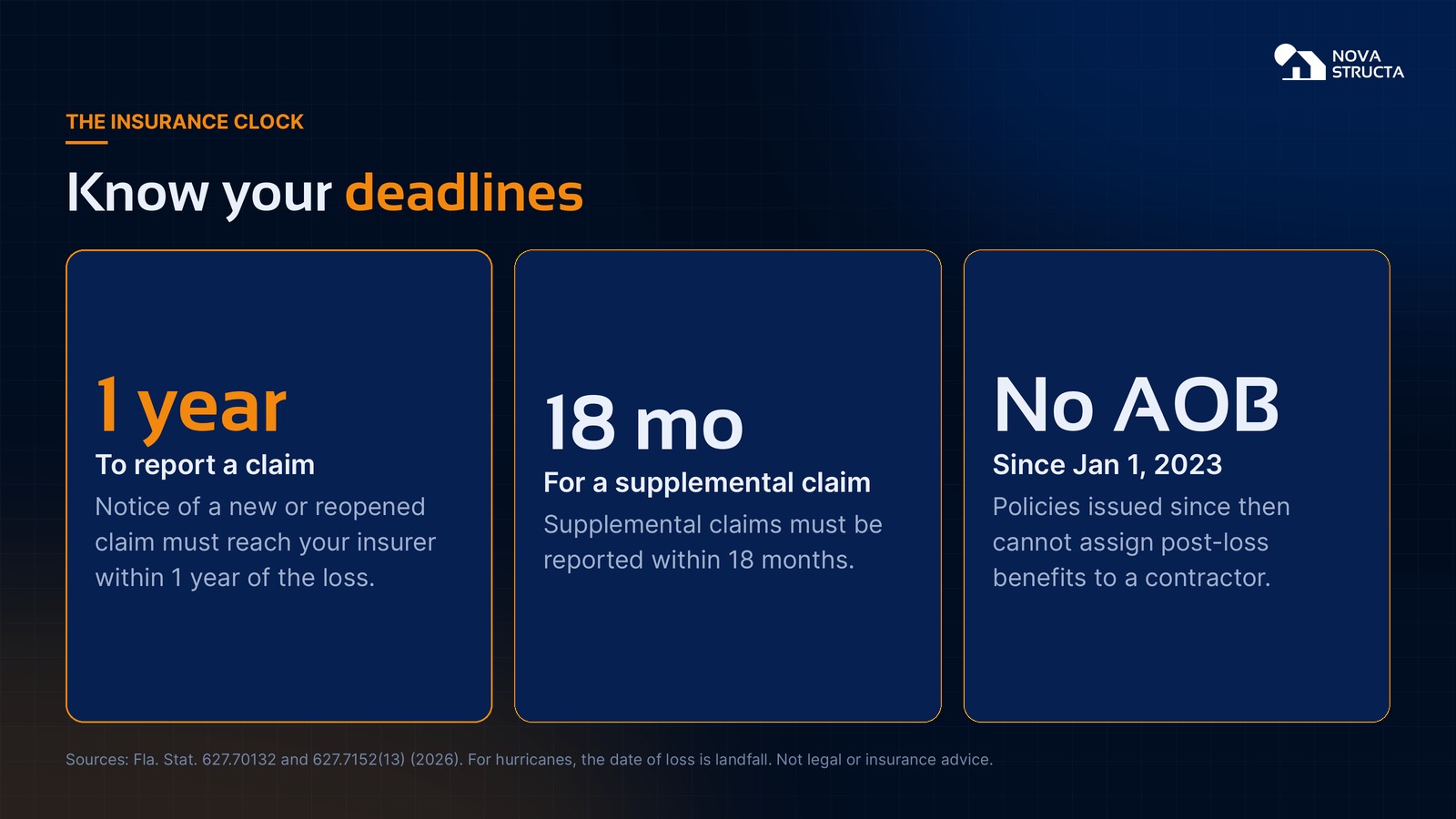
One more change since 2023: for residential policies issued on or after January 1, 2023, you cannot assign your post-loss insurance benefits to a contractor. Any attempt is void [16].
Red flags at your door
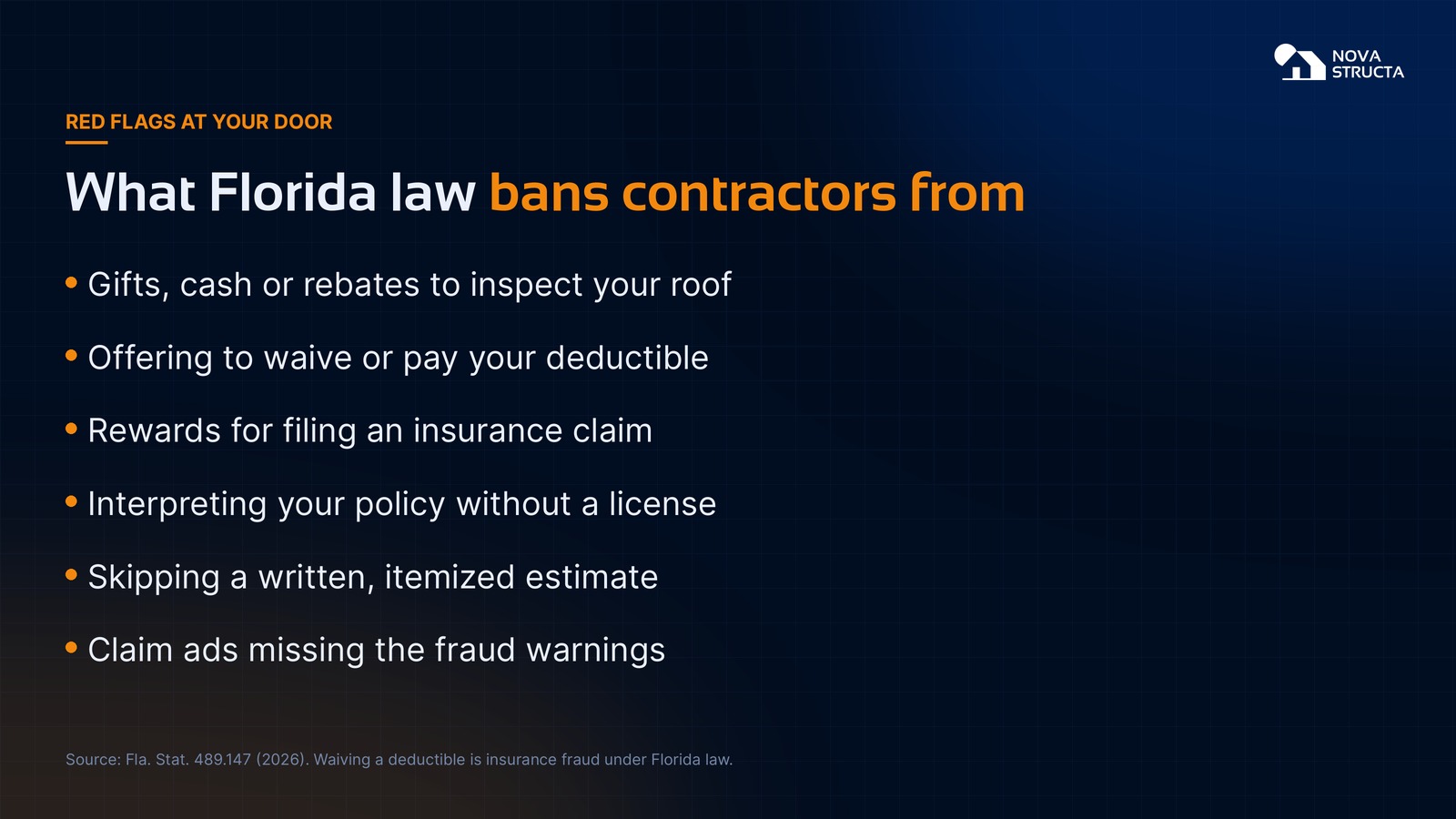
After every storm, contractors knock on doors. Florida law sets clear limits on what they can offer [17]:
- No gifts for an inspection or a claim. A contractor may not offer a rebate, gift, gift card, cash, coupon, waiver of your deductible or anything else of value in exchange for inspecting your roof or for you making an insurance claim.
- No interpreting your policy or adjusting your claim unless the person is a licensed public adjuster.
- A written, itemized estimate is required.
- Claim ads must carry warnings, including that you pay your deductible and that waiving it is insurance fraud.
- Contracts must include a notice of these rules. Contracts signed soon after a declared emergency come with extra cancellation rights.
A contractor who offers to cover your deductible is offering to break the law, and to put you in the middle of it.
If you replace, build it back stronger
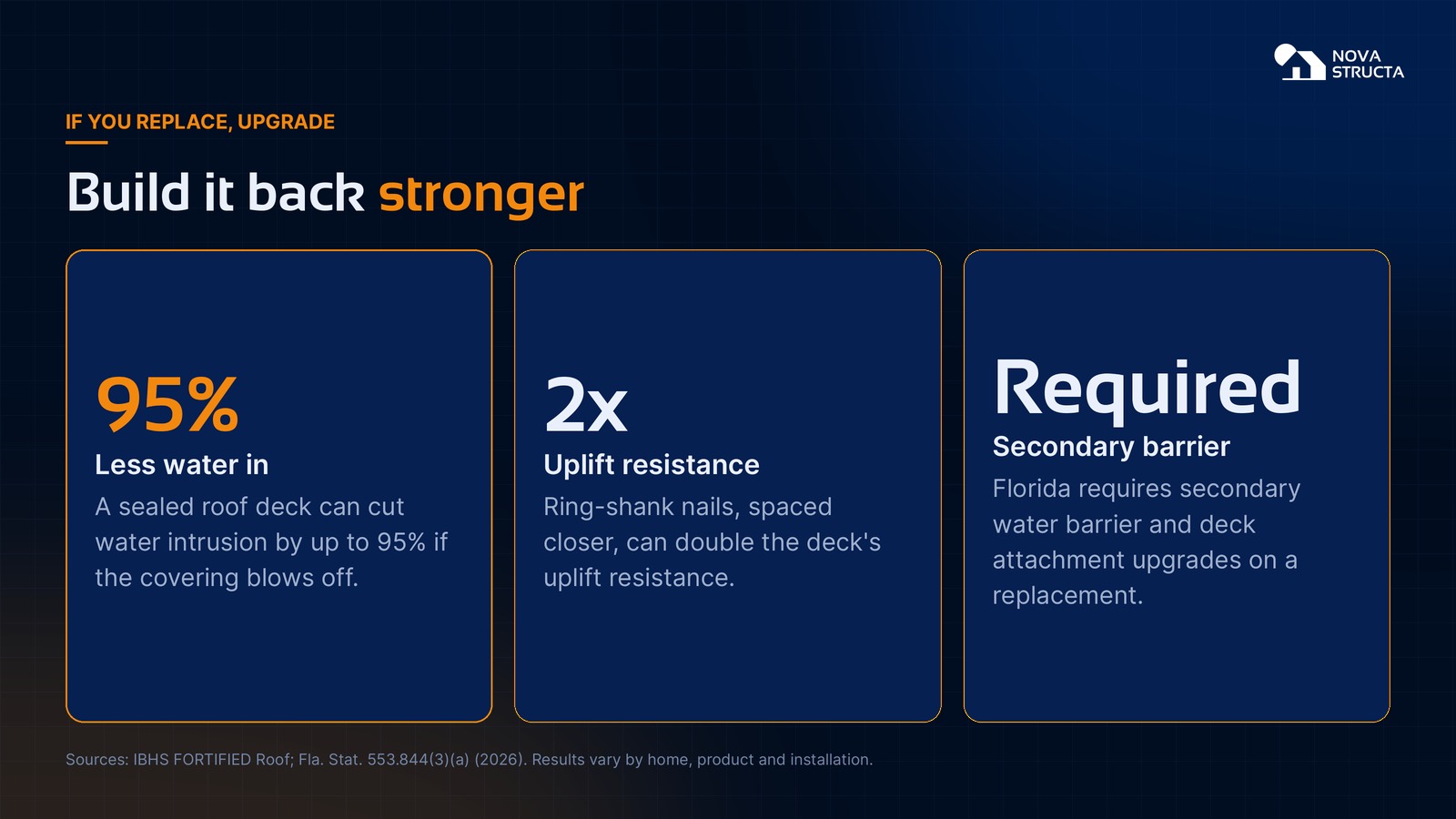
A replacement is the one moment every part of the roof is open, so it is the moment to fix what you cannot reach later:
- Florida requires it. A roof replacement must include a secondary water barrier and strengthening or correcting the roof deck attachments and fasteners [9].
- Seal the deck. The Insurance Institute for Business & Home Safety says a sealed roof deck can reduce water intrusion by up to 95% if the covering is lost [18]. FEMA lists sealing the deck among its recommended upgrades when a roof covering is replaced [19].
- Nail it down. Switching to 8d ring-shank nails, spaced closer together, can double the deck's uplift resistance [18].
- Look into My Safe Florida Home. The state program offers matching grants of up to $10,000 for eligible homes, built before 2008 and homesteaded among other rules, for items like roof deck attachment and secondary water resistance [21]. A 2026 law limited grants to low- and moderate-income applicants [23], and patching or partial repairs do not qualify [21].
These upgrades may also show up on a wind mitigation inspection. Whether they change your premium is up to your insurer.
Questions to ask your roofer
- Is this a repair, or is the roof near the end of its life? What did you see on the deck and in the attic [4]?
- When was the roof last fully replaced, and was it under the 2007 code or later [9]?
- Does this repair trigger the 25% rule on my roof [9] [11]?
- Can the new roof go over the old one, or does it need a tear-off [10]?
- What will you do about deck nailing and the secondary water barrier [9]?
- Can I have a written, itemized estimate for both repair and replacement [17]?
- What warranty covers the work, and what covers the materials?
The bottom line
Repair the roof when the problem is in one place and the roof has life left. Replace it when the wear is everywhere, the leaks keep coming, the deck is soft, or the roof is near 20 years on asphalt shingles [4] [6]. In Florida, two more things decide the timing: whether your insurer will keep writing the roof [12], and how the 25% rule treats your roof's age [9]. If a storm is the reason you are asking, report the claim within a year [15], and walk away from anyone offering to cover your deductible [17].
If you would like someone to look at your roof and give you a written, itemized estimate for repair and replacement side by side, see roofing or book a free assessment. For a quick timeline, see when to replace your roof. Results vary by home, roof and insurer. Installations are performed by independent Florida licensed contractor(s).
Sources
- I. Giammanco, E. Newby and H. Pogorzelski, Insurance Institute for Business & Home Safety, "Observations of Building Performance in Southwest Florida During Hurricane Ian (2022), Part I: Roof Cover Damage Assessment," 2023. ibhs.org
- National Association of Home Builders and Bank of America Home Equity, Study of Life Expectancy of Home Components, February 2007. PDF
- Englert, "How Long Does a Metal Roof Last?" englertinc.com
- National Roofing Contractors Association, roofing guidelines and consumer FAQs. nrca.net
- National Roofing Contractors Association, "Roof Repair After a Hurricane." nrca.net (PDF)
- Asphalt Roofing Manufacturers Association, Frequently Asked Questions. asphaltroofing.org
- Asphalt Roofing Manufacturers Association, "Algae and Moss: Prevention and Cleaning of Asphalt Roofing Systems." asphaltroofing.org
- Asphalt Roofing Manufacturers Association, "A Simple Guide to Understanding Your Asphalt Shingle Roofing System." asphaltroofing.org
- Florida Statutes, Section 553.844, Windstorm loss mitigation; requirements for roofs and opening protection (2026). flsenate.gov
- Florida Roofing & Sheet Metal Contractors Association, "FBC 2026 Updates," February 2, 2026, reprinting Florida Building Code, Existing Building, Section 706.3. floridaroof.com
- Florida Building Commission, "Analysis of Changes, 8th Edition (2023) Florida Building Code, Existing Building." floridabuilding.org (PDF)
- Florida Statutes, Section 627.7011, Homeowners' policies; offer of replacement cost coverage and law and ordinance coverage (2026). flsenate.gov
- Florida Statutes, Section 627.701, Liability of insureds; coinsurance; deductibles (2026), subsection (10). flsenate.gov
- Citizens Property Insurance Corporation, Inspections. citizensfla.com
- Florida Statutes, Section 627.70132, Notice of property insurance claim (2026). flsenate.gov
- Florida Statutes, Section 627.7152, Assignment agreements (2026), subsection (13). flsenate.gov
- Florida Statutes, Section 489.147, Prohibited property insurance claim practices (2026). flsenate.gov
- Insurance Institute for Business & Home Safety, FORTIFIED Roof. fortifiedhome.org
- FEMA, P-804 Technical Advisory, Wind Retrofit Guide for Residential Buildings, July 2023. fema.gov (PDF)
- U.S. Army Corps of Engineers, Jacksonville District, "U.S. Army Corps of Engineers announces start of Blue Roof program," October 15, 2024. usace.army.mil
- My Safe Florida Home, FAQs and "Can I replace my roof?" mysafeflhome.com; support.mysafeflhome.com
- Remodeling 2025 Cost vs. Value Report (www.costvsvalue.com), South Atlantic region. © 2025 Zonda Media, a Delaware Corporation. Complete data from the Remodeling 2025 Cost vs. Value Report can be downloaded free at www.costvsvalue.com. costvsvalue.com
- The Florida Senate, Bill Summary, SB 1452 (2026), My Safe Florida Home Program. flsenate.gov
Savings and utility-bill examples shown are illustrative only, are not guaranteed, and may not reflect typical results. Actual savings depend on your energy usage, system size, roof and site conditions, financing terms, utility rates, net-metering rules, and other factors specific to your home.