Roofing
Best Roofing Materials for Florida Homes in 2026: Why Metal Leads
What is the best roofing material for a Florida home in 2026?
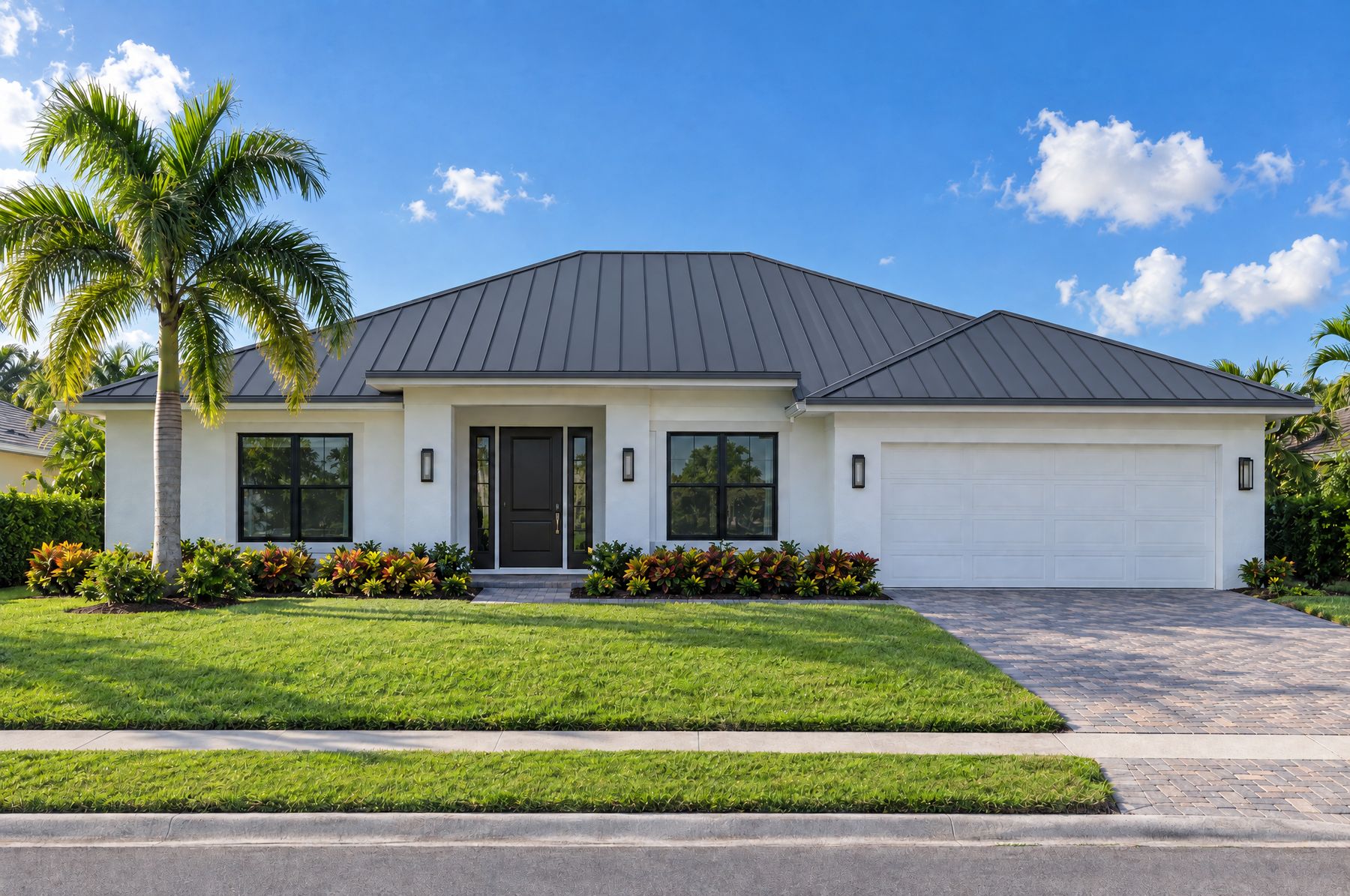
For most Florida homes in 2026, a standing seam metal roof is the strongest all-around choice. It had the lowest damage rate of any roof type after Hurricane Ian, it is built for decades of sun and rain, and it suits solar. Tile, shingle and flat roofs still fit some homes and budgets.
A Florida roof has a harder job than most. It bakes in sun nearly all year, takes sideways rain every summer afternoon, breathes salt air near the coast, and has to stay put when a hurricane comes through. Every common roof can be done well here. But when you line them up on storm performance, service life, heat and how well they work with solar, one comes out ahead often enough to call it: standing seam metal.
This guide compares the four roofs you see across Florida, explains why metal leads and where it does not, and covers the Florida rules that affect any roof decision. Every claim links to a source. It is general information, not a promise about any specific home, and the right roof for yours depends on its structure, location, HOA rules and budget.
How do the four common Florida roofs compare?
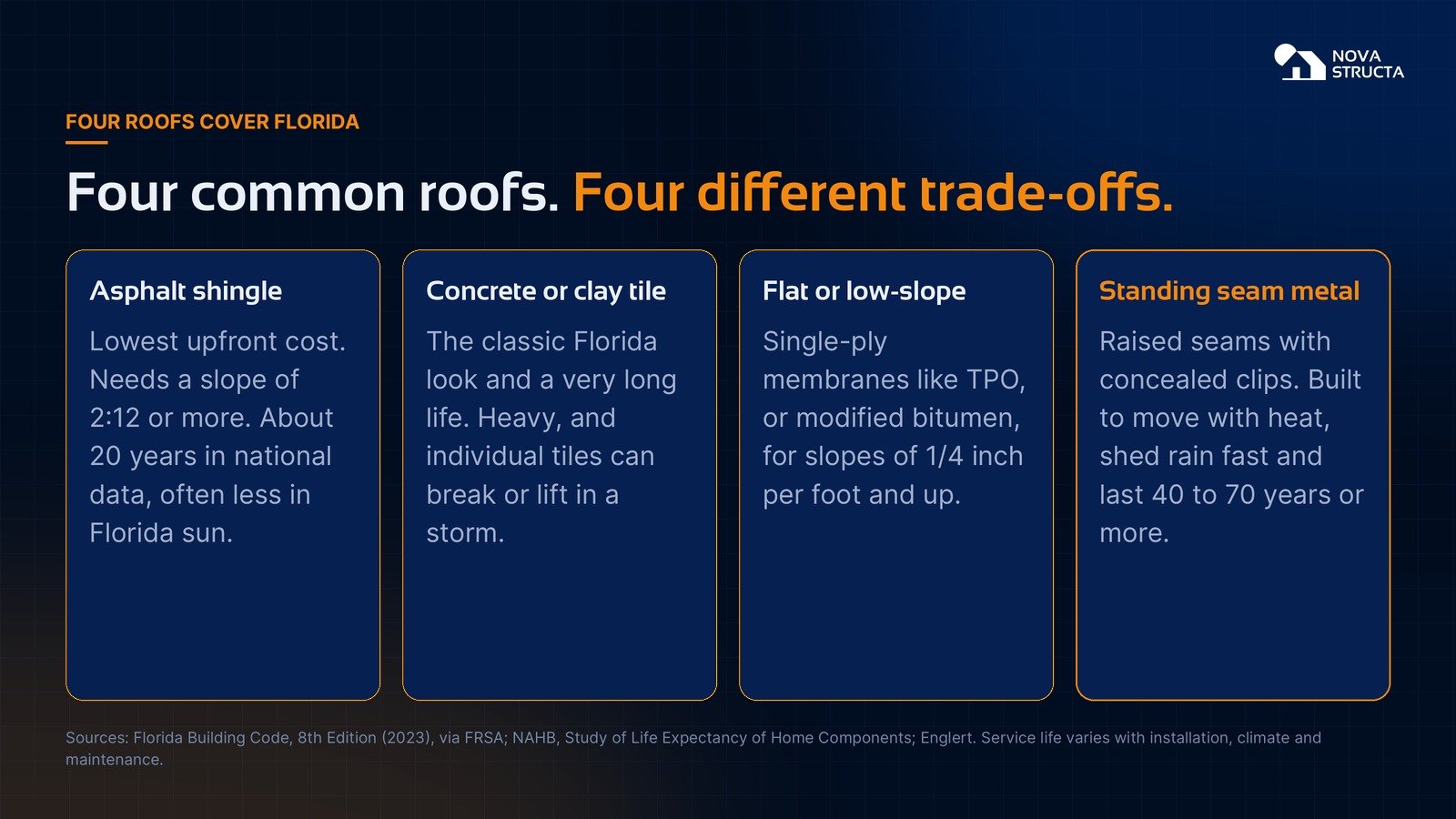
| Shingle | Tile | Standing seam metal | Flat membrane | |
|---|---|---|---|---|
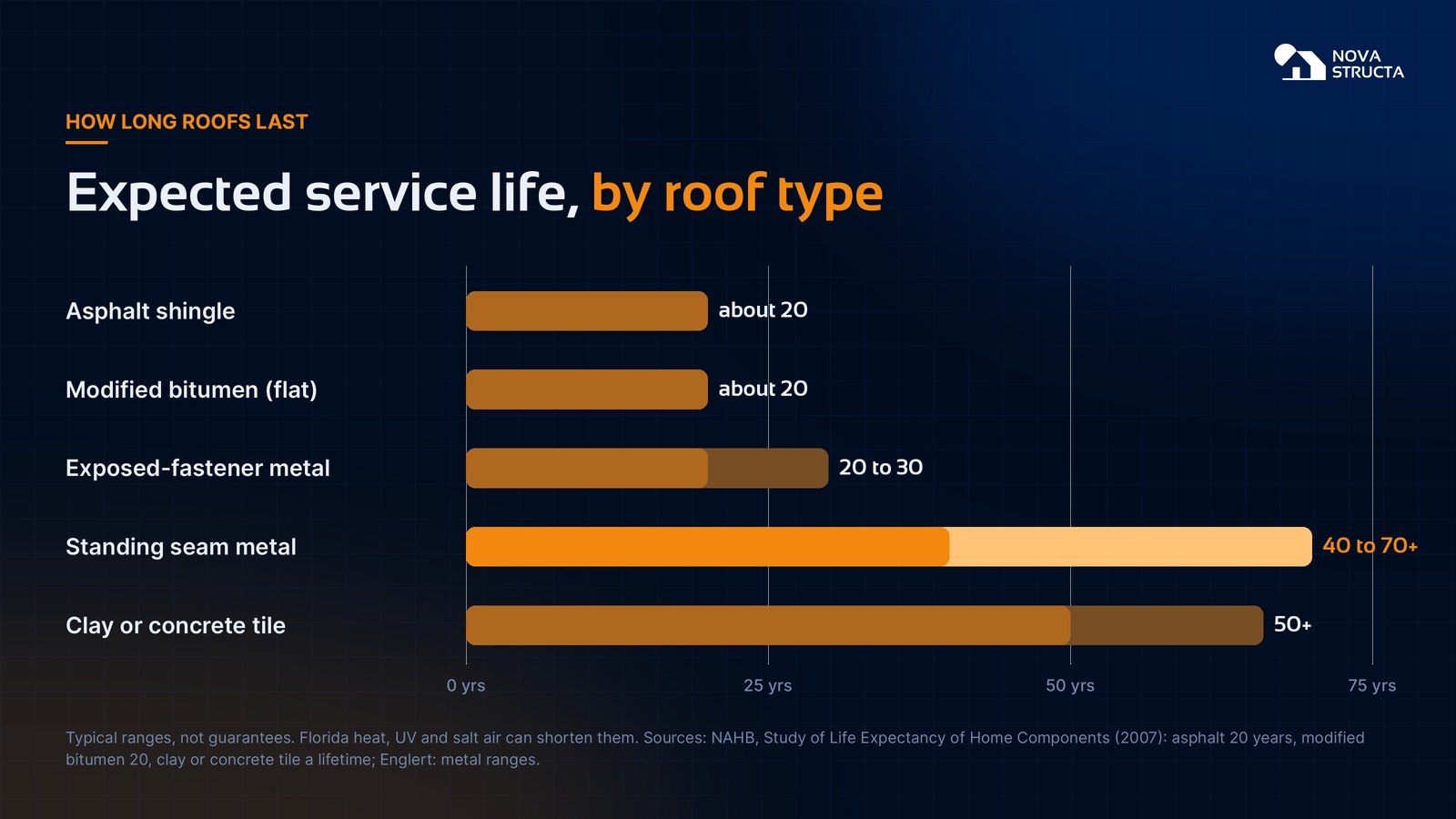
| Typical service life | About 20 years | 50+ years | 40 to 70+ years | About 20 years |
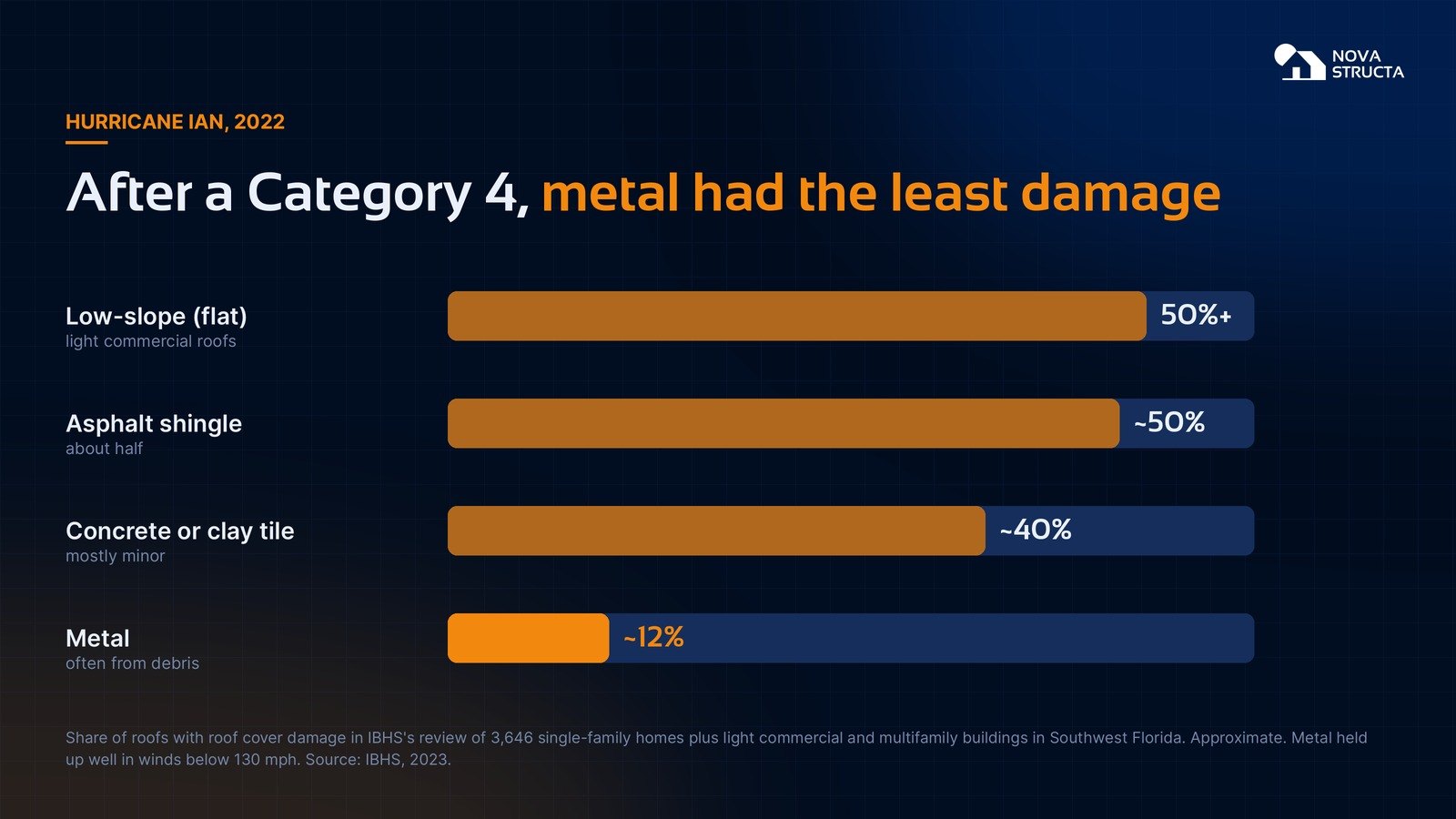
| Hurricane Ian damage rate | ~50% | ~40% | ~12% | 50%+ (light commercial) |
| Upfront cost | Lowest | Higher | Higher, about 2 to 3 times shingle | Varies |
| Solar mounting | Flashed mounts | Flashed mounts | Clamps to the seams | Depends on design |
Sources: service life, NAHB [4] and Englert [5]; damage rates, IBHS [1]; cost, Englert [5]. Ranges are typical, not guarantees, and Florida heat and salt can shorten any of them.
How did each roof hold up in Hurricane Ian?
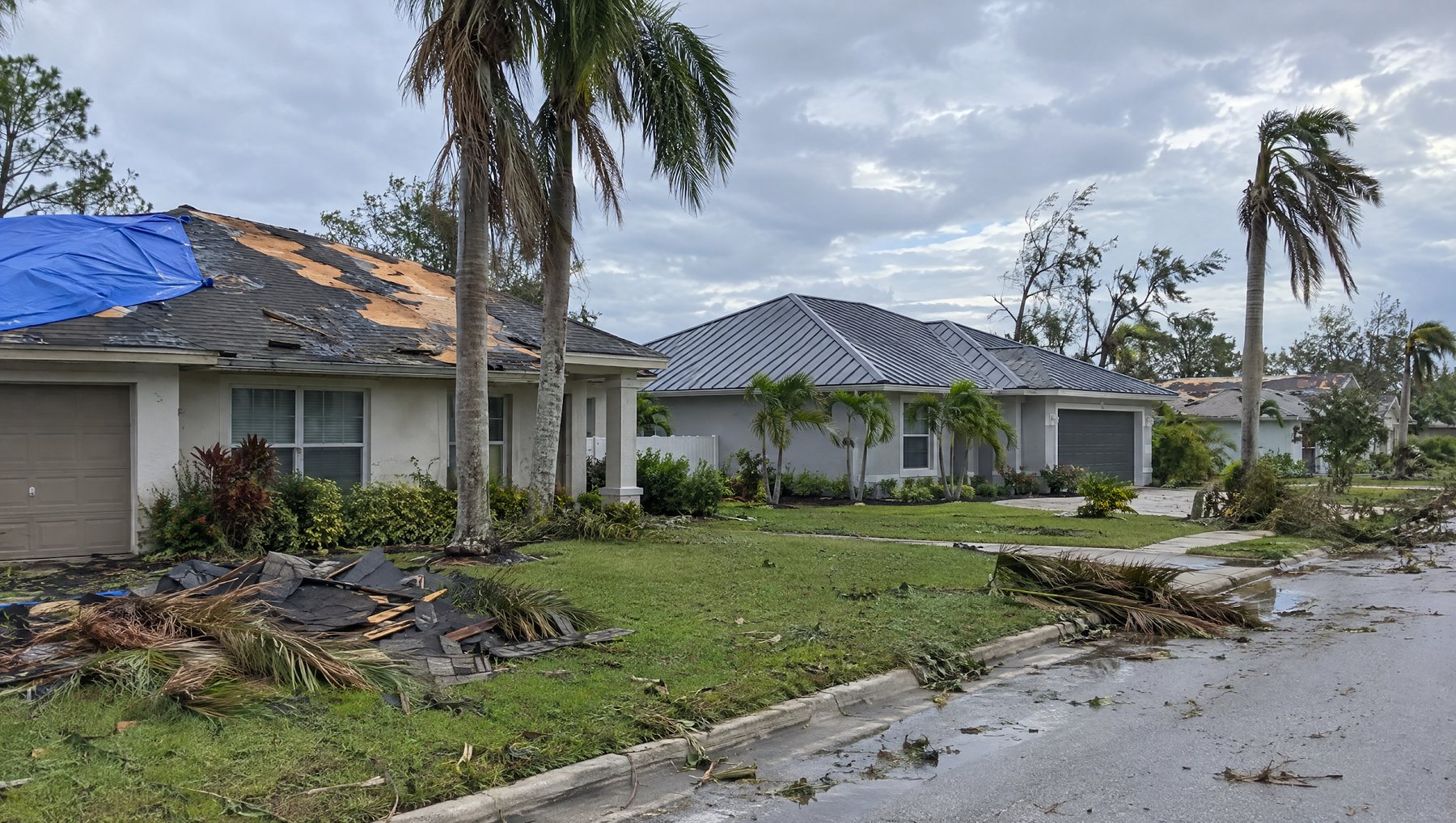
Hurricane Ian made landfall as a Category 4 near Punta Gorda in September 2022. The Insurance Institute for Business & Home Safety (IBHS) used aerial and street-level imagery to review roof damage on 3,646 single-family homes, plus light commercial and multifamily buildings, across Southwest Florida [1]. What it found:
- Metal roofs performed best. Damage rates were around 12%, and most of that came from nearby structures failing, not the roofs themselves. IBHS notes metal held up well in winds below 130 mph [1].
- Asphalt shingles saw the most damage. About half of shingle roofs had issues, similar to Hurricane Charley in 2004, and roofs 10 or more years old were especially vulnerable [1].
- Tile improved a lot since 2004. About 40% had some damage, but significant damage was rare except on tile roofs more than 20 years old [1].
- Low-slope commercial roofs had damage rates above 50%, often at the flashing and edge metal [1].
FEMA's own team, which studied Ian on the ground, reached a related conclusion. Newer roof coverings generally performed better than older ones, and the most common damage it saw was at hips and ridges, on newer and older roofs alike [2]. It also observed no wind-related structural damage to homes built after Florida's statewide building code took effect [2]. In other words, the code is working, and the roof covering is the part most likely to fail. That is exactly where material choice matters.
For what happens to rooftop solar in a storm, see do solar panels work in a hurricane?
Why does metal lead for Florida homes?
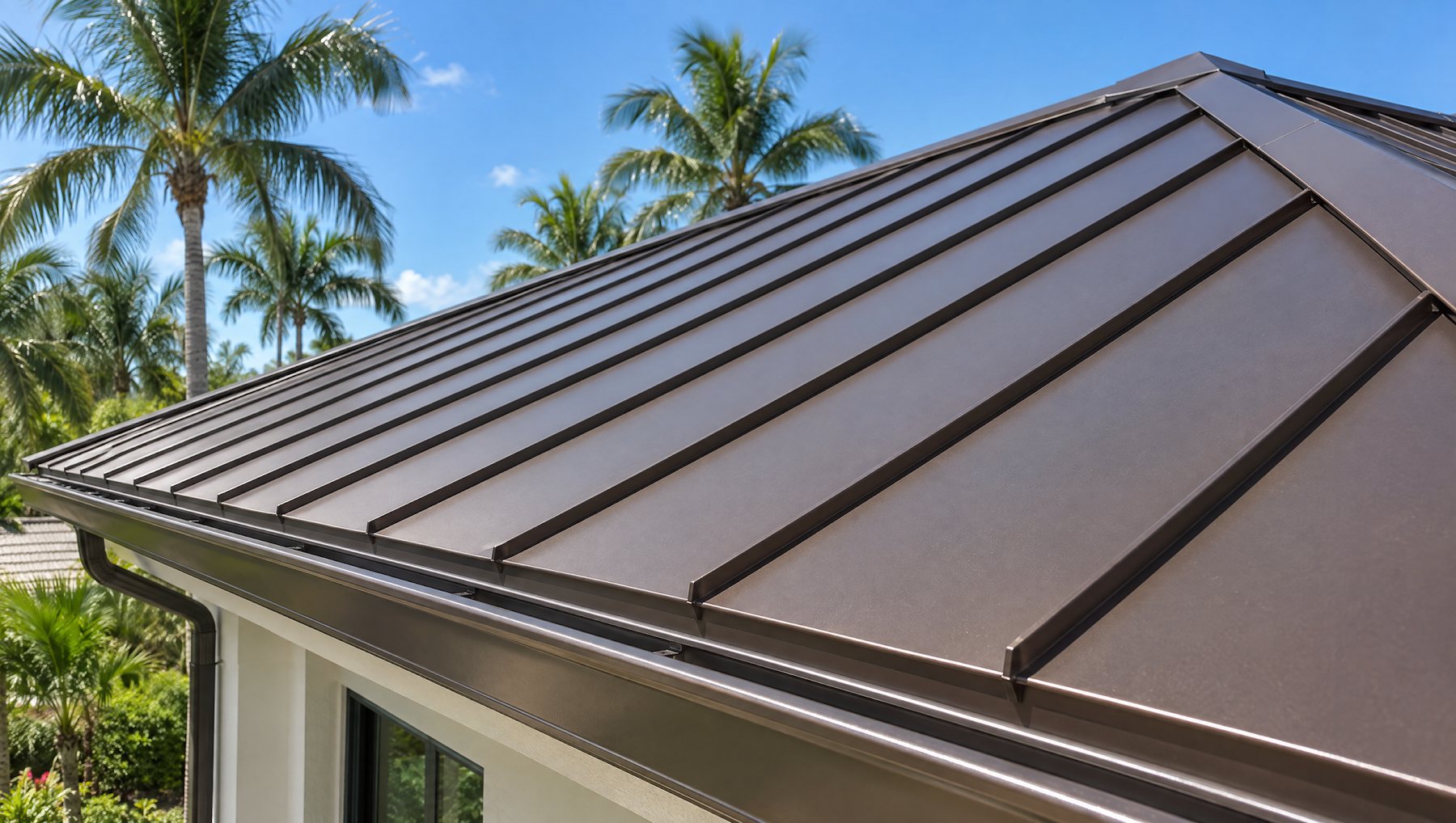
Storm performance is the headline, but it is not the only reason. A standing seam metal roof does several Florida jobs well at once.
It lasts
Standing seam metal roofs typically last 40 to 70 years or more, according to Englert, because the interlocking panels can expand and contract with heat instead of fighting it [5]. For comparison, national survey data puts asphalt shingles at about 20 years [4], and Florida sun is harder on them than most climates. If you plan to stay in your home, that difference can mean one roof instead of two or three.
It handles heat well, especially in light colors
In a study for FPL, the Florida Solar Energy Center built seven nearly identical homes side by side in Fort Myers, each with a different roof, and measured them through July 2000 [3]. At the peak summer hour, the attic under dark shingles ran about 40°F hotter than the outdoor air, while attics under the most reflective roofs stayed near outdoor temperature [3].
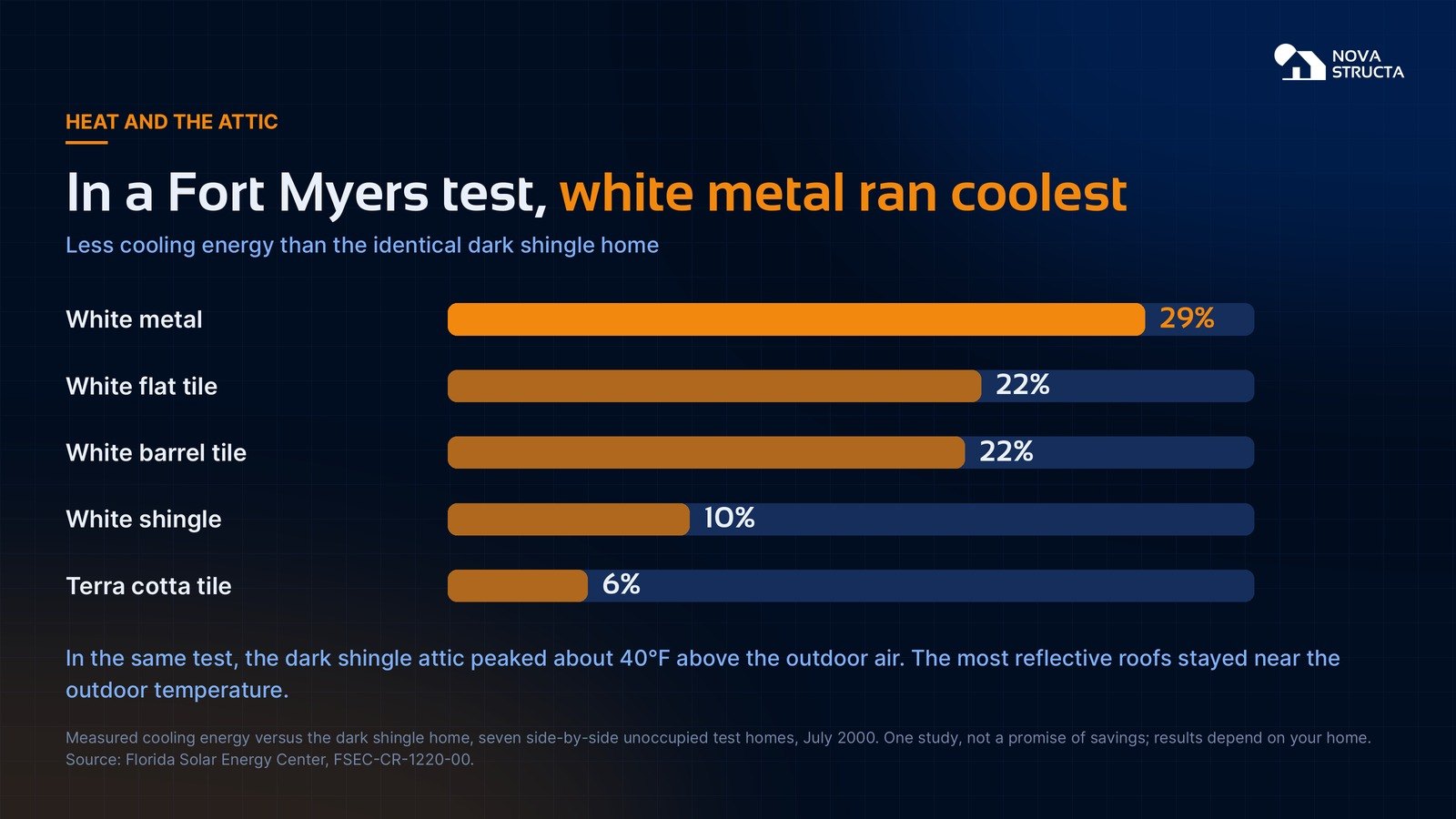
The white metal home used the least cooling energy of the group, 29.4% less than the dark shingle home during the unoccupied test [3]. That is one study in one summer, not a promise about your bill, but it shows why color and reflectivity matter here. FSEC noted that tile and metal were both available with high solar reflectance [3], and attic heat matters more in Florida because so many duct systems run through the attic.
It is the easiest roof to pair with solar
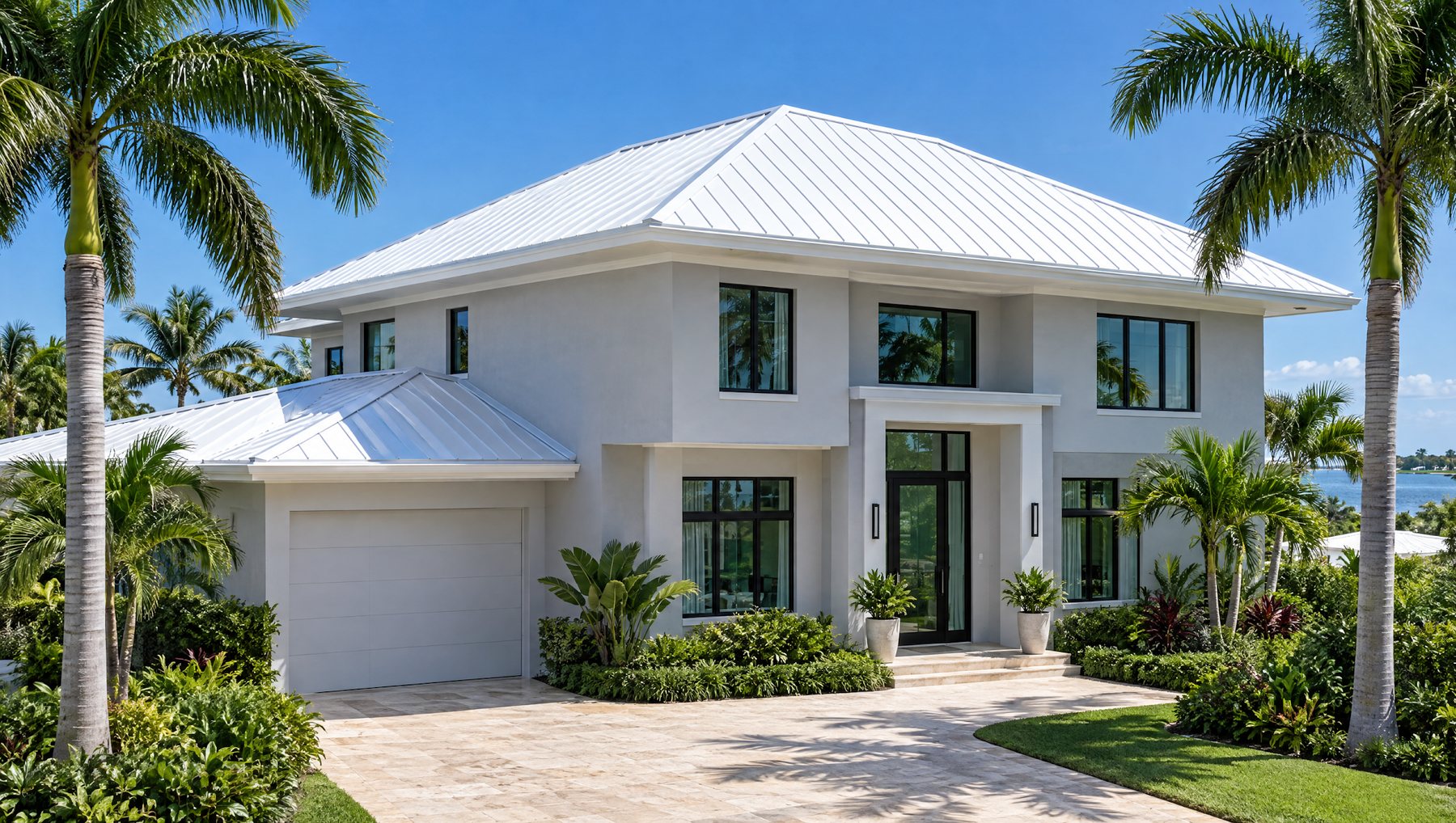
On a standing seam roof, solar mounts clamp onto the raised seam itself, so the roofing panel is not drilled and no new penetration is created. On shingle and tile, mounts do penetrate the roof deck and are flashed and sealed as part of the installation. If solar is in your future, metal makes that step simpler. For the full picture, see is solar worth it in Florida in 2026?
It looks right on modern Florida homes
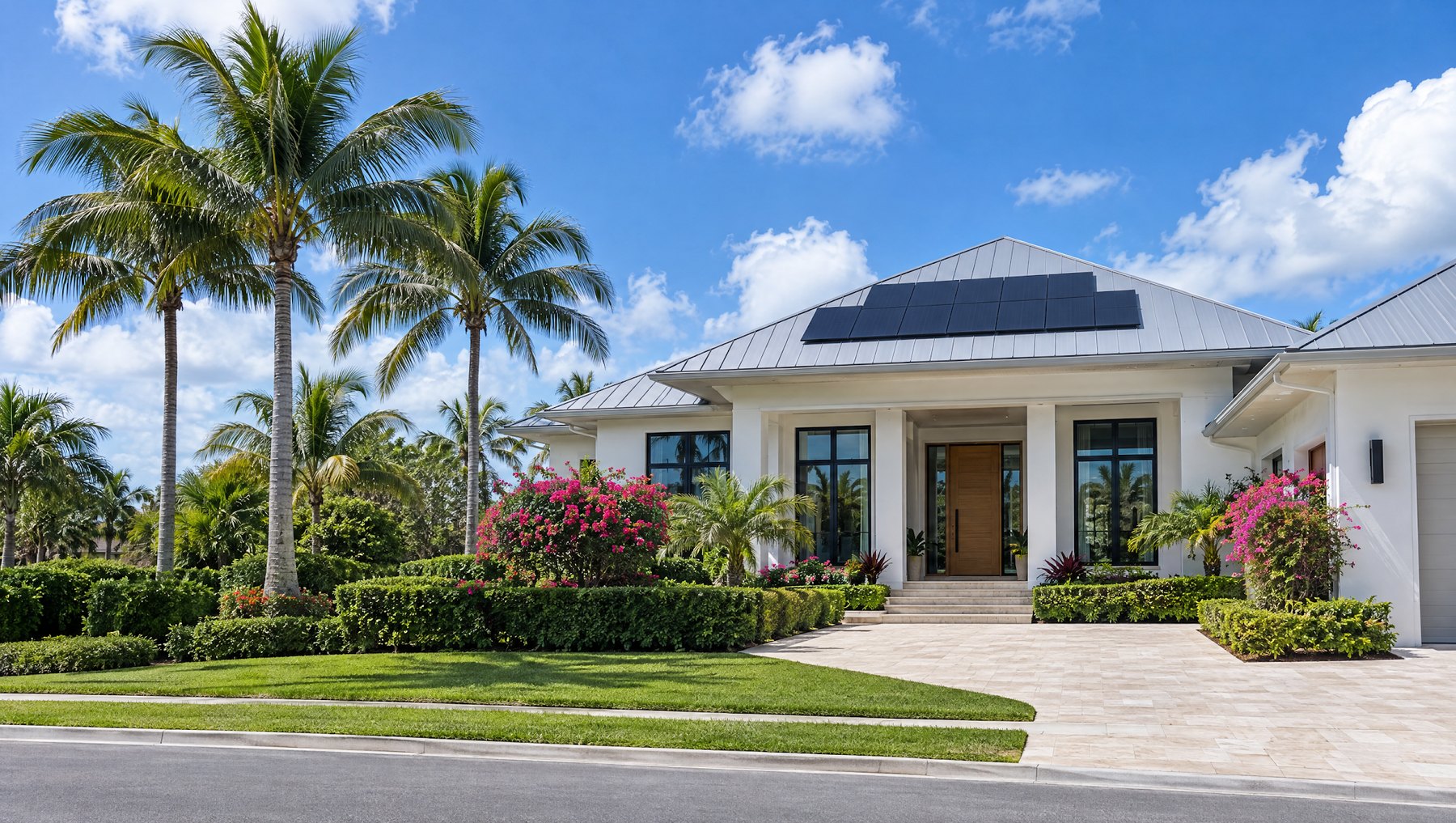
This is the part that is hard to put a number on. A standing seam roof gives a home long, clean lines that read as modern and coastal at the same time, and it works in charcoal, bronze, white or silver. It suits the coastal-contemporary style that so many new Florida homes are built in.
Which kind of metal roof?
Not all metal roofs are the same, and the difference matters more than the color.
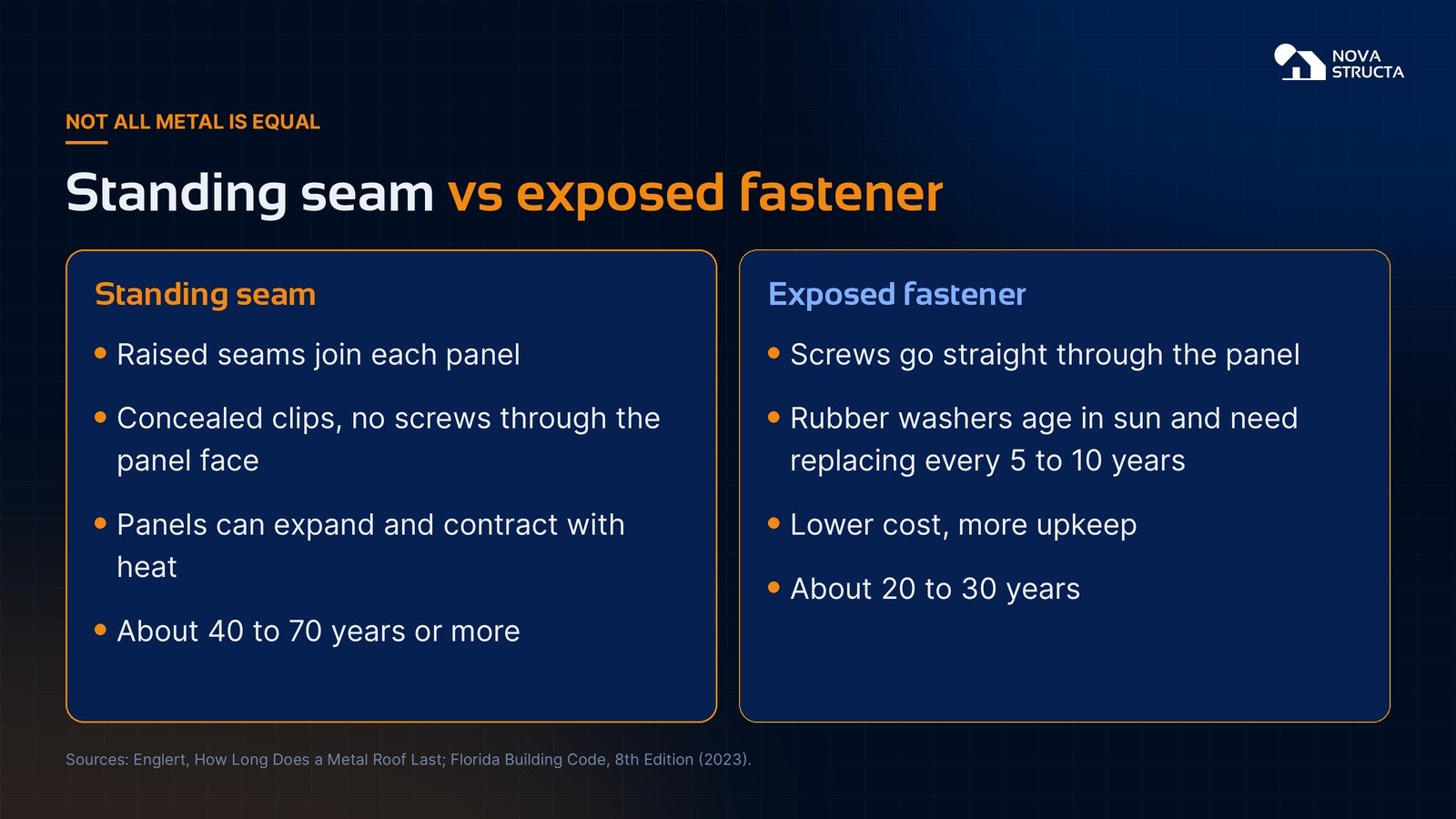
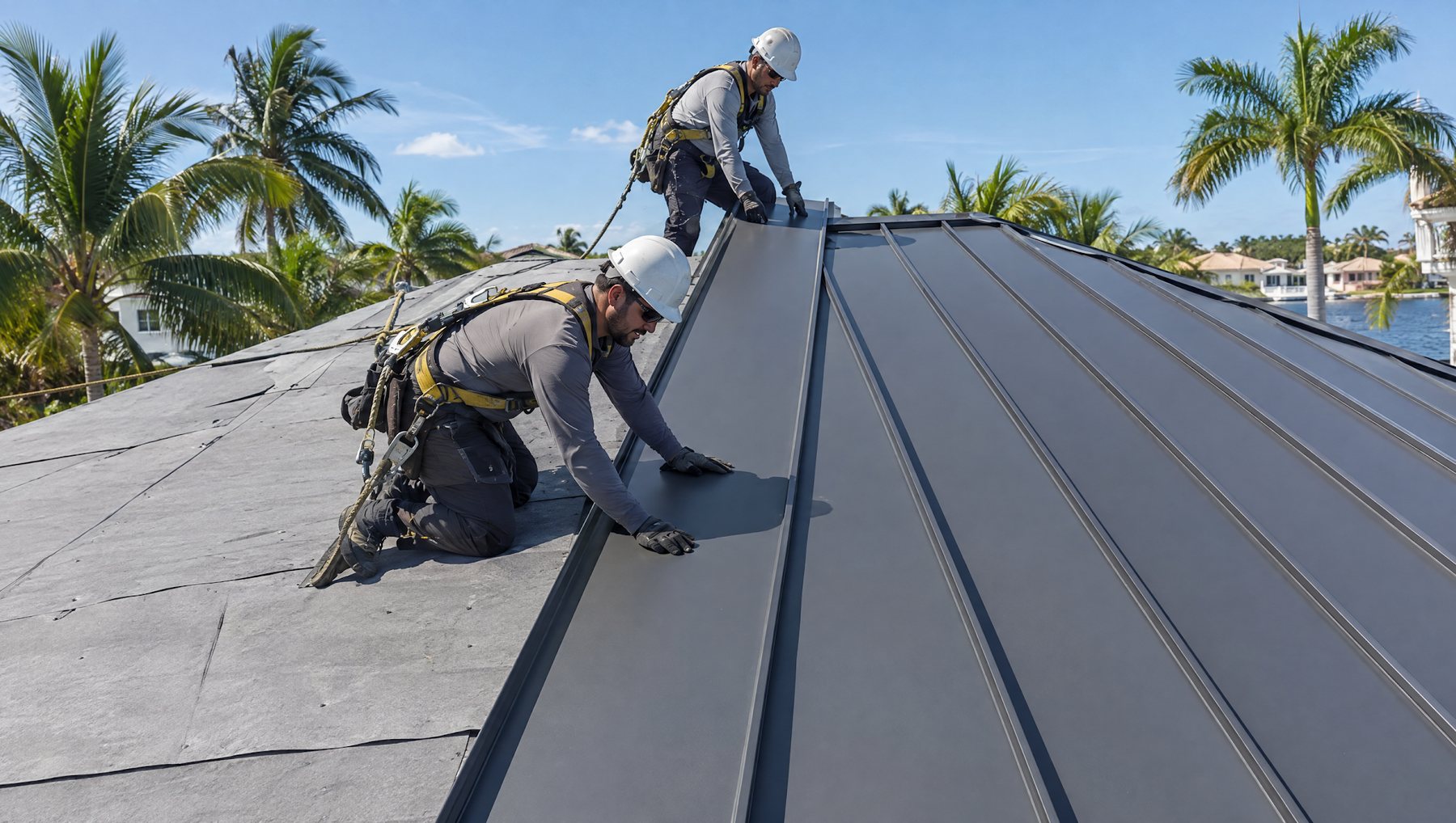
- Standing seam panels join at raised seams with concealed clips, so no screws go through the face of the panel. Englert puts their life at 40 to 70 years or more [5].
- Exposed-fastener (screw-down) panels are fastened straight through the face. They cost less, but the screws and washers need replacing every 5 to 10 years, and Englert puts their life at 20 to 30 years [5].
When this guide says metal leads, it means standing seam.
Near the coast, the metal itself matters
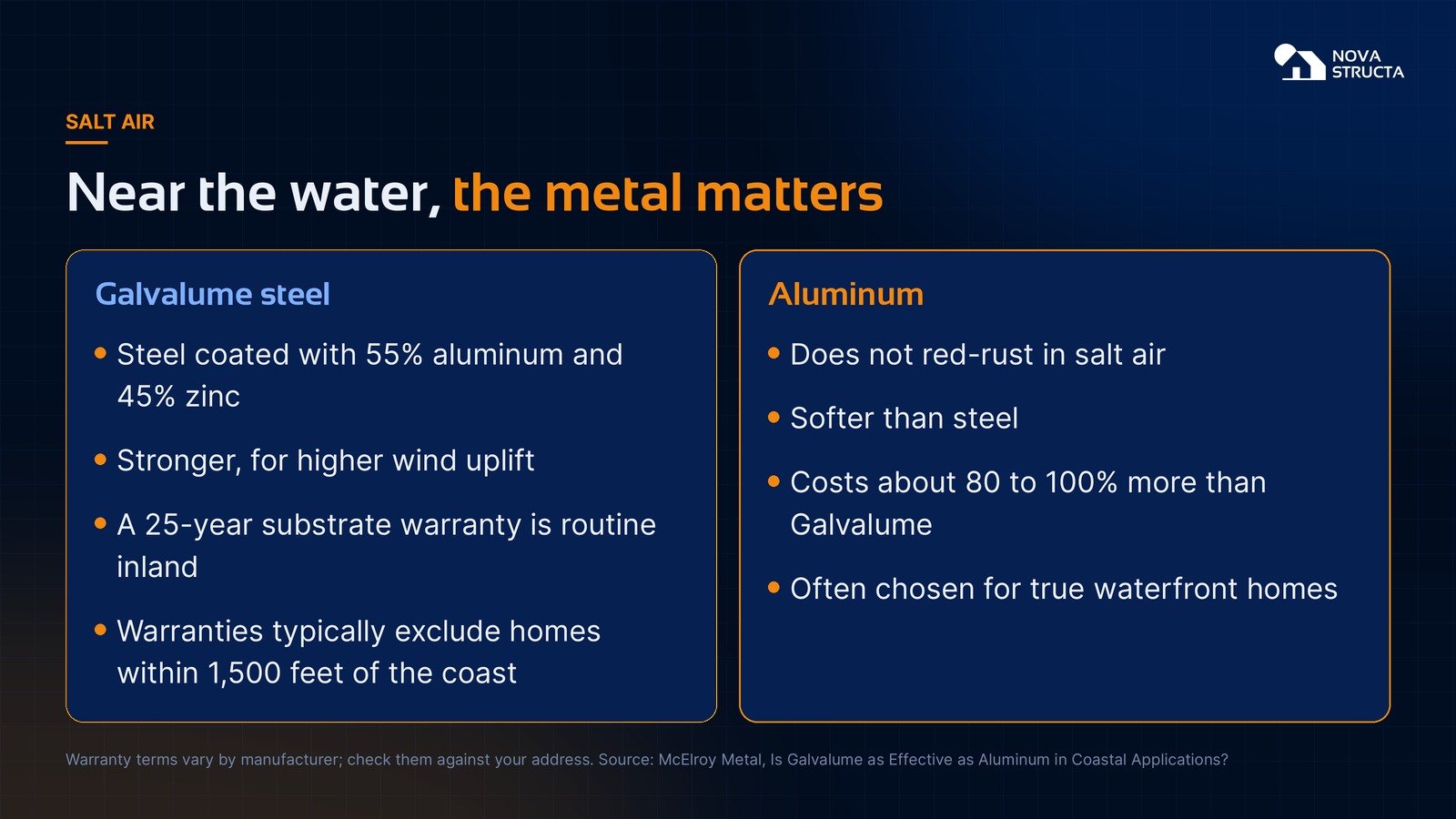
Most residential metal panels are Galvalume, steel coated with 55% aluminum and 45% zinc. It is strong, which helps with wind uplift, and a 25-year substrate warranty is routine under normal conditions. But according to manufacturer McElroy Metal, even Galvalume warranties typically exclude structures within 1,500 feet of the coast [6]. Aluminum panels resist salt corrosion naturally but are softer and cost about 80 to 100% more as a substrate [6]. If you live near saltwater, ask which metal is being quoted and read the warranty against your address.
The honest downsides
- Upfront cost. Englert puts metal at about 2 to 3 times the initial cost of asphalt shingles [5].
- Installation skill. Metal needs a crew that installs it regularly. Mistakes during installation can shorten its life [5].
- Hail. Metal can dent from large hail [5]. That is rare in South Florida but worth knowing.
- Hips and ridges. FEMA's team still saw roof covering damage on metal panel roofs after Ian, and hips and ridges were the most common weak point on every type [2]. Ask how the hip and ridge trim will be attached.
What about tile, shingle and flat roofs?
Metal leads, but it does not win every case.
Concrete and clay tile
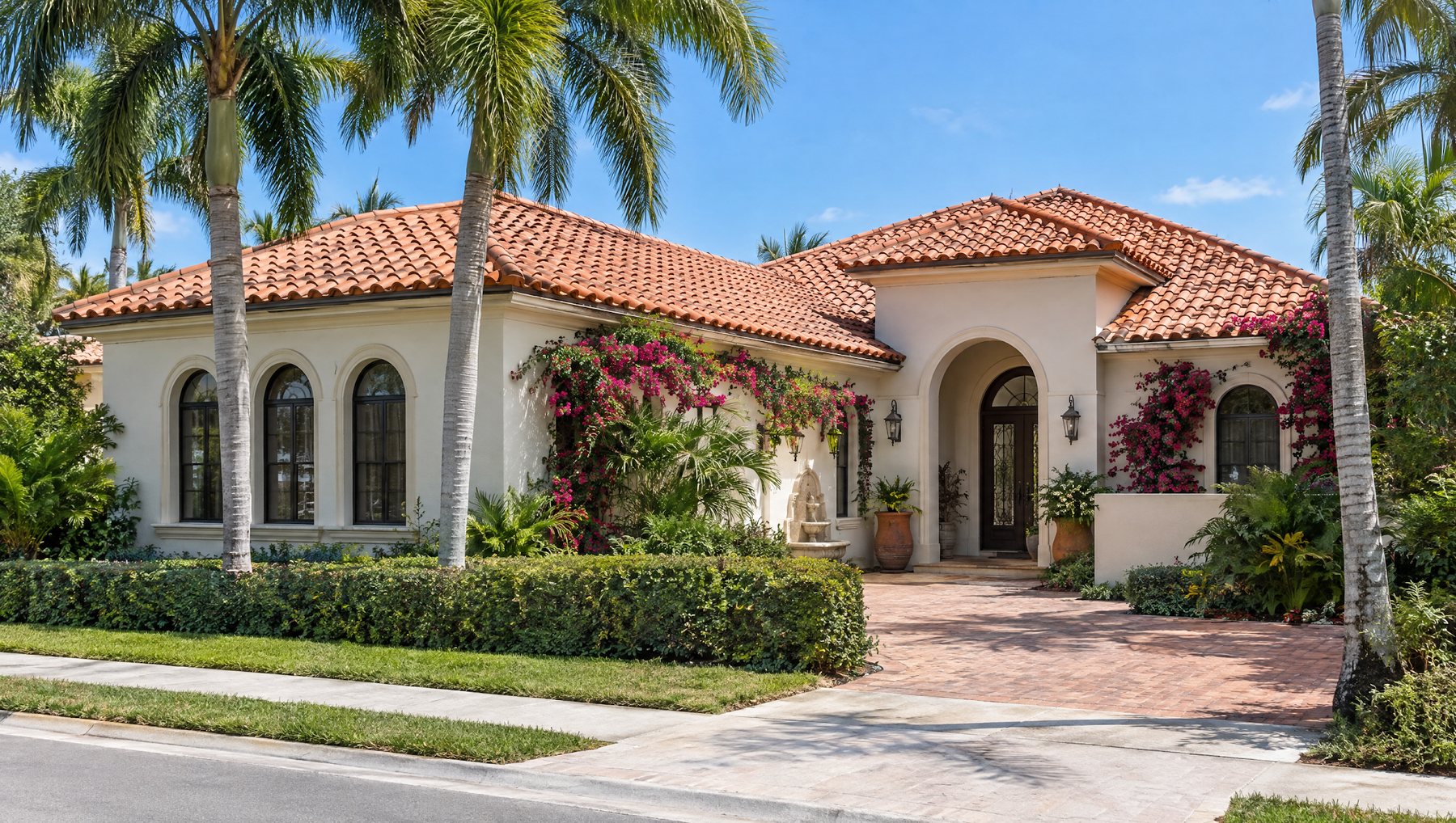
Tile is the classic Florida look, and it lasts. National survey data lists clay and concrete tile roofs as lasting a lifetime [4]. Tile also performed far better in Ian than in 2004, with significant damage mostly limited to roofs over 20 years old [1]. The trade-offs are weight and repair. Standard concrete tile weighs about 9 pounds per square foot, and switching an existing home to it normally requires a structural engineering report [8]. If your home was designed for tile and your HOA expects it, tile is a strong choice.
Asphalt shingle
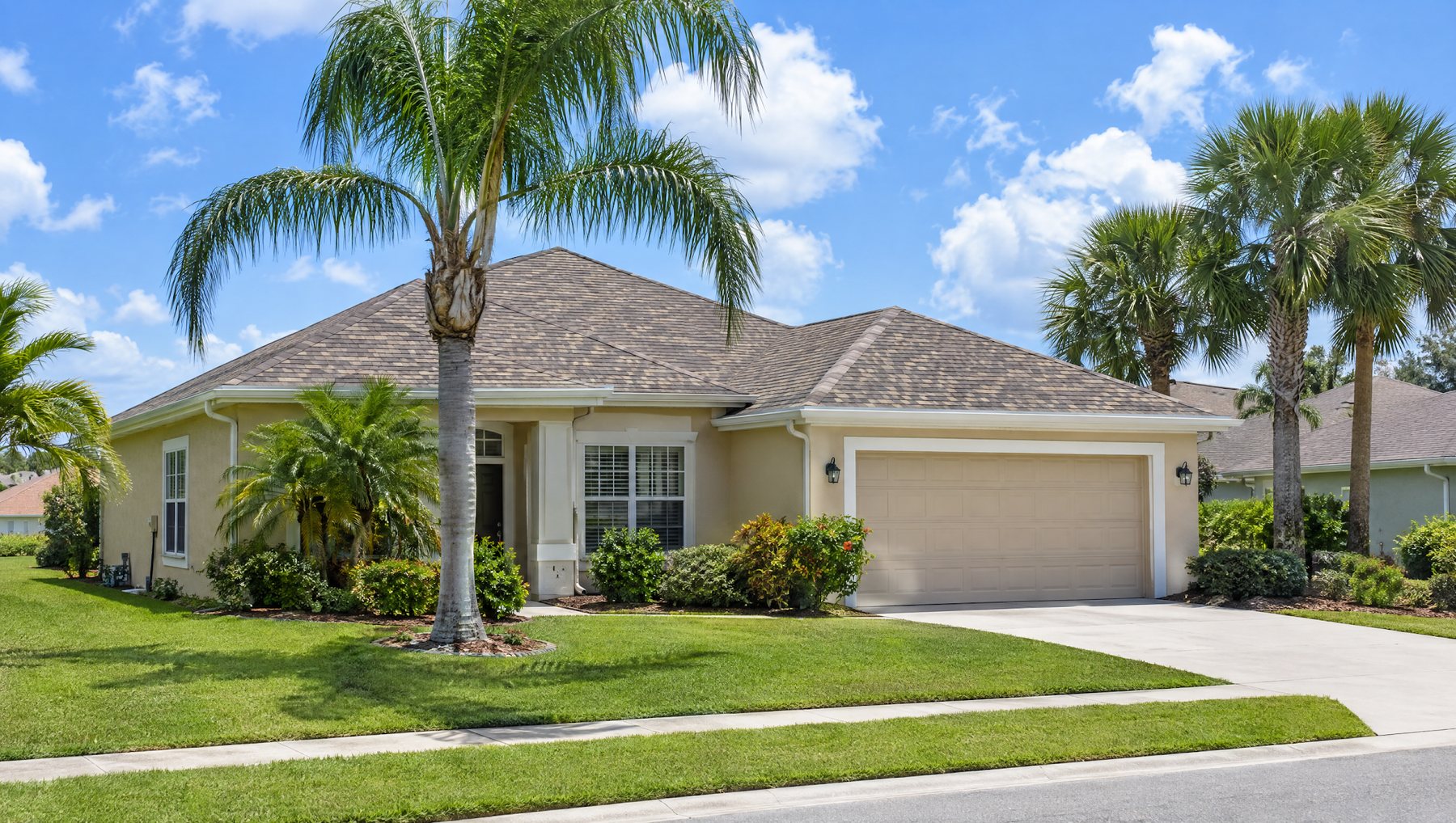
Shingle costs the least upfront and is quick to install. The Florida Building Code requires shingles to be tested and classified for wind resistance and labeled for the wind speed where they are installed, and they can only be used on slopes of 2:12 or steeper [9]. The catch is lifespan and storms. National data puts shingles at about 20 years [4], and after Ian, shingle roofs 10 or more years old were especially vulnerable [1]. If budget is the deciding factor, choose a shingle rated for your wind zone and plan for an earlier replacement.
Flat and low-slope roofs
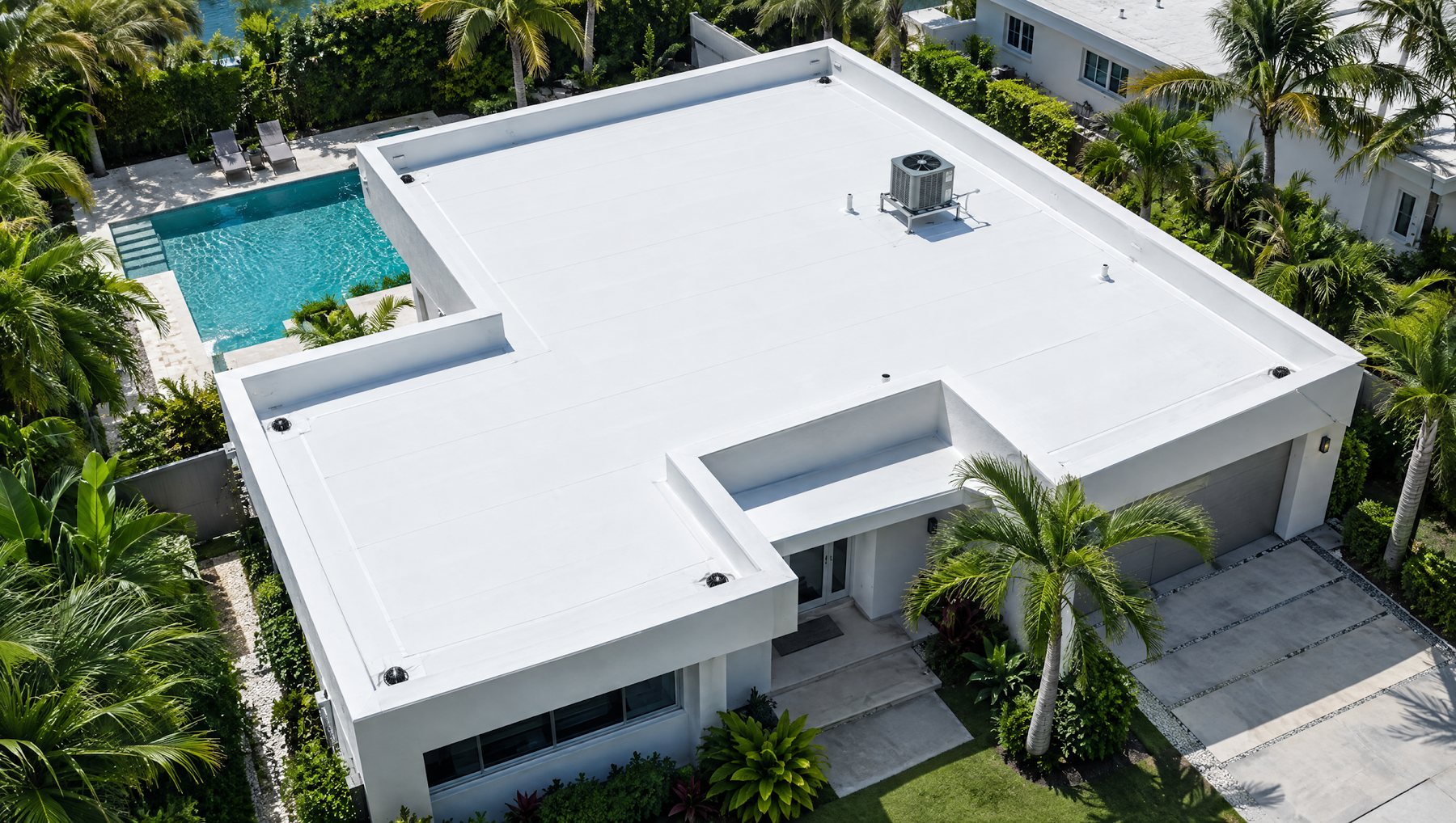
Flat sections and modern flat-roof homes use single-ply membranes like TPO or modified bitumen. Code requires a design slope of at least 1/4 inch per foot for drainage [9]. National data puts modified bitumen at about 20 years [4]. In Ian, low-slope roofs on light commercial buildings had damage rates above 50%, often at the flashing and edge metal [1], so edge details are where to focus questions.
What Florida rules affect your roof?
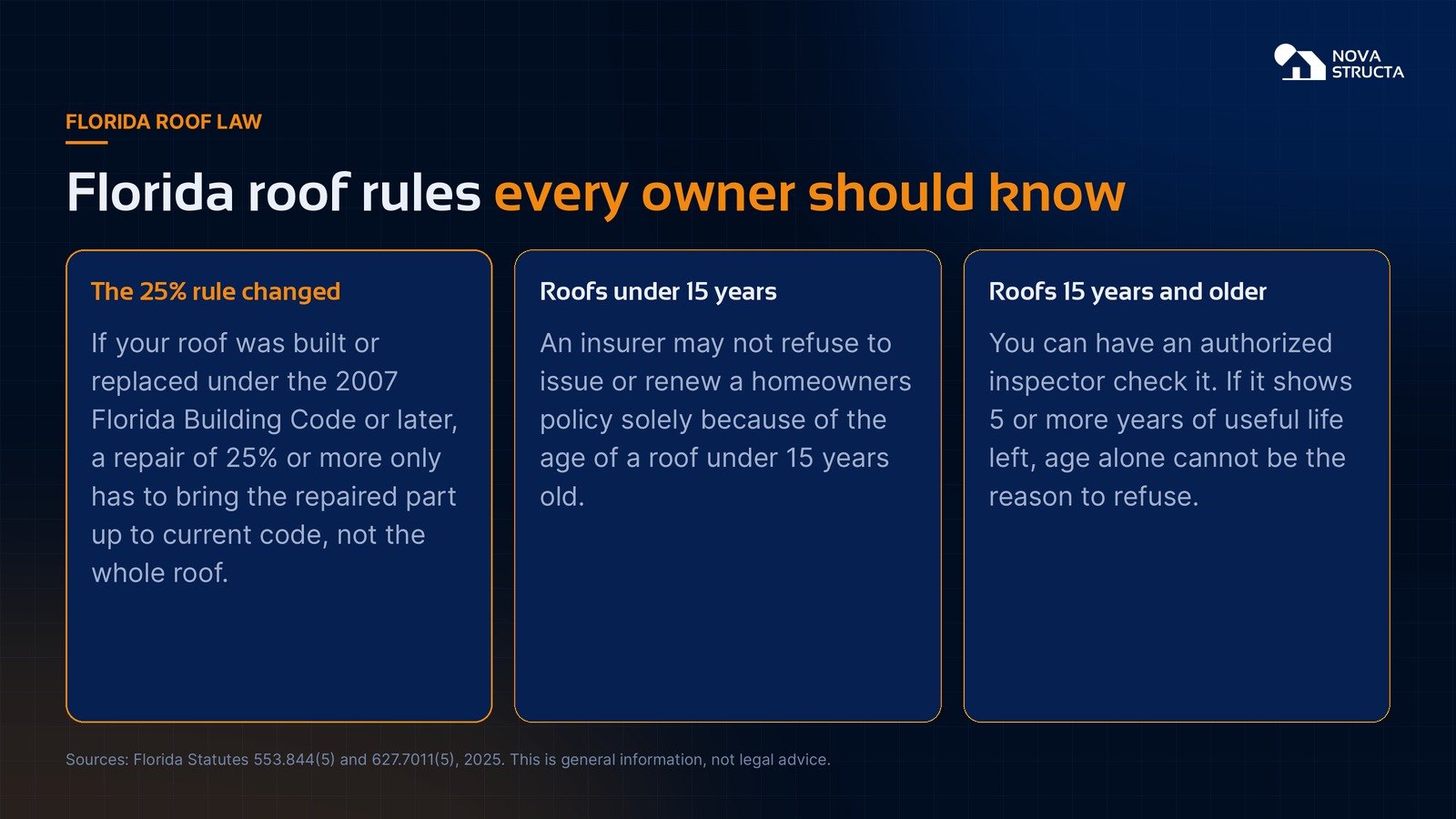
Three rules worth knowing before you repair or replace.
The 25% rule changed. If your roof was built, repaired or replaced under the 2007 Florida Building Code or later, and 25% or more of it is being repaired or replaced, only the repaired part has to meet the current code [10]. Older roofs can still trigger a full replacement.
Roofs under 15 years old. An insurer may not refuse to issue or renew a homeowners policy solely because of the age of a roof that is less than 15 years old [11].
Roofs 15 years and older. You can have an authorized inspector check the roof at your expense. If the inspection shows 5 or more years of useful life left, the insurer may not refuse to issue or renew solely because of roof age [11].
When a roof covering is replaced, current code also requires a secondary water barrier under it [9], which helps keep water out if the covering is damaged. For more on how roofs affect coverage, see roof insurance in Florida.
What a wind mitigation inspection looks at
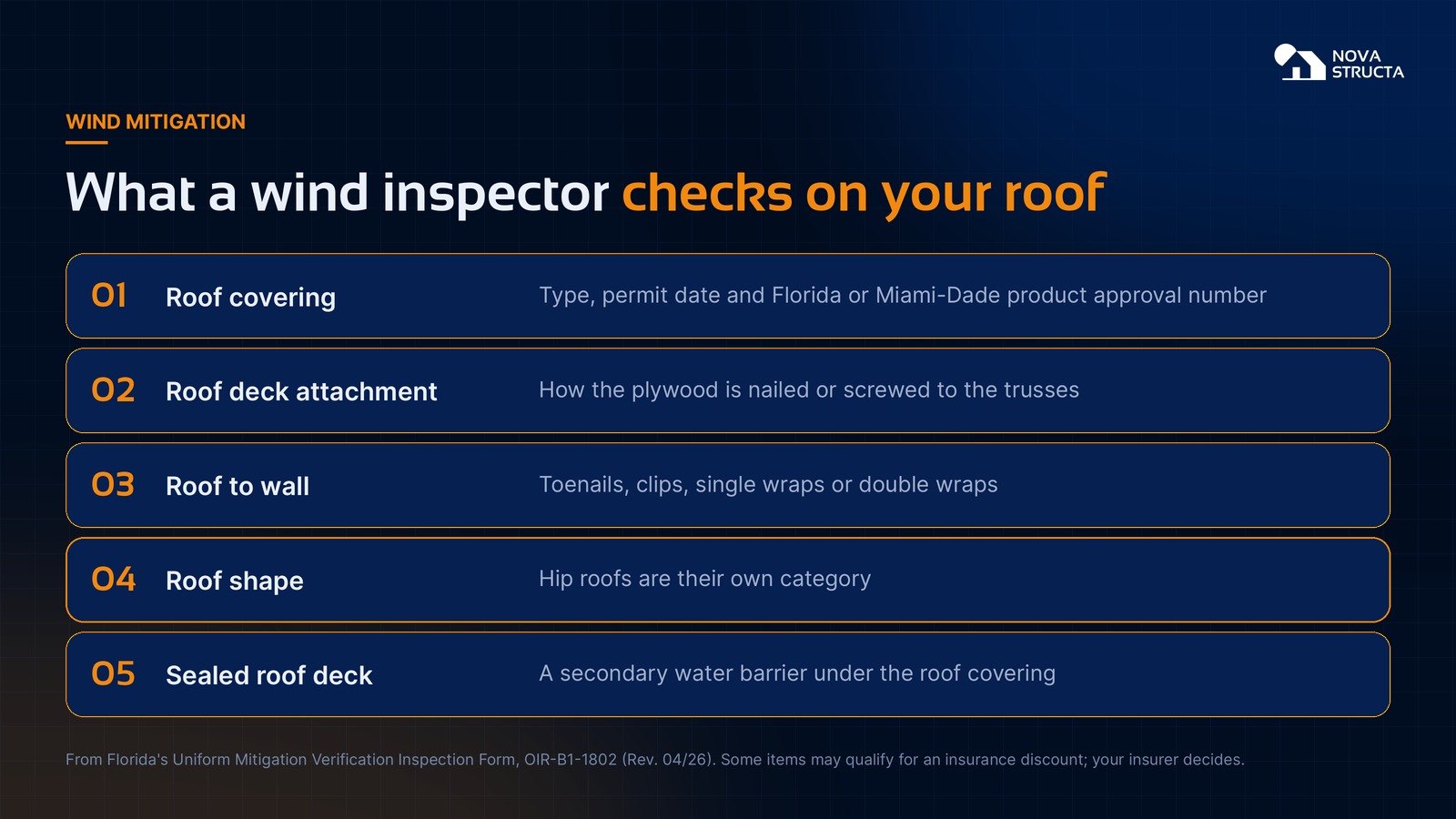
Florida's Uniform Mitigation Verification Inspection Form asks about your roof covering type and its Florida or Miami-Dade product approval, how the roof deck is attached, how the roof connects to the walls, whether the roof is a hip roof, and whether there is a sealed roof deck or secondary water resistance [12]. Homes in Miami-Dade and Broward fall in the High-Velocity Hurricane Zone, which the form treats as its own region [12]. A reroof is a natural time to improve the items that are visible during the work, such as deck nailing and the secondary water barrier. Whether any of it changes your premium is up to your insurer.
Three myths about metal roofs
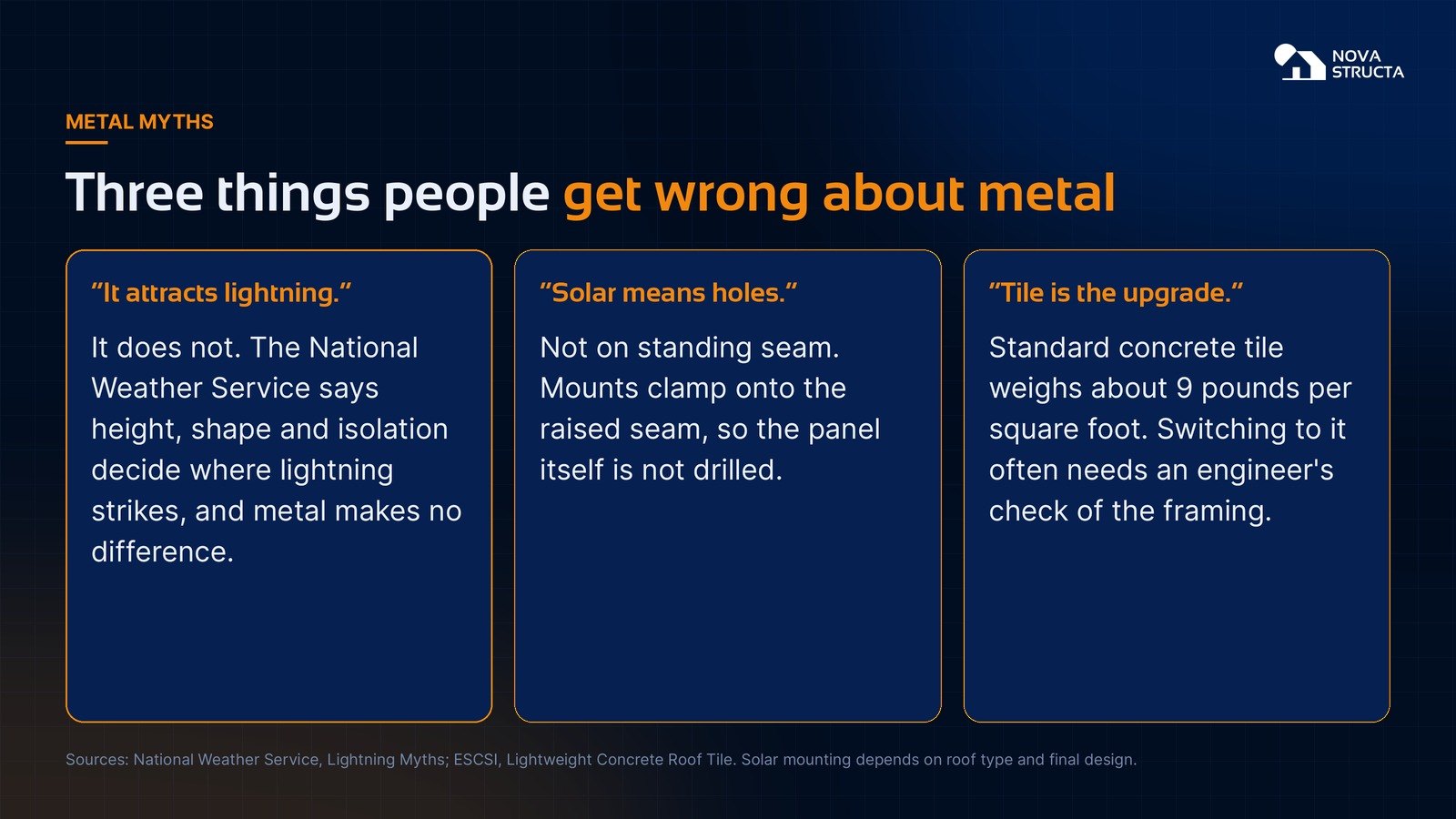
- "Metal roofs attract lightning." They do not. The National Weather Service says height, pointy shape and isolation decide where lightning strikes, and the presence of metal makes no difference [7].
- "Solar on metal means holes in the roof." Not on standing seam, where mounts clamp onto the seams.
- "Tile is always the upgrade." Tile is a beautiful roof, but standard concrete tile weighs about 9 pounds per square foot, and a retrofit usually needs an engineering check first [8].
Which roof fits your home?
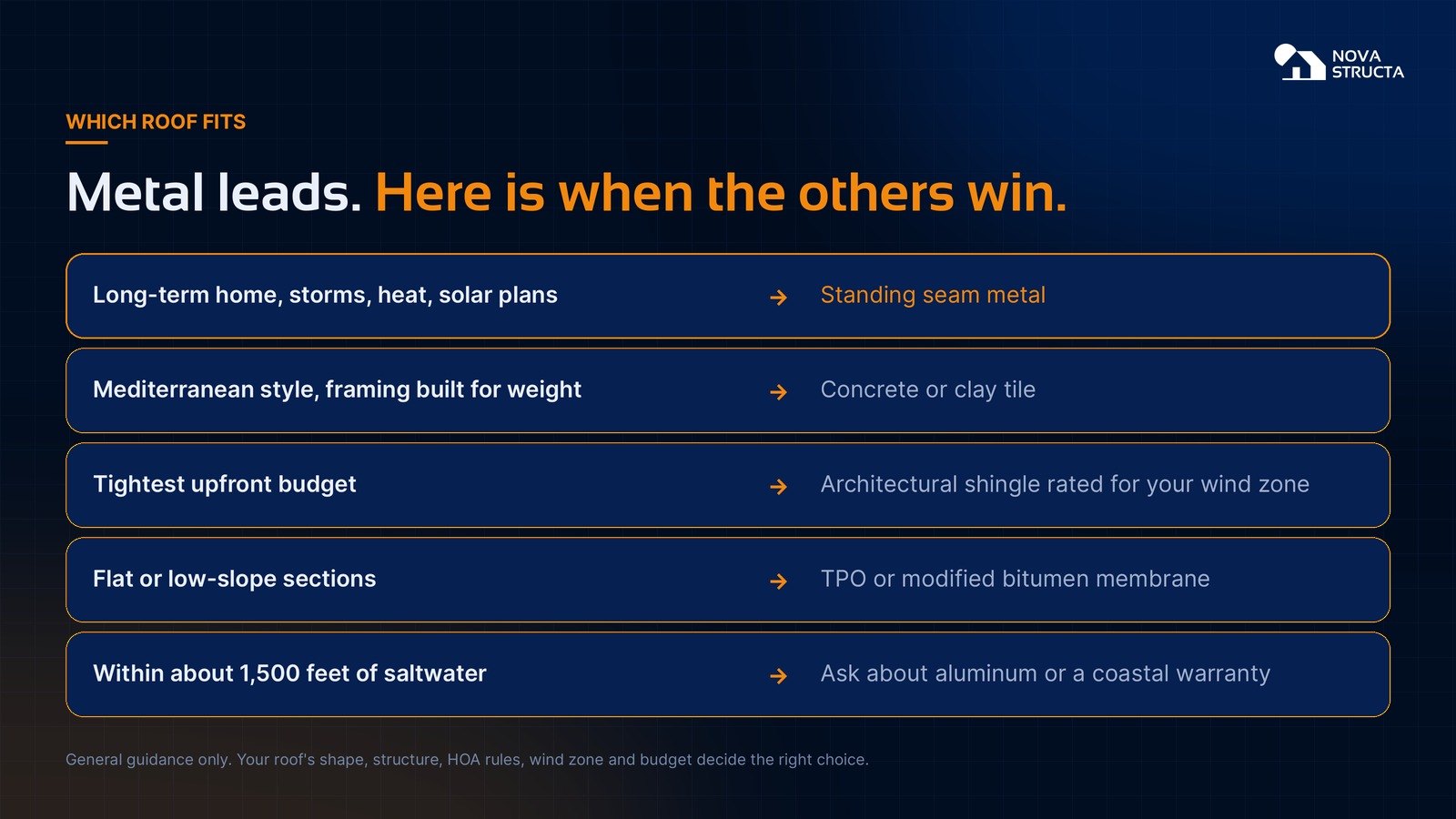
- You plan to stay, you want storm resilience, and solar may be in your future. Standing seam metal.
- Your home is Mediterranean or Spanish style and was built for tile. Concrete or clay tile.
- Upfront budget is the deciding factor. Architectural shingle rated for your wind zone.
- You have flat or low-slope sections. A single-ply membrane or modified bitumen, with careful edge details.
- You are within about 1,500 feet of saltwater. Metal still works, but ask about aluminum or a coastal warranty [6].
For signs it is time, see when to replace your roof, and for how pricing works, see the cost of a new roof.
Questions to ask before you choose
- What is the Florida or Miami-Dade product approval number for the roof system being quoted?
- For metal: is it standing seam or exposed fastener, Galvalume or aluminum, and what gauge?
- What does the warranty say about distance from saltwater, and who handles warranty service?
- What underlayment and secondary water barrier are included?
- How will hips, ridges and edges be attached?
- Will the roof deck nailing be checked and brought up to current code during the reroof?
- If I add solar later, how will it mount to this roof?
The bottom line
Every common roof can work in Florida when it is the right product, installed well. But when you weigh storm performance, service life, heat and solar together, standing seam metal comes out ahead for most homes. It had the lowest damage rate of any roof type in IBHS's Hurricane Ian review [1], it is built to last 40 to 70 years or more [5], it reflects heat well in light colors [3], and solar clamps right onto it. It costs more upfront, and near the coast the type of metal matters.
Results vary by home, product and installation. If you would like help comparing options for yours, see roofing or book a free roof assessment. Roofing work is performed by independent Florida licensed contractor(s).
Sources
- I. Giammanco, E. Newby and H. Pogorzelski, Insurance Institute for Business & Home Safety, "Observations of Building Performance in Southwest Florida During Hurricane Ian (2022), Part I: Roof Cover Damage Assessment," 2023. ibhs.org
- International Code Council, Building Safety Journal, "Hurricane Ian in Florida: A Mitigation Success Story for Building Codes," February 7, 2024, summarizing FEMA's Hurricane Ian Mitigation Assessment Team report. iccsafe.org; FEMA report: fema.gov (PDF)
- D. Parker, J. Sonne, J. Sherwin and N. Moyer, Florida Solar Energy Center, "Comparative Evaluation of the Impact of Roofing Systems on Residential Cooling Energy Demand in Florida," FSEC-CR-1220-00, November 2000. fsec.ucf.edu
- National Association of Home Builders and Bank of America Home Equity, Study of Life Expectancy of Home Components, February 2007. PDF
- Englert, "How Long Does a Metal Roof Last?" englertinc.com
- McElroy Metal, "Is Galvalume As Effective As Aluminum In Coastal Applications?" mcelroymetal.com
- National Weather Service, Lightning Myths. weather.gov
- Expanded Shale, Clay and Slate Institute, "Lightweight Concrete Roof Tile Offers Fire Safety, Beauty and Value." escsi.org
- M. Silvers, Florida Roofing & Sheet Metal Contractors Association, "New 2023 FBC Eighth Edition is Now in Effect," February 13, 2024. floridaroof.com
- Florida Statutes, Section 553.844, Windstorm loss mitigation; requirements for roofs and opening protection (2025). flsenate.gov
- Florida Statutes, Section 627.7011(5), Homeowners' policies (2025). flsenate.gov
- Florida Office of Insurance Regulation, Uniform Mitigation Verification Inspection Form, OIR-B1-1802 (Rev. 04/26). floir.gov (PDF)
Savings and utility-bill examples shown are illustrative only, are not guaranteed, and may not reflect typical results. Actual savings depend on your energy usage, system size, roof and site conditions, financing terms, utility rates, net-metering rules, and other factors specific to your home.